Short Talks by Anne Caron was recently reissued by Brick Books as one of its Brick Books Classics.
There are 45 short talks in the book with a very short afterword that was added for this new edition (where indeed the new introduction by poet Margaret Christakos is nearly as long as the rest of the book!).
I guess I would classify the talks as very short prose poems. Most are quite curious.
Here are a few excerpts:
Short Talk on Mona Lisa - "Every day he poured his question into her, as you pour water from one vessel into another, and it poured back. Don't tell me he was painting his mother, lust, etc."
Short Talk on Shelter - "You can write on a wall with a fish heart, it's because of the phosphorous..."
These short talks are certainly poetic and intriguing -- and misleading, since they are presented somewhat flatly as if they were non-fiction, though seem wildly fanciful in some cases.
(This review was a bit too short, even for me, as pressed for time as I am, so I extended it slightly.)
There is a bit of a theme running through many of these talks, focusing on artists (Kafka, Van Gogh, Prokofiev) and sadness. It isn't entirely clear what form the sadness takes -- being unappreciated in a world of philistines, never finding the right word or note until it is too late, perhaps only becoming an artist due to unrelated mental illness (Sylvia Plath). Ovid is a particularly interesting case, as he was exiled for crossing Emperor Augustus, and indeed Ovid died in exile, writing several long poems during his long exile to try to regain favour, though of course he remains best known for Metamorphoses.
Here is Carson on Ovid: "He sups and walks back to his room. The radio is on the floor. Its luminous green dial blares softly. He sits down at the table; people in exile write so many letters. Now Ovid is weeping. Each night about this time he puts on sadness like a garment and goes on writing."
Tuesday, June 30, 2020

13th Canadian Challenge - 12th Review - Basic Black with Pearls
This slim novel, Basic Black with Pearls by Helen Weinzweig is quite difficult to review (and this is review #12, btw). The novel was reissued on House of Anansi Press in 2015 and then was brought out by NYRB Classics in 2018, which is the edition I own.

Here is a CBC interview with Sarah Weinman, who wrote the afterword for the NYRB edition, where she discusses aspects of Weinzweig's life and how it fed into the novel.
To return to my review, I find it is, in fact, difficult to know what actually happens in the novel. I wouldn't say that this novel is spoiler-proof, but it is so hard to know what is going on and what is the ground truth that who can say if the plot was SPOILED or not...
There is another postmodern novel I would put into dialog with Basic Black with Pearls, and that is Hotel Crystal by Olivier Rolin, which is quite experimental.* Each entry begins with a physical description of a hotel room - discussion of the door, style and placement of the window, condition of the paint and/or wallpaper, and then finally an inventory of the artwork on the walls, the bed and the ubiquitous television. Information about the author of these notes leaks through, particularly by the second half of each entry. He is apparently a secret agent of sorts or an arms dealer and possibly also a famous author (under a nom de guerre). The footnotes to many of the entries often link back to another entry, creating a bit of a web (not completely different from something Calvino or Cortazar might have attempted). However, a little of this goes a long way, and I did find myself getting tired of the room descriptions about halfway through the book.
Fortunately, Basic Black with Pearls wasn't quite that obscure, but the narrator, Shirley, is engaged in a long-running affair with a secret agent, Coenraad (or at least that is what she maintains from the start of the novel). Since he is a secret agent, he can't just call her up and tell her where they are meeting, as all of their phones and computers are bugged. So instead, he will find ways to plant information in the local newspaper or leave a postcard with some clues that she needs to decipher, generally directing her to go to a different hotel than the one where she is actually staying.
Where things get very odd is that (again she claims but we the readers don't actually see) nearly all of the time she actually encounters Coenraad he is in deep disguise, actually getting enraged if she tries to break his cover. Apparently, he is so convincing in his disguises that he can portray himself as different nationalities (and I believe different ethnicities and races as well, which brings up unpleasant recollections of blackface, which was in the news not so long ago).
Given the radical uncertainty over what is actually going on, even Shirley wonders once in a while if she has slept with Coenraad or an unwitting (but generally willing) stranger. She tries to reassure herself that Coenraad would always intervene at the last moment, if she inadvertently ran across the "wrong Coenraad."
There is some additional tension, on top of the espionage angle, in that she thinks there is pressure on Coenraad's end to break things off, and that is why they are meeting (likely for their final assignation) in Toronto, which is Shirley's hometown, despite their previous rule to never meet on anyone's home turf. Shirley spends quite a bit of time wandering around downtown Toronto, and I believe she makes it as far as Kensington Market, looking for clues to Coenraad's whereabouts. At one point, she seems to break into the wrong apartment (not a hotel at all) and has to be escorted out. There is then a scene of her with her husband and children (who have been completely off-screen ciphers up until this point). No question by this point I was wondering if the entire novel was the record of a major breakdown (either schizophrenia or some other form of psychosis) and whether Coenraad existed (doubtful) and if she had even left Toronto at any point in the past. And that's basically how it ends. It is definitely an interesting but very challenging book. I will let it simmer for a while and then read it a second time to see how my reactions are different on a second reading, particularly if I will find all the games and mental puzzles between Shirley and Coenraad intriguing or just sad the second time around.
* Just to thoroughly confuse matters, I would definitely recommend the interested reader check out Rick Moody's Hotels of North America, where a somewhat obsessive reviewer gradually reveals his life story through a series of long-form reviews of hotels and motels on a rating site (that is inspired by but is clearly not Yelp or Yahoo). It's quite droll and melancholy at the same time. As I am well over my allotted limit for this review, I will point you to this review instead.
* Just to thoroughly confuse matters, I would definitely recommend the interested reader check out Rick Moody's Hotels of North America, where a somewhat obsessive reviewer gradually reveals his life story through a series of long-form reviews of hotels and motels on a rating site (that is inspired by but is clearly not Yelp or Yahoo). It's quite droll and melancholy at the same time. As I am well over my allotted limit for this review, I will point you to this review instead.
13th Canadian Challenge - 11th Review - Sandra Beck
I wanted to like this novel, Sandra Beck by John Lavery, a lot more than I actually did enjoy it, which makes it a major challenge to review.

I suspect at some level, I was blocked because I didn't really know quite what to say about it. I'm sure I'll still do only a marginal job of it, and I may come back around later to clean the review up a bit more. This blog has quite a bit of information about John Lavery's writing career (he came to writing quite late), as well as the fact that Sandra Beck was his only novel, along with two short story collections. He died of cancer at the age of 62, and concerns about cancer are rife in Sandra Beck. I will warn you that the interview with Lavery embedded in the blog do contain SPOILERS.
As does the rest of this review (SPOILERS ahead).
I'm not sure if it should really count as a spoiler if the back cover blurb gives away a major plot point, but so be it. Sandra Beck is by all (or at least most) accounts a pretty incredible mother, wife, musician and manager at the Montreal Symphony Orchestra. And then people need to deal with the sudden loss of her out of their lives. Indeed, she is only a very shadowy figure in the first large chunk of this novel, which focuses on Sandra's daughter, Josee, but she is clearly not dead. Quite a bit of this chapter involves Josee moving between English and French, with her teachers and classmates and so forth. She has the general spirit, if not quite the anarchic impulse or brattiness of Raymond Queneu's Zazie, so in that sense it did feel like a bit of a retread. I also really struggled reading about Josee having sexual relations with "Uncle" Danilo, who was the clarinetist in the orchestra. There are lines I just don't even like to read about being crossed, and this went too far for me and certainly spoiled this chapter.
I thought in general, this would be a little bit like the prismatic view of a missing (or in this case dead) person, like Jack Fuller's The Best of Jackson Payne, first getting Josee to reflect on her mother and then get Sandra's husband's recollections and then some of the musicians to chime in. But it wasn't like that at all, aside from the fact that we never really get a sense of Sandra's interior life (a bit odd for a book named after her...). As I mentioned Sandra is alive throughout Josee's chapter. There was sort of a cloud of gloom hanging over P.F. Bastarache or some sort of postmodern finger of God, but then in the end it was sort of explained that this was his happiness gone up in smoke (again, a terrible paraphrase) as he forced himself to think about the fact that she was dead, whereas she is only occasionally in his memory throughout this stretch of the book (possibly because it is simply too painful to think about her). The vast majority of the book (the sections from P.F. Bastarache's perspective) is almost entirely about him dealing with a police brutality case. (No question this would feel even more relevant today, but it still has very little to do with Sandra Beck, the namesake of the book after all.)
To add even more to the confusion there is a short story embedded after the novel ends which is a flashback of Sandra and P.F. Bastarche visiting Josee in Bolivia (she apparently went down there after graduating from high school).
I think this is a book that either wasn't as clever as it thought it was or it was in fact too clever for me and I simply didn't appreciate it. That said, it is a reasonably good example of the Canadian postmodern novel, and if that is your thing, then you probably do want to check out Sandra Beck.
13th Canadian Challenge - 10th Review - Riffs
I'm in a bit of a groove now, so I'll riff a bit on this book and move on. Dennis Lee is quite an important poet, though one that doesn't get a lot of attention outside of Canada. Several years back I reviewed Civil Elegies, which is likely his most sustained attempt at engaging with the urban condition. I admire a lot about Civil Elegies, though I still haven't read it enough times for it to really stick, and I'll have to reread it again soon. I had actually expected to review Heart Residence, a collected poems that incorporates Civil Elegies, Riffs, most of his poetry aimed at children and some other poetic suites. However, I made it through Riffs and paused (and I have yet to restart), though I suppose there is always the next Challenge. At any rate, I wasn't able to get the signed copy of Heart Residence I had wanted, so I ended up ordering a standalone (signed) copy of Riffs, and I'll go ahead and review that now.

I did not carefully compare the revised version of Riffs in Heart Residence to this edition, but I did flip through them both looking for major changes. I did catch that Riff #86 was completely replaced with a new riff in Heart Residence, but otherwise the changes seemed fairly minor.
Anyway, there are 88 poems (riffs) in the collection, which is supposed to correspond with the 88 keys of a piano. Overall these poems could be read as jazz-infused lyrics (and occasionally blues-soaked laments) as the poet relates his falling in love with a woman. Lee doesn't really hold back, alternating poems where he is infatuated and disenchanted, based on what has been going on in this (now highly public) love affair. Given that these poems are dedicated to his wife, Susan, and that he is still married to her, roughly 15 years later at the time of the publication of Heart Residence, then she is particularly forgiving and/or generous to allow some of these poems into print. (While there is a disclaimer that Riffs is a work of fiction, I don't think anyone really believes those legal fig leafs, particularly in the case of confessional or semi-confessional poets). In this specific case, I am thinking of Riff #70 where the poet is bitterly raging after some rejection: "but you know I / never did like your body, / never those porridge thighs the spider crawl around your eyes".
Again, keeping legal disclaimers in mind, the poet appears to be separated from his wife or partner and has "kids" who don't really make an appearance in these poems. However, the object of his infatuation is married, which certainly complicates matters and sends him into these almost manic phases of joy and despondency, depending on how far he thinks he can go with her (which is often quite far indeed). Generally, the poet doesn't spend too much time thinking about the morality of adultery, but it does surface in Riffs #55 and 56. In Riff #55, he writes "I am so utterly / tired of this slimy ribbon of / lies, wound round my / head, my / shame my / too-long life to come..."
After what appears to be a final break (recounted in Riff #77), the poet is despondent, just barely hanging on in Riff #80 and going through the motions in Riff #81: "Get up eat fruit brew coffee, / do work see friends lie down."
Then a reconciliation occurs, but the poet is coy who initiated it. And before you know it, they are a couple of sorts in Riff #87: "And / then we were home. / Our / breath bunched, the shudder-us / twined-of / (and if the) desire and the / planet / go on ...". The ending is essentially suspended, but it seems that (adulterous) love has triumphed in a somewhat contingent way, but still hanging in there as the series closes.
This is definitely an interesting collection. It is not by any stretch as deep as Civil Elegies, but still worth reading and pondering.
13th Canadian Challenge - 9th Review - The Book of Eve
This novel, The Book of Eve by Constance Beresford-Howe, is often considered a bit of an neglected classic feminist novel. Within the first few pages, we see Eva grow tired of the low-level browbeating she has taken from her husband, Burt, for decades. While there was never much true attraction to Burt (she married him due to the stability he offered and the chance to start a family*), any affection had been worn away by the fact that he unexpectedly became a semi-invalid and retired, and she had to care for him. Despite the fact that she knows she will scandalize the neighbours and her own daughter, she packs a small bag and leaves Burt to his own devices. She has no real idea where to go and asks a taxi driver to take her to a part of Montreal where they have inexpensive rooms for let, and she sets off on a completely new and unexpected path. Such things were just not done in 1973, let alone by a 70 year-old-woman (and pensioner) who had simply had enough.
Every so often, Eva imagines writing a letter to God, sort of standing in for Eve, the mother of all disobedient women. She basically asks for him to understand things from her point of view, though she suspects that He will not be particularly receptive to her story.
Eva spends a good deal of her time trying to figure out how to make ends meet, as her rent takes a huge chunk out of her pension. She makes one half-hearted attempt to get some maintenance funds out of Burt (under Quebec law at that time, even though she had paid a very large part of the mortgage on their house, it was entirely his property) before becoming a bit of a scavenger, taking interesting things she finds to the local pawn shops. Of course, Eva limits her meetings with her son, Neil, who cannot understand her and would be horrified that his mother had essentially become a tramp (in the Chaplinesque sense of the word), though her granddaughter Kim ultimately finds out a bit more about her bohemian way of life and doesn't seem quite as judgmental.
Perhaps the most astonishing turn of events is when she meets one of her fellow tenants, Johnny, who is a bit of a handyman and carpenter and perhaps even an artist at heart. He helps her fix up her room and its stove, and they end up spending a surprising amount of time together. There are certainly flashes of Joyce Cary's Gulley Jimson in Johnny, though Johnny does not appear to be an artist of that calibre.
There are a few other interesting turns of the wheel of fate still to come, but I think I'll stop there before spoiling the book any further. I found The Book of Eve thought-provoking and occasionally exasperating, but usually quite amusing, and I definitely think it deserves to be more widely read.
* And he also caught her on the rebound from a short affair with the principal of the school where she worked.
13th Canadian Challenge - 8th Review - Tomorrow’s Bright White Light
I am not familiar with the Canadian poem Jan Conn, despite
this being her 9th book of poetry (with 2 previous volumes on the
Brick Books label). Here are a few
intriguing facts about Jan Conn: she is a professor of biomedical science (so
being a poet is only a side gig for her and she has serious science credentials)
and she has done most of her field work (on mosquitoes) in South America, notably Guatemala. Bolivia, Peru and Brazil.
This biographical experience only works its way into a few of these poems (most
notably “On the Left Bank of the Itaya”) but was a much more prominent theme in
her previous collection, Botero’s Beautiful Horses. There is a fairly extensive interview with her on the Brick Books' website for those interested.
I’d say that these are poems that creep up on you (or at least
the ones that held my attention on a second or third reading). In addition, at least some (not all) of the
poems tap into a bleak vision that all is not as pleasant as it seems on the
surface. “Family Portrait in an Unmarked
Car" focuses on a family trying to keep up appearances in the face of some
unspecified economic ruin: “in the parking lot where our neighbours dwell-- /
new lives in old cars. … / … In winter, we’ll run low on fuel, / station
ourselves in the basement of that shrink-wrapped / renovation. When security insists we move along, we’ll bark a lot. …”
While the narrator of “Frontier Mentality” has much further
to fall, economic disaster seems to be looming here as well, though there also seems to
be a strong thread of urban anomie present in the poem: “More and more
we turn to urban life where the next big thing / is being created as we speak … / …
What possessed us to purchase a condo whose / single distinguishing attribute
is a view of a reflection / of the Statue of Liberty? … / college loans
unforgiven, we’re looking for the scam / that makes the ends crawl a little
closer together.”
Bad real estate decisions also come into play in the
slightly surreal poem “Melodrama is Foreign to My Name”: “By error I rent the
shadow / of an apartment building, celebrating / all the ledges I have never
dusted. / … / I’m forced to abandon summer: / the boarded-up lighthouse /
blocked my paths to sunlight / one by one.”
I’d say in general, these are fairly challenging poems that
never reveal their meaning clearly, but her sometimes sardonic tone and
outsized vocabulary holds some appeal to me, so I’ll likely check out a couple of her previous poetry collections.
Monday, June 29, 2020
Partially Successful Sunday
I was a little annoyed to learn that the UT book drop was closed, so it looks like I will be hanging onto The Plague longer than I anticipated. I had specifically asked about the availability of the book drop, though
to be fair, I did ask about this several months ago and obviously things have
changed, as the shut-down dragged on a lot longer than many people
expected. As it happens, I didn’t go too
far out of my way, since I had planned to check out the Bau-Xi Gallery as
well. They had just hung a new
exhibition of Chase Langford's work. There were several
pieces I liked, sort of geometric abstractions, that in several cases were also
reminiscent of Lawren Harris’s arctic scenes (perhaps by way of Douglas Coupland’s
cheeky paint-by-numbers deconstructions of the Group of Seven).
 |
| Chase Langford, Grinnel Mountain |
 |
| Chase Langford, Blue Glacier 1 |
 |
| Douglas Coupland, Maligne Lake, Jasper Park after Lawren Harris |
At any rate, I’m glad I checked it out (and the photo gallery 3 doors down was also open). I managed to make it over there to the Michael Wolf exhibit right before things closed down. The Wolf photos have been rotated back into storage, but they had a number of interesting photos from David Leventi.
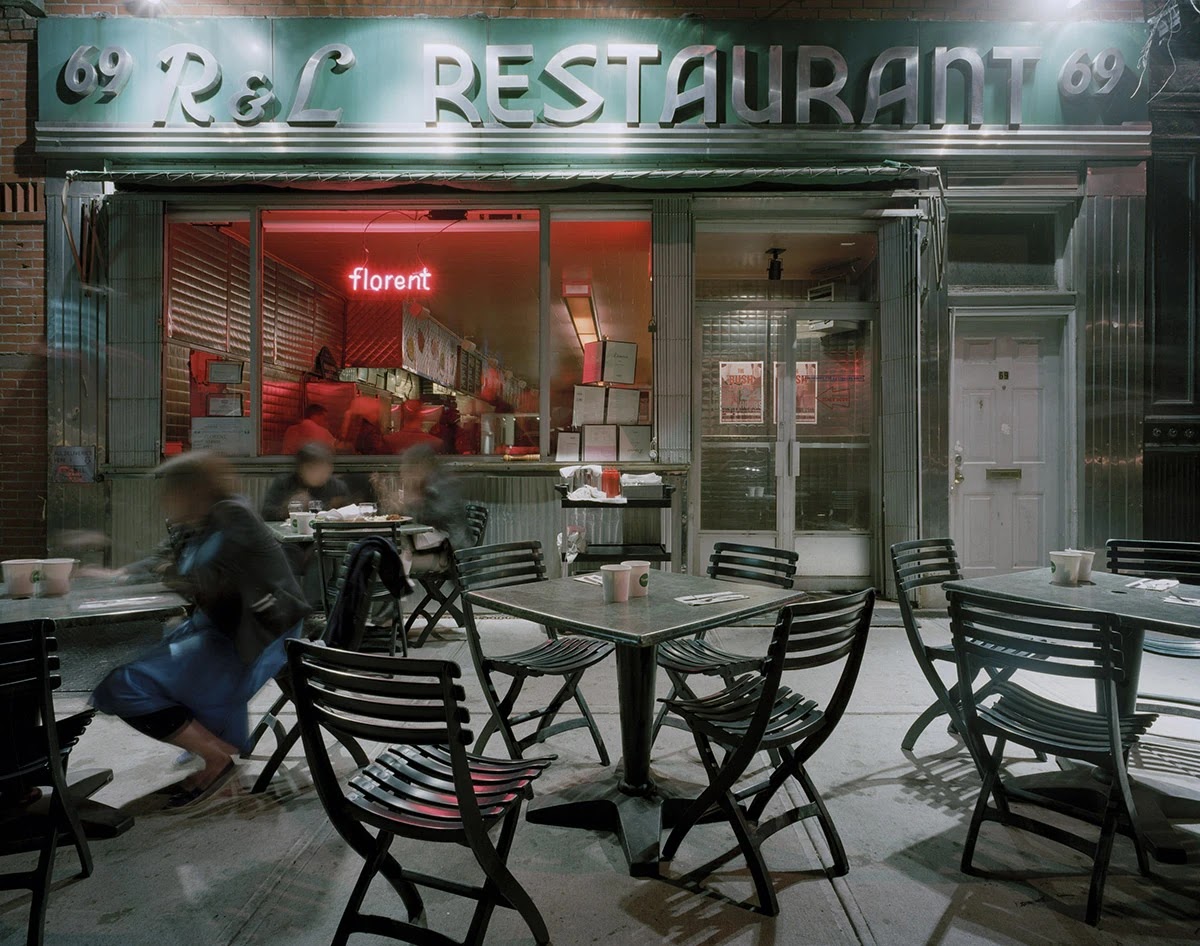 |
| David Leventi, Florent |
I’m not that likely to visit the AGO next weekend (probably a bit too
packed) but maybe the weekend after (and I might stop in another time or
not). The weekend after that I will most
likely be biking over to MOCA, so hopefully the weather cooperates.
I then continued on to Union Station. I was disappointed but not particularly
surprised than the food court wasn’t open.
I put in a few hours at work and came home. Overall a decent day, though I didn’t really
get enough rest.
Subscribe to:
Posts (Atom)