The reviews are sort of out of order at the moment, but I should be catching up soon.
I'm just going to start off with
SPOILERS AHEAD
before I get into the review of Underwater Welder by Jeff Lemire. This is a graphic novel (actually the second I've reviewed). There is no way to escape the fact that this was structured like a Twilight Zone episode, and the introduction by Damon Lindelof drives home the point even more forcefully. However, it is a crappy TZ episode, maybe from season 3 or 4. Most of the Amazon reviewers are positive, but I am going to side with the lone negative reviewer who feels it is too drawn out, we don't care about the characters at all, and the art is scraggly and ugly.
The plot is paper-thin. This man has returned to Nova Scotia where his father died in a diving accident. He is now a diver himself and surprise, surprise, comes across a watch that triggers all these flashbacks to his childhood. Then, temporarily abandoning his very pregnant wife, he sneaks back to dive again and he actually grabs the watch. This forces him into a parallel universe where he is the only one alive. He even drives round and round and can't leave Tigg's Bay (talk about ripping off TZ!). Finally, he sees that he is becoming his father, then he has a conversation with the ghost of his father. And then he is saved by another diver and re-enters the real world (still holding the watch) and soon goes home to gaze peacefully at his new-born baby.
I'm not even sure what the point is, other than perhaps you should make peace with your family (even if they are basically no-good drunks who abandon you at the hockey rink) or you won't have the peace of mind to start your own family. I mean really -- forgiveness for everyone? I'm with Prudie (over at Slate.com), that I am not for forgiveness/acceptance in all circumstances, as some Christians would urge. I'm glad I've cut certain people out of my life. And related to that, there are some things that people have done to me that I will never forgive. I'd guess this took less than an hour for me to read, but I still would kind of like that time back. Oh well.
Friday, January 25, 2013

Wednesday, January 2, 2013
6th Canadian challenge - 12th review (New)
This will be a joint review of W.H. New's Stone | Rain and the last section of Riverbook & Ocean. It has finally been fixed up.
Stone | Rain (2001) is composed of three sections. The first has some poems about New's memories of Vancouver, and the third heavily features bicycles in China (most likely New had visited but perhaps it is part of an imagined journey). I can't even recall what the second section was about (probably nature of some sort), which is never a good sign... I would have been interested in the bicycle poems for a variety of reasons, but I came across them as I was wrapping up my proposed transportation anthology and found them filling a gap (there are so few good poems about riding a bicycle). I'll spend a bit of time on these in a moment, but want to start with historic Vancouver.
Stone | Rain was the first but not last time New decided to write about Vancouver. Riverbook and Ocean (2002) ends with a section on Biblical characters transported to Vancouver (the other sections weren't nearly as interesting to me). Underwood Log (2004) is a curious, somewhat closed-off collection where New titles all his poems by the longitude and latitude of the place he is writing about. This might have been an interesting experiment on a blog where you could hyper-link to the place names, but it ends up being annoying and off-putting to the casual reader who is looking at a printed book (frankly too hermeneutic for my taste, both the poems and the overarching concept). Still, it is clear that some of the locations in Underwood Log are in Vancouver, often the Kitsilano neighbourhood. Finally, YVR is a book-length meditation on living in Vancouver in the present while recalling its past. I have this sort of the memory overlay for Chicago but I haven't lived other places long enough to be haunted by the past (perhaps one advantage of always being on the move...). YVR, however, will have its own stand-alone review.
Early on in the Vancouver section of Stone | Rain, New addresses the transitory nature of the urban landscape in the poem "Timing":
Something changed when they moved Birks’ Corner,
took away the clock: they just
shifted it a few blocks north,
but that removed the meeting place
and no-one stops there any more—
Funny, how you take things for granted:
Woodward’s, Scott’s, the Honey Dew,
they all disappear—and even Birks
got sold...
Certainly a number of poets have commented on the transience of "life," though not nearly enough urban poets have commented on the ever-changing nature of the urban landscape, particularly at the local scale. Perhaps this is more notable in places like New York, Chicago, Toronto and Vancouver than smaller cities (despite its size, the pace of change in Vancouver is on a level with these other cities). But this is where most urban poets are, so it is odd how little we read about this never-ending change. I do think Alan Dugan touched on it, and surely some that I am forgetting. It is the kind of thing that Frank O'Hara or Ted Berrigan might have picked up on had they lived longer (they were in New York when it was at the bottom of its reinvestment cycle and largely seen as a dying city with its best days behind it).
He casts back into his memory for times he felt worth commemorating. This vision of community in "Pieces of Eight" probably ironically references Normal Rockwell:
Saturday night at 6:30—it’s a Rockwell cover
at the White Spot on Broadway, the whole city’s
eating, two cops in the first booth
drinking tea, getting a leg up
on overdue reports, so’s not to stay late;
the math teacher and two of her friends, dividing
the bill by 3, minus GST, adding
the tip outside the brackets;
the waitress
knows them all ...
Slightly later in the poem, New mentions a somewhat discordant note: a Punjabi child trying to fit in by singing Christmas carols. In this way, New references the major demographic shifts that Vancouver went through since his early adulthood. Rockwell indeed would have made much of the stranger's face trying to get a look in at the "White Spot." Vancouver today is a very multi-cultural place, in some ways more influenced by Asian culture than Toronto and gradually orienting itself towards Asia more than "back East."
In the poem "You know" summarily dismisses the Yuppies who are transforming Vancouver (he is probably half a generation older than the core of the Yuppie crowd). Not that he is as cruel as some who attack gentrification, but their interests (jazzercising, espresso and arugula) and his do not seem to coincide. Surprisingly, he doesn't mention yoga, as I have never been in a city so yoga-crazy, but perhaps that is more of a Gen Y/Millennial preoccupation. I do like the last stanza where he is a bit knowing about how each generation does move in and kind of rubbishes what came before:
Anyway, the Y Generation's
already moving into unfinished suites
in some place different, what else is new,
finding space for the cds, and clearing away
the hula hoops from the basement corner.
I'll return to the bicycle poems in Stone | Rain shortly.
I find it somewhat droll that YVR does not appear to have a single poem about the airport (that I recall anyway), but Riverbook & Ocean has the poem "Carousel":
On the Arrivals Level
a disembodied voice blurs its welcome
FLIGHTS 112 224 CANADIAN DELTA
mix in static the fairground chute
the trolley rides the kiddiecar conveyor belt
a tired diorama
Signs everywhere warn
KEEP HANDS CLEAR CHECK YOUR LABELS
BAGGAGE MAY LOOK THE SAME Port
to port the flotsam follows Sydney
Seattle Tokyo Rome sisal
passengers with package tape & string
matched plastic & leather trim
...
Beyond the turnstile calico observers
smile & smile holding names
& brass rings waving & waving
as though to generate the world
Not sure if New was familiar with the final scene of Tati's Playtime with the amusing scene of a huge mass of cars proceeding through a roundabout, much like a carousel*, and Tati of course plays it up in the soundtrack. There is also a scene of cars at the airport at the end of Mon Oncle, when the put-upon father/industrialist finally manages to ship Tati off. If one combined the two, it might congeal into the kind of scene that New is describing. I don't think the airport carousels were as widely used in the early 70s or Tati would have had quite a field day with them!
The interesting section of Riverbook & Ocean is where New reimagines Biblical characters and places them in various Vancouver settings. In some cases, it is pretty much a direct transfer (Hosea and Gideon). In others, he is setting their stories in a more contemporary way (Samson and Goliath). And in a few cases, he is trying to imagine how the religious impulse that animated these figures would find itself expressed in the contemporary world (Joseph, Jonah and Daniel). A few figures no longer seem nearly as religious, but they still have some of their identifying characteristics.
For instance, Job is now a successful real-estate developer, but he finds there is "never a day without problems: con- /tractors, taxes, breaks in the power line, /permits delayed, plumbers on strike, dry-/ wallers working roofers’ time, rain..."
Yes, there is definitely rain. I still see loads of construction going on in the rain since if you completely stopped for rain, you would never build anything. And yet, I think it must mean that the quality is low, since the foundations out here never dry/cure properly. While the houses do strike me as built better than those in England, that isn't saying much. I have a hunch that the quality is lower than those in the Prairies and Ontario, but I would no longer automatically grant that they are worse than the construction in Quebec after these recent revelations on how mobbed up the industry is out there. Canadian mobsters, who knew!
Ishmael, like his Biblical namesake, is in exile, though it isn't clear from where (though probably across the ocean) or for what reason or even if the exile was self-imposed:
Hundreds on a summer day skate
or stroll the seawall to Second Beach...
Ishmael’s one of them
now, having somewhere along the line
come to stilted terms with exile— now
the sand feels like home, the sea an accident
of youth ...
New does a lot of (place) name-dropping in these poems: Jericho Beach, Extension Beach, Wreck Beach, University Beach, Iona Beach, the Stevenson Dunes (hmm, a bit of a theme here?). But in many of the poems, this starts to come off as nothing more than a gimmick. I mean there is no real reason for all these characters to be located here, and New's attempts to draw parallels between the figures from the Bible and contemporary folks that one would encounter in Vancouver just don't often hold up.
Perhaps the most successful of them all is "Jonah":
Jonah likes weekdays best at Stanley
Park—smaller crowds—& fewer swimmers
... {visit}
... the old aquarium.
Jonah cleans there
now, wipes fingerprints off the glass
partitions three, four times a day, more
if school's in, & sweeps lunch litter
through the back doorway, out of sight,
newspapers, candy wrappers, bus
transfers, life.
When he's tired, he stops
by the orca pool, leans on the push broom,
& watches the animals ...
weren't you the one, he hears,
weren't you the one, his ears ringing with echoes
he learned at sea, before the nightmares started ...
I do have a minor quibble in that of all the whales, orcas would seem to be the very least likely to swallow a man and then regurgitate him, but the rest of the poem has a real down-to-earth nature that I like. I can certainly imagine that a person who went through some traumatic experience would want to avoid the limelight, even though the whole point of the journey through the whale's belly was to force him to go out as a preacher. Perhaps New is imagining a point after Jonah had discharged this duty and was left alone and more or less forgotten by the Lord.
Ok, let me (finally) close out this post by dropping in a few of the bicycle poems from the final section of Stone | Rain. These were among my favourites.
2.
At 7 a.m. on a Wednesday morning, forty-
four people go by in less
than a minute, cycling to work and school,
their faces as impassive as Yang
figurines moulded in clay: scholar,
fortune-teller, cobbler, baker,
in Nikes and blue uniform.
One young lover pedals
dreamily, his eyes inward. Perched
side-saddle behind him, his girlfriend,
legs crossed, polishes her nails.
14.
At night the bicycles disappear
into a waterhiss of wheels
turning, lightless, in the dark.
...
Voices carry. No-one speaks:
leaf and path alive with riders,
bus and bench alive with lovers.
Toads croak. Shadow bends.
The scent of jasmine hides the moon.
15.
The women who ride bicycles rise
early, leave by 6 for the hour’s
trip to where they work: bank,
bar, computer factory. Some
jobs are uniformed: the women
who sell silk and lipstick live
all day in gloss and blue apron;
the tellers count kuài in brown.
Behind doors and walls, some
are uniformed, steaming rice,
mending cotton, rising by six.
21.
Abandoned bicycles gather in the outer
court of Confucius Temple. Across
the bridge of the pan pool, marble
carving itself, all is silent.
Taxi horns recede. ...
22.
Down streets, lanes, alleys
every sidewalk market sports
a bicycle repairman. All men,
some arranging brake shoes, locks
and handlebars, most content with pump
and patches, a waterbowl nearby
to test for air. The elegant woman
whose tire bursts outside the Workers’
Museum spurns them all; the garnet
silk’s deceptive: she fixes her own,
inflating, calm, on platform soles.
Looking these over, it is obvious that New loves lists, building a poem from somewhat disparate parts, trying to triangulate the world.
* I mistakenly thought the carousel scene was in Trafic not Playtime (and just fixed that after watching Playtime again). I was going to link to Trafic (and possibly Playtime), but Trafic seems to have gone OOP already. There often seem to be rights issues with Tati's films, so I'm glad I got it when I did! It is generally easier to pick up Tati in Region 2 DVDs from BFI, though Trafic is the only Tati film not available from BFI.
Edit (12/17/15) With some things, particularly movies and books, if you wait long enough it will come round again, and there is an impressive DVD or Blu-Ray Tati set out now from Criterion that I ended up springing for, even though I had most of the material already.
On the other hand, to tie back to the ever-changing urban landscape, once department stores go, they do not come back. I remember going into Woolworth's in Ann Arbor (there was one quite close to campus) and then six or seven years later to the one in Evanston, where it was clear the chain was on its last legs. I assume Woodward's (mentioned above in one of New's poems) was a similar kind of store. While Rodney Graham is trading on nostalgia in his photographic work The Avid Reader, 1949, I am not quite sure what the message is supposed to be. Is he saying that even at its height (and Woolworth's would have been thriving in 1949), that one should have considered the eventual decline of this commercial empire? That the temporary closure of a store (for remodelling?) is a stand-in for the chain going out of business in 1997? What's kind of interesting is how things evolved at a corporate level (the core holding corporation that once ran Woolworth's now focuses on Foot Locker) and in the urban landscape the role that Woolworth's once played is now largely filled by the down-market chains like Dollarama and Dollar General.
What is more depressing to me is that the middle range department store seems to be on its last legs in the U.S. and particularly in Canada. Sears is struggling, and I expect it to completely close up in Canada within 5 more years. Eaton's is gone. I am personally turned off by The Bay, though I guess it is doing ok in Canada. J.C. Penney seems to have retrenched a bit but still exists, though not in Canada either. Of course, Target, while not a true department store, filled many of the same roles, had such a poor reception in Canada that it lasted only 2 years, actually less time than I lived in Vancouver. Given that nothing has really replaced Target (which itself was supposed to replace Zellers) it really does feel like there is a fairly sizable hole left in the urban fabric. Same thing with the general decline of bookstores and DVD rental places. I guess we're all waiting for the next big thing...
Stone | Rain (2001) is composed of three sections. The first has some poems about New's memories of Vancouver, and the third heavily features bicycles in China (most likely New had visited but perhaps it is part of an imagined journey). I can't even recall what the second section was about (probably nature of some sort), which is never a good sign... I would have been interested in the bicycle poems for a variety of reasons, but I came across them as I was wrapping up my proposed transportation anthology and found them filling a gap (there are so few good poems about riding a bicycle). I'll spend a bit of time on these in a moment, but want to start with historic Vancouver.
Stone | Rain was the first but not last time New decided to write about Vancouver. Riverbook and Ocean (2002) ends with a section on Biblical characters transported to Vancouver (the other sections weren't nearly as interesting to me). Underwood Log (2004) is a curious, somewhat closed-off collection where New titles all his poems by the longitude and latitude of the place he is writing about. This might have been an interesting experiment on a blog where you could hyper-link to the place names, but it ends up being annoying and off-putting to the casual reader who is looking at a printed book (frankly too hermeneutic for my taste, both the poems and the overarching concept). Still, it is clear that some of the locations in Underwood Log are in Vancouver, often the Kitsilano neighbourhood. Finally, YVR is a book-length meditation on living in Vancouver in the present while recalling its past. I have this sort of the memory overlay for Chicago but I haven't lived other places long enough to be haunted by the past (perhaps one advantage of always being on the move...). YVR, however, will have its own stand-alone review.
Early on in the Vancouver section of Stone | Rain, New addresses the transitory nature of the urban landscape in the poem "Timing":
Something changed when they moved Birks’ Corner,
took away the clock: they just
shifted it a few blocks north,
but that removed the meeting place
and no-one stops there any more—
Funny, how you take things for granted:
Woodward’s, Scott’s, the Honey Dew,
they all disappear—and even Birks
got sold...
Certainly a number of poets have commented on the transience of "life," though not nearly enough urban poets have commented on the ever-changing nature of the urban landscape, particularly at the local scale. Perhaps this is more notable in places like New York, Chicago, Toronto and Vancouver than smaller cities (despite its size, the pace of change in Vancouver is on a level with these other cities). But this is where most urban poets are, so it is odd how little we read about this never-ending change. I do think Alan Dugan touched on it, and surely some that I am forgetting. It is the kind of thing that Frank O'Hara or Ted Berrigan might have picked up on had they lived longer (they were in New York when it was at the bottom of its reinvestment cycle and largely seen as a dying city with its best days behind it).
He casts back into his memory for times he felt worth commemorating. This vision of community in "Pieces of Eight" probably ironically references Normal Rockwell:
Saturday night at 6:30—it’s a Rockwell cover
at the White Spot on Broadway, the whole city’s
eating, two cops in the first booth
drinking tea, getting a leg up
on overdue reports, so’s not to stay late;
the math teacher and two of her friends, dividing
the bill by 3, minus GST, adding
the tip outside the brackets;
the waitress
knows them all ...
Slightly later in the poem, New mentions a somewhat discordant note: a Punjabi child trying to fit in by singing Christmas carols. In this way, New references the major demographic shifts that Vancouver went through since his early adulthood. Rockwell indeed would have made much of the stranger's face trying to get a look in at the "White Spot." Vancouver today is a very multi-cultural place, in some ways more influenced by Asian culture than Toronto and gradually orienting itself towards Asia more than "back East."
In the poem "You know" summarily dismisses the Yuppies who are transforming Vancouver (he is probably half a generation older than the core of the Yuppie crowd). Not that he is as cruel as some who attack gentrification, but their interests (jazzercising, espresso and arugula) and his do not seem to coincide. Surprisingly, he doesn't mention yoga, as I have never been in a city so yoga-crazy, but perhaps that is more of a Gen Y/Millennial preoccupation. I do like the last stanza where he is a bit knowing about how each generation does move in and kind of rubbishes what came before:
Anyway, the Y Generation's
already moving into unfinished suites
in some place different, what else is new,
finding space for the cds, and clearing away
the hula hoops from the basement corner.
I'll return to the bicycle poems in Stone | Rain shortly.
I find it somewhat droll that YVR does not appear to have a single poem about the airport (that I recall anyway), but Riverbook & Ocean has the poem "Carousel":
On the Arrivals Level
a disembodied voice blurs its welcome
FLIGHTS 112 224 CANADIAN DELTA
mix in static the fairground chute
the trolley rides the kiddiecar conveyor belt
a tired diorama
Signs everywhere warn
KEEP HANDS CLEAR CHECK YOUR LABELS
BAGGAGE MAY LOOK THE SAME Port
to port the flotsam follows Sydney
Seattle Tokyo Rome sisal
passengers with package tape & string
matched plastic & leather trim
...
Beyond the turnstile calico observers
smile & smile holding names
& brass rings waving & waving
as though to generate the world
Not sure if New was familiar with the final scene of Tati's Playtime with the amusing scene of a huge mass of cars proceeding through a roundabout, much like a carousel*, and Tati of course plays it up in the soundtrack. There is also a scene of cars at the airport at the end of Mon Oncle, when the put-upon father/industrialist finally manages to ship Tati off. If one combined the two, it might congeal into the kind of scene that New is describing. I don't think the airport carousels were as widely used in the early 70s or Tati would have had quite a field day with them!
The interesting section of Riverbook & Ocean is where New reimagines Biblical characters and places them in various Vancouver settings. In some cases, it is pretty much a direct transfer (Hosea and Gideon). In others, he is setting their stories in a more contemporary way (Samson and Goliath). And in a few cases, he is trying to imagine how the religious impulse that animated these figures would find itself expressed in the contemporary world (Joseph, Jonah and Daniel). A few figures no longer seem nearly as religious, but they still have some of their identifying characteristics.
For instance, Job is now a successful real-estate developer, but he finds there is "never a day without problems: con- /tractors, taxes, breaks in the power line, /permits delayed, plumbers on strike, dry-/ wallers working roofers’ time, rain..."
Yes, there is definitely rain. I still see loads of construction going on in the rain since if you completely stopped for rain, you would never build anything. And yet, I think it must mean that the quality is low, since the foundations out here never dry/cure properly. While the houses do strike me as built better than those in England, that isn't saying much. I have a hunch that the quality is lower than those in the Prairies and Ontario, but I would no longer automatically grant that they are worse than the construction in Quebec after these recent revelations on how mobbed up the industry is out there. Canadian mobsters, who knew!
Ishmael, like his Biblical namesake, is in exile, though it isn't clear from where (though probably across the ocean) or for what reason or even if the exile was self-imposed:
Hundreds on a summer day skate
or stroll the seawall to Second Beach...
Ishmael’s one of them
now, having somewhere along the line
come to stilted terms with exile— now
the sand feels like home, the sea an accident
of youth ...
New does a lot of (place) name-dropping in these poems: Jericho Beach, Extension Beach, Wreck Beach, University Beach, Iona Beach, the Stevenson Dunes (hmm, a bit of a theme here?). But in many of the poems, this starts to come off as nothing more than a gimmick. I mean there is no real reason for all these characters to be located here, and New's attempts to draw parallels between the figures from the Bible and contemporary folks that one would encounter in Vancouver just don't often hold up.
Perhaps the most successful of them all is "Jonah":
Jonah likes weekdays best at Stanley
Park—smaller crowds—& fewer swimmers
... {visit}
... the old aquarium.
Jonah cleans there
now, wipes fingerprints off the glass
partitions three, four times a day, more
if school's in, & sweeps lunch litter
through the back doorway, out of sight,
newspapers, candy wrappers, bus
transfers, life.
When he's tired, he stops
by the orca pool, leans on the push broom,
& watches the animals ...
weren't you the one, he hears,
weren't you the one, his ears ringing with echoes
he learned at sea, before the nightmares started ...
I do have a minor quibble in that of all the whales, orcas would seem to be the very least likely to swallow a man and then regurgitate him, but the rest of the poem has a real down-to-earth nature that I like. I can certainly imagine that a person who went through some traumatic experience would want to avoid the limelight, even though the whole point of the journey through the whale's belly was to force him to go out as a preacher. Perhaps New is imagining a point after Jonah had discharged this duty and was left alone and more or less forgotten by the Lord.
Ok, let me (finally) close out this post by dropping in a few of the bicycle poems from the final section of Stone | Rain. These were among my favourites.
2.
At 7 a.m. on a Wednesday morning, forty-
four people go by in less
than a minute, cycling to work and school,
their faces as impassive as Yang
figurines moulded in clay: scholar,
fortune-teller, cobbler, baker,
in Nikes and blue uniform.
One young lover pedals
dreamily, his eyes inward. Perched
side-saddle behind him, his girlfriend,
legs crossed, polishes her nails.
14.
At night the bicycles disappear
into a waterhiss of wheels
turning, lightless, in the dark.
...
Voices carry. No-one speaks:
leaf and path alive with riders,
bus and bench alive with lovers.
Toads croak. Shadow bends.
The scent of jasmine hides the moon.
15.
The women who ride bicycles rise
early, leave by 6 for the hour’s
trip to where they work: bank,
bar, computer factory. Some
jobs are uniformed: the women
who sell silk and lipstick live
all day in gloss and blue apron;
the tellers count kuài in brown.
Behind doors and walls, some
are uniformed, steaming rice,
mending cotton, rising by six.
21.
Abandoned bicycles gather in the outer
court of Confucius Temple. Across
the bridge of the pan pool, marble
carving itself, all is silent.
Taxi horns recede. ...
22.
Down streets, lanes, alleys
every sidewalk market sports
a bicycle repairman. All men,
some arranging brake shoes, locks
and handlebars, most content with pump
and patches, a waterbowl nearby
to test for air. The elegant woman
whose tire bursts outside the Workers’
Museum spurns them all; the garnet
silk’s deceptive: she fixes her own,
inflating, calm, on platform soles.
Looking these over, it is obvious that New loves lists, building a poem from somewhat disparate parts, trying to triangulate the world.
* I mistakenly thought the carousel scene was in Trafic not Playtime (and just fixed that after watching Playtime again). I was going to link to Trafic (and possibly Playtime), but Trafic seems to have gone OOP already. There often seem to be rights issues with Tati's films, so I'm glad I got it when I did! It is generally easier to pick up Tati in Region 2 DVDs from BFI, though Trafic is the only Tati film not available from BFI.
Edit (12/17/15) With some things, particularly movies and books, if you wait long enough it will come round again, and there is an impressive DVD or Blu-Ray Tati set out now from Criterion that I ended up springing for, even though I had most of the material already.
On the other hand, to tie back to the ever-changing urban landscape, once department stores go, they do not come back. I remember going into Woolworth's in Ann Arbor (there was one quite close to campus) and then six or seven years later to the one in Evanston, where it was clear the chain was on its last legs. I assume Woodward's (mentioned above in one of New's poems) was a similar kind of store. While Rodney Graham is trading on nostalgia in his photographic work The Avid Reader, 1949, I am not quite sure what the message is supposed to be. Is he saying that even at its height (and Woolworth's would have been thriving in 1949), that one should have considered the eventual decline of this commercial empire? That the temporary closure of a store (for remodelling?) is a stand-in for the chain going out of business in 1997? What's kind of interesting is how things evolved at a corporate level (the core holding corporation that once ran Woolworth's now focuses on Foot Locker) and in the urban landscape the role that Woolworth's once played is now largely filled by the down-market chains like Dollarama and Dollar General.
What is more depressing to me is that the middle range department store seems to be on its last legs in the U.S. and particularly in Canada. Sears is struggling, and I expect it to completely close up in Canada within 5 more years. Eaton's is gone. I am personally turned off by The Bay, though I guess it is doing ok in Canada. J.C. Penney seems to have retrenched a bit but still exists, though not in Canada either. Of course, Target, while not a true department store, filled many of the same roles, had such a poor reception in Canada that it lasted only 2 years, actually less time than I lived in Vancouver. Given that nothing has really replaced Target (which itself was supposed to replace Zellers) it really does feel like there is a fairly sizable hole left in the urban fabric. Same thing with the general decline of bookstores and DVD rental places. I guess we're all waiting for the next big thing...
Monday, December 31, 2012
6th Canadian challenge - 11th review
I decided that my review of Sue Sinclair's Mortal Arguments didn't seem to adequately convey the strengths of the collection. I will add a bit here, before moving on to review her follow-up collection Breaker.
The "Ways of Leaving" section starts off with "At the Platform, Newcastle." I particularly like the lines: "there was none of the pain / you'd expect until the train pulled / out and the piece of us / that is time / ripped apart."
The rupture between family or friends separated by a journey, esp. a long and perhaps permanent one, can be quite challenging. I actually have fairly weak ties to most people, but still, it does seem preferable in terms of emotional impact to be the one who leaves (since one usually has something to look forward to at the end of a journey). Certainly, in general I've lived up to my vow to be the leaver and not the leavee. Probably my favourite set of paintings on this theme are at the MoMA -- they are called States of Mind by Umberto Boccioni.
These images could have been appended to the post on mobility/rootlessness, but that was pretty long as it was. And they do seem to fit the poem in the sense that the journey is a train journey.
Perhaps even more central (than struggling with religion) to the final section of Mortal Arguments ("Patience") is wrangling with death and/or oblivion. Indeed, the poet declares in "St. Phillip's": "No one really / believes in death or dying, / its unwilled oblivion."
However, the voice is less convinced in "Dusk": "Under the surgical gaze of the stars / we bare ourselves, wait to see what can be done."
And in "Forever" death is imagined almost as a parlor trick (on the unwitting): "you can't imagine / that time might turn itself inside out, showing / that what you thought was the infinite / was only its lining." After death, friends and family members "will pull a square of bright silk ... / then let it go, watch it drift away." This is certainly one of the more melancholy poems of the collection. Though the conclusions drawn may be a bit different, it does have interesting parallels with my poem, "My Tailor."
Turning to Breaker, the poems that explore religion and/or the sublime are not as fresh or seem a bit cruder than in Mortal Arguments. But I think Sinclair still rises to the occasion with slightly off-center language and metaphor. Though in terms of the percentage of poems where this stands out may be slightly lower (and more poems come across as a bit more straight-forward and perhaps not as carefully constructed with thought-provoking metaphors).
I like the first stanza of "Sunburst," but am not as interested where the poem goes afterwards:
"Objects in their endless sleep,
hearts beating once, maybe
twice an hour. The clouds drifting
just under the skin of the visible."
In "St. Philip's, Rain," the relationship with the divine seems very fraught: "the rest of us sick with longing for a god / we no longer believe in, our faces / like spoons, plain and hungry." While not everyone feels this need to believe, Sinclair expresses this longing well.
"Metropolis" contains interesting metaphors: "The city is a piano, its pedals sunk / deep underground." Then "We [commuters or city dwellers in general] become paper shredders for obsolete decades." I don't even know precisely what this means, though it may well be discussing the idea that cities (which are dominated by gesellschaft relations) are part of the project of modernity and that the past is routinely churned up and discarded. Sinclair continues with this thought: "History might disappear entirely if we work hard enough."
Sinclair has a few other urban poems -- often looking what happens when "routine" city life is disrupted or interrupted. In "Blackout," people "prowl the streets, greet everyone / as the intimate strangers we've become / ... soon a line of bicycles glides past, following / the glow of a single headlight as though / chasing a butterfly."
In addition to the shout-out to bicycles, Sinclair sneaks in a few poems on transportation into Breaker, and these are generally the ones I like most. "Driving North" focuses on night-time driving, ferries turn up in "Sixth View of Bell Island" and both "Delay" and "View from the Train" are about train rides. In "Delay" the train never arrives. "All of us thinking about home and how / we're not there and will or won't be missed, / how the surface of our life goes on elsewhere / even as we stand here."
Yet Sinclair suggests it isn't such a great thing to be on the train after all in "View from the Train": "The air in the car is sour with the breath / of strangers ... / The train pushes steadily on, / repeating the same clicks and clacks, chugging along as if / it will never stop."
To return to the Boccioni paintings, Sinclair definitely seems to be suggesting that the difference between the two phases of staying and going are not nearly as clear cut as they seem at first, or more centrally that one's personal satisfaction is probably not going to be altered that much by being on a moving train or being left on the platform. I'm not at all sure I would agree with her, esp. if one is stuck on a platform but expected to be on the train, but there is certainly something to the notion that people make all kinds of changes in their situation (like going on journeys) and then end up no happier than before they set out.
Breaker is definitely another thought-provoking collection with a number of poems I enjoyed, though I do rank Mortal Arguments somewhat higher.
The "Ways of Leaving" section starts off with "At the Platform, Newcastle." I particularly like the lines: "there was none of the pain / you'd expect until the train pulled / out and the piece of us / that is time / ripped apart."
The rupture between family or friends separated by a journey, esp. a long and perhaps permanent one, can be quite challenging. I actually have fairly weak ties to most people, but still, it does seem preferable in terms of emotional impact to be the one who leaves (since one usually has something to look forward to at the end of a journey). Certainly, in general I've lived up to my vow to be the leaver and not the leavee. Probably my favourite set of paintings on this theme are at the MoMA -- they are called States of Mind by Umberto Boccioni.
 |
| The Farewells |
 |
| Those Who Depart |
 |
| Those Who Stay |
Perhaps even more central (than struggling with religion) to the final section of Mortal Arguments ("Patience") is wrangling with death and/or oblivion. Indeed, the poet declares in "St. Phillip's": "No one really / believes in death or dying, / its unwilled oblivion."
However, the voice is less convinced in "Dusk": "Under the surgical gaze of the stars / we bare ourselves, wait to see what can be done."
And in "Forever" death is imagined almost as a parlor trick (on the unwitting): "you can't imagine / that time might turn itself inside out, showing / that what you thought was the infinite / was only its lining." After death, friends and family members "will pull a square of bright silk ... / then let it go, watch it drift away." This is certainly one of the more melancholy poems of the collection. Though the conclusions drawn may be a bit different, it does have interesting parallels with my poem, "My Tailor."
Turning to Breaker, the poems that explore religion and/or the sublime are not as fresh or seem a bit cruder than in Mortal Arguments. But I think Sinclair still rises to the occasion with slightly off-center language and metaphor. Though in terms of the percentage of poems where this stands out may be slightly lower (and more poems come across as a bit more straight-forward and perhaps not as carefully constructed with thought-provoking metaphors).
I like the first stanza of "Sunburst," but am not as interested where the poem goes afterwards:
"Objects in their endless sleep,
hearts beating once, maybe
twice an hour. The clouds drifting
just under the skin of the visible."
In "St. Philip's, Rain," the relationship with the divine seems very fraught: "the rest of us sick with longing for a god / we no longer believe in, our faces / like spoons, plain and hungry." While not everyone feels this need to believe, Sinclair expresses this longing well.
"Metropolis" contains interesting metaphors: "The city is a piano, its pedals sunk / deep underground." Then "We [commuters or city dwellers in general] become paper shredders for obsolete decades." I don't even know precisely what this means, though it may well be discussing the idea that cities (which are dominated by gesellschaft relations) are part of the project of modernity and that the past is routinely churned up and discarded. Sinclair continues with this thought: "History might disappear entirely if we work hard enough."
Sinclair has a few other urban poems -- often looking what happens when "routine" city life is disrupted or interrupted. In "Blackout," people "prowl the streets, greet everyone / as the intimate strangers we've become / ... soon a line of bicycles glides past, following / the glow of a single headlight as though / chasing a butterfly."
In addition to the shout-out to bicycles, Sinclair sneaks in a few poems on transportation into Breaker, and these are generally the ones I like most. "Driving North" focuses on night-time driving, ferries turn up in "Sixth View of Bell Island" and both "Delay" and "View from the Train" are about train rides. In "Delay" the train never arrives. "All of us thinking about home and how / we're not there and will or won't be missed, / how the surface of our life goes on elsewhere / even as we stand here."
Yet Sinclair suggests it isn't such a great thing to be on the train after all in "View from the Train": "The air in the car is sour with the breath / of strangers ... / The train pushes steadily on, / repeating the same clicks and clacks, chugging along as if / it will never stop."
To return to the Boccioni paintings, Sinclair definitely seems to be suggesting that the difference between the two phases of staying and going are not nearly as clear cut as they seem at first, or more centrally that one's personal satisfaction is probably not going to be altered that much by being on a moving train or being left on the platform. I'm not at all sure I would agree with her, esp. if one is stuck on a platform but expected to be on the train, but there is certainly something to the notion that people make all kinds of changes in their situation (like going on journeys) and then end up no happier than before they set out.
Breaker is definitely another thought-provoking collection with a number of poems I enjoyed, though I do rank Mortal Arguments somewhat higher.
Wednesday, December 26, 2012
6th Canadian challenge - 10th review
As might be surmised from my recent posts, I have been kind of submerged in my old poetry, trying to get the best of it up on the blog. This will probably continue through Feb., and I won't have nearly as much time for reviewing. Also, at the moment I am reading more books on the theme of "the road trip," and naturally more of these books are by Americans. In general, I've kind of gorged myself on others' poetry over the past 6 months and am kind of tired of it. I think I have 1 more collection by W.H. New and 3.5 books by Sharon Olds to go, and, after that, I think I will be done with poetry for quite a while.
In any event, I did want to get to this review before the end of the year. Mortal Arguments by Sue Sinclair is one of the best collections I've come across in the last couple of years. The collection kind of grew on me slowly. The collection is divided into five sections: Abundance, Private Lives in Public Places, Heed, Ways of Leaving and Patience.
On rereading the collection there are fewer poems than I remembered that seem to be about transcendence and the difficulty of putting words to sublime (typically religious) phenomena. In fact, sublime itself is an overused word; I prefer ineffable. There are a few of these, primarily in the third section Heed.
"Sympathy" may be the most "explicit" about the paucity of language, and indeed human experience: "The blindness of perception, what we seek / never quite available, reflections skimmed / off the surface. / ... the abundance of the hidden."
"Witness II" has some lines along the same lines: "the elocution of the stars,/ unpronouncable, perfect syllables. God encrypted / in the world."
Other poems consider other aspects of reconciling a personal deity with the infinite universe that science has revealed to us ("Bounty" and "Prayer II"). I found the same kind of general tension in Mary Oliver's earlier collections (sometimes the tension was more between faith and wanting to live in the modern world), though her later work has taken Oliver down an uninteresting path leading to (more or less) unquestioning faith. And certainly I do think that Breaker (Sinclair's next collection) is less interesting than this one for various reasons. But as I said, there is less overt religiosity in these two overall collections than in those of Oliver.
If the religious tension had been the only thing going for the poems, I wouldn't have been that interested, but I find her use of metaphor quite interesting and challenging. She doesn't always go for the obvious one, which leads one to ponder what she had in mind longer. Having to work a bit harder (but not too hard) is a feature of the better Metaphysical poems and some of the earlier work of the Modernist poets (T.S. Eliot in particular but not Pound by the time of The Cantos).
Here are some, more or less selected at random:
"Vacation": "The ocean roams / like a stray dog"
"Dreamlife of Houses": "Your sheets like the skin of another animal"
"Days in Between I": "The day is a cruise ship"
"Calgary": "The city, a glass bottle left / upright in the middle of the prairie."
"Prairie": "the sun has parked its car / in front of your door / and refuses to move."
"Night Fare": "Taxis float like water lilies / on the slick tarmac."
"Night Fare" is probably my favourite in the collection, though I also like the streetcar poem "From Spadina Station." In both cases, the modes of transport are anthropomorphized to some extent and they are eagerly awaiting passengers.
In "Night Fare," the poet proclaims "they [the taxis] know too much about you, / the shine of each door a warning. / You won't give them the satisfaction." And the reader walks home. In some ways the tone (and certainly the use of the imperative) reminds me a bit of my own A Gradual Slipping Out of Circle.
In "From Spadina Station" the poet stays home, trying to sleep, while it is the streetcar pushing on through the night that is her surrogate. Her dreams then take the form of a cat pacing in her apartment. In some ways, there may be just a bit too much going on in this poem, though I did appreciate that it wasn't a straight-forward "dream poem," as those are pretty boring in general.
In general these poems reward second and third readings, since they are just slightly askew and the obvious choice in language and/or metaphor is rarely taken.
In any event, I did want to get to this review before the end of the year. Mortal Arguments by Sue Sinclair is one of the best collections I've come across in the last couple of years. The collection kind of grew on me slowly. The collection is divided into five sections: Abundance, Private Lives in Public Places, Heed, Ways of Leaving and Patience.
On rereading the collection there are fewer poems than I remembered that seem to be about transcendence and the difficulty of putting words to sublime (typically religious) phenomena. In fact, sublime itself is an overused word; I prefer ineffable. There are a few of these, primarily in the third section Heed.
"Sympathy" may be the most "explicit" about the paucity of language, and indeed human experience: "The blindness of perception, what we seek / never quite available, reflections skimmed / off the surface. / ... the abundance of the hidden."
"Witness II" has some lines along the same lines: "the elocution of the stars,/ unpronouncable, perfect syllables. God encrypted / in the world."
Other poems consider other aspects of reconciling a personal deity with the infinite universe that science has revealed to us ("Bounty" and "Prayer II"). I found the same kind of general tension in Mary Oliver's earlier collections (sometimes the tension was more between faith and wanting to live in the modern world), though her later work has taken Oliver down an uninteresting path leading to (more or less) unquestioning faith. And certainly I do think that Breaker (Sinclair's next collection) is less interesting than this one for various reasons. But as I said, there is less overt religiosity in these two overall collections than in those of Oliver.
If the religious tension had been the only thing going for the poems, I wouldn't have been that interested, but I find her use of metaphor quite interesting and challenging. She doesn't always go for the obvious one, which leads one to ponder what she had in mind longer. Having to work a bit harder (but not too hard) is a feature of the better Metaphysical poems and some of the earlier work of the Modernist poets (T.S. Eliot in particular but not Pound by the time of The Cantos).
Here are some, more or less selected at random:
"Vacation": "The ocean roams / like a stray dog"
"Dreamlife of Houses": "Your sheets like the skin of another animal"
"Days in Between I": "The day is a cruise ship"
"Calgary": "The city, a glass bottle left / upright in the middle of the prairie."
"Prairie": "the sun has parked its car / in front of your door / and refuses to move."
"Night Fare": "Taxis float like water lilies / on the slick tarmac."
"Night Fare" is probably my favourite in the collection, though I also like the streetcar poem "From Spadina Station." In both cases, the modes of transport are anthropomorphized to some extent and they are eagerly awaiting passengers.
In "Night Fare," the poet proclaims "they [the taxis] know too much about you, / the shine of each door a warning. / You won't give them the satisfaction." And the reader walks home. In some ways the tone (and certainly the use of the imperative) reminds me a bit of my own A Gradual Slipping Out of Circle.
In "From Spadina Station" the poet stays home, trying to sleep, while it is the streetcar pushing on through the night that is her surrogate. Her dreams then take the form of a cat pacing in her apartment. In some ways, there may be just a bit too much going on in this poem, though I did appreciate that it wasn't a straight-forward "dream poem," as those are pretty boring in general.
In general these poems reward second and third readings, since they are just slightly askew and the obvious choice in language and/or metaphor is rarely taken.
Vancouver culture
I probably have mentioned this before, but the cultural scene is pretty dire here. And what is particularly upsetting is how amateurish so many of these companies and institutions are. Take for example, the Queen Elizabeth Hall. The sight lines are poor, but the dance company doesn't take that into account, staging a lot of the action at the front of the stage. Much more upsetting to me is how the seats line up exactly, rather than being offset, so you almost guarantee being blocked by the person in front of you (it certainly was when we went to see The Nutcracker). There is an upcoming production of Swan Lake in the same hall, and I decided to pass.
Other halls are slightly better, and the Chan Centre has better seat alignment, though in this case it is in such a remote location (very far side of UBC) that I probably won't go again. Also, the restroom and lobby layout is terrible.
I've never shaken my grudge against The Cultch. On top of being relatively inaccessible, they provided terrible transit directions on their website and an incorrect map! This caused me to miss a production of Waiting for Godot, and I have decided to never go again. The box office is also quite amateurish and indirectly spoiled an event over at SFU where the SFU box office used The Cultch's computer system, which was totally fouled up when I went to see The Far Side of the Moon. I don't like trying to reach anything at Granville Island, and I've basically given up on trying to get to UBC.
It is a real shame that Vancouver Playhouse Theatre Company closed, as that was kind of the closest to Victory Gardens (I saw Red there, which was their second-to-last production). Arts Club seems just a bit closer to Goodman, and certainly overpriced for what it actually offers. I've gone once, but probably won't go again. One of the main downtown movie theatres is shutting down and I think that is going to put a big crimp in VIFF. I didn't even go this year, though I went a few times last year, before the family arrived. For whatever reason, I don't get really stoked by going to see foreign films in theatres. Maybe it is just one too many things to care about and track.
I do enjoy Bard on the Beach for what it is, but it tends to go for slightly sloppy and populist versions of Shakespearean plays. It looks like I will only go to one production in 2013 (Hamlet), just as I only went once in 2012 (Macbeth). To be fair, I would have gone to see Findley's Elizabeth Rex this summer if I hadn't seen such a terrific production at Chicago Shakespeare last year (and I don't want to risk having a great production over-written with an average one in my mind).
And don't get me started on how lousy the Vancouver Art Gallery is. The permanent collection is an embarrassment (unless you love, love, love Emily Carr), though some of the touring exhibits have been nice.
On a more personal level, I am really bummed that the Pacific Rim String Quartet have more or less hung up their bows and called it a day. One of the very first things I did after arriving in Vancouver was to go to one of their concerts. I ended up seeing three out of five (and took my son to one) and thought they were quite good for a local ensemble. One less quality offering in the city...
So out of everything on offer in Vancouver, I have pretty much scaled back to VSO at the Orpheum (not the Chan Centre), occasional student productions at Langara College and the occasional play at Firehall Arts Centre. Well, Ninja Pirates may not be totally defunct after all, and I may go see their next show, and occasionally there are other interesting co-op productions. Still, this seems quite paltry for a city this size. It is definitely a "push factor" for sure.
Other halls are slightly better, and the Chan Centre has better seat alignment, though in this case it is in such a remote location (very far side of UBC) that I probably won't go again. Also, the restroom and lobby layout is terrible.
I've never shaken my grudge against The Cultch. On top of being relatively inaccessible, they provided terrible transit directions on their website and an incorrect map! This caused me to miss a production of Waiting for Godot, and I have decided to never go again. The box office is also quite amateurish and indirectly spoiled an event over at SFU where the SFU box office used The Cultch's computer system, which was totally fouled up when I went to see The Far Side of the Moon. I don't like trying to reach anything at Granville Island, and I've basically given up on trying to get to UBC.
It is a real shame that Vancouver Playhouse Theatre Company closed, as that was kind of the closest to Victory Gardens (I saw Red there, which was their second-to-last production). Arts Club seems just a bit closer to Goodman, and certainly overpriced for what it actually offers. I've gone once, but probably won't go again. One of the main downtown movie theatres is shutting down and I think that is going to put a big crimp in VIFF. I didn't even go this year, though I went a few times last year, before the family arrived. For whatever reason, I don't get really stoked by going to see foreign films in theatres. Maybe it is just one too many things to care about and track.
I do enjoy Bard on the Beach for what it is, but it tends to go for slightly sloppy and populist versions of Shakespearean plays. It looks like I will only go to one production in 2013 (Hamlet), just as I only went once in 2012 (Macbeth). To be fair, I would have gone to see Findley's Elizabeth Rex this summer if I hadn't seen such a terrific production at Chicago Shakespeare last year (and I don't want to risk having a great production over-written with an average one in my mind).
And don't get me started on how lousy the Vancouver Art Gallery is. The permanent collection is an embarrassment (unless you love, love, love Emily Carr), though some of the touring exhibits have been nice.
On a more personal level, I am really bummed that the Pacific Rim String Quartet have more or less hung up their bows and called it a day. One of the very first things I did after arriving in Vancouver was to go to one of their concerts. I ended up seeing three out of five (and took my son to one) and thought they were quite good for a local ensemble. One less quality offering in the city...
So out of everything on offer in Vancouver, I have pretty much scaled back to VSO at the Orpheum (not the Chan Centre), occasional student productions at Langara College and the occasional play at Firehall Arts Centre. Well, Ninja Pirates may not be totally defunct after all, and I may go see their next show, and occasionally there are other interesting co-op productions. Still, this seems quite paltry for a city this size. It is definitely a "push factor" for sure.
Monday, December 24, 2012
The Palace: Palace Portrait
I believe this is the last poem in the series that was inspired directly by a specific piece of artwork, though the one about the train to the palace was inspired in a generic way by Giorgio de Chirico's work. Anyway, this came about because I had been looking at a painting of Fernando Botero called La familia del Presidente (which is a riff on Velazquez and his paintings of Spanish royalty). It is owned by MoMA, but I am not sure it has been on display for some time. Most likely, I saw it back during an exhibit they did on Latin American art.
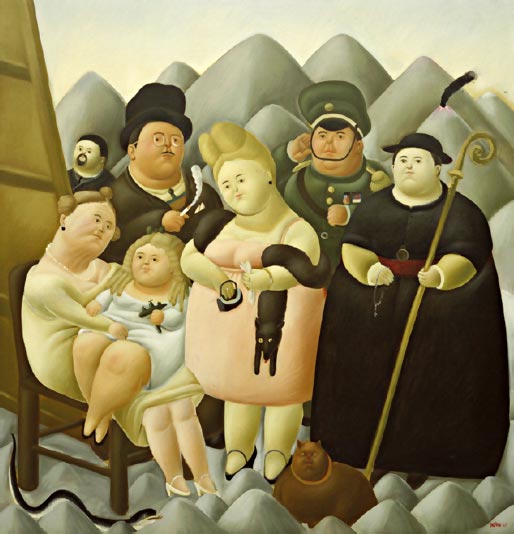
The poem also apparently draws on this painting as well, though I am not sure when or where I would have seen it. But certainly the puffiness and general ridiculousness of the figurehead ruler should come through in the poem -- and ideally the rest of the series.

Thinking back, it seems likely I was also influenced a bit by the sculpted pieces of Marisol Escobar, though I can't find a specific piece I might have been drawing on. Some of the details in the poem don't match up; some are clearly things I added, but a few do seem like a direct reference to another piece (not the Botero painting). Well, it must remain a mystery for the time being.
Palace Portrait
The imperial family is sitting for a painting.
The emperor wears a scarlet red sash
and all his medals.
They have to strap him to the chair
to keep him from tilting over.
He is upset that his uniform is tight.
It will be let out in the morning.
The old tailor was thrown out of the palace
from the tallest tower.
In the morning a new tailor will be selected
from a line that already stretches out for nearly a mile.
The empress sits on his right.
She wears her weight in diamonds.
His mistress sits a little behind and to the left.
The zipper on her black dress is made of silver.
The pearl necklace, however, is not real.
His brother is a soldier,
in fact a seven-star general,
who poses holding a cannon ball.
His other brother is a cardinal
who breathes heavily through his nose.
He also has put on flesh,
and his red robes reach only halfway around.
One of the boys is trying to ride the dog.
The others giggle.
The emperor’s oldest daughter scowls.
She wants to slap the brat,
but she has to hide the ring on her finger.
Her father would definitely kill her suitor,
no, kill all her suitors if he knew about it.
Last night never happened, she decides.
The painter picks up his brush.
“Quiet!” commands the emperor.
“Nobody move!”
The poem also apparently draws on this painting as well, though I am not sure when or where I would have seen it. But certainly the puffiness and general ridiculousness of the figurehead ruler should come through in the poem -- and ideally the rest of the series.

Thinking back, it seems likely I was also influenced a bit by the sculpted pieces of Marisol Escobar, though I can't find a specific piece I might have been drawing on. Some of the details in the poem don't match up; some are clearly things I added, but a few do seem like a direct reference to another piece (not the Botero painting). Well, it must remain a mystery for the time being.
Palace Portrait
The imperial family is sitting for a painting.
The emperor wears a scarlet red sash
and all his medals.
They have to strap him to the chair
to keep him from tilting over.
He is upset that his uniform is tight.
It will be let out in the morning.
The old tailor was thrown out of the palace
from the tallest tower.
In the morning a new tailor will be selected
from a line that already stretches out for nearly a mile.
The empress sits on his right.
She wears her weight in diamonds.
His mistress sits a little behind and to the left.
The zipper on her black dress is made of silver.
The pearl necklace, however, is not real.
His brother is a soldier,
in fact a seven-star general,
who poses holding a cannon ball.
His other brother is a cardinal
who breathes heavily through his nose.
He also has put on flesh,
and his red robes reach only halfway around.
One of the boys is trying to ride the dog.
The others giggle.
The emperor’s oldest daughter scowls.
She wants to slap the brat,
but she has to hide the ring on her finger.
Her father would definitely kill her suitor,
no, kill all her suitors if he knew about it.
Last night never happened, she decides.
The painter picks up his brush.
“Quiet!” commands the emperor.
“Nobody move!”
Friday, December 21, 2012
A Rage of Angels: Deliverance
This poem closes out the "A Rage of Angels" series. It is thematically the least like the rest of the poems in the series, though perhaps there are some hints of things going a bit awry in the first one: the Angel of the City. Still, it does serve as a bit of a rude awakening from the others.
In many ways, it is a fairly dark poem, perhaps closest in spirit to The Way It Was When I Was There. Given they do have quite a bit of overlap at least in tone, it might just be too much for the two poems to actually co-exist in the same collection. It doesn't appear that will ever be an issue, however. I think of the two, I like Deliverance a bit better.
The most obvious inspiration is Jose Rivera's play Marisol. I suspect I had seen the play before writing the poem, but I am not 100% sure (I saw the play for the first time in 1995). I would have had experience dealing with homeless people in NYC by this point, but I think I also recollect a Toronto-based poet in a poetry group I attended in 1993 borrowing (figuratively) a homeless man's sign and incorporating it into his poem (and at least another established poet -- probably either Alan Dugan or Charles Reznikoff -- has done the same). Just for the record, I did not steal the words off of a homeless woman's sign. In addition to filching from Marisol, there may be some flashes of Findley's Headhunter in there. Again, I cannot recall exactly when I read that book for the first time. Perhaps if I keep digitizing my files (and ultimately my diary), I will be able to track down some answers. In the meantime, I present "Deliverance":
Deliverance
I woke in a city.
Was I in—
the city of lights,
the city of love,
the endless city,
the eternal city
or simply the unspeakable city?
I recall a bridge on fire,
cars falling through into a dark river,
a crowd scattering under black clouds.
It could have been the city of desperate angels.
Desperate men
sell themselves on the street,
organ by organ.
The rain does not rain down,
will not put out these fires.
Small children stumble through the streets,
stalked by alley cats.
One woman crouches under a broken plate glass window,
hiding a brick behind her back,
the other hand holding a sign:
“I want to be good —
Please help”
in red ragged letters.
Growling dogs drag scraps of dirty, unspeakable meat to dark corners.
When two angels bump into each other,
heads averted or perhaps bowed,
they struggle.
One loses half its feathers,
while the other sits heavily, nursing a knife wound.
Both weep and pray for deliverance.
In many ways, it is a fairly dark poem, perhaps closest in spirit to The Way It Was When I Was There. Given they do have quite a bit of overlap at least in tone, it might just be too much for the two poems to actually co-exist in the same collection. It doesn't appear that will ever be an issue, however. I think of the two, I like Deliverance a bit better.
The most obvious inspiration is Jose Rivera's play Marisol. I suspect I had seen the play before writing the poem, but I am not 100% sure (I saw the play for the first time in 1995). I would have had experience dealing with homeless people in NYC by this point, but I think I also recollect a Toronto-based poet in a poetry group I attended in 1993 borrowing (figuratively) a homeless man's sign and incorporating it into his poem (and at least another established poet -- probably either Alan Dugan or Charles Reznikoff -- has done the same). Just for the record, I did not steal the words off of a homeless woman's sign. In addition to filching from Marisol, there may be some flashes of Findley's Headhunter in there. Again, I cannot recall exactly when I read that book for the first time. Perhaps if I keep digitizing my files (and ultimately my diary), I will be able to track down some answers. In the meantime, I present "Deliverance":
Deliverance
I woke in a city.
Was I in—
the city of lights,
the city of love,
the endless city,
the eternal city
or simply the unspeakable city?
I recall a bridge on fire,
cars falling through into a dark river,
a crowd scattering under black clouds.
It could have been the city of desperate angels.
Desperate men
sell themselves on the street,
organ by organ.
The rain does not rain down,
will not put out these fires.
Small children stumble through the streets,
stalked by alley cats.
One woman crouches under a broken plate glass window,
hiding a brick behind her back,
the other hand holding a sign:
“I want to be good —
Please help”
in red ragged letters.
Growling dogs drag scraps of dirty, unspeakable meat to dark corners.
When two angels bump into each other,
heads averted or perhaps bowed,
they struggle.
One loses half its feathers,
while the other sits heavily, nursing a knife wound.
Both weep and pray for deliverance.
Subscribe to:
Posts (Atom)