Sunday, December 11, 2016

Escape from Buffalo

I have been planning for a while to get to the Picasso exhibit at the Albright-Knox.  Initially, I had anticipated going on Sunday (today), but the weather forecast started calling for snow on Sunday (possibly as high as 10 cm through Monday morning, though I don't actually think Toronto will get that much).  Nonetheless, it usually snows considerably more in Buffalo, so I decided to switch the plans around and go Saturday morning, bringing my son along for the trip.

We didn't have too much trouble in getting to the Greyhound station, though we had to leave early and I was quite tired on the bus ride.  I had anticipated getting in 5 or 6 hours of reading in total, so I actually switched books and took David Foster Wallace's The Pale King, which is considerably longer than Steve Zipp's Yellowknife.  In the end, I managed to get through a bit under 200 pages, which is still a decent chunk of the book.  However, I could have stuck it out with Yellowknife, and it might actually have been a bit more appropriate, given that Zipp is writing about a city in a very cold climate with its share of eccentrics.  (I'm not quite sure how I feel about The Pale King.  I'm glad that readers have a chance to read it, but it is a sad book, full of death and suicide (perhaps it functions on a meta-level as Wallace's cry for help).  It isn't likely to be on my top ten list for the year.)

It was a bit unusual that there were only 19 passengers on the bus, but it meant that there was no problem in finding a good seat.  It was a bit frustrating to get hung up at customs for 20+ minutes.  Our bus breezed through, and the charter bus right before us.  But the one before that must have had a number of people without visas or perhaps some passenger was suspected of smuggling something.  Anyway, kind of a drag.  We did manage to get to downtown Buffalo around 12:30, which was slightly ahead of scheduled time, but we ought to have made it just after noon.  Given that we had to mail off a few things at the post office, and then go to the Albright-Knox, I decided we didn't want to gamble on getting back for the 4:30 bus and booked the 6:55 return instead.

It was pretty cold in Buffalo, but there was no snow.  I don't think we managed to get to the museum until 2:30. 


Obviously, we would have made better time taking a cab or Ubering it, but we stuck to the local bus or walking (to and from the post office).

The main attraction at the Albright-Knox right now is of course the Picasso exhibit, which runs through Feb. 19, but to get to it, you first walk through an exhibit called Rosalyn Drexler: Who Does She Think She Is?  Drexler is a relatively unknown pop artist, who was big into recycling (images, that is).  One of the droller moments in the show is that Warhol did a series of images of Rosalyn Drexler in her role as a woman wrestler.

I wasn't blown away by her exhibit, but there were a few interesting pieces.

Rosalyn Drexler, Shadow Figures in the City, 1962

Rosalyn Drexler, Night Visitors, 1988

The crowds at the Picasso exhibit were very manageable, and we had no trouble in looking at the various paintings (it was slightly busier than this, but not by much).


The exhibit had two rooms dedicated entirely to Picasso, but then another 4 rooms with paintings from the same period, drawing on the museum's collections.  Honestly, most of these paintings were stronger than the Picasso's.

I was glad to see a few of their cubist paintings (Braque and Juan Gris) and some of the surrealist paintings.  But it didn't make any particular sense to include the Stuart Davis in one of the other rooms.  Why Davis and not Beckmann?  (Again, I have a bit of an axe to grind that they still haven't reinstalled Beckmann's Hotel Lobby in the last two years, since they sent it off to Milwaukee.)

Anyway, here are some of the non-Picasso highlights of the exhibit.

Kurt Schwitters, Difficult, 1942-43

Giorgio de Chirico The Anguish of Departure, 1913–14

Robert Delaunay, Soleil, tour, aeroplane, 1913

As far as the Picasso's, La Toilette (1906) from the Albright-Knox and Three Musicians (1921) from the Philadelphia Museum of Art are the stand out pieces (both shown above).

I also quite liked this painting from the Wadsworth Atheneum* and two prints from the Albright-Knox.

Pablo Picasso, The Women of Algiers (after Delacroix), 1954

Pablo Picasso, The Black Pitcher and Death's Head, 1946

Pablo Picasso, In the Studio, 1965

The rest of the Albright-Knox had a few treasures that we hadn't seen previously, or at least not that I can recall.  I'm still hoping that they reinstall their Beckmann soon, and I'll definitely ask the next time I am considering making a visit (probably late 2017 or 2018).

Oskar Kokoschka, London, Large Thames View I, 1926

Robert Rauschenberg, Painting with Red Letter S, 1957

We hopped on the bus back downtown and were anxiously watching the clock.  We actually lost a few minutes when the police blocked the road to let a bus full of visiting NHL players speed along!  We ran over to the terminal.  It was 4:30, but the bus hadn't left yet!  Unfortunately, the driver wouldn't take us, since we didn't have open tickets and the clerk was extremely slow.  I imagine it would have cost another $20, and I just didn't feel like paying the difference.

So we went back out to do a bit of shopping in downtown Buffalo.  While there were fewer construction barriers up, Buffalo's downtown just seems drearier each time I visit.  The strip mall where I had bought some shoes on the last visit now appears to be completely vacant (possibly the food court still operates).  I wouldn't have been completely surprised to see a couple of zombies from Dawn of the Dead shuffling along...


We did get a few things at Rite Aid and looked at the Christmas lights in this park.


Most of the restaurants were closed or closing (even the Tim Horton's closed at 6 pm!), but we did stop in at this Chinese restaurant I had eaten at on the last visit.  It was also empty and desolate.


After we got back, I looked up some of the stats about Buffalo, and it has lost essentially half the population it had in 1950, and its population is just over 250,000 today.  Most tellingly, the average household income is under $25,000, so not only is it a shrinking city, it is a very poor one as well.

When we got back to the bus station, we saw a great big sign saying that all buses to Cleveland (and indeed any points west) were cancelled.  There was a big snowstorm in Ohio that had closed off all the major roads!  They really didn't seem too concerned about what people were going to do, and some stranded passengers probably got hotel rooms but others were just going to camp out in the station apparently.  Fortunately, the buses heading on to New York City were unaffected, and the 6:55 bus back to Toronto was fine (and indeed far less crowded than the one that left at 4:30, so that was a bonus).  As unpleasant as it would have been to be stuck in Cleveland overnight (as almost happened to me last December), getting stuck in Buffalo would have been worse.  So we managed to get out of Buffalo without seeing any meaningful snowfall.  On the whole it was a decent trip, though mostly it reminds me that I am glad I don't live in Buffalo.


* I didn't recall immediately this, but I actually had seen the painting from the Wadsworth Atheneum in 2004, when it was on loan to the Phillips Collection.  I actually had seen many of these Picasso's previously.  The best painting I had never previously seen in person was this one from Fondation Beyeler, located right outside Basel, Switzerland.

Pablo Picasso, Le Sauvetage (The Rescue), 1932

Friday, December 9, 2016

TTC's Leslie Barns

I had the opportunity today to get a guided tour of the TTC's Leslie Barns.  This is a brand new facility at Leslie and East Lake Shore that is designed to allow the TTC to store and do maintenance on the new low floor streetcars.  Since the Bombardier order is many, many months behind (the TTC now has 28 of these streetcars when they were originally supposed to have about 100 by the end of 2016!), they are using the facility to do maintenance on the other, much older streetcars, many of which are 30 years or older and are essentially past their shelf-life.  It's easy to knock the TTC, and I frequently do it myself, but they are really working hard to keep these older cars in service, and they have built a state-of-the-art facility that should keep the low floor streetcars in good repair whenever they finally get them from Bombardier.

For folks in Leslieville, the good news is that the construction that had torn up Leslie (twice!) and impacted Queen St. is over.  The bike path along Leslie will be officially opened by Christmas (not that that stopped cyclists from using it anyway -- I actually used part of it on my way to Luminato last summer).  The Leslie Barns still will suffer through a bit of growing pains (and it is somewhat difficult to picture the impact on the area when all 200 low floor streetcars are actually delivered, though not all of them will be stored at Leslie Barns when not in service), but it is a pretty neat facility.

Here are a couple of shots of the maintenance shop floor.


Here is the green roof (one of the largest in all of Toronto) and a view of downtown.  Naturally, the green roof will be considerably greener come spring.


After the tour, I had one last item that had to go out by the end of the day.  Where else would I find free wifi but at the Starbucks at the corner of Leslie and Lake Shore?  It turned out that a lot of folks from the neighbourhood had the same idea, and essentially every table was taken up with at least one and often two people working on laptops.  The wifi was actually kind of iffy.  I did manage to get the report out, but then my connection was lost, and I had to deal with a handful of email follow-ups using my phone.  (I got dragged kicking and screaming into having a work phone synced up with my work email, and now I am just as addicted as everyone else, but I have to admit it has come in handy on a few occasions.)  We are actually putting together some material on what we call the gig economy scenario: a future where everyone is scrambling to piece together work and full-time employment is a forgotten memory.  I think we'll end up using a couple of these shots I took as I was wrapping up my own work.


T-t-t-temptation

While I am not happy about the cold weather creeping in (and I did my last biking of the season last week actually, and it was cold and unpleasant), I do like some of the holiday decorations popping up around the city.  Not the commercialization of Christmas itself, but the rest of the holiday spirit can be nice.

Here is Yonge-Dundas Square getting into the act.


And here are a couple of displays along Bloor.


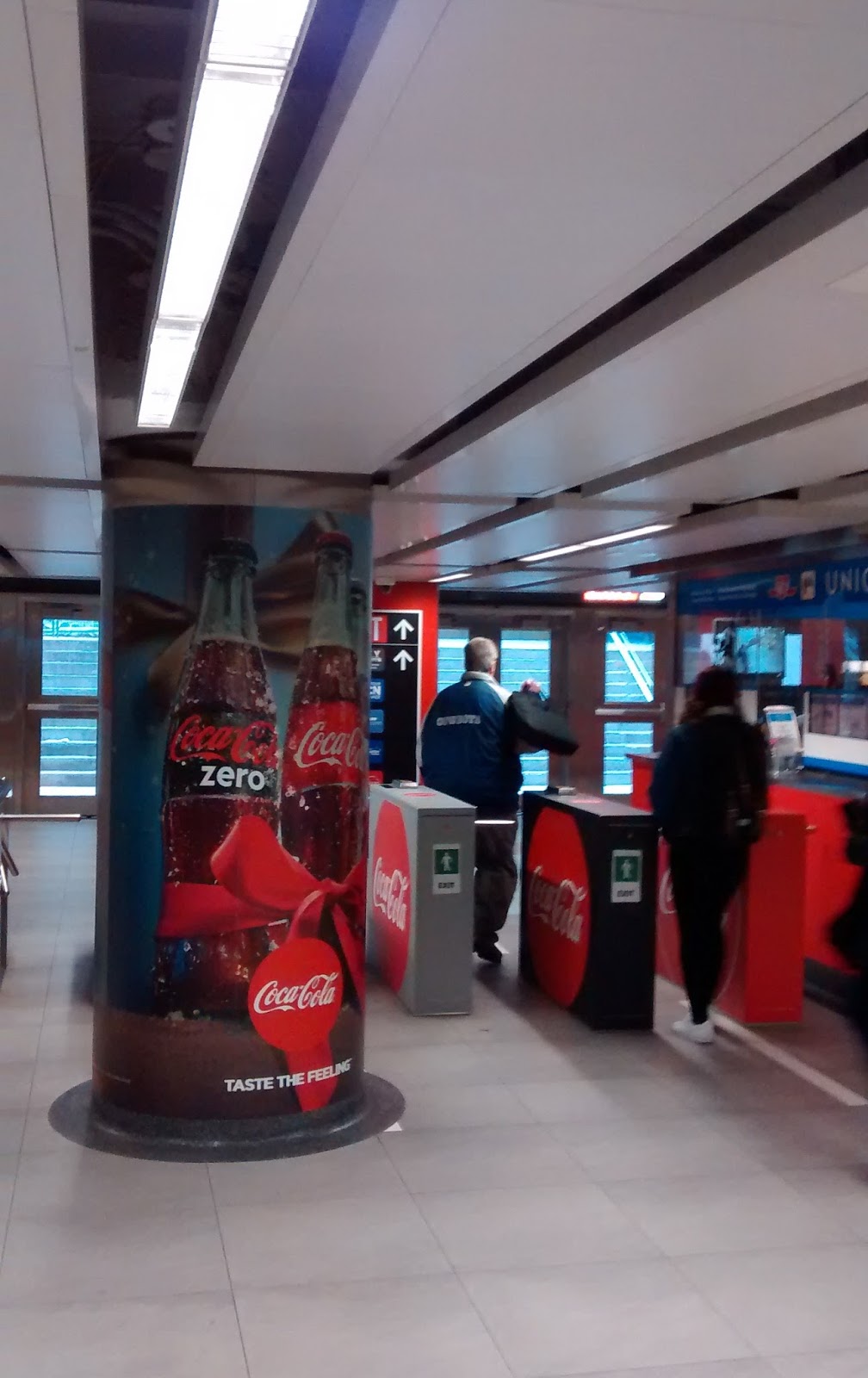
What has been a bit overwhelming is how Coke has just taken over the TTC station at Union.  While it isn't strictly Christmas-y, the station has a certain red glow to it.


It is making it somewhat of a challenge to my vow to give up all Coke (and Pepsi).  It is just about two months now, since I took the pledge, and while I have been sorely tempted, I have not slipped up yet. While I am not able to work quite as much in the late evenings as I used to, in general the switch to tea seems sustainable (if somewhat monotonous).  This station ad blast will not help; however, I will try to stay strong.

I think after the holidays I will try to up the ante and cut back more on sugar and particularly sugary snacks at work, and then to find some exercises I can do at home in the evening.  There isn't much point in vowing to go to the gym, since I know I won't be able to commit to that.  I might be able to integrate more swimming at Regent Park Aquatic Centre into my routine, but I don't want to commit to that right now.  In any case, there are definitely too many temptations to keep me where I don't want to be in terms of not in shape.

Wednesday, December 7, 2016

Henry James (and some Howells on the side)

I am finding that while I generally do prefer to read books in printed hard copy (and trade paperback more than hard cover), some books do lend themselves to reading on-line.  While I haven't attempted to read Trollope or Dickens as an electronic book, Samuel Butler's The Way of All Flesh is going reasonably well, and I read snatches here and there, particularly while waiting on downloads (as my internet connection is still pretty iffy these days).

At any rate, I am not going to make reading Henry James a particularly high priority, but after I finish The Way of All Flesh, I will see if reading Henry James on-line goes as smoothly, or if I find I have to devote longer periods of time and more uninterrupted reading to make any progress.  If it is the former, then I will try to tackle these novels (and a novella or two) in order of their publication:

The American
The Europeans
Daisy Miller
Washington Square
The Portrait of A Lady
The Bostonians
The Princess Casamassima ??
What Maisie Knew/The Turn of the Screw
The Awkward Age ?
The Wings of the Dove
The Ambassadors
The Golden Bowl

This is certainly the core of his work, though it is not a complete list of his novels.  The only James I have read to date is The Ambassadors, and that was in undergrad, so I don't really remember much about it.  All of these works, with the exception of The Princess Casamassima can be found at Project Gutenberg.  I suspect since they are in the public domain, you can find them fairly cheaply for the Kindle at Amazon, but I'd rather download them from Gutenberg, since the proof reading and error checking for PD works seems somewhat better.  It is totally hit or miss with older works at Amazon, though new books are generally fine.  Incidentally, it is an Australian site that hosts Princess Casamassima.  If I feel I am simply running out of time (with reading in general) or getting bored with James, I would probably cut it back to Washington Square, The Portrait of a Lady, The Bostonians and The Wings of the Dove.

William Dean Howells has definitely fallen from fashion.  At one point he was read as much or perhaps more than Henry James (they were mutual admirers, incidentally).  Curiously, the Library of America (or rather John Updike) makes a reasonably strong case for reading Indian Summer,* which is essentially forgotten now, but they did not publish A Hazard of New Fortunes (which can be found at Amazon, as well as at Project Gutenberg).  As it happens, I do have A Hazard of New Fortunes in paperback, and that is probably how I would actually read it, though I don't even have it on my reading list at the moment.  I'm not sure I will ever tackle Indian Summer, but I do plan on reading The Rise of Silas Lapham, and in this case, I would see if I could make reasonable progress with the epub file before I tackle New Fortunes, which was published a few years after Silas Lapham.  As worthy as Howells surely is, I just don't see myself making a thorough study of his novels, outside the two or three that I have listed.

* Updike also suggests that A Modern Instance is worth reading.  Most curiously, NYRB has published their own edition of Indian Summer (the only novel by Howells that they publish), which does suggest it is a bit of a forgotten gem.  Of the two editions, I'd still go for LOA in this case, as the Updike introduction is of more interest.

Sunday, December 4, 2016

10th Canadian Challenge - 11th Review - Unless

I did manage to read Carol Shields's Unless in November, which seemed appropriate (the events basically took place between Oct. and Dec.), though obviously I didn't quite manage to write my review in the same month.  Unless is a book that has held some interest for me for a while, as I have a bit of a morbid interest in works of art that are the last ones finished by a writer, playwright or artist, and this is especially true if the artist was generally aware that they were racing death to the finish line.  My understanding is that Shields was aware she had only a short time left to live while she was writing Unless (during a bit of a remission from the cancer that ultimately killed her).  What I was not aware of is that she ultimately attempted to write one more novel after Unless.  This is discussed at some length in this post, which talks a bit about Shields's plans for the novel and the short story "Segue," which was ultimately salvaged from her working draft of this novel.  "Segue" is included in Collected Stories.  I'll be reviewing the rest of the stories in a separate post, but I will add a few of my own thoughts on "Segue" at the end of this post, after I discuss Unless.

Shields is generally known as a feminist writer who often focuses on telling the story of a fairly unremarkable woman (esp. in the case of The Stone Diaries), making the point that it is not only famous and/or successful men that deserve novels written about them.  The downside is that there is often not as much plot.  There is some plot in Unless, though it is very much a domestic drama.  In some ways, this reminded me of an Anne Tyler novel.

In any case, I had wondered what would be sufficiently distracting for someone facing death, and I think Shields's answer is to dwell on a child who is in peril.  I suppose for many of us that is true -- about the only thing more upsetting than our own mortality is fearing that our children will die first.

Minor SPOILERS ahead.

I will try not to SPOIL the actual ending, but I can't discuss the book without going into what is wrong with Reta's life is that her oldest daughter, Norah, was going to U of T (and living with her first serious boyfriend) and then she abruptly decides to ditch everything (school, boyfriend, house) and camp out on the corner of Bloor and Bathurst, right near Honest Ed's, with a big sign reading GOODNESS.  She passively accepts whatever passersby give her, though she shares this with the residents of the shelter where she stays at night.  She is clearly having a breakdown of some sort, but it takes quite a while to understand why and whether she can recover from this.  What's sort of interesting about the novel is that based on feedback from social workers, Reta only checks in with her daughter once a week or so and the rest of the time carries on with her interactions with friends as well as carrying on with work.

I should take a minute to memorialize Honest Ed's, which will be closing down at the end of this month.  It really does feel like the end of an era.  While I never really bought that much in the place (though I did pick up a fair bit of cloth from Fabricland), I will miss it.  I really ought to try to take my family there at least once.


I'm not quite sure how long it will last, but the TTC collaborated with some of the Honest Ed's staff to decorate the Bathurst station just like Honest Ed's, even with some corny jokes and puns.  It's done quite well actually.


Back to Shields's novel, Reta has a somewhat accidental career as a translator, but she also wrote a minor hit novel and decides that the best thing to do to distract her from her woes is to write a sequel.  She has unexpected trouble from a new editor, who does a fair bit of mansplaining to her.

One of the more intriguing aspects of the novel is that Reta writes a fair number of letters to public figures, mostly academics, complaining how women have been marginalized in the university as well as in literature, and she thinks this is partly causing her daughter to withdraw from the world.  (Unlike Bellow's character Herzog, she only mails off one of these missives.)  My impression is that Shields does deeply believe in what Reta is writing, but she may actually be hinting that feminist theory (or rather dogma) is not actually helping her to navigate her troubles and may be blinding her to what is really wrong with her daughter.  (This was my view anyway.  In fact, at one point, Reta says that Norah says she is hearing voices, and Reta interprets this as the way women internalize social pressure as a running commentary in their head.  I was thinking this might actually be a serious warning that Norah was developing schizophrenia and was more than a little annoyed at Reta and her feminist preoccupations at this point.  Fortunately, Norah is not schizophrenic, though it is her father who is closer to the right track as to what is actually wrong with her.)

In general the stakes do feel higher here than in The Stone Diaries, and I suspect that is why I like it a bit better.  However, it is like The Stone Diaries in that much of the novel focuses on relationships -- and how women are cast as supporting characters to men, even in their own lives!  While relationships between women may be somewhat less fraught than those between men and women, there is still plenty of room for misunderstanding (sometimes explicitly because it is hard to determine who is "the dominant one" in the relationship).  It is somewhat interesting that Reta's visit with an old friend who moved away from Toronto was extracted into a stand-alone story "A Scarf," which is in Collected Stories.

I suppose that is an appropriate segue to "Segue."  I won't go into too much detail as the article I linked to above explains the characters.  The story really doesn't do much beyond introduce the characters.  It is very hard to decide where Shields would have gone with this story.  The narrator seems to be shedding responsibility and is more or less retiring (though whether a poet can actually "retire" is an open question).  She seems fairly content in her marriage, so it is unclear why the story ends with her claiming that she isn't happy.  The "particular circumstances" that don't allow her to be happy could of course be related to her unhappiness around her aging body, or it might be some domestic issue that Shields never got around to detailing.  So it is definitely a cliff-hanger that will not be resolved.  Actually, if one delves into her working notes for the unfinished novel, it does seem to be mostly a medical issue.  (A previous draft said that she was happy "until [her] diagnosis.")  What apparently comes through more in the unpublished fragments (and not as much in "Segue" itself) is that the novel was going to touch on 9/11 indirectly and the Gulf War fairly directly (or at least the narrator's reflections on the Gulf War).  So there is sort of a ghost novel that emanates from the published story.  I am certainly sorry that Shields didn't have the time or energy to finish it, as it might have been quite interesting and a bit different from her other work.

In closing, I would encourage people to seek out "Segue" in Collected Stories.  If you have a copy of that, you might as well read "A Scarf," which will give you a strong sense of whether you would enjoy Unless.

Saturday, December 3, 2016

André Gide (& Céline & Bove)

One of the downsides of not being particularly versed in French literature (and only being able to read the originals tolerably well) is that one's perception of how important certain authors are is wholly dependent upon what has been translated.  Perhaps this is even more true of post-1930 Russian literature where the main authors that have been translated were critical of the regime or on the outs for one reason or another (Bulgakov in particular).  Almost all of the contemporary NYRB Russian translations have been of outsider authors (Grossman, Sokolov, Platonov, etc.).

While the slant is not as purely political with French literature, it still seems to me that there is a real focus on outsider authors getting more attention, such as Céline or Gide and more recently there has been a bit of a resurgent interest in Bove.  In terms of relatively contemporary poetry, the two that come to mind are Baudelaire and Rimbaud, both of whom sort of exemplify the poet of the outcasts.  There are some exceptions, of course.  Muriel Barbery was/is fairly mainstream, and likely the most read French author (by English-speakers that is) is Antoine de Saint-Exupéry.  While he has a dash of the romantic outsider to him, this is a far cry from the focus on down-and-out characters by Bove or Gide's exploration of sexual deviance (including homosexuality at a time when it was still a criminal offense).

I am sure one could construct a similar picture of writers working in English if one only read Charles Bukowski, William Burroughs and Paul Bowles, for example.  I'm just aware of the much wider range of conventional English novels.  While these authors certainly have their place, they probably would not be considered the core of the literary canon.  I honestly don't know what the French literary canon would look like, other than Proust would probably be at the top of the list.  This list from Le Monde is interesting, since it includes far more "foreign" authors and Camus's The Outsider/The Stranger displaces Proust for the top slot.  In any case, Céline's Journey to the End of Night is in the top 10, though none of his other works make the list.  Gide's The Counterfeiters is at slot 30, though it would crack the top 20 if only French-language works were counted.  None of Gide's other novels are on there, which surprises me a bit, since I would have expected to see L'Immoraliste.  Bove is not on the list at all, which doesn't surprise me that much, as his reputation definitely slipped after 1970 or so, and while he is being "rehabilitated" in English, I am not sure if that is the case in France.  I don't want to dwell too much on this list* (though it is a solid list of books filtered through a Parisian frame of mind), aside from the fact that it has inspired me to include Malraux's Man's Fate on my reading list (it's a book I've been vaguely aware of for a long time but never have read).  I also wasn't aware of Jacques Prévert's Paroles, and I decided to order the City Lights edition which has the original poems and a side-by-side translation by Lawrence Ferlinghetti.

I won't really discuss Bove here, since I already have a post dedicated to his work.  My favorite book so far has been Armand and my least favorite was A Man Who Knows.  It appears that I will get to A Singular Man in the middle of 2017.

I've owned Céline's Journey to the End of Night (the New Directions edition) for what seems like forever, and a few years back, I picked up the companion Death on the Installment Plan (also ND).  I've never cracked them.  Recently, I added Journey to my reading list, but it is fairly close to the end, and it may well be 3 or so years before I get to it.  On the other hand, if the spirit moves me, I may move it up so that I read it no later than early 2018 for instance, and then slip in Death into Journey's place.  After some reflection (and reading of the reviews), I have decided to hold off from buying any other of his later works (such as Castle to Castle or even North), since they seem kind of like the writings of a very cranky, right-wing jerk (sort of like a more political Victor Meldrew complaining about everything).  They may be worth reading once, but that would definitely be it.

As far as Gide goes, I'm fairly sure that in high school I picked up a box set of his novels in French (from a library book sale) but eventually parted with them not having read any of them.  While that is a bit disappointing to my 40-year-old self, I have found that most of them can be found in electronic editions here, and that may actually be better, since it will be a lot easier for me to look up words and phrases on-line.

While not at all a complete list, this is how I am thinking of approaching Gide in terms of my overall interest level:

X Les Caves du Vatican – (The Vatican Cellars aka Lafcadio's Adventures) - 1914
X L'immoraliste – (The Immoralist) - 1902
La porte étroite – (Strait Is the Gate) - 1909
Les faux-monnayeurs – (The Counterfeiters) - 1925
Isabelle – 1911/La Symphonie Pastorale – (The Pastoral Symphony) - 1919 Published as Two Symphonies by Vintage Books.

While there are several translations floating around, I'll probably stick with the Penguin editions.  (I haven't bought any of these so far, but I'll keep an eye out when I am in used book stores over the next couple of years.)  I've added The Vatican Cellars to my reading list, sort of pairing it with Bellow's The Adventures of Augie March.  There is a small chance that I will actually end up tackling The Immoralist and Strait is the Gate sooner, since they are short novels and may end up on a parallel reading list of short novels I read at work on breaks (though I have to get through D.M. Thomas's The White Hotel first, and before I start that I want to read some of Freud's case histories -- there's just so much to try to read in one lifetime...).

Anyway, this basically covers my recent forays into French 20th C. literature.  I do feel I should have read much of it sooner, but I was occupied with other books.

* I went back and checked to see how many I had read, and I am up to 30 with another 15 on my long reading list.  I'll never read all of these books, but I'll probably cover about half of them within 3-4 years.  Pas mal.

Thursday, December 1, 2016

At the Rex

I went over to the Rex Hotel on Queen St. last night to catch the early set (the Allison Au Trio + 1).  There have been a few times I saw a group on the calendar that I wanted to catch, but invariably it was for a 9:30 show, and I just am not interested any longer in staying out that late.  I'm not sure they ever got a lot of major acts (10 or more years before), but now it is fairly rare, and the focus is certainly on local acts.  That said, I enjoyed it.  There was no cover and no hassle about a 2 drink minimum (I just ordered some decent quesadillas), and I was able to sit quite close to the small stage.  Allison's group was quite good, though I only stayed for the first set.  I might go back from time to time, though it probably is best not to have one's expectations set too high, particularly for the groups that get the 6:30 slot.

One thing that I like about jazz clubs with actual tables is I can haul out a notebook and write (the music helps me get those creative juices flowing).  Last night, I was able to write out almost all of the ending of The Study Group, so I have the first quarter and last few pages done now, which is a good feeling.  I'm still having a bit of trouble deciding how to recover from the Back to the Future gag.  And also whether this should unfold "in real time" or should I put in a break to allow for the passage of time.  If they are supposed to be studying all afternoon, how can this be accomplished in an hour (or even 70 minutes) of  stage time?  I can't think of any natural break, at least not right now.  Maybe one will reveal itself as I write the middle bit.

I don't know if it is possible to SPOIL an unwritten play that may never be produced, but if you don't like endings being revealed, then turn away.

I'm fairly happy with the second-to-last part.  The math whiz, Kim, had sort of tentatively been coming out of her shell to Trevor, the science geek, and was hinting that maybe she would like to go to Prom with him (she's pretty awkward and may not even be fully aware of what she is doing).  He says he has to study for A.P. chemistry test and can't be distracted.  This sort of happened to me in reverse.  I was sort of dating a girl my Junior year and did ask if she wanted to go to the Prom, but she blew me off with that excuse.  I was also taking the AP exam (and scored quite well), but I didn't think it required my whole attention.

Anyway, as the play is winding down, one of the regular kids encourages Trevor to hang out with Kim, since he is pretty sure she likes him.  Trevor is paralyzed between thinking that they are making fun of him (setting him up and having a huge laugh when she rejects him) and the possibility that it might be true.  This also happened to me with a guy I knew a little said that this high school Senior thought I was kind of cute.  I never got the nerve to really probe if it was true.  Now it didn't help that I wasn't in any classes with her at all, and I had absolutely no interactions with her, so there was no obvious reason why she would even have known who I was.  It definitely felt like a set up.  I still remember that I was out with my mom, towards the end of the school year, and we ran into this girl and her friends in a donut shop, and I was feeling totally humiliated (at this point I could drive myself).  Note to self: it doesn't take a lot to upset teenagers with all those hormones rushing around and I might try to squeeze a bit more of that into the play.  I doubt that I would actually have managed to talk to her with her friends around, but it felt like a missed opportunity.  So I am giving Trevor the shot at redemption I didn't get (or take).

But after this, Will (who has been a bit annoying throughout the play, feuding with his ex-girlfriend) gets a fairly brutal put down and finds out that his friend (or someone he considered a friend) is taking his ex to the Prom.  I'm thinking about leaving him alone in the basement and then having the lights go out, as a particularly stark reminder of how it can feel to be on the short end of the stick when it comes to childhood cliques.  On the other hand, the tone overall has been fairly light, even with minor currents of aggression surfacing throughout, so maybe it would be a better ending if they relent and ask him along to go to the movies.  I honestly can't tell, so this might be something to take to a workshop, like the Toronto Cold Reads folks.  If you have an opinion whether I should go with the darker ending or the softer ending, feel free to comment on this post.  Thanks!

Edit (12/2): I think I have come up with a way to have my cake and eat it too (to borrow from a term much loved by Boris Johnson).  Early on in the play, I introduce an 8-sided die (the singular form of dice) from Dungeons & Dragons (quite popular in the 1980s) and they pretend to use it during the play (the die rolls are fixed in the script).  I am thinking that Will rolls the die for real (as a saving throw) and announces what the actual number is.  There are a variety of ways to do this, but I am leaning towards 1-5 leaving Will in the basement alone, 6 means a couple of his friends come back and ask him to go to the movies, 7 means Kim comes back and he offers to coach her in English grammar (it's implied that he will make a move on her, but it is left open ended) and 8 means that another friend comes by and wonders if Will is interested in going to the Prom with his cousin.  I could adjust these settings or even add yet one more outcome, but I think leaving it up to chance it somewhat satisfying.  It could be considered a bit of a tribute to John Cage, though Cage would probably have make large chunks of the play dependent upon the roll of a die, but I think that would be too much of a challenge, particularly for younger actors.  (I have seen this done occasionally (and I really should have gone to see Too Much Light Makes the Baby Go Blind when I lived in Chicago, since it follows these principles), but it puts too much focus on the gimmick as it were.)  Anyway, any thoughts on this approach are also welcome.