So I actually did contact the Ebert website and got a response from Jim Emerson that Ebert had planned on a 4th volume of the Great Movies series, and that the publisher was seriously considering it. What I don't know -- and didn't really have the opportunity to probe --is whether Ebert had notes on which of his other reviews, particularly his 4 star ones, might be migrated to Great Movie status. I assume that he didn't actually have any unpublished Great Movies posts lying about, since he pretty much put everything up on-line as soon it was ready.
It looks like there are roughly 65 uncollected movies (plus the review he did on the expanded version of Metropolis, but I don't think he would include that). That is on the thin side -- most of the Great Movie volumes come in at close to 100 reviews. I already suggested Chloe in the Afternoon, Bringing Out the Dead and After Life. I think there are legitimate reasons that he would have eventually included these as Great Movies, particularly the last two given that he was generally more inclined towards philosophical movies and movies about death and the hereafter.
I spent a big part of the last couple of evenings archiving Ebert's recent 4-star movies and even some 3.5 star ones (operating on the somewhat paranoid assumption that some conflict will arise between the Sun Times and the Ebert estate and they will all be wiped out without notice some day). Here are a few reviews that might not be out of place in a potential volume 4. Not that I expect this to happen, but I'd hate for these to get lost in the cracks -- mostly too late to be in his book of 4 star reviews and not collected anywhere else at the moment. Note that I am not including all of his recent 4-star reviews, but just movies that I have seen or where the review really resonated with me.
The American
Another Year
Argo
Broken Flowers
The Death of Mr. Lazarescu
The Descendants
Le Havre
I Am Love
Inception
The Informant!
Last Train Home
The Mill and the Cross
Monsoon Wedding
A Separation
A Serious Man
Sita Sings the Blues
Still Walking
Synecdoche, New York (I guess this will hardly get lost given how much he promoted this film)
Tampopo
Up
Up in the Air (Ebert really had a thing for Clooney apparently)
And one that I can almost guarantee you've never heard of:
Patang (one of the few movies that I sought out solely on Ebert's advice -- it was good but perhaps not 4-star good)
Pedro Almodovar:
All About My Mother
Broken Embraces
Talk to Her
Volver
I find it fairly astonishing that none of Pedro Almodovar's films made the Great Movies cut, when he had 3 movies garner 4-star reviews and a couple of 3.5 star reviews. This may be one of the more significant oversights in the Great Movies list, especially since Ebert generally liked what he was up to. But it was a slowly acquired taste. In the High Heels review, he admits that he simply didn't get Women on the Verge of a Nervous Breakdown, which remains my favourite Almodovar film, even if I realize some of the later films are more artistically complex.
(At least Ebert continued engaging with Almodovar. He really didn't care for Terry Gilliam and didn't like Brazil at all, whereas he was quite taken with the even more anarchic and difficult to follow Holy Motors. I do wonder if he gave more of a pass to French and Italian directors than to directors of English-language films. David Cronenberg gets just a little love here, but not surprisingly it is Eastern Promises -- a most atypical film -- that gets the highest approval from Ebert.)
But enough quibbling. I agreed with Ebert about 75% of the time, and respected him whether I agreed with the review or not. I know I'm not alone in really missing Ebert and his take on the movies...
Wednesday, April 17, 2013

Saturday, April 13, 2013
Kurelek's O Toronto
William Kurelek is an interesting case. He had studied as an artist, but his approach to his subject matter came across as quite naive for a 20th century artist and certainly vastly more religiously oriented than most of his contemporaries. He really strikes me as an outsider artist, like Grandma Moses or Howard Finster (perhaps a more apt comparison) but with more training. In terms of the actual look of the art, it is often a mix between Bruegel and Hieronymus Bosch, at least for the more intriguing pieces. What is actually kind of odd is that Kurelek also painted more domestic scenes where he does look a lot more like an outsider artist and the style is much less refined. I assume this was deliberate. (It took me a while to fix the images below. Hopefully there will be no further problems. Sorry about that for those early viewers.)
I really knew almost nothing about Kurelek, but I was visiting Toronto and stopping in at the expanded AGO. I was pretty overwhelmed at the new galleries, particularly the Thomson Collection on the 2nd floor. There was a room devoted to Kurelek, who was really completely new to me, whereas I was pretty familiar with the Group of 7. This domestic scene of a bachelor was by far my favourite.
 Now what is particularly odd is that not a single Kurelek painting shows up in the AGO's on-line highlights of Canadian art, but in the book that AGO published on the Thomson collection Kurelek has his own chapter and this image is included. (I don't have any awareness of what goes on behind the scenes at the AGO, but I suspect that the current curators aren't particular fans of Kurelek.)
Despite Kurelek's very public Christianity, he was a bit more sophisticated in his dealings with the art world. He did a number of paintings that are essentially aimed at the middlebrow crowd. He published books of paintings based on several of the provinces, as well as "the north" and Toronto. While he has faded from popular view, he had published calendars of these domestic scenes. O Toronto has a number of these paintings, including this one of a snowy street.
 The O Toronto book is a bit more interesting than the others in that his religious paintings do spill over and kind of overwhelm the more domestic scenes. So we have Christ on the steps of the old provincial capitol building, completely ignored by the busy Torontonians on the sidewalk in the foreground. A detail below:

(Kurelek does draw the people a bit more realistically than L.S. Lowry for example, but the feel is somewhat similar.)

"Harvest of Our Mere Humanism Years" may be Kurelek's most famous painting, which cribs so heavily from Bosch that Kurelek should have paid royalties (joke). It is also included in O Toronto.
 While I find this an interesting painting, it is so opaque to me that I have no idea what Kurelek is actually getting at (much like Bosch in fact). Apparently, the bomb is about to drop on the modernist Toronto City Hall, and all the learning that goes on at UT will be of no help at all. I still can't quite wrap my head around why the fact that Canadians (rather than the Soviets) are humanist and/or godless is any more likely to bring about nuclear war, but so be it.
As it turns out, I was visiting Victoria last fall and apparently missed being able to see a major retrospective on Kurelek by about a week or two. Review of the exhibition here. Now that I have seen the catalogue of the exhibit, and I have to say that I really only wanted to see 3 or 4 pieces up close, Harvest among them. (Harvest apparently belongs to Manulife Financial and is in their Toronto HQ, but it isn't at all clear how one goes about asking to view the painting.)
The truth is that the more I learn about Kurelek, the less I like him. He truly was a religious fanatic and frankly much of his art is lousy. When it isn't overtly religious, it is sickly sentimental. So for instance, this one is titled "Hope of the World" (a cross in the window). Gag me with a spoon.

In contrast, some scholars (though not all) claim that the tiny cross in the window in this Max Beckmann painting ("The Night") serves the same general purpose, though it seems to me that it is by no means clear that the tiny cross will triumph over the general degradation of the times. The painting can certainly be read ironically as well. And despite its intentional ugliness, the artistic quality of the Beckmann piece is just so much higher than what Kurelek achieves.

There does not appear to be a clear consensus on whether Max Beckmann was conventionally religious, though his early work was occasionally on religious themes (like Christ and and the Woman Taken in Adultery or Descent from the Cross). In most of the later works, working in his high Expressionist mode, Christianity and legends from various other mythologies are combined in a style that suggests to me Beckmann was on the same wavelength as Joseph Campbell (of The Hero with a Thousand Face). One aspect of his personal history that cannot be overstated in its impact on his art (and his general outlook on life) is that Beckmann was targeted by the Nazis for being a degenerate artist in 1937. Beckmann wisely left Germany immediately and lived in Amsterdam for 10 years; apparently the U.S. officials -- to their great discredit -- refused to grant him a visa. He was able to move to the U.S. after the war but only lived another 3 years, primarily in St. Louis and New York City. Beckmann was also very aware of the depths that humanity had sunk to, but unlike Kurelek this was from first-hand knowledge and not an abstract notion that humanity had abandoned Christianity (observed from the relative comfort and safety of Canada). In an upcoming post, I'll try to write more on Beckmann's triptychs, many of which I have been fortunate to see in person (6 of 9, I believe).
Back to Kurelek, I basically cannot shake the feeling that he is a religious prig who would have been really unpleasant to be around (there is another painting where young people are massed in this near orgiastic state, just waiting to get paired up, by the devil apparently). It's a little hard to see at this scale unfortunately.
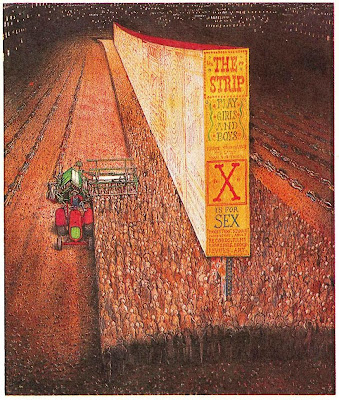
One painting included in O Toronto but not in the exhibition is this one called "Our My Lai, the Massacre of Highland Creek." While it is hard to see in the small reproduction, the buckets are full of aborted fetuses, many of them near full-term babies. Personally, I find this completely outrageous. It just reminds me of the horrid tactics the right-to-lifers employ in the U.S., suggesting that nearly all abortions are late term and so on.* As if doctors would just throw out aborted fetuses in a nearby stream (in buckets no less). Though I have to admit the "blood" that seeps outside the frame at the bottom adds to the overall effect.

I wasn't too crazy about Kurelek up to this point, but this really caused me to lose all interest in him as a person and really as an artist as well. It would have been interesting had the retrospective organizers had the courage to show the unvarnished Kurelek by including this painting, but they did not. Most likely the controversy engendered would have been good for his estate. As for me, I will steer clear from Kurelek, and I certainly won't be buying any calendars or prints of his paintings from here on out.
* Since this is my blog, I am not going to be publishing any comments from outraged Right-to-lifers, just so you know.
I really knew almost nothing about Kurelek, but I was visiting Toronto and stopping in at the expanded AGO. I was pretty overwhelmed at the new galleries, particularly the Thomson Collection on the 2nd floor. There was a room devoted to Kurelek, who was really completely new to me, whereas I was pretty familiar with the Group of 7. This domestic scene of a bachelor was by far my favourite.

Despite Kurelek's very public Christianity, he was a bit more sophisticated in his dealings with the art world. He did a number of paintings that are essentially aimed at the middlebrow crowd. He published books of paintings based on several of the provinces, as well as "the north" and Toronto. While he has faded from popular view, he had published calendars of these domestic scenes. O Toronto has a number of these paintings, including this one of a snowy street.


(Kurelek does draw the people a bit more realistically than L.S. Lowry for example, but the feel is somewhat similar.)
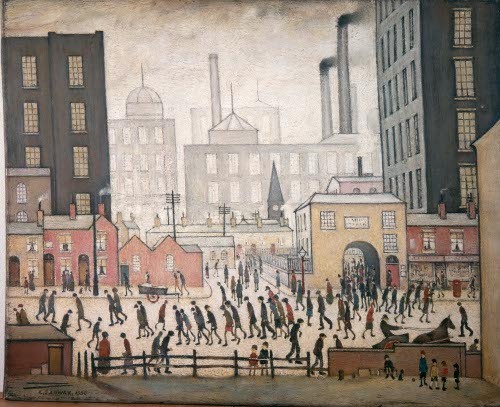
"Harvest of Our Mere Humanism Years" may be Kurelek's most famous painting, which cribs so heavily from Bosch that Kurelek should have paid royalties (joke). It is also included in O Toronto.

As it turns out, I was visiting Victoria last fall and apparently missed being able to see a major retrospective on Kurelek by about a week or two. Review of the exhibition here. Now that I have seen the catalogue of the exhibit, and I have to say that I really only wanted to see 3 or 4 pieces up close, Harvest among them. (Harvest apparently belongs to Manulife Financial and is in their Toronto HQ, but it isn't at all clear how one goes about asking to view the painting.)
The truth is that the more I learn about Kurelek, the less I like him. He truly was a religious fanatic and frankly much of his art is lousy. When it isn't overtly religious, it is sickly sentimental. So for instance, this one is titled "Hope of the World" (a cross in the window). Gag me with a spoon.

In contrast, some scholars (though not all) claim that the tiny cross in the window in this Max Beckmann painting ("The Night") serves the same general purpose, though it seems to me that it is by no means clear that the tiny cross will triumph over the general degradation of the times. The painting can certainly be read ironically as well. And despite its intentional ugliness, the artistic quality of the Beckmann piece is just so much higher than what Kurelek achieves.

Back to Kurelek, I basically cannot shake the feeling that he is a religious prig who would have been really unpleasant to be around (there is another painting where young people are massed in this near orgiastic state, just waiting to get paired up, by the devil apparently). It's a little hard to see at this scale unfortunately.

One painting included in O Toronto but not in the exhibition is this one called "Our My Lai, the Massacre of Highland Creek." While it is hard to see in the small reproduction, the buckets are full of aborted fetuses, many of them near full-term babies. Personally, I find this completely outrageous. It just reminds me of the horrid tactics the right-to-lifers employ in the U.S., suggesting that nearly all abortions are late term and so on.* As if doctors would just throw out aborted fetuses in a nearby stream (in buckets no less). Though I have to admit the "blood" that seeps outside the frame at the bottom adds to the overall effect.

I wasn't too crazy about Kurelek up to this point, but this really caused me to lose all interest in him as a person and really as an artist as well. It would have been interesting had the retrospective organizers had the courage to show the unvarnished Kurelek by including this painting, but they did not. Most likely the controversy engendered would have been good for his estate. As for me, I will steer clear from Kurelek, and I certainly won't be buying any calendars or prints of his paintings from here on out.
* Since this is my blog, I am not going to be publishing any comments from outraged Right-to-lifers, just so you know.
Sunday, April 7, 2013
Ebert's Great Movies
I mentioned that I definitely appreciate Robert Ebert's Great Movie
reviews where he reviews the classics or re-reviews more contemporary
movies that he felt should join the list of greats. He collected them into 3 books and a fourth may have been in the works. To go to the original source (which then allows you to read the entire review), click here. (I hope that these reviews stay up indefinitely, but his wife and/or the Sun Times may decide to move them elsewhere for more permanent archiving.) I see that they have already revamped the Great Movies site (and possibly added one or two more that Ebert always intended to include). In many ways it is better with links where you can order the DVDs, but now slightly harder to get the basics (and a few are mischaracterized according to their sorting app), so I think I'll keep going with my own version of the list below.
There appear to be 363 movies in the list -- a great movie each day for a year with just a couple of days off for rest! Though at my typical rate, it might take 10 years, and there are some I really have no interest in seeing. More than many posts, this will require some editing. I think what I shall do, is sort them by decade, as well as add director's name, and then put in a note as to which Volume the review appears in. This may take me a while, so this post is definitely a work in progress. An X in front the title means I have watched it (it's too embarrassing to list the ones I own but haven't watched). I clearly have a long ways to go...
Incidentally, while I would like to introduce my children to these cinema classics, there are a lot that are completely inappropriate for children. I have tried to watch the Tati films with them, but even these are just a bit over their heads. In terms of my own personal viewing, I will probably re-watch Iriku next (to celebrate getting the U.S. taxes done -- Canadian taxes still undone...) and then Werckmeister Harmonies, mostly because the novel I just started (Michael Crummey's Galore) starts off with a whale beaching itself in a small town, though it plays itself out completely differently of course.
Note any links below will link to my own thoughts on the movies, and not Ebert's, so forewarned is forearmed. Actually, there are three exceptions -- 3 italicized movies were 4-star reviews that Ebert didn't have the time (or perhaps inclination) to include in his collection of Great Movies, so I shall link to the original reviews.
Movies from the 1910s & 20s
X The Battleship Potemkin - V1
The Birth of a Nation - V2
Broken Blossoms (D.W. Griffith) - V1
The Cabinet of Dr. Caligari (Robert Wiene)
X The Circus (Chaplin)
Diary of a Lost Girl (G.W. Pabst)
The Fall of the House of Usher - V2
Faust (Murnau) - V3
The Films of Buster Keaton
The General - V1
Greed (Erich von Stroheim) - V1
The Last Laugh - V2
The Man Who Laughs - V2
Man With a Movie Camera
X Metropolis [2010 Restoration] (Fritz Lang) - V1
Nanook of the North - V3
Nosferatu (Murnau) - V1
Pandora's Box - V1
The Passion of Joan of Arc - V1
The Phantom of the Opera
X Safety Last - V3
Souls For Sale (Rupert Hughes)
Sunrise - V2
X Un Chien Andalou (Bunuel/Dali) - V1
Movies from the 1930s
The Adventures of Robin Hood - V2
X Bride of Frankenstein (James Whalen) - V1
X City Lights (Chaplin) - V1
X Dracula - V1
X Duck Soup (Marx Brothers) - V1
X Gone With the Wind - V1
Grand Illusion (Renoir) - V1
X King Kong (Merian Cooper) - V2
L'Atalante (Vigo) - V1
M (Fritz Lang) - V1
Make Way for Tomorrow
X My Man Godfrey - V3
The Only Son (Ozu)
The Rules of the Game (Renoir) - V2
The Scarlet Empress - V3
X Snow White and the Seven Dwarfs - V2
Stagecoach
Swing Time - V1
The Thin Man - V2
Top Hat - V3
Triumph of the Will (Leni Riefenstahl) - V3
Trouble in Paradise (Lubitsch) - V1
X The Wizard of Oz - V1
Movies from the 1940s
X The Bank Dick (W.C. Fields) - V2
Beauty and the Beast (Jean Cocteau) - V1
The Best Years of Our Lives (Goldwyn) - V3
X The Bicycle Thief / Bicycle Thieves (De Sica) - V1
X The Big Sleep (Howard Hawks) - V1
X Casablanca - V1
Cat People (Jacques Tourneur) - V3
Children of Paradise (Marcel Carne) - V2
X Citizen Kane (Welles) - V1
Detour - V1
Double Indemnity (Billy Wilder) - V1
X The Great Dictator (Chaplin) - V3
The Grapes of Wrath - V2
Great Expectations (David Lean) - V2
X It's a Wonderful Life (Frank Capra) - V1
X Kind Hearts and Coronets (I actually find this film over-rated) - V2
X Laura (Otto Preminger) - V2
The Life and Death of Colonel Blimp (Powell & Pressburger) - V2
The Lady Eve - V1
X The Maltese Falcon (John Huston) - V1
My Darling Clementine (John Ford) - V1
Notorious (Hitchcock) - V1
Orpheus (Jean Cocteau) - V2
X Out of the Past (Jacques Tourneur) - V3
X Pinocchio - V1
Red River (Howard Hawks) - V1
The Red Shoes (Powell & Pressburger) - V3
Shadow of a Doubt (Hitchcock)
The Thief of Bagdad - V3
X The Third Man - V1
The Treasure of the Sierra Madre (John Huston) - V2
Yankee Doodle Dandy (Michael Curtiz) - V2
Movies from the 1950s
12 Angry Men (Sidney Lumet) - V2
Ace in the Hole (Billy Wilder) - V3
All About Eve - V1
X The Apu Trilogy (S. Ray) - V1
The Ballad of Narayama
The Band Wagon (Vincente Minnelli) - V3
Beat the Devil - V2
The Big Heat - V2
X Bob le Flambeur (Melville) - V2
The Bridge on the River Kwai (David Lean) - V2
X Chuck Jones: Three Cartoons - V3
X Diary of a Country Priest
The Earrings of Madame de... (Max Ophuls) - V2
Floating Weeds (Ozu) - V1
Forbidden Games (Rene Clement) - V3
X The 400 Blows (Truffaut) - V1
French Cancan (Jean Renoir)
X Ikiru (Kurosawa) - V1
In a Lonely Place (Nicholas Ray)
Ivan the Terrible, Parts I & II (Eisenstein)
Johnny Guitar (Nicholas Ray) - V3
The Killing (Kubrick)
The Life of Oharu (Mizoguchi)
X M. Hulot's Holiday (Tati) - V1
A Man Escaped (Bresson)
X Mon Oncle (Tati) - V2
The Music Room (S. Ray) - V2
The Night of the Hunter (Charles Laughton) - V1
Nights of Cabiria (Fellini) - V2
On the Waterfront - V1
Ordet (Carl Dreyer) - V3
Paths of Glory (Kubrick) - V3
Pickpocket (Bresson) - V1
X Rashomon (Kurosawa) - V2
X Rear Window (Hitchcock) - V2
Rebel Without a Cause - V3
Rififi (Dassin) - V2
Rio Bravo (Howard Hawks)
The River (Jean Renoir) - V3
Sansho the Bailiff (Mizoguchi) - V3
The Searchers (John Ford) - V2
Senso (Visconti)
The Seven Samurai (Kurosawa) - V1
X The Seventh Seal - V1
Shane - V2
Singin' in the Rain - V1
X Smiles of a Summer Night (Bergman)
X Some Like It Hot - V1
X Strangers on a Train (Hitchcock) - V2
Sunset Boulevard (Billy Wilder) - V1
The Sweet Smell of Success - V1
Tokyo Story (Ozu) - V2
Touch of Evil (Welles) - V2
X Touchez Pas au Grisbi - V2
Ugetsu (Mizoguchi) - V2
X Umberto D - V2
X Vertigo (Hitchcock) - V1
Written on the Wind (Douglas Sirk) - V1
Movies from the 1960s
X 8 1/2 / Eight and a Half Fellini - V1
X 2001: A Space Odyssey (Kubrick) - V1
The Apartment (Billy Wilder)
Army of Shadows (Melville) - V3
Au Hasard Balthazar (Bresson) - V2
An Autumn Afternoon (Ozu)
The Battle of Algiers - V3
Belle de Jour (Bunuel) - V1
Blow-Up (Antonioni) - V1
Bonnie and Clyde - V1
Breathless (Godard) - V2
X Chimes at Midnight (Welles) - V3
Cleo from 5 to 7 (Agnes Varda)
La Collectionneuse (Rohmer)
Cool Hand Luke - V3
X La Dolce Vita (Fellini) - V1
X Dr. Strangelove (Kubrick) - V1
Easy Rider - V3
The Exterminating Angel (Bunuel) - V1
The Firemen's Ball (Milos Forman) - V2
X Goldfinger - V2
The Good, the Bad and the Ugly (Sergio Leone) - V2
The Gospel According to St. Matthew (Pasolini) - V2
Harakiri
A Hard Day's Night - V1
The Hustler - V2
(Truman Capote's) In Cold Blood (Richard Brooks) - V2
Inherit the Wind - V3
Jules and Jim (Truffaut) - V2
Juliet of the Spirits (Fellini) - V3
L'Avventura (Antonioni) - V1
X Last Year at Marienbad (Alain Resnais) - V1
Lawrence of Arabia (David Lean) - V1
Leon Morin, Priest (Melville)
The Leopard - V2
X The Manchurian Candidate - V2
The Man Who Shot Liberty Valance
My Fair Lady (George Cukor) - V3
Pale Flower (Mishima ?)
Peeping Tom - V1
Persona (Bergman) - V1
X Playtime (Tati) - V3
The Producers - V2
Psycho (Hitchcock) - V1
Red Beard (Kurosawa)
Rocco and His Brothers (Luchino Visconti) - V3
Romeo and Juliet - V2
X Le Samourai (Melville) - V1
Samurai Rebellion - V3
X The Silence (Bergman) - V3
X Through a Glass Darkly (Bergman) - V3
Victim (Price) - V2
Viridiana (Bunuel)
Vivre sa Vie / My Life to Live (Godard) - V1
West Side Story - V2
What Ever Happened to Baby Jane? (Robert Aldrich) - V3
The Wild Bunch - V1
Winter Light (Bergman) - haven't made it through Bergman's Faith Trilogy (yet) -V3
Woman in the Dunes - V1
Yellow Submarine
Yojimbo (Kurosawa) - V3
Movies from the 1970s
Aguirre, the Wrath of God (Werner Herzog) - V1
Ali: Fear Eats the Soul (Fassbinder) - V1
Alien - V2
Amarcord (Fellini) - V2
X Annie Hall (Woody Allen) - V2
X Apocalypse Now (Coppola) - V1
Badlands(Terence Malick)
Barry Lyndon (Kubrick)
X Being There - V2
Le Boucher / The Butcher (Chabrol) - V2
Bring Me the Head of Alfredo Garcia (Peckinpah) - V2
Chinatown (Polanski) - V1
* Chloe in the Afternoon (Rohmer)
The Conversation - V2
X Cries and Whispers (Bergman) - V2
X Day for Night/La Nuit Americaine (Truffaut)
Days of Heaven (Terence Malick) - V1
The Discreet Charm of the Bourgeoisie (Bunuel) - V2
Dog Day Afternoon - V3
Don't Look Now - V2
El Topo - V3
The Enigma of Kaspar Hauser (Werner Herzog) - V3
Five Easy Pieces - V2
Gates of Heaven - V1
The Godfather - V1
The Godfather, Part II - V3
Heart of Glass (Werner Herzog)
X Jaws (Spielberg) - V2
Killer of Sheep (Burnett) - V3
The Last Picture Show - V3
Last Tango in Paris - V3
Late Spring (Ozu) - V3
The Long Goodbye (Altman) - V3
X Manhattan - V1
The Marriage of Maria Braun (Fassbinder) - V3
McCabe & Mrs. Miller (Altman) - V1
Mean Streets (Scorsese) - V2
Mon Oncle Antoine - V3
Nashville (Altman) - V1
Network - V1
Night Moves (Arthur Penn)
Nosferatu the Vampyre (Werner Herzog)
One Flew Over the Cuckoo's Nest - V2
Patton - V2
Picnic at Hanging Rock - V2
X Saturday Night Fever - V2
X Solaris (Tarkovsky) - V2
Spirit of the Beehive
X Star Wars (Lucas) - V1
Stroszek (Werner Herzog) - V2
X Superman
Taxi Driver (Scorsese) - V1
3 Women (Altman) - V3
Walkabout - V2
A Woman Under the Influence (John Cassavetes) - V1
Woodstock - V3
WR -- Mysteries of the Organism - V3
Movies from the 1980s
X After Hours - V3
Amadeus - V2
Atlantic City - V3
Au Revoir, les Enfants - V3
The Big Red One - V3
X Blade Runner: The Final Cut (Ridley Scott) - V3
Body Heat - V1
X A Christmas Story - V2
The Color Purple (Spielberg) - V2
Come and See
X Crimes and Misdemeanors (Woody Allen) - V3
X The Dead (John Huston) - V3
X The Decalogue (Krzysztof Kieslowski) - V1
Diva (Jean-Jacques Beineix) - V3
X Do the Right Thing (Spike Lee) - V1
El Norte - V3
X E.T. -- The Extra-Terrestrial - V1
Fanny and Alexander (Bergman) - V3
Fitzcarraldo (Werner Herzog) - V3
Grave of the Fireflies - V2
House of Games - V2
The Last Temptation of Christ (Scorsese) - V3
Mephisto - V3
Mishima: A Life in Four Chapters - V3
Mon oncle d'Amerique
Monsieur Hire (Patrice Leconte)
Moonstruck - V2
My Dinner With Andre - V2
Mystery Train (Jim Jarmusch)
Paris, Texas - V2
X Pink Floyd: The Wall
Pixote - V3
X Planes, Trains and Automobiles (John Hughes) - V2
Raging Bull - V1
X Raiders of the Lost Ark - V2
X Ran (Kurosawa) - V2
The Right Stuff (Philip Kaufman) - V2
Say Anything (Cameron Crowe) - V2
Scarface - V2
The Shining (Kubrick) - V3
Shoah
A Sunday in the Country - V2
Tender Mercies
X This Is Spinal Tap (Reiner) - V2
The Up Documentaries - V1
Vengeance Is Mine - V3
Veronika Voss (Fassbinder)
Wings of Desire - V1
Withnail & I - V3
A Year of the Quiet Sun - V3
Movies from the 1990s
After Dark, My Sweet (James Foley) - V3
X * After Life (Hirokazu Kore-eda)
The Age of Innocence - V3
Baraka - V3
La Belle Noiseuse (Rivette ?)
X The Big Lebowski
The Blue Kite - V2
*X Bringing Out the Dead (Scorsese)
La Ceremonie (Claude Chabrol)
Contact
Crumb - V3
The Double Life of Veronique (Krzysztof Kieslowski) - V3
Exotica (Atom Egoyan) - V3
X Fargo - V1
GoodFellas - V2
X Groundhog Day - V3
The Hairdresser's Husband
Hoop Dreams - V1
Howards End - V3
JFK (Oliver Stone) - V1
X L.A. Confidential (Curtis Hanson) - V3
Leaving Las Vegas (Mike Figgis) - V2
Leolo - V3
Magnolia - V3
The Match Factory Girl (Kaurismaki)
X My Neighbor Totoro - V2
X Pulp Fiction (Tarantino) - V1
Raise the Red Lantern - V2
Richard III
Santa Sangre - V3
Schindler's List (Spielberg) - V1
X Secrets & Lies (Mike Leigh) - V3
Seven
The Shawshank Redemption - V1
The Silence of the Lambs - V1
A Tale of Winter (Eric Rohmer) - V2
Three Colors Trilogy: Blue, White, Red (Kieslowski) - V2
Unforgiven (Clint Eastwood) - V2
A Woman's Tale (Paul Cox) - V3
Movies from 2000 and after
25th Hour (Spike Lee)
Adaptation - V3
A.I. Artificial Intelligence
Babel - V3
Cache (Michael Haneke)
Chop Shop - V3
X Dark City - V3
Departures
X Eternal Sunshine of the Spotless Mind
The Grey Zone (Tim Blake Nelson)
X Lost in Translation (Sofia Coppola)
Moolaade - V3
Mulholland Dr. (Lynch)
Pan's Labyrinth - V3
The Pledge (Sean Penn)
A Prairie Home Companion (Altman) - V3
Ripley's Game - V3
Spirited Away (Hiyao Miyazaki)
Spring, Summer, Fall, Winter… and Spring
The Terrorist - V3
Waking Life (Richard Linklater) - V3
X Werckmeister Harmonies (Tarr Bela) - V3
I'll try to add the rest of the director's names and then provide some simple stats on which decade and directors got the most nods from Ebert.
It looks like close to everything Kieslowski put out was on Ebert's Great Movies list, and a large proportion of Kubrick's output. A healthy but by no means exhaustive serving of Ozu but virtually no Rohmer, who generally was a director Ebert liked and respected? Other directors are rewarded for their ambition, but Rohmer's 4- and 6-part series are not covered well. I am not really pleading for Rohmer, just intrigued by how this works. What is particularly curious is that La Collectionneuse made it to the list (3rd of the 6 Moral Tales) when in his 4-star review for Chloe in the Afternoon (the 6th of 6), Ebert basically says that it is the best of the bunch. Perhaps he would have had time to come back to his review and expand it just slightly and add it to the list (and volume 4?). While I have a bit more cleaning up to do, it appears that there were roughly 60 reviews that didn't make it into one of the published books, and some were very fine movies: Blow-Up, Truffaut's Day for Night, Bergman's Smiles of a Summer Night, and the review for Spring, Summer, Fall, Winter… and Spring, which really ought to be published somewhere. Thus, a 4th volume seems completely justified. While I will go ahead and archive the reviews, I really do like having them all in one place, so I can easily flip between them and read them on the train, in bed, etc. I will go ahead and email my suggestion to the Ebert website shortly.
* Thus, I will make Chloe an unofficial member of the list to bring this to 364 entries, and, just because I want to add it, Scorsese's Bringing Out the Dead makes it 365. Heck, 2012 was a Leap Year, so I will also add his 4-star review for After Life -- a film that I enjoyed very much and consider a kind of bookend to Departures, which Ebert did include on his Great Movies list. It does strike me that he always was interested in the more philosophical movies, like After Life or Depatures and certainly Terence Malick's recent work and he might well have gotten back around to After Life, given enough time...
In any case, the spacing in the books does appear to be a bit more deliberate, with the truly great directors (Fellini, Bergman, Hitchcock, Welles, Kubrick, Tati, Renoir, Godard, Truffaut, Melville, Kurosawa, Ozu and, according to Ebert, Altman and Kieslowski) getting one or two great films per book, rather than overloading the reader in the first book.
It is hard to argue with many (any?) of Ebert's entries, though I tend not to be as interested in documentaries, so probably would not have viewed nearly as many. It would probably not have crossed my mind to put Altman's final film A Prairie Home Companion on the list, but the many other Altman entries are certainly justified. On the other hand the Rivette that Ebert picked seems like a strange choice. I think, conversely, people will certainly say oh this film or that film should be on there. So for instance, I actually don't care that much for Vertigo and prefer North by Northwest for example, but I certainly respect Ebert's take on Vertigo and his reasoning for its inclusion. Anyway, it is a healthy and interesting debate. I will think of some of the "missing" films that I would include on my list of greatest films and post them in a week or so.
I would say that Satyajit Ray is a bit under-represented with just The Apu Trilogy and The Music Room on Ebert's list. It turns out Ebert was very taken with Mahanagar (The Big City) and might have returned to expand this 4-star review. Personally, I am quite interested in Ray's unofficial Calcutta trilogy: Pratidwandi (The Adversary) (1971), Seemabaddha (Company Limited) (1971) and Jana Aranya (The Middleman) (1976). I will try to put my own reviews of these movies up at some point (in their own post).
Unless I have missed it, Naruse is completely unrepresented on Ebert's list (and he may never have actually reviewed in Naruse at all), but that speaks mostly to the sheer unavailability of his filmography (the situation is slightly better in R2-land but far from ideal). Given how taken Ebert was with Ozu, it is all but inconceivable that he wouldn't have consider Naruse to be a great fellow director. And given that Criterion did just put a bunch of Naruse up on Hulu (and Ebert watched an increasing number of films that way), it certainly is possible he caught one or two in his last days. It is nice to imagine that happening at any rate. While it is a bit morbid, I do wonder if we will ever know the last film Ebert watched. I kind of hope it was Ikiru, not that he needed further encouragement in living a meaningful life.
As it happens, we do know that his last review was a positive review for Terrence Malick's To the Wonder. Probably not quite Great Movie territory, but still a movie that moved him and left him full of "wonder." Not a bad way to go out.
RIP, Roger.
There appear to be 363 movies in the list -- a great movie each day for a year with just a couple of days off for rest! Though at my typical rate, it might take 10 years, and there are some I really have no interest in seeing. More than many posts, this will require some editing. I think what I shall do, is sort them by decade, as well as add director's name, and then put in a note as to which Volume the review appears in. This may take me a while, so this post is definitely a work in progress. An X in front the title means I have watched it (it's too embarrassing to list the ones I own but haven't watched). I clearly have a long ways to go...
Incidentally, while I would like to introduce my children to these cinema classics, there are a lot that are completely inappropriate for children. I have tried to watch the Tati films with them, but even these are just a bit over their heads. In terms of my own personal viewing, I will probably re-watch Iriku next (to celebrate getting the U.S. taxes done -- Canadian taxes still undone...) and then Werckmeister Harmonies, mostly because the novel I just started (Michael Crummey's Galore) starts off with a whale beaching itself in a small town, though it plays itself out completely differently of course.
Note any links below will link to my own thoughts on the movies, and not Ebert's, so forewarned is forearmed. Actually, there are three exceptions -- 3 italicized movies were 4-star reviews that Ebert didn't have the time (or perhaps inclination) to include in his collection of Great Movies, so I shall link to the original reviews.
Movies from the 1910s & 20s
X The Battleship Potemkin - V1
The Birth of a Nation - V2
Broken Blossoms (D.W. Griffith) - V1
The Cabinet of Dr. Caligari (Robert Wiene)
X The Circus (Chaplin)
Diary of a Lost Girl (G.W. Pabst)
The Fall of the House of Usher - V2
Faust (Murnau) - V3
The Films of Buster Keaton
The General - V1
Greed (Erich von Stroheim) - V1
The Last Laugh - V2
The Man Who Laughs - V2
Man With a Movie Camera
X Metropolis [2010 Restoration] (Fritz Lang) - V1
Nanook of the North - V3
Nosferatu (Murnau) - V1
Pandora's Box - V1
The Passion of Joan of Arc - V1
The Phantom of the Opera
X Safety Last - V3
Souls For Sale (Rupert Hughes)
Sunrise - V2
X Un Chien Andalou (Bunuel/Dali) - V1
Movies from the 1930s
The Adventures of Robin Hood - V2
X Bride of Frankenstein (James Whalen) - V1
X City Lights (Chaplin) - V1
X Dracula - V1
X Duck Soup (Marx Brothers) - V1
X Gone With the Wind - V1
Grand Illusion (Renoir) - V1
X King Kong (Merian Cooper) - V2
L'Atalante (Vigo) - V1
M (Fritz Lang) - V1
Make Way for Tomorrow
X My Man Godfrey - V3
The Only Son (Ozu)
The Rules of the Game (Renoir) - V2
The Scarlet Empress - V3
X Snow White and the Seven Dwarfs - V2
Stagecoach
Swing Time - V1
The Thin Man - V2
Top Hat - V3
Triumph of the Will (Leni Riefenstahl) - V3
Trouble in Paradise (Lubitsch) - V1
X The Wizard of Oz - V1
Movies from the 1940s
X The Bank Dick (W.C. Fields) - V2
Beauty and the Beast (Jean Cocteau) - V1
The Best Years of Our Lives (Goldwyn) - V3
X The Bicycle Thief / Bicycle Thieves (De Sica) - V1
X The Big Sleep (Howard Hawks) - V1
X Casablanca - V1
Cat People (Jacques Tourneur) - V3
Children of Paradise (Marcel Carne) - V2
X Citizen Kane (Welles) - V1
Detour - V1
Double Indemnity (Billy Wilder) - V1
X The Great Dictator (Chaplin) - V3
The Grapes of Wrath - V2
Great Expectations (David Lean) - V2
X It's a Wonderful Life (Frank Capra) - V1
X Kind Hearts and Coronets (I actually find this film over-rated) - V2
X Laura (Otto Preminger) - V2
The Life and Death of Colonel Blimp (Powell & Pressburger) - V2
The Lady Eve - V1
X The Maltese Falcon (John Huston) - V1
My Darling Clementine (John Ford) - V1
Notorious (Hitchcock) - V1
Orpheus (Jean Cocteau) - V2
X Out of the Past (Jacques Tourneur) - V3
X Pinocchio - V1
Red River (Howard Hawks) - V1
The Red Shoes (Powell & Pressburger) - V3
Shadow of a Doubt (Hitchcock)
The Thief of Bagdad - V3
X The Third Man - V1
The Treasure of the Sierra Madre (John Huston) - V2
Yankee Doodle Dandy (Michael Curtiz) - V2
Movies from the 1950s
12 Angry Men (Sidney Lumet) - V2
Ace in the Hole (Billy Wilder) - V3
All About Eve - V1
X The Apu Trilogy (S. Ray) - V1
The Ballad of Narayama
The Band Wagon (Vincente Minnelli) - V3
Beat the Devil - V2
The Big Heat - V2
X Bob le Flambeur (Melville) - V2
The Bridge on the River Kwai (David Lean) - V2
X Chuck Jones: Three Cartoons - V3
X Diary of a Country Priest
The Earrings of Madame de... (Max Ophuls) - V2
Floating Weeds (Ozu) - V1
Forbidden Games (Rene Clement) - V3
X The 400 Blows (Truffaut) - V1
French Cancan (Jean Renoir)
X Ikiru (Kurosawa) - V1
In a Lonely Place (Nicholas Ray)
Ivan the Terrible, Parts I & II (Eisenstein)
Johnny Guitar (Nicholas Ray) - V3
The Killing (Kubrick)
The Life of Oharu (Mizoguchi)
X M. Hulot's Holiday (Tati) - V1
A Man Escaped (Bresson)
X Mon Oncle (Tati) - V2
The Music Room (S. Ray) - V2
The Night of the Hunter (Charles Laughton) - V1
Nights of Cabiria (Fellini) - V2
On the Waterfront - V1
Ordet (Carl Dreyer) - V3
Paths of Glory (Kubrick) - V3
Pickpocket (Bresson) - V1
X Rashomon (Kurosawa) - V2
X Rear Window (Hitchcock) - V2
Rebel Without a Cause - V3
Rififi (Dassin) - V2
Rio Bravo (Howard Hawks)
The River (Jean Renoir) - V3
Sansho the Bailiff (Mizoguchi) - V3
The Searchers (John Ford) - V2
Senso (Visconti)
The Seven Samurai (Kurosawa) - V1
X The Seventh Seal - V1
Shane - V2
Singin' in the Rain - V1
X Smiles of a Summer Night (Bergman)
X Some Like It Hot - V1
X Strangers on a Train (Hitchcock) - V2
Sunset Boulevard (Billy Wilder) - V1
The Sweet Smell of Success - V1
Tokyo Story (Ozu) - V2
Touch of Evil (Welles) - V2
X Touchez Pas au Grisbi - V2
Ugetsu (Mizoguchi) - V2
X Umberto D - V2
X Vertigo (Hitchcock) - V1
Written on the Wind (Douglas Sirk) - V1
Movies from the 1960s
X 8 1/2 / Eight and a Half Fellini - V1
X 2001: A Space Odyssey (Kubrick) - V1
The Apartment (Billy Wilder)
Army of Shadows (Melville) - V3
Au Hasard Balthazar (Bresson) - V2
An Autumn Afternoon (Ozu)
The Battle of Algiers - V3
Belle de Jour (Bunuel) - V1
Blow-Up (Antonioni) - V1
Bonnie and Clyde - V1
Breathless (Godard) - V2
X Chimes at Midnight (Welles) - V3
Cleo from 5 to 7 (Agnes Varda)
La Collectionneuse (Rohmer)
Cool Hand Luke - V3
X La Dolce Vita (Fellini) - V1
X Dr. Strangelove (Kubrick) - V1
Easy Rider - V3
The Exterminating Angel (Bunuel) - V1
The Firemen's Ball (Milos Forman) - V2
X Goldfinger - V2
The Good, the Bad and the Ugly (Sergio Leone) - V2
The Gospel According to St. Matthew (Pasolini) - V2
Harakiri
A Hard Day's Night - V1
The Hustler - V2
(Truman Capote's) In Cold Blood (Richard Brooks) - V2
Inherit the Wind - V3
Jules and Jim (Truffaut) - V2
Juliet of the Spirits (Fellini) - V3
L'Avventura (Antonioni) - V1
X Last Year at Marienbad (Alain Resnais) - V1
Lawrence of Arabia (David Lean) - V1
Leon Morin, Priest (Melville)
The Leopard - V2
X The Manchurian Candidate - V2
The Man Who Shot Liberty Valance
My Fair Lady (George Cukor) - V3
Pale Flower (Mishima ?)
Peeping Tom - V1
Persona (Bergman) - V1
X Playtime (Tati) - V3
The Producers - V2
Psycho (Hitchcock) - V1
Red Beard (Kurosawa)
Rocco and His Brothers (Luchino Visconti) - V3
Romeo and Juliet - V2
X Le Samourai (Melville) - V1
Samurai Rebellion - V3
X The Silence (Bergman) - V3
X Through a Glass Darkly (Bergman) - V3
Victim (Price) - V2
Viridiana (Bunuel)
Vivre sa Vie / My Life to Live (Godard) - V1
West Side Story - V2
What Ever Happened to Baby Jane? (Robert Aldrich) - V3
The Wild Bunch - V1
Winter Light (Bergman) - haven't made it through Bergman's Faith Trilogy (yet) -V3
Woman in the Dunes - V1
Yellow Submarine
Yojimbo (Kurosawa) - V3
Movies from the 1970s
Aguirre, the Wrath of God (Werner Herzog) - V1
Ali: Fear Eats the Soul (Fassbinder) - V1
Alien - V2
Amarcord (Fellini) - V2
X Annie Hall (Woody Allen) - V2
X Apocalypse Now (Coppola) - V1
Badlands(Terence Malick)
Barry Lyndon (Kubrick)
X Being There - V2
Le Boucher / The Butcher (Chabrol) - V2
Bring Me the Head of Alfredo Garcia (Peckinpah) - V2
Chinatown (Polanski) - V1
* Chloe in the Afternoon (Rohmer)
The Conversation - V2
X Cries and Whispers (Bergman) - V2
X Day for Night/La Nuit Americaine (Truffaut)
Days of Heaven (Terence Malick) - V1
The Discreet Charm of the Bourgeoisie (Bunuel) - V2
Dog Day Afternoon - V3
Don't Look Now - V2
El Topo - V3
The Enigma of Kaspar Hauser (Werner Herzog) - V3
Five Easy Pieces - V2
Gates of Heaven - V1
The Godfather - V1
The Godfather, Part II - V3
Heart of Glass (Werner Herzog)
X Jaws (Spielberg) - V2
Killer of Sheep (Burnett) - V3
The Last Picture Show - V3
Last Tango in Paris - V3
Late Spring (Ozu) - V3
The Long Goodbye (Altman) - V3
X Manhattan - V1
The Marriage of Maria Braun (Fassbinder) - V3
McCabe & Mrs. Miller (Altman) - V1
Mean Streets (Scorsese) - V2
Mon Oncle Antoine - V3
Nashville (Altman) - V1
Network - V1
Night Moves (Arthur Penn)
Nosferatu the Vampyre (Werner Herzog)
One Flew Over the Cuckoo's Nest - V2
Patton - V2
Picnic at Hanging Rock - V2
X Saturday Night Fever - V2
X Solaris (Tarkovsky) - V2
Spirit of the Beehive
X Star Wars (Lucas) - V1
Stroszek (Werner Herzog) - V2
X Superman
Taxi Driver (Scorsese) - V1
3 Women (Altman) - V3
Walkabout - V2
A Woman Under the Influence (John Cassavetes) - V1
Woodstock - V3
WR -- Mysteries of the Organism - V3
Movies from the 1980s
X After Hours - V3
Amadeus - V2
Atlantic City - V3
Au Revoir, les Enfants - V3
The Big Red One - V3
X Blade Runner: The Final Cut (Ridley Scott) - V3
Body Heat - V1
X A Christmas Story - V2
The Color Purple (Spielberg) - V2
Come and See
X Crimes and Misdemeanors (Woody Allen) - V3
X The Dead (John Huston) - V3
X The Decalogue (Krzysztof Kieslowski) - V1
Diva (Jean-Jacques Beineix) - V3
X Do the Right Thing (Spike Lee) - V1
El Norte - V3
X E.T. -- The Extra-Terrestrial - V1
Fanny and Alexander (Bergman) - V3
Fitzcarraldo (Werner Herzog) - V3
Grave of the Fireflies - V2
House of Games - V2
The Last Temptation of Christ (Scorsese) - V3
Mephisto - V3
Mishima: A Life in Four Chapters - V3
Mon oncle d'Amerique
Monsieur Hire (Patrice Leconte)
Moonstruck - V2
My Dinner With Andre - V2
Mystery Train (Jim Jarmusch)
Paris, Texas - V2
X Pink Floyd: The Wall
Pixote - V3
X Planes, Trains and Automobiles (John Hughes) - V2
Raging Bull - V1
X Raiders of the Lost Ark - V2
X Ran (Kurosawa) - V2
The Right Stuff (Philip Kaufman) - V2
Say Anything (Cameron Crowe) - V2
Scarface - V2
The Shining (Kubrick) - V3
Shoah
A Sunday in the Country - V2
Tender Mercies
X This Is Spinal Tap (Reiner) - V2
The Up Documentaries - V1
Vengeance Is Mine - V3
Veronika Voss (Fassbinder)
Wings of Desire - V1
Withnail & I - V3
A Year of the Quiet Sun - V3
Movies from the 1990s
After Dark, My Sweet (James Foley) - V3
X * After Life (Hirokazu Kore-eda)
The Age of Innocence - V3
Baraka - V3
La Belle Noiseuse (Rivette ?)
X The Big Lebowski
The Blue Kite - V2
*X Bringing Out the Dead (Scorsese)
La Ceremonie (Claude Chabrol)
Contact
Crumb - V3
The Double Life of Veronique (Krzysztof Kieslowski) - V3
Exotica (Atom Egoyan) - V3
X Fargo - V1
GoodFellas - V2
X Groundhog Day - V3
The Hairdresser's Husband
Hoop Dreams - V1
Howards End - V3
JFK (Oliver Stone) - V1
X L.A. Confidential (Curtis Hanson) - V3
Leaving Las Vegas (Mike Figgis) - V2
Leolo - V3
Magnolia - V3
The Match Factory Girl (Kaurismaki)
X My Neighbor Totoro - V2
X Pulp Fiction (Tarantino) - V1
Raise the Red Lantern - V2
Richard III
Santa Sangre - V3
Schindler's List (Spielberg) - V1
X Secrets & Lies (Mike Leigh) - V3
Seven
The Shawshank Redemption - V1
The Silence of the Lambs - V1
A Tale of Winter (Eric Rohmer) - V2
Three Colors Trilogy: Blue, White, Red (Kieslowski) - V2
Unforgiven (Clint Eastwood) - V2
A Woman's Tale (Paul Cox) - V3
Movies from 2000 and after
25th Hour (Spike Lee)
Adaptation - V3
A.I. Artificial Intelligence
Babel - V3
Cache (Michael Haneke)
Chop Shop - V3
X Dark City - V3
Departures
X Eternal Sunshine of the Spotless Mind
The Grey Zone (Tim Blake Nelson)
X Lost in Translation (Sofia Coppola)
Moolaade - V3
Mulholland Dr. (Lynch)
Pan's Labyrinth - V3
The Pledge (Sean Penn)
A Prairie Home Companion (Altman) - V3
Ripley's Game - V3
Spirited Away (Hiyao Miyazaki)
Spring, Summer, Fall, Winter… and Spring
The Terrorist - V3
Waking Life (Richard Linklater) - V3
X Werckmeister Harmonies (Tarr Bela) - V3
I'll try to add the rest of the director's names and then provide some simple stats on which decade and directors got the most nods from Ebert.
It looks like close to everything Kieslowski put out was on Ebert's Great Movies list, and a large proportion of Kubrick's output. A healthy but by no means exhaustive serving of Ozu but virtually no Rohmer, who generally was a director Ebert liked and respected? Other directors are rewarded for their ambition, but Rohmer's 4- and 6-part series are not covered well. I am not really pleading for Rohmer, just intrigued by how this works. What is particularly curious is that La Collectionneuse made it to the list (3rd of the 6 Moral Tales) when in his 4-star review for Chloe in the Afternoon (the 6th of 6), Ebert basically says that it is the best of the bunch. Perhaps he would have had time to come back to his review and expand it just slightly and add it to the list (and volume 4?). While I have a bit more cleaning up to do, it appears that there were roughly 60 reviews that didn't make it into one of the published books, and some were very fine movies: Blow-Up, Truffaut's Day for Night, Bergman's Smiles of a Summer Night, and the review for Spring, Summer, Fall, Winter… and Spring, which really ought to be published somewhere. Thus, a 4th volume seems completely justified. While I will go ahead and archive the reviews, I really do like having them all in one place, so I can easily flip between them and read them on the train, in bed, etc. I will go ahead and email my suggestion to the Ebert website shortly.
* Thus, I will make Chloe an unofficial member of the list to bring this to 364 entries, and, just because I want to add it, Scorsese's Bringing Out the Dead makes it 365. Heck, 2012 was a Leap Year, so I will also add his 4-star review for After Life -- a film that I enjoyed very much and consider a kind of bookend to Departures, which Ebert did include on his Great Movies list. It does strike me that he always was interested in the more philosophical movies, like After Life or Depatures and certainly Terence Malick's recent work and he might well have gotten back around to After Life, given enough time...
In any case, the spacing in the books does appear to be a bit more deliberate, with the truly great directors (Fellini, Bergman, Hitchcock, Welles, Kubrick, Tati, Renoir, Godard, Truffaut, Melville, Kurosawa, Ozu and, according to Ebert, Altman and Kieslowski) getting one or two great films per book, rather than overloading the reader in the first book.
It is hard to argue with many (any?) of Ebert's entries, though I tend not to be as interested in documentaries, so probably would not have viewed nearly as many. It would probably not have crossed my mind to put Altman's final film A Prairie Home Companion on the list, but the many other Altman entries are certainly justified. On the other hand the Rivette that Ebert picked seems like a strange choice. I think, conversely, people will certainly say oh this film or that film should be on there. So for instance, I actually don't care that much for Vertigo and prefer North by Northwest for example, but I certainly respect Ebert's take on Vertigo and his reasoning for its inclusion. Anyway, it is a healthy and interesting debate. I will think of some of the "missing" films that I would include on my list of greatest films and post them in a week or so.
I would say that Satyajit Ray is a bit under-represented with just The Apu Trilogy and The Music Room on Ebert's list. It turns out Ebert was very taken with Mahanagar (The Big City) and might have returned to expand this 4-star review. Personally, I am quite interested in Ray's unofficial Calcutta trilogy: Pratidwandi (The Adversary) (1971), Seemabaddha (Company Limited) (1971) and Jana Aranya (The Middleman) (1976). I will try to put my own reviews of these movies up at some point (in their own post).
Unless I have missed it, Naruse is completely unrepresented on Ebert's list (and he may never have actually reviewed in Naruse at all), but that speaks mostly to the sheer unavailability of his filmography (the situation is slightly better in R2-land but far from ideal). Given how taken Ebert was with Ozu, it is all but inconceivable that he wouldn't have consider Naruse to be a great fellow director. And given that Criterion did just put a bunch of Naruse up on Hulu (and Ebert watched an increasing number of films that way), it certainly is possible he caught one or two in his last days. It is nice to imagine that happening at any rate. While it is a bit morbid, I do wonder if we will ever know the last film Ebert watched. I kind of hope it was Ikiru, not that he needed further encouragement in living a meaningful life.
As it happens, we do know that his last review was a positive review for Terrence Malick's To the Wonder. Probably not quite Great Movie territory, but still a movie that moved him and left him full of "wonder." Not a bad way to go out.
RIP, Roger.
Thursday, April 4, 2013
Roger Ebert passes
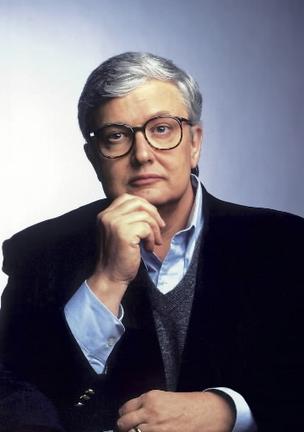
I am so, so sad to hear of Roger Ebert's passing. I am not terribly surprised, simply because he had so many health problems, though he faced them a lot better than most of us would have done in his place. Maybe it is crazy that I am more affected by his death than Gene Siskel's, but I didn't actually watch that many episodes of At the Movies and I certainly didn't read many of Siskel's reviews, whereas I have read hundreds of Ebert's reviews and most of his blog posts over the past couple of years. So the relationship (as one-sided as it is) just feels deeper.

I really liked his reviews and agreed with him maybe 75% of the time. I thought he had really good insights into what made certain films work, in contrast to the critic for the Chicago Reader (Rosenbaum?) who insisted on viewing all films through a political lens (his reviews were boring and predictable, though he did have a soft spot for Tati). I also liked the fact that Ebert was flexible enough that he could watch a movie again and revise his opinion on it, in some cases fairly dramatically. He didn't worry that this made him look like a "weak" reviewer, whatever that means. Most of all he clearly loved the movies, at least when they lived up to their potential.
I particularly liked Ebert's recently books: Great Movies vol 1, 2, and 3. I was already planning on working my way through them, trying to see the films I haven't gotten to yet, and this will definitely spur me on. Maybe I will start with Ikiru, which I have seen (and loved). It just so fitting right now, since it is about a man who learns he is dying of cancer and decides he must do something worthy of his remaining time on earth. It is one of Ebert's favorite films as well, and he often said that it could change your life and make you a better person, which I largely agree with as well. I think it {Ikiru} is just a bit too sad (and deep) for my kids right now, so I'll just have to find some time to watch it after they are in bed.
I saw Ebert one time at a Borders in downtown Chicago, where he was doing a book signing. This was after he had started losing weight, but before all the problems with his jaw. I actually lived in his neighborhood for a year or so (or maybe just a few blocks over) but never saw him around. My wife says she saw him on the street once.
I am glad that he got around to writing his memoirs and the really personal blog posts, but I wish he could he been with us for several more years. Of course, I didn't mind the political and religious topics that he covered (since I was generally in agreement with him), though they turned off some long-term readers. I just thought they made him an even more rounded personality. (This is the same reason why I write posts that aren't strictly reviews, though I wouldn't say I was particularly influenced by Ebert in this instance.)
Anyway, RIP and thanks for all the reviews.

I really liked his reviews and agreed with him maybe 75% of the time. I thought he had really good insights into what made certain films work, in contrast to the critic for the Chicago Reader (Rosenbaum?) who insisted on viewing all films through a political lens (his reviews were boring and predictable, though he did have a soft spot for Tati). I also liked the fact that Ebert was flexible enough that he could watch a movie again and revise his opinion on it, in some cases fairly dramatically. He didn't worry that this made him look like a "weak" reviewer, whatever that means. Most of all he clearly loved the movies, at least when they lived up to their potential.
I particularly liked Ebert's recently books: Great Movies vol 1, 2, and 3. I was already planning on working my way through them, trying to see the films I haven't gotten to yet, and this will definitely spur me on. Maybe I will start with Ikiru, which I have seen (and loved). It just so fitting right now, since it is about a man who learns he is dying of cancer and decides he must do something worthy of his remaining time on earth. It is one of Ebert's favorite films as well, and he often said that it could change your life and make you a better person, which I largely agree with as well. I think it {Ikiru} is just a bit too sad (and deep) for my kids right now, so I'll just have to find some time to watch it after they are in bed.
I saw Ebert one time at a Borders in downtown Chicago, where he was doing a book signing. This was after he had started losing weight, but before all the problems with his jaw. I actually lived in his neighborhood for a year or so (or maybe just a few blocks over) but never saw him around. My wife says she saw him on the street once.
I am glad that he got around to writing his memoirs and the really personal blog posts, but I wish he could he been with us for several more years. Of course, I didn't mind the political and religious topics that he covered (since I was generally in agreement with him), though they turned off some long-term readers. I just thought they made him an even more rounded personality. (This is the same reason why I write posts that aren't strictly reviews, though I wouldn't say I was particularly influenced by Ebert in this instance.)
Anyway, RIP and thanks for all the reviews.

Works in progress
I like "works in progress" so much more than "unfinished work" or in some cases "work not yet started." Anyway, I've heard that the public shaming aspect of the internet can be helpful in keeping people on track and on their toes, so I will list various projects in various stages of completion to see if it motivates me to get any of them done (and remind me not to spend so much time on the internet -- a bit of a paradox, whut!?!). In truth, while the blogging can be a bit of a time drain, it is useful in the sense that it has gotten my "writing muscles" back in shape, which in turn makes it more likely that I will actually return to work on these projects, esp. as they are mostly writing based. I'll list them basically in order of how close to completion they are (and not chronologically, i.e. when I started the projects -- that would be far too depressing!).
Actually, before I get started, I should list some things that I have actually completed, so this post doesn't become a total downer. It will also give me a bit of inspiration to believe that I can cross off many of these projects once I am ready to be serious about them. Time is always an issue, but sometimes lacking inspiration is a bigger problem...
First, my work accomplishments:
I completed my dissertation in sociology at Northwestern University, even though it wasn't strictly necessary for my chosen profession (my Master's in transportation has always been sufficient).
I had a chapter on Johannesburg and its suburbs published in an edited volume on comparative suburbanization outside the U.S. This felt like a particularly sweet accomplishment, and I think it is a really strong piece (one of the stronger ones in the collection). Not being in academia, and particularly not on the hunt for tenure, allows me to spend more time on the projects that I do undertake.
I self-published a poetry chapbook and placed 5 or 6 poems in small literary magazines. This was right after college but before I decided that being a poet and trying to teach in a MFA program somewhere wasn't really what I wanted to do with my life...
I have actually written two full-length plays (and 4 or so shorter theatre pieces), though I have them down as works-in-progress, since they still need heavy editing. Still, I got them over the finish line in the first place, which was quite an accomplishment.
Ok, enough patting myself on the back. What have I left undone?
1) Poetry anthology on the topic of transportation
Status: two sections sent in to a publisher with 85% of the rest of the anthology complete.
Notes: this was the main project I worked on this past summer. I could definitely whip it into shape in maybe 2-3 weeks if the publisher expressed interest. If they decide to pass, I will have to think seriously about how hard I want to shop this to other publishers. In fact, the anthology began life as a subway poetry anthology that I shopped around with a few nibbles but no takers. I think this has slight broader appeal, but publishers are still wary of anthologies where they don't have 100% control over the publishing rights from the outset.
2) "No More Robinsons" - a SF short story
Status: nearly the entire story has been written out except the ending, though most still needs to be typed up.
Notes: this really shouldn't take that much more time, though I am worried that the ending I am heading to is not strong enough.
3) "Dharma Donuts" - a play
Status: 2nd draft of the entire play was completed but some revisions still required. Some sections have have a staged reading.
Notes: I think I can manage to get through the edits this summer. I have had a bit of useful feedback on the play.
4) "Final Exams" - a SF short story about the Earth after a Borg-like alien presence arrives on the scene
Status: the plot mostly worked out and a few pages were typed up
Notes: in some ways, I think this would be a bit easier to sell to a SF magazine than the Robinson story, so perhaps I will work on it next. The idea came to me while I was biking back and forth from work, and that still is where I do some of my most useful brain-storming.
5) "Corporate Codes of Conduct" - a play
Status: 3rd draft of the entire play completed but some significant revisions to second act required. The 1st draft received a table read, which I taped for reference.
Notes: I think this is a good play, but it is hard to get motivated to put in the time to work on it when it is all but impossible to stage works by unknown authors, esp. those that can't be marketed as the next fresh young voice! I will write about that below. The play was loosely inspired by Tom Stoppard's Arcadia and to a lesser extent David Auburn's Proof. One thing that may help me make these necessary changes is that I am making a day trip soon to SF to catch a revival of Arcadia. There is also a company in Seattle that would be a natural fit to put on Corporate Codes, but that is basically just wishful thinking on my part.
6) Dark Heart of the Moon - SF novel with some mystery elements.
Status: large section typed up (maybe 25-30 pages worth) and much of the plot was worked out but some changes are required. I am doing some plotting out of potential sequels.
Notes: I think this needs a better title. I also need to see if the writing style still holds up. I am a bit torn because the more realistic I make it (as well as laying down the seeds for the plots of sequels), the smaller the lunar colony has to be, which in turn undermines some of the other elements that I have already written. I think I am getting closer to being able to thread the needle, but I have to put more and more power into the hands of the shadowy figure who started the colony, and I don't want it to get to the point it is ridiculous a la Dr. Mabuse.
7) "Northern Latitudes" - a novel about Toronto and the misadventures of an American who wants to live there but has no appreciable skills
Status: the first chapter and part of ending written out. I have extensive notes on the entire plot and have even given some consideration to potential follow-up novels.
Notes: this has been a novel-in-progress for a ridiculous length of time -- close to 20 years. It basically is a historical novel now, since it really does need to be set in 1994-95. I certainly do need to go through and make sure I want to write in the style that I started out writing in -- if I can even maintain that. I did recently come across all my journal articles and email from the period I lived in Toronto and right afterwards. That might prove to be helpful. It is too bad that MacLean's doesn't have its back issues on DVD, but I can go to the library (perhaps this summer) and skim through the relevant months. This is probably the project that means the most to me to finish up, but one which must be blocked in some way or I would have tackled it more seriously in the past 20 years. Perhaps the fact that I am on the verge of moving back there (to Toronto) will actually inspire me to cross the finish line, not completely unlike how moving back to Chicago was the motivating factor to finally finish the dissertation. When I feel the first chapter is ready for sharing, I will link to it.
8) Turning my dissertation into a book on Chicago transportation
Status: I have an entire 500+ page dissertation complete, but published books are very different things from dissertations.
Notes: I have basically stayed on top of major Chicago transportation controversies, but I would have to do some research to keep the chapters up-to-date, and I would probably have to arrange interviews with more people, which I am not particularly eager to do. Also, I might end up at a company that would frown on such a book if it is too critical of the Chicago powers-that-be.
9) Article on the (unbuilt) Chicago Crosstown Expressway
Status: a paper that made it to revise and resubmit status at the Journal of Urban History.
Notes: this is horribly embarrassing, but because I went on leave, I never got around to dealing with this R&R paper (from roughly 15 years back). I would basically have to swallow my pride and start over from scratch at that journal or even send it somewhere else. It would have been 3 or 4 weeks' worth of work back then, but now I'd have to really refresh my memory before I tried to fix it, and I would probably extend the time frame of the analysis (to justify why they should re-consider it after I dropped the ball so badly).
10) "Lester's Last Testament" - a play (heavily) inspired by King Lear.
Status: I have 3 or 4 pages written and the rest is only partly plotted out (though it does follow Lear/Ran fairly closely).
Notes: Just not really sure the world needs another adaptation of Shakespeare, though two that I have seen were brilliant. Also, it is really hard to justify spending time writing for the theatre when there is just so little pay-off. But now and again, I am really drawn to work on this and can visualize the characters having their conversations. As they say, when the Muse comes knocking, you really have to answer the door -- or she will refuse to come around anymore. I imagine it will be the last thing I ever write for the theatre.
11) Writing an academic book on Toronto, Johannesburg and Shanghai
Status: mostly a handful of Powerpoint presentations made at various conferences.
Notes: while this could be really interesting (and I recently thought of ways to make this a more doable project), I'm just not sure the world needs such a book.
12) Writing an academic book on transportation infrastructure
Status: several conference papers on the topic and a lot of background knowledge.
Notes: this came pretty close to happening with a co-author, but neither of us could really devote the time to getting an outline just right to get approval from a publishing house. I think I would really have to demonstrate (to my co-author as well as myself) that I could handle the deadlines and my job, and I am not sure that is true. Nonetheless, I sense this book would be more important in some ways than the one on Toronto, Johannesburg and Shanghai.
13) Writing an academic article on African suburbanization
Status: a couple of conference papers and a lot of background research already completed.
Notes: I might actually submit a variant of this to an upcoming conference. The real Achilles heel is not having quite enough data that is truly comparable across the cases, so it might not be worth it.
14) Writing an academic article on "non-events"
Status: a conference paper was written and part of the intro to my dissertation discussed this issue.
Notes: my advisor wanted to do this but then kept flaking out, even after I sent him an outline and the introduction. That was quite disheartening. I think if he were a more typical (and organized) academic, we would have polished this off a few year's back.
15) Article on Crosstown and Westway
Status: the Crosstown parts have been written up, but I would have to draw comparisons to the Westway.
Notes: I have gathered virtually all the data there is to be gathered on the two unbuilt projects. It would be a shame if no one ever benefited from my extensive research and digging through archives, but that happens sometimes.
16) Writing an academic article on the importance of studying regionalism in a meaningful way.
Status: some material from the intro. to my dissertation
Notes: this might be fun and even a bit provocative. I don't really have anything to lose, so I may write this up one day (or simply take the more interesting observations and post them here).
17) Writing academic article about trust and youth hostelers
Status: a conference paper, as well as some graduate student papers written on the topic.
Notes: I think the sun has set on this one. I simply don't see it as important anymore. Worst of all, I never managed to get back in touch with the youth hostels where I had done a follow-up survey (almost 5 years on now) and I would have to provide them with this fairly out-of-date (for their purposes) data before I could even feel right about publishing a paper using the survey data. So hard to see this happening.
18) Writing academic article on casino impacts
Status: a conference paper was presented
Notes: Not sure I can ever get the data to the level I would like. We found that the data on impacts was just so hard to make heads or tails of, because the gambling population is so dispersed, with many people traveling from several counties away to gamble and even crossing state lines in many cases. This is almost certainly a dead project.
At one point I wanted to write more about environmental justice and transportation, but it isn't that compelling to me any more.
I think the biggest issue I face is that the projects that I tend to believe I really ought to pursue are the ones that are 1) the hardest to complete or 2) have almost no pay-off, monetary or otherwise, because the acceptance rates are so low. Writing plays is in many ways far more pointless than writing novels, since the chances of finding a publisher for a novel (slim as they are) are so much better than finding a theatre company that will stage one's play. As I ponder this (reasonably complete) list of work that I still might complete one day, I really need to take that into consideration. I also need to weigh the fact that my job is quite demanding (I almost always work more than 40 hours in a week, generally 50+) and that virtually none of these projects will gain me recognition at work -- and in some cases might be viewed negatively. I probably will continue to refocus on the creative writing over the academic writing. But I think the main thing is to try to set aside some time each week to work on one of the projects and eventually cross one or two off the list, so that they may be added to the list of accomplishments.
Actually, before I get started, I should list some things that I have actually completed, so this post doesn't become a total downer. It will also give me a bit of inspiration to believe that I can cross off many of these projects once I am ready to be serious about them. Time is always an issue, but sometimes lacking inspiration is a bigger problem...
First, my work accomplishments:
- I have contributed a great deal to advanced transportation models in New York City, Columbus, OH, and Houston in particular.
- I have co-written 10 papers on modelling and transportation policy for Transportation Research Record and the Journal of Public Transportation.
- I am so very close to completing the upgrade of the Vancouver Regional Transportation Model. While it isn't a particularly advanced model (still a 4-step model) it is so much better than what was here before. And it has my fingerprints on every component, and this will be the case for roughly the next decade. I have been working overtime on this for months and certainly is the main focus of my energies.
I completed my dissertation in sociology at Northwestern University, even though it wasn't strictly necessary for my chosen profession (my Master's in transportation has always been sufficient).
I had a chapter on Johannesburg and its suburbs published in an edited volume on comparative suburbanization outside the U.S. This felt like a particularly sweet accomplishment, and I think it is a really strong piece (one of the stronger ones in the collection). Not being in academia, and particularly not on the hunt for tenure, allows me to spend more time on the projects that I do undertake.
I self-published a poetry chapbook and placed 5 or 6 poems in small literary magazines. This was right after college but before I decided that being a poet and trying to teach in a MFA program somewhere wasn't really what I wanted to do with my life...
I have actually written two full-length plays (and 4 or so shorter theatre pieces), though I have them down as works-in-progress, since they still need heavy editing. Still, I got them over the finish line in the first place, which was quite an accomplishment.
Ok, enough patting myself on the back. What have I left undone?
1) Poetry anthology on the topic of transportation
Status: two sections sent in to a publisher with 85% of the rest of the anthology complete.
Notes: this was the main project I worked on this past summer. I could definitely whip it into shape in maybe 2-3 weeks if the publisher expressed interest. If they decide to pass, I will have to think seriously about how hard I want to shop this to other publishers. In fact, the anthology began life as a subway poetry anthology that I shopped around with a few nibbles but no takers. I think this has slight broader appeal, but publishers are still wary of anthologies where they don't have 100% control over the publishing rights from the outset.
2) "No More Robinsons" - a SF short story
Status: nearly the entire story has been written out except the ending, though most still needs to be typed up.
Notes: this really shouldn't take that much more time, though I am worried that the ending I am heading to is not strong enough.
3) "Dharma Donuts" - a play
Status: 2nd draft of the entire play was completed but some revisions still required. Some sections have have a staged reading.
Notes: I think I can manage to get through the edits this summer. I have had a bit of useful feedback on the play.
4) "Final Exams" - a SF short story about the Earth after a Borg-like alien presence arrives on the scene
Status: the plot mostly worked out and a few pages were typed up
Notes: in some ways, I think this would be a bit easier to sell to a SF magazine than the Robinson story, so perhaps I will work on it next. The idea came to me while I was biking back and forth from work, and that still is where I do some of my most useful brain-storming.
5) "Corporate Codes of Conduct" - a play
Status: 3rd draft of the entire play completed but some significant revisions to second act required. The 1st draft received a table read, which I taped for reference.
Notes: I think this is a good play, but it is hard to get motivated to put in the time to work on it when it is all but impossible to stage works by unknown authors, esp. those that can't be marketed as the next fresh young voice! I will write about that below. The play was loosely inspired by Tom Stoppard's Arcadia and to a lesser extent David Auburn's Proof. One thing that may help me make these necessary changes is that I am making a day trip soon to SF to catch a revival of Arcadia. There is also a company in Seattle that would be a natural fit to put on Corporate Codes, but that is basically just wishful thinking on my part.
6) Dark Heart of the Moon - SF novel with some mystery elements.
Status: large section typed up (maybe 25-30 pages worth) and much of the plot was worked out but some changes are required. I am doing some plotting out of potential sequels.
Notes: I think this needs a better title. I also need to see if the writing style still holds up. I am a bit torn because the more realistic I make it (as well as laying down the seeds for the plots of sequels), the smaller the lunar colony has to be, which in turn undermines some of the other elements that I have already written. I think I am getting closer to being able to thread the needle, but I have to put more and more power into the hands of the shadowy figure who started the colony, and I don't want it to get to the point it is ridiculous a la Dr. Mabuse.
7) "Northern Latitudes" - a novel about Toronto and the misadventures of an American who wants to live there but has no appreciable skills
Status: the first chapter and part of ending written out. I have extensive notes on the entire plot and have even given some consideration to potential follow-up novels.
Notes: this has been a novel-in-progress for a ridiculous length of time -- close to 20 years. It basically is a historical novel now, since it really does need to be set in 1994-95. I certainly do need to go through and make sure I want to write in the style that I started out writing in -- if I can even maintain that. I did recently come across all my journal articles and email from the period I lived in Toronto and right afterwards. That might prove to be helpful. It is too bad that MacLean's doesn't have its back issues on DVD, but I can go to the library (perhaps this summer) and skim through the relevant months. This is probably the project that means the most to me to finish up, but one which must be blocked in some way or I would have tackled it more seriously in the past 20 years. Perhaps the fact that I am on the verge of moving back there (to Toronto) will actually inspire me to cross the finish line, not completely unlike how moving back to Chicago was the motivating factor to finally finish the dissertation. When I feel the first chapter is ready for sharing, I will link to it.
8) Turning my dissertation into a book on Chicago transportation
Status: I have an entire 500+ page dissertation complete, but published books are very different things from dissertations.
Notes: I have basically stayed on top of major Chicago transportation controversies, but I would have to do some research to keep the chapters up-to-date, and I would probably have to arrange interviews with more people, which I am not particularly eager to do. Also, I might end up at a company that would frown on such a book if it is too critical of the Chicago powers-that-be.
9) Article on the (unbuilt) Chicago Crosstown Expressway
Status: a paper that made it to revise and resubmit status at the Journal of Urban History.
Notes: this is horribly embarrassing, but because I went on leave, I never got around to dealing with this R&R paper (from roughly 15 years back). I would basically have to swallow my pride and start over from scratch at that journal or even send it somewhere else. It would have been 3 or 4 weeks' worth of work back then, but now I'd have to really refresh my memory before I tried to fix it, and I would probably extend the time frame of the analysis (to justify why they should re-consider it after I dropped the ball so badly).
10) "Lester's Last Testament" - a play (heavily) inspired by King Lear.
Status: I have 3 or 4 pages written and the rest is only partly plotted out (though it does follow Lear/Ran fairly closely).
Notes: Just not really sure the world needs another adaptation of Shakespeare, though two that I have seen were brilliant. Also, it is really hard to justify spending time writing for the theatre when there is just so little pay-off. But now and again, I am really drawn to work on this and can visualize the characters having their conversations. As they say, when the Muse comes knocking, you really have to answer the door -- or she will refuse to come around anymore. I imagine it will be the last thing I ever write for the theatre.
11) Writing an academic book on Toronto, Johannesburg and Shanghai
Status: mostly a handful of Powerpoint presentations made at various conferences.
Notes: while this could be really interesting (and I recently thought of ways to make this a more doable project), I'm just not sure the world needs such a book.
12) Writing an academic book on transportation infrastructure
Status: several conference papers on the topic and a lot of background knowledge.
Notes: this came pretty close to happening with a co-author, but neither of us could really devote the time to getting an outline just right to get approval from a publishing house. I think I would really have to demonstrate (to my co-author as well as myself) that I could handle the deadlines and my job, and I am not sure that is true. Nonetheless, I sense this book would be more important in some ways than the one on Toronto, Johannesburg and Shanghai.
13) Writing an academic article on African suburbanization
Status: a couple of conference papers and a lot of background research already completed.
Notes: I might actually submit a variant of this to an upcoming conference. The real Achilles heel is not having quite enough data that is truly comparable across the cases, so it might not be worth it.
14) Writing an academic article on "non-events"
Status: a conference paper was written and part of the intro to my dissertation discussed this issue.
Notes: my advisor wanted to do this but then kept flaking out, even after I sent him an outline and the introduction. That was quite disheartening. I think if he were a more typical (and organized) academic, we would have polished this off a few year's back.
15) Article on Crosstown and Westway
Status: the Crosstown parts have been written up, but I would have to draw comparisons to the Westway.
Notes: I have gathered virtually all the data there is to be gathered on the two unbuilt projects. It would be a shame if no one ever benefited from my extensive research and digging through archives, but that happens sometimes.
16) Writing an academic article on the importance of studying regionalism in a meaningful way.
Status: some material from the intro. to my dissertation
Notes: this might be fun and even a bit provocative. I don't really have anything to lose, so I may write this up one day (or simply take the more interesting observations and post them here).
17) Writing academic article about trust and youth hostelers
Status: a conference paper, as well as some graduate student papers written on the topic.
Notes: I think the sun has set on this one. I simply don't see it as important anymore. Worst of all, I never managed to get back in touch with the youth hostels where I had done a follow-up survey (almost 5 years on now) and I would have to provide them with this fairly out-of-date (for their purposes) data before I could even feel right about publishing a paper using the survey data. So hard to see this happening.
18) Writing academic article on casino impacts
Status: a conference paper was presented
Notes: Not sure I can ever get the data to the level I would like. We found that the data on impacts was just so hard to make heads or tails of, because the gambling population is so dispersed, with many people traveling from several counties away to gamble and even crossing state lines in many cases. This is almost certainly a dead project.
At one point I wanted to write more about environmental justice and transportation, but it isn't that compelling to me any more.
I think the biggest issue I face is that the projects that I tend to believe I really ought to pursue are the ones that are 1) the hardest to complete or 2) have almost no pay-off, monetary or otherwise, because the acceptance rates are so low. Writing plays is in many ways far more pointless than writing novels, since the chances of finding a publisher for a novel (slim as they are) are so much better than finding a theatre company that will stage one's play. As I ponder this (reasonably complete) list of work that I still might complete one day, I really need to take that into consideration. I also need to weigh the fact that my job is quite demanding (I almost always work more than 40 hours in a week, generally 50+) and that virtually none of these projects will gain me recognition at work -- and in some cases might be viewed negatively. I probably will continue to refocus on the creative writing over the academic writing. But I think the main thing is to try to set aside some time each week to work on one of the projects and eventually cross one or two off the list, so that they may be added to the list of accomplishments.
Wednesday, April 3, 2013
BTR - updates
Well, there are already some minor updates to my book pile, which I suspected would happen (well, knowing myself I knew for a fact the list would keep growing), but I haven't decided if I will actually add to the list in that post or just post the updated list every couple of months. I am just wrapping up On the Road, and maybe 2/3 of the way through, Kerouac starts talking about Dean Moriarty (well, actually Neal Cassady in the original scroll version I am reading) as a kind of holy fool, which is similar to the way that Allen Ginsberg is also portrayed throughout (personally I would be slightly more inclined to give Ginsberg the benefit of a doubt, whereas Neal just seems like a totally selfish a-hole*). His status had been sort of implied up 'til now, but Kerouac is really explicit about it on one of the later trips back East (they do indeed go back and forth across the country and not just head westward). This got me thinking of Doestovesky's The Idiot, where he basically riffs off the idea that anyone who truly tries to emulate Jesus would be considered a madman in contemporary society (even more true today than back when he was writing). I clearly won't be able to read it in time for Easter, which has already come and gone, but I think it might fit nicely between Lolita and Anna Karenina, so I'll see if I can get to it and round out a bit of a Russian detour embedded in the pile.
One of the more tempting book buys is the Colour Your Library collection over at Chapters. I saw a few of them and they seem to have expanded the series out to 25 or so volumes.

On the one hand, I don't like how they are so clearly pitching this at designers and not really at readers. On the other, they are nice looking, if somewhat simply designed, books. But I own a few of the titles already and I'm not really that interested some of the other selections. And for sure, I would not stack them together -- they would go alphabetically like everything else, which really undermines the impact to be sure, particularly if you only see the spines!
Nonetheless, I went down to Chapters to check them out and write down the titles of some interest. It turns out that you can get them for $15 each or $25 for 2. That is almost within reason for a new book.
Chinua Achebe - Things Fall Apart (I believe this was sold out at my local branch)
Margaret Atwood - Alias Grace
Shauna Singh Baldwin - The Tiger Claw
Julian Barnes - Arthur & George
Peter Carey - True History of the Kelly Gang
Camilla Gibb - Sweetness in the Belly
Wayson Choy - All That Matters
Douglas Coupland - Eleanor Rigby
Jeff Eugenides - The Virgin Suicides
Mark Haddon - The Curious Incident of the Dog in the Night-time
Mohsin Hamid - The Reluctant Fundamentalist
Elizabeth Hay - A Student of Weather
John Irving - A Prayer for Owen Meany
Kazuo Ishiguro - Never Let Me Go
Jhumpa Lahiri - Unaccustomed Earth
Vincent Lam - Bloodletting/Miraculous Cures (kind of a mustard instead of the more obvious red)
Lori Lansens - Rush Home Road
Anne Michaels - The Winter Vault
David Mitchell - Black Swan Green (one of the few to have the colour correspond to the book)
Michael Ondaatje - In the Skin of a Lion
Tom Rachman - The Imperfectionists
Arundhati Roy - The God of Small Things
Salman Rushdie - The Satanic Verses
Shyam Selvadurai - Funny Boy
Diane Setterfield - The Thirteenth Tale
Sarah Waters - The Little Stranger
I believe this is the entire list. It's kind of an odd series. In many cases, these are titles that didn't sell all that well and are sort of the less-regarded novels by these authors (Alias Grace, Black Swan Green), though the novels by Asian authors are generally chosen fairly well. The problem is that I have many of these already (Satanic Verses, Reluctant Fundamentalist, Unaccustomed Earth, Things Fall Apart). I was a bit underwhelmed by the offerings from Canadian authors. I was probably most interested in Wayson Choy's All That Matters until I realized this was essentially a sequel to The Jade Peony, so it made little sense to get one version in this series and the other in a different binding. Of course, there are plenty of copies of his novels in the Vancouver Library, and that makes more sense anyway. It might almost be worth picking up The Satanic Verses in this binding for when I decide to reread the novel so as to avoid quite so many stares on the train. I was sort of circling around to Setterfield's The Thirteenth Tale and Rachman's The Imperfectionists when I went to look at reviews on Amazon and realized that 1) they could be picked up super cheap (another odd thing about this series is how long-in-the-tooth the books are) and 2) I liked the alternate covers much better (being such a bibliophile).
It would be possible to find another two books, but it would certainly be a stretch. There are a handful that I would consider reading (Bloodletting and perhaps In the Skin of a Lion), but these aren't books that I feel compelled to own. I think in the end, I may add a bit to my BTR pile using this as a jumping-off point (Wayson Choy for example), but that I won't buy any in the series proper.
I do remain on the lookout for Canadian books of interest. I'll have to fit Hill's The Book of Negroes in there somewhere. And I certainly will begin adding some novels set in Montreal to the list, both by Anglophones and Francophones. Probably something by Dany LaFerriere fairly soon and Gabrielle Roy's The Cashier (assuming I like The Tin Flute). Well, one thing is for certain, the BTR will keep changing and growing. (I guess I'll stick this here as well as anywhere: I had run across some odd cult book probably through an Amazon linkage. It was about a boy who sort of shadows this woman from the elite. I'm not describing it well -- largely because it is a novel that supposedly defies easy categorization. I wasn't quite gripped enough to seek it out, but recently decided I might as well still it in a list, so I wouldn't forget. After poking around on some lists of cult novels, I was about to try to do some Amazon searching when the title just popped into my head -- Ferdydurke by Witold Gombrowicz. Memory is a funny thing and mine is still fairly good, knock wood...)
* I think I already mentioned this, but viewed from the outside, these Beats just seemed to be pretty unpleasant to interact with. They felt the need to cut free from conventional society and not hold down any boring job, so of course they were always mooching off the more respectable people in their circles. Kind of a drag when you think about it. You always have to pay the piper somehow, and these folks really were a fairly substantial burden to their friends and relatives, but of course they didn't see it that way. I guess I would try for more of a middle ground -- to not be hopelessly conventional and rule-bound (can't describe how much it irks me when somebody says you have to obey the law and if you disagree with a law, work on changing it -- as if obedience in and of itself was the highest moral principle and with no awareness or concern over how much is stacked against those who try to change bad laws) but not be a total slacker and a deadweight on my family.
Actually, let me follow up on this theme. I am really struggling to finish On the Road because at roughly the 3/4 mark, Neal Cassidy switches from a ne'er-do-well to a psychotic scumbag: beating one of his girlfriends or ex-wives (hard to tell her status at this point), chasing after 16 year old girls, stealing cars, wrecking car after car because he drives them too far and too fast (including a nice Cadillac that they were hired to drive across the country). And Kerouac basically comes across as a pathetic enabler, who actually is trying to glorify this criminal after the fact. Both of them make terrible decision after terrible decision. I just don't think "freedom" for its own sake is of any value when it leads to these horrible behaviors. Sorry if that makes me square. Kind of like the 60s, this book has overstayed its welcome and become a sorry shadow of its self. I didn't react this badly when I read the book years ago, but I am sure I wouldn't have identified with Neal or Jack even back then. I think from this point on, it is going to be really hard for me to ever want to crack open a book by Kerouac.
One of the more tempting book buys is the Colour Your Library collection over at Chapters. I saw a few of them and they seem to have expanded the series out to 25 or so volumes.

On the one hand, I don't like how they are so clearly pitching this at designers and not really at readers. On the other, they are nice looking, if somewhat simply designed, books. But I own a few of the titles already and I'm not really that interested some of the other selections. And for sure, I would not stack them together -- they would go alphabetically like everything else, which really undermines the impact to be sure, particularly if you only see the spines!
 |
| Do you think the "colour" books might get a bit lost? |
Nonetheless, I went down to Chapters to check them out and write down the titles of some interest. It turns out that you can get them for $15 each or $25 for 2. That is almost within reason for a new book.
Chinua Achebe - Things Fall Apart (I believe this was sold out at my local branch)
Margaret Atwood - Alias Grace
Shauna Singh Baldwin - The Tiger Claw
Julian Barnes - Arthur & George
Peter Carey - True History of the Kelly Gang
Camilla Gibb - Sweetness in the Belly
Wayson Choy - All That Matters
Douglas Coupland - Eleanor Rigby
Jeff Eugenides - The Virgin Suicides
Mark Haddon - The Curious Incident of the Dog in the Night-time
Mohsin Hamid - The Reluctant Fundamentalist
Elizabeth Hay - A Student of Weather
John Irving - A Prayer for Owen Meany
Kazuo Ishiguro - Never Let Me Go
Jhumpa Lahiri - Unaccustomed Earth
Vincent Lam - Bloodletting/Miraculous Cures (kind of a mustard instead of the more obvious red)
Lori Lansens - Rush Home Road
Anne Michaels - The Winter Vault
David Mitchell - Black Swan Green (one of the few to have the colour correspond to the book)
Michael Ondaatje - In the Skin of a Lion
Tom Rachman - The Imperfectionists
Arundhati Roy - The God of Small Things
Salman Rushdie - The Satanic Verses
Shyam Selvadurai - Funny Boy
Diane Setterfield - The Thirteenth Tale
Sarah Waters - The Little Stranger
I believe this is the entire list. It's kind of an odd series. In many cases, these are titles that didn't sell all that well and are sort of the less-regarded novels by these authors (Alias Grace, Black Swan Green), though the novels by Asian authors are generally chosen fairly well. The problem is that I have many of these already (Satanic Verses, Reluctant Fundamentalist, Unaccustomed Earth, Things Fall Apart). I was a bit underwhelmed by the offerings from Canadian authors. I was probably most interested in Wayson Choy's All That Matters until I realized this was essentially a sequel to The Jade Peony, so it made little sense to get one version in this series and the other in a different binding. Of course, there are plenty of copies of his novels in the Vancouver Library, and that makes more sense anyway. It might almost be worth picking up The Satanic Verses in this binding for when I decide to reread the novel so as to avoid quite so many stares on the train. I was sort of circling around to Setterfield's The Thirteenth Tale and Rachman's The Imperfectionists when I went to look at reviews on Amazon and realized that 1) they could be picked up super cheap (another odd thing about this series is how long-in-the-tooth the books are) and 2) I liked the alternate covers much better (being such a bibliophile).
 |  |
It would be possible to find another two books, but it would certainly be a stretch. There are a handful that I would consider reading (Bloodletting and perhaps In the Skin of a Lion), but these aren't books that I feel compelled to own. I think in the end, I may add a bit to my BTR pile using this as a jumping-off point (Wayson Choy for example), but that I won't buy any in the series proper.
I do remain on the lookout for Canadian books of interest. I'll have to fit Hill's The Book of Negroes in there somewhere. And I certainly will begin adding some novels set in Montreal to the list, both by Anglophones and Francophones. Probably something by Dany LaFerriere fairly soon and Gabrielle Roy's The Cashier (assuming I like The Tin Flute). Well, one thing is for certain, the BTR will keep changing and growing. (I guess I'll stick this here as well as anywhere: I had run across some odd cult book probably through an Amazon linkage. It was about a boy who sort of shadows this woman from the elite. I'm not describing it well -- largely because it is a novel that supposedly defies easy categorization. I wasn't quite gripped enough to seek it out, but recently decided I might as well still it in a list, so I wouldn't forget. After poking around on some lists of cult novels, I was about to try to do some Amazon searching when the title just popped into my head -- Ferdydurke by Witold Gombrowicz. Memory is a funny thing and mine is still fairly good, knock wood...)
* I think I already mentioned this, but viewed from the outside, these Beats just seemed to be pretty unpleasant to interact with. They felt the need to cut free from conventional society and not hold down any boring job, so of course they were always mooching off the more respectable people in their circles. Kind of a drag when you think about it. You always have to pay the piper somehow, and these folks really were a fairly substantial burden to their friends and relatives, but of course they didn't see it that way. I guess I would try for more of a middle ground -- to not be hopelessly conventional and rule-bound (can't describe how much it irks me when somebody says you have to obey the law and if you disagree with a law, work on changing it -- as if obedience in and of itself was the highest moral principle and with no awareness or concern over how much is stacked against those who try to change bad laws) but not be a total slacker and a deadweight on my family.
Actually, let me follow up on this theme. I am really struggling to finish On the Road because at roughly the 3/4 mark, Neal Cassidy switches from a ne'er-do-well to a psychotic scumbag: beating one of his girlfriends or ex-wives (hard to tell her status at this point), chasing after 16 year old girls, stealing cars, wrecking car after car because he drives them too far and too fast (including a nice Cadillac that they were hired to drive across the country). And Kerouac basically comes across as a pathetic enabler, who actually is trying to glorify this criminal after the fact. Both of them make terrible decision after terrible decision. I just don't think "freedom" for its own sake is of any value when it leads to these horrible behaviors. Sorry if that makes me square. Kind of like the 60s, this book has overstayed its welcome and become a sorry shadow of its self. I didn't react this badly when I read the book years ago, but I am sure I wouldn't have identified with Neal or Jack even back then. I think from this point on, it is going to be really hard for me to ever want to crack open a book by Kerouac.
Children's book series
One of the oddest feelings is when you come across these series you read as a child -- and there are more books in the series than when you read them. It's actually quite unsettling, I find. While this shouldn't be a problem for a lot of the classic series -- Little House on the Prairie, the Narnia series or the Oz books (more in that series than you might imagine), the jury is still out whether Pullman will add to His Dark Materials trilogy or if Rowling returns to Harry Potter's world.
I was really surprised to learn that Madeleine L'Engle added two books to what had originally been a triology (A Swiftly Tilting Planet, A Wrinkle in Time and A Wind in the Door) with the 4th book (Many Waters) coming 8 years after Wind in the Door, followed two years later by An Acceptable Time. The reviews suggest that Many Waters is a decent addition to the series, but that the 5th book is fairly skip-able.
I was even more surprised to learn that Ursula Le Guin had added three more books to her Earthsea series, with book #4 (Tehanu) coming 18 years after The Farthest Shore and The Other Wind arriving 21 years after Tehanu!
With those gaps, it is pretty hard to put yourself into the mindset of the young teen reader (or even an advanced child reader) that you might have been when the first book came out, since it was basically guaranteed you would be an adult by the publication date of the last one. However, just as there are some advantages to being late adopters of technology, my children will be able to read these series straight through (if they enjoy them), whereas I will have to decide if it really is worth my time to reread the earlier books and then move on to the newer ones. I do recall that the first three in each series are suitable for my son at his current age, and there is something to be said for not having to spend a lot of time pre-screening these books. My son has turned into a voracious reader (possibly reading even more than I did at his age), and it is just too hard for me to pre-screen everything. He might well get through 4 or 5 books in either series in a week. Still, I would be more comfortable letting him read these series, which I have some familiarity with, before the Pullman books, which I think I will want to screen. If I simply do not have the time to get to the Pullman books, then he can read them in a couple more years. I managed to find reasonable used copies of the first four books in each series in these new bundles (still find it weird to see them this way) and ordered them.
I'm pretty sure his sister will be just as interested in reading these books, so might as well make the investment now. Other series I just try to obtain through the library system, but it can be tricky when the available books are out of sequence. I guess it is a mixed blessing that there are so many new series for kids now. Most do not appear to be destined for classic status. However, I was blown away to learn that Stephen Hawking contributed to three children's books (on a SF theme) with his daughter, Lucy Hawking. (Now I feel even more like I am frittering my life away and not actually writing my novel or doing the final edits on my two plays. I wonder if I really have to invest in one of those programs that basically blocks the internet while you work, since I have limited self-control and keep checking for breaking news on 3 or 4 on-line sites.)
I was really surprised to learn that Madeleine L'Engle added two books to what had originally been a triology (A Swiftly Tilting Planet, A Wrinkle in Time and A Wind in the Door) with the 4th book (Many Waters) coming 8 years after Wind in the Door, followed two years later by An Acceptable Time. The reviews suggest that Many Waters is a decent addition to the series, but that the 5th book is fairly skip-able.
I was even more surprised to learn that Ursula Le Guin had added three more books to her Earthsea series, with book #4 (Tehanu) coming 18 years after The Farthest Shore and The Other Wind arriving 21 years after Tehanu!
With those gaps, it is pretty hard to put yourself into the mindset of the young teen reader (or even an advanced child reader) that you might have been when the first book came out, since it was basically guaranteed you would be an adult by the publication date of the last one. However, just as there are some advantages to being late adopters of technology, my children will be able to read these series straight through (if they enjoy them), whereas I will have to decide if it really is worth my time to reread the earlier books and then move on to the newer ones. I do recall that the first three in each series are suitable for my son at his current age, and there is something to be said for not having to spend a lot of time pre-screening these books. My son has turned into a voracious reader (possibly reading even more than I did at his age), and it is just too hard for me to pre-screen everything. He might well get through 4 or 5 books in either series in a week. Still, I would be more comfortable letting him read these series, which I have some familiarity with, before the Pullman books, which I think I will want to screen. If I simply do not have the time to get to the Pullman books, then he can read them in a couple more years. I managed to find reasonable used copies of the first four books in each series in these new bundles (still find it weird to see them this way) and ordered them.
I'm pretty sure his sister will be just as interested in reading these books, so might as well make the investment now. Other series I just try to obtain through the library system, but it can be tricky when the available books are out of sequence. I guess it is a mixed blessing that there are so many new series for kids now. Most do not appear to be destined for classic status. However, I was blown away to learn that Stephen Hawking contributed to three children's books (on a SF theme) with his daughter, Lucy Hawking. (Now I feel even more like I am frittering my life away and not actually writing my novel or doing the final edits on my two plays. I wonder if I really have to invest in one of those programs that basically blocks the internet while you work, since I have limited self-control and keep checking for breaking news on 3 or 4 on-line sites.)
Subscribe to:
Posts (Atom)