Every serious book collector has a few stories about books that slipped out of their hands while they dithered. In many respects it is even worse with the rise of the internet, as now you are competing with hundreds, potentially thousands, of others. In my case, it is not so bad, as I am not looking for signed first editions or anything like that. I only made a special effort to get a signed copy of am Adrienne Rich collection to make up for one that had been stolen from me. I am really only interested in the content of the book and getting a good to very good reading copy. The rest is extraneous to me.
That said, there are still times I didn't pull the trigger and then I regretted it later. One reason is that I am making a real effort not to buy as many books as I used to, but there are still those books I just want in the house. Second, Canadian shipping prices are high enough that I do take them into consideration (and I virtually never buy anything from Amazon.com and have it shipped to Canada). So then it becomes a question of how do the Amazon.ca prices compare to the trouble (and imposition on others) of shipping to a friend in the States.
I heard very recently about the passing of Carolyn Kizer on October 9. She was a feminist poet whom I had sort of heard of but hadn't read. It seems that she had a really great collection called Yin, but then virtually all of her work (including Yin) was in Cool, Calm and Collected. I had two decent options: a quite inexpensive copy of Yin (on Amazon.ca) or a cheap copy of the Collected Poems that I would have to ship to my father. Then I decided I really ought to at least read a bit of her work, but that added some delay, since the Toronto Library didn't have circulating copies and I had to wait to get to Robarts to check one out. I find that I enjoy her work, but am not completely in love with it. Still, I probably would have gotten the Collected Poems at the low price. But others were reading the same news that I did, and all the cheap copies have gone. So now I might as well read the entire volume (which I did check out) and see if I really do need it (it's not that expensive on Amazon.ca). Maybe the answer will be no. (I'm about 1/4 through it and still not sure, but I often find poets improve considerably as they mature.) That's certainly the responsible answer (not buying another book), but I will probably be "haunted" at least for a while by not jumping sooner, especially as the copy of Yin was so cheap...
I'm sure there are many other cases of this, but I am blanking on them at the moment. Oh wait, there is one painful memory. I was at a Sarah Sze exhibit at MCA in Chicago and they had a special book (for not too much) based on her site-specific artwork. I was never able to track down a copy after leaving the museum (and of course it was sold out on my next trip there).
There are other cases as well, but in many of those, the book was just a bit more than I wanted to pay, and I kept thinking the price would come down, but it never did. Normally, I just hold out and see if other copies pop up (this happened for several books) but sometimes it doesn't. I usually just try to live without the book if the price just keeps going up, and eventually my attention wanes and I move onto something else I think I need. As I mostly am just going after reading copies, the library is often an effective substitute as well, though not as good for art books where I really do like looking at them in the moment (or when I am seeking inspiration).
Edit: In the spirit of full disclosure, I should note that at the end of October, I saw an autographed copy of Yin for not too much, and I ordered it, though it took a while to get into my hands, as I had I shipped to the States. So sometimes if one is patient (and willing to shell out a bit), you can get a second chance. Actually, it is good to let some time pass to make sure that you really wanted that book that got away or if it was more of an impulse purchase. In this case, it was worth going after the book.
Monday, October 20, 2014
Sunday, October 19, 2014
Leaves changing
It seemed to me the leaves took a particularly long time to change this fall. They have only slowly been changing in Toronto itself. I decided to speed things along by renting a car and driving up to Kleinburg and viewing the McMichael. It wasn't the best of days -- it had gotten quite chilly and it was grey and overcast most of the day, but on the whole I think the trip was a success.
Probably the best view of all was coming up the Don Valley Parkway. Unfortunately, as I was driving I was not able to take any photos. My daughter was feeling kind of car sick, so I had to stop a bit earlier than planned in Richmond Hill. After a bit of walking around, we continued on to Party City and got them costumes. (I really have not seen any pop-up costume places in downtown Toronto this year nor were they in Chicago. Thus, the drive to the suburbs.) We ate lunch at a giant T & T Supermarket nearby. I had no idea that they had stores in metro Toronto. And it turns out there is one sort of down the street from us at Commissioners St. I should be able to get there on the 72 bus, though I am not entirely sure it is worth it just to get their sushi...
So we set off for Kleinburg. The trip there was fairly uneventful. It was bizarre seeing so many candidate signs everywhere, so it looks like there are some hard fought races even out in the burbs this election.
Here are a few shots of the trees outside (and from the inside) of the McMichael Collection.
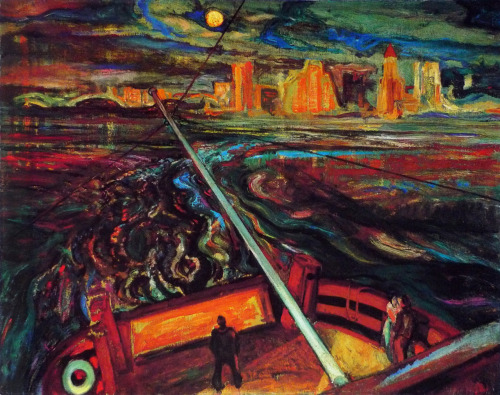
While in general, my favourite single painting in the collection is Varley's Night Ferry, Vancouver, it didn't "pop" the way it sometimes does, and that may have been because the outside light was so grey and dim and the inside lights also seemed dimmed.
I think my son's favourite was one of the Tom Thomson's -- Woodland Waterfall. (But he thought the poster wasn't big enough given the price.)
I had to pick my daughter up to see most of the paintings, which got to be a little much. I am starting to rethink this whole idea of taking her to see the museums in New York. It might have to wait until she is another six inches or a foot taller.
I thought the exhibit Morrice & Lyman in the Company of Matisse was ok, but I was expecting a lot more Matisse. I think in the end there were only 5 oils by Matisse and maybe another 4 pencil sketches. I really did like one of the images at the end of the exhibit (Rainy Day, Paris by Morrice) but not enough to get the catalog. I'm still holding out to see if it gets picked up by the library, but so far there are only reference copies that do not circulate, which is not helpful at all (to me at least).
I somehow missed the turn to get onto Highway 427, so we went down Islington the whole way to the Gardiner. The Gardiner was pretty bad all the way to Spadina when it finally opened up. My daughter was feeling woozy and I was sure she was going to throw up on the way back, but somehow she kept it together until we got home. So I think we are just going to have to be really cautious and not plan on a lot of car trips for another year or so. Maybe it is just as well that we didn't buy a car as one of the first things we did after moving to Toronto!
Probably the best view of all was coming up the Don Valley Parkway. Unfortunately, as I was driving I was not able to take any photos. My daughter was feeling kind of car sick, so I had to stop a bit earlier than planned in Richmond Hill. After a bit of walking around, we continued on to Party City and got them costumes. (I really have not seen any pop-up costume places in downtown Toronto this year nor were they in Chicago. Thus, the drive to the suburbs.) We ate lunch at a giant T & T Supermarket nearby. I had no idea that they had stores in metro Toronto. And it turns out there is one sort of down the street from us at Commissioners St. I should be able to get there on the 72 bus, though I am not entirely sure it is worth it just to get their sushi...
So we set off for Kleinburg. The trip there was fairly uneventful. It was bizarre seeing so many candidate signs everywhere, so it looks like there are some hard fought races even out in the burbs this election.
Here are a few shots of the trees outside (and from the inside) of the McMichael Collection.
While in general, my favourite single painting in the collection is Varley's Night Ferry, Vancouver, it didn't "pop" the way it sometimes does, and that may have been because the outside light was so grey and dim and the inside lights also seemed dimmed.
I think my son's favourite was one of the Tom Thomson's -- Woodland Waterfall. (But he thought the poster wasn't big enough given the price.)
I had to pick my daughter up to see most of the paintings, which got to be a little much. I am starting to rethink this whole idea of taking her to see the museums in New York. It might have to wait until she is another six inches or a foot taller.
I thought the exhibit Morrice & Lyman in the Company of Matisse was ok, but I was expecting a lot more Matisse. I think in the end there were only 5 oils by Matisse and maybe another 4 pencil sketches. I really did like one of the images at the end of the exhibit (Rainy Day, Paris by Morrice) but not enough to get the catalog. I'm still holding out to see if it gets picked up by the library, but so far there are only reference copies that do not circulate, which is not helpful at all (to me at least).
I somehow missed the turn to get onto Highway 427, so we went down Islington the whole way to the Gardiner. The Gardiner was pretty bad all the way to Spadina when it finally opened up. My daughter was feeling woozy and I was sure she was going to throw up on the way back, but somehow she kept it together until we got home. So I think we are just going to have to be really cautious and not plan on a lot of car trips for another year or so. Maybe it is just as well that we didn't buy a car as one of the first things we did after moving to Toronto!
Saturday, October 18, 2014
Mid Oct. updates
I don't have the energy to make a very thorough post, but I'll provide a few highlights of the last week or so. We were in Chicago visiting relatives last weekend. I had the kids for much of Saturday. I almost turned around when my daughter said she was woozy on the train to downtown. This is becoming a real issue, and we might not make it to New York (where getting from the airports is not easy and pretty much everything involves long train rides). I think we have to see where she is at in another year, but this is a total drag.
Anyway, we did make it to the Art Institute of Chicago for the final weekend of their René Magritte exhibit. My daughter was not all that cooperative when she saw the line, so, to keep the peace, we went and did some drawing in the children's wing first. She was still balking but I said that I would carry her if there were too many people for her to see the art. We actually got in when the wait was a bit under 15 minutes. By the time we were done, the line was more like a 45 minute wait, and it was getting worse with every passing minute. I might have just given up had we gotten there later, which would have been an incredible shame. It was a good exhibit, but one marred by very thoughtless considerations of spacing and crowd control, like forcing everyone to go around a tight corner into a small room. I'm sure it was ok during the week and most weekends, but on opening and closing weekends it was really hard to maneuver around the crowds. (Quite possibly the worst laid out exhibit I have seen there.) Needless to say, I had to pick my daughter up constantly. The most amusing moment was when we saw one of the famous paintings that read "Ceci n'est pas une pipe." I told her it said This is not a pipe. But it is a pipe, she said. And everyone around us laughed... The second half of the exhibit was better spaced and more fun. We saw a bit of the Modern Wing after that, and I made sure to see Seurat's La Grande Jatte and Caillebotte's Paris Street, Rainy Day. (They have many great paintings in their collection, but the Caillebotte is probably my favorite.) My daughter's favorite was the Renoir with the two girl acrobats (below).
They were getting a bit tired after that, but we did walk next door to Millennium Park and saw the Bean and took some photos. Maybe I can post one tomorrow.
Then we made a super quick trip to a Subway, but they looked at me like I was crazy when I asked if they had yogurt parfaits (which they carry in nearly all their Canadian outlets). Then we looked at some modern art at the Cultural Center. Interestingly, my daughter liked this odd exhibit on the second floor the best of everything she had seen that day. (The exhibit was called "here and there pink melon joy" and was by Chicago/Oak Park artist Sabina Ott.) Her favorite was the words moving about on the walls (the last photo below).
Then I handed off the kids to my wife (who had been checking out the David Bowie exhibit at the MCA).
And I was free! I went off to see two plays -- one at Steppenwolf's Garage Theatre and then Caryl Churchill's Owners at Athenaeum. They were both enjoyable, though I found the cast of Owners to be projecting just a bit too much for the space they were in. Also, the AC was really cranked up.
The trip back to Toronto was generally less stressful, though we didn't find everything we had hoped to find downtown (running shoes, flu shots, Halloween costumes, etc.). It was nice to have Monday off (Canadian Thanksgiving), though I ultimately ended up working a fair bit. Given all the horrible headlines lately (ebola and some potential hurricanes and even Calgary losing power downtown for several days), I really ought to donate to the Red Cross, given that we are so fortunate. On the other hand, the United Way Campaign just kicked off at work, and I may be too stretched to contribute to both. But I will make some donation shortly.
At work this week I feel I have been playing catch up the whole time, even after going in on Monday. I guess it was just writing one more darn proposal on top of two projects with extremely demanding deadlines (and clients). (It definitely didn't help my mood to get so wet coming home on Thurs. I actually was biking but was out of the rain (at the library) for the worst of it. Could have been worse -- being on the subway when they had to suspend service due to flooding!)
Today, I ended up working close to midnight to get something out, as did one of the juniors, though I must admit that while he was making some changes to the spreadsheets, I went off to my concert at Roy Thompson Hall. Still, I had to come back after the concert, check his work, make some changes and send it off.
But enough about that, the concert itself was quite enjoyable. It was actually the London Philharmonic in town, conducted by Vladimir Jurowski. They are doing a North American tour, mostly playing Russian pieces, and tonight was no exception. They did a rousing version of Prokofiev's Piano Concerto #3 and Shostakovich's Symphony 8. I liked a lot of what they did with the uptempo sections of the Shostakovich, and they were quite magical in this section where the winds kept trading off (this was probably the 3rd or 4th movement). But the symphony as a whole dragged on too long, and I really thought Jurowski slowed it down too much in the 5th movement. Still I was not at all inspired by the ending and would have preferred something else. Those endings that just peter out can sometimes work for symphonic poems or string quartets, but not really for symphonies. And while this is a very minor point, I just strongly dislike how European conductors come back for curtain call after curtain call. I think he was up to 5 when I finally got up and left. There is much more of a tradition of getting the entire symphony to do an encore in Europe which is basically non-existent in North America, so this certainly leads to some misunderstandings.
It seemed appropriate that I was listing to this Russian program while wrapping up Tolstoy's Family Happiness, though I guess it might have even been better had I been reading Platonov at the time (though that is probably a couple months away still). I have a few things to note down about Tolstoy, but I think that can wait for another day. We are supposed to drive up to see the McMichael Collection tomorrow, so I had better get at least some rest tonight. Ciao.
Anyway, we did make it to the Art Institute of Chicago for the final weekend of their René Magritte exhibit. My daughter was not all that cooperative when she saw the line, so, to keep the peace, we went and did some drawing in the children's wing first. She was still balking but I said that I would carry her if there were too many people for her to see the art. We actually got in when the wait was a bit under 15 minutes. By the time we were done, the line was more like a 45 minute wait, and it was getting worse with every passing minute. I might have just given up had we gotten there later, which would have been an incredible shame. It was a good exhibit, but one marred by very thoughtless considerations of spacing and crowd control, like forcing everyone to go around a tight corner into a small room. I'm sure it was ok during the week and most weekends, but on opening and closing weekends it was really hard to maneuver around the crowds. (Quite possibly the worst laid out exhibit I have seen there.) Needless to say, I had to pick my daughter up constantly. The most amusing moment was when we saw one of the famous paintings that read "Ceci n'est pas une pipe." I told her it said This is not a pipe. But it is a pipe, she said. And everyone around us laughed... The second half of the exhibit was better spaced and more fun. We saw a bit of the Modern Wing after that, and I made sure to see Seurat's La Grande Jatte and Caillebotte's Paris Street, Rainy Day. (They have many great paintings in their collection, but the Caillebotte is probably my favorite.) My daughter's favorite was the Renoir with the two girl acrobats (below).
![]() |
| Renoir, Acrobats at the Cirque Fernando, 1879 |
They were getting a bit tired after that, but we did walk next door to Millennium Park and saw the Bean and took some photos. Maybe I can post one tomorrow.
Then we made a super quick trip to a Subway, but they looked at me like I was crazy when I asked if they had yogurt parfaits (which they carry in nearly all their Canadian outlets). Then we looked at some modern art at the Cultural Center. Interestingly, my daughter liked this odd exhibit on the second floor the best of everything she had seen that day. (The exhibit was called "here and there pink melon joy" and was by Chicago/Oak Park artist Sabina Ott.) Her favorite was the words moving about on the walls (the last photo below).
Then I handed off the kids to my wife (who had been checking out the David Bowie exhibit at the MCA).
And I was free! I went off to see two plays -- one at Steppenwolf's Garage Theatre and then Caryl Churchill's Owners at Athenaeum. They were both enjoyable, though I found the cast of Owners to be projecting just a bit too much for the space they were in. Also, the AC was really cranked up.
The trip back to Toronto was generally less stressful, though we didn't find everything we had hoped to find downtown (running shoes, flu shots, Halloween costumes, etc.). It was nice to have Monday off (Canadian Thanksgiving), though I ultimately ended up working a fair bit. Given all the horrible headlines lately (ebola and some potential hurricanes and even Calgary losing power downtown for several days), I really ought to donate to the Red Cross, given that we are so fortunate. On the other hand, the United Way Campaign just kicked off at work, and I may be too stretched to contribute to both. But I will make some donation shortly.
At work this week I feel I have been playing catch up the whole time, even after going in on Monday. I guess it was just writing one more darn proposal on top of two projects with extremely demanding deadlines (and clients). (It definitely didn't help my mood to get so wet coming home on Thurs. I actually was biking but was out of the rain (at the library) for the worst of it. Could have been worse -- being on the subway when they had to suspend service due to flooding!)
Today, I ended up working close to midnight to get something out, as did one of the juniors, though I must admit that while he was making some changes to the spreadsheets, I went off to my concert at Roy Thompson Hall. Still, I had to come back after the concert, check his work, make some changes and send it off.
But enough about that, the concert itself was quite enjoyable. It was actually the London Philharmonic in town, conducted by Vladimir Jurowski. They are doing a North American tour, mostly playing Russian pieces, and tonight was no exception. They did a rousing version of Prokofiev's Piano Concerto #3 and Shostakovich's Symphony 8. I liked a lot of what they did with the uptempo sections of the Shostakovich, and they were quite magical in this section where the winds kept trading off (this was probably the 3rd or 4th movement). But the symphony as a whole dragged on too long, and I really thought Jurowski slowed it down too much in the 5th movement. Still I was not at all inspired by the ending and would have preferred something else. Those endings that just peter out can sometimes work for symphonic poems or string quartets, but not really for symphonies. And while this is a very minor point, I just strongly dislike how European conductors come back for curtain call after curtain call. I think he was up to 5 when I finally got up and left. There is much more of a tradition of getting the entire symphony to do an encore in Europe which is basically non-existent in North America, so this certainly leads to some misunderstandings.
It seemed appropriate that I was listing to this Russian program while wrapping up Tolstoy's Family Happiness, though I guess it might have even been better had I been reading Platonov at the time (though that is probably a couple months away still). I have a few things to note down about Tolstoy, but I think that can wait for another day. We are supposed to drive up to see the McMichael Collection tomorrow, so I had better get at least some rest tonight. Ciao.
Monday, October 13, 2014
Literary frenemies
There are quite a few literary pairings where two authors were constantly competing with each other and trying to outdo the other. Sometimes the competition was relatively good-natured and/or one author took the other as a mentor (which tended to smooth ruffled feathers, at least until one became more successful than the other). I guess in general, I would find the Ezra Pound/T.S. Eliot relationship to be fairly balanced. While I am not that aware of the particulars, John A. Williams, in The Man Who Cried I Am, asserts that James Baldwin was trying to kill off (metaphorically) and supplant Richard Wright, who was a kind of father figure to African-American writers, particularly those living in exile in Paris.
But far more frequently there is a lot of ill-natured competition between equals or near equals. I'm honestly not aware if Dostoevsky and Tolstoy ever had it out (though readers today certainly take sides), but Dostoevsky definitely disliked Turgenev at least most of the time.* I would still take Dostoevsky over Tolstoy (if forced) and probably over Turgenev, but it would be an extremely difficult choice. In fact, after I reread Fathers and Sons and get through A Sportsman's Sketches, I may well re-evaluate and find that Turgenev is a bit slier and more cosmopolitan than Dostoevsky and my allegiances may shift.
Now there is no question that between Hemingway and Fitzgerald, I would choose Fitzgerald, though I suppose I would ultimately choose Faulkner over both. Nonetheless, it is the fierce friendship and rivalry between Hemingway and Fitzgerald that really was a bit remarkable. To be honest, I don't think I would have wanted to be friends with either of them, though I had a friend who was definitely more in the Hemingway line (and perhaps I am a bit snooty like Fitzgerald, though I think on the whole I am better to waiters and taxi drivers...).
As far as I can tell, Hemingway never did smack Fitzgerald in the nose, though he came close on a few occasions. My last pair of frenemies were once close friends and yet Julio Vargas Llosa indeed did sucker punch Gabriel Garcia Marquez in 1976 and they never spoke again, though there were some rumours of a bit of thaw towards the end of Garcia Marquez's life. While this feud was sometimes ascribed to a gradual misalignment in their political philosophies, it seems to have been far more personal than political (apparently after Garcia Marquez got too close to Vargas Llosa's wife).
In this case, I am more closely aligned with Garcia Marquez, not only because I read several of his key works at an earlier stage in my literary development (early 20s) but because he seems to generally write better female characters and to have slightly lower levels of machismo running through his works. In some sense, this is still a matter of degree, as he dwells on prostitutes and soldiers (both major themes of Vargas Llosa) but just seems slightly more rounded.
There is no question that I have read more of Garcia Marquez: just about 65% of the major works. While this will mostly be of interest to myself, I will go ahead and list them below and my progress through them:
R Leaf Storm (1955)
RR No One Writes to the Colonel (1961)
R In Evil Hour (1962)
R One Hundred Years of Solitude (1967)
O The Story of a Shipwrecked Sailor (1970)
R The Autumn of the Patriarch (1975)
R Chronicle of a Death Foretold (1981)
R Collected Stories (1984)
R Love in the Time of Cholera (1985)
R The General in His Labyrinth (1989)
O Strange Pilgrims (1993)
O Of Love and Other Demons (1994)
News of a Kidnapping (1996)
O Memories of My Melancholy Whores (2004)
So I think there is a fairly good chance I will start working my way back through Garcia Marquez's works, starting in 2016 or so (maybe skipping The General in His Labyrinth as I read that so recently), and I'd only need to check two out of the library. (It is an open question if We'll Meet Again in August will be published, but that might take away some of the sting of his last novel being somewhat unworthy, at least to my eyes.)
It's quite embarrassing when I do the same for Vargas Llosa because I simply cannot remember which I read or didn't read (many of these novels were read during my first year teaching in Newark where so much has become a blur). I'm sure I've read 5 and perhaps as many as 8 of his novels (whereas I've definitely read 9 novels and novellas by Garcia Marquez). I've gone ahead and listed the Spanish title and the English translation, though I've only read him in English:
R? La ciudad y los perros - 1963 (The Time of the Hero, 1966)
R La casa verde - 1966 (The Green House, 1968)
R ConversaciĂ³n en la catedral - 1969 (Conversation in the Cathedral, 1975)
O PantaleĂ³n y las visitadoras - 1973 (Captain Pantoja and the Special Service, 1978)
La orgĂa perpetua: Flaubert y "Madame Bovary" - 1975 (The Perpetual Orgy)
R? La tĂa Julia y el escribidor - 1977 (Aunt Julia and the Scriptwriter, 1982)
R La guerra del fin del mundo - 1981 (The War of the End of the World, 1984)
R? Historia de Mayta - 1984 (The Real Life of Alejandro Mayta, 1985)
R? ¿QuiĂ©n matĂ³ a Palomino Molero? - 1986 (Who Killed Palomino Molero?, 1987)
El hablador - 1987 (The Storyteller, 1989)
Elogio de la madrastra -1988 (In Praise of the Stepmother, 1990)
Lituma en los Andes - 1993 (Death in the Andes, 1996)
Cartas a un joven novelista - 1997 (Letters to a Young Novelist)
O Los cuadernos de don Rigoberto - 1997 (Notebooks of Don Rigoberto, 1998)
La fiesta del chivo - 2000 (The Feast of the Goat, 2001)
El paraĂso en la otra esquina - 2003 (The Way to Paradise, 2003)
R Travesuras de la niña mala - 2006 (The Bad Girl, 2007)
El sueño del celta - 2010 (The Dream of the Celt, 2012)
El héroe discreto - 2013 (The Discrete Hero, 2015)
So this is a case where I probably ought to just go through the list (though skipping The Bad Girl, which I didn't like much at all). Ideally, I would even alternate with Garcia Maquez, maybe trying to knock one off each list per month (maybe doubling up some of the shorter works). So that sounds like a fairly reasonable plan. I have to admit, I am not that interested in The Dream of the Celt, but what little I have heard of The Discrete Hero suggests it would be a worthy final novel (assuming he doesn't publish anything else in the meantime).
As far as I know Borges never got into any major literary spats, though I wouldn't be at all surprised if Pablo Neruda had several running feuds due to his (leftist) politics. Carlos Fuentes and Octavio Paz ended up in a major feud essentially over whether Fuentes was Mexican enough. That actually makes Fuentes a bit more interesting in my eyes. I never have managed to tackle Terra Nostra (one day!), but I've read and enjoyed most of his other works, particularly Christopher Unborn, which I keep name checking. Well, some day I'll try to get through his major novels as well, though it is hard to see where I will find the time. Maybe I can find that elusive balance between work and life, or be like Mister X and do away with sleep altogether.
* While I was hoping to find more about the dust-up between Garcia Marquez and Vargas Llosa, this piece gives some brief highlights of other famous literary spats and reveals that Tolstoy once challenged Turgenev to a duel. Those Russians really took their differences, political and literary, quite seriously!

But far more frequently there is a lot of ill-natured competition between equals or near equals. I'm honestly not aware if Dostoevsky and Tolstoy ever had it out (though readers today certainly take sides), but Dostoevsky definitely disliked Turgenev at least most of the time.* I would still take Dostoevsky over Tolstoy (if forced) and probably over Turgenev, but it would be an extremely difficult choice. In fact, after I reread Fathers and Sons and get through A Sportsman's Sketches, I may well re-evaluate and find that Turgenev is a bit slier and more cosmopolitan than Dostoevsky and my allegiances may shift.
Now there is no question that between Hemingway and Fitzgerald, I would choose Fitzgerald, though I suppose I would ultimately choose Faulkner over both. Nonetheless, it is the fierce friendship and rivalry between Hemingway and Fitzgerald that really was a bit remarkable. To be honest, I don't think I would have wanted to be friends with either of them, though I had a friend who was definitely more in the Hemingway line (and perhaps I am a bit snooty like Fitzgerald, though I think on the whole I am better to waiters and taxi drivers...).
As far as I can tell, Hemingway never did smack Fitzgerald in the nose, though he came close on a few occasions. My last pair of frenemies were once close friends and yet Julio Vargas Llosa indeed did sucker punch Gabriel Garcia Marquez in 1976 and they never spoke again, though there were some rumours of a bit of thaw towards the end of Garcia Marquez's life. While this feud was sometimes ascribed to a gradual misalignment in their political philosophies, it seems to have been far more personal than political (apparently after Garcia Marquez got too close to Vargas Llosa's wife).
In this case, I am more closely aligned with Garcia Marquez, not only because I read several of his key works at an earlier stage in my literary development (early 20s) but because he seems to generally write better female characters and to have slightly lower levels of machismo running through his works. In some sense, this is still a matter of degree, as he dwells on prostitutes and soldiers (both major themes of Vargas Llosa) but just seems slightly more rounded.
There is no question that I have read more of Garcia Marquez: just about 65% of the major works. While this will mostly be of interest to myself, I will go ahead and list them below and my progress through them:
R Leaf Storm (1955)
RR No One Writes to the Colonel (1961)
R In Evil Hour (1962)
R One Hundred Years of Solitude (1967)
O The Story of a Shipwrecked Sailor (1970)
R The Autumn of the Patriarch (1975)
R Chronicle of a Death Foretold (1981)
R Collected Stories (1984)
R Love in the Time of Cholera (1985)
R The General in His Labyrinth (1989)
O Strange Pilgrims (1993)
O Of Love and Other Demons (1994)
News of a Kidnapping (1996)
O Memories of My Melancholy Whores (2004)
So I think there is a fairly good chance I will start working my way back through Garcia Marquez's works, starting in 2016 or so (maybe skipping The General in His Labyrinth as I read that so recently), and I'd only need to check two out of the library. (It is an open question if We'll Meet Again in August will be published, but that might take away some of the sting of his last novel being somewhat unworthy, at least to my eyes.)
It's quite embarrassing when I do the same for Vargas Llosa because I simply cannot remember which I read or didn't read (many of these novels were read during my first year teaching in Newark where so much has become a blur). I'm sure I've read 5 and perhaps as many as 8 of his novels (whereas I've definitely read 9 novels and novellas by Garcia Marquez). I've gone ahead and listed the Spanish title and the English translation, though I've only read him in English:
R? La ciudad y los perros - 1963 (The Time of the Hero, 1966)
R La casa verde - 1966 (The Green House, 1968)
R ConversaciĂ³n en la catedral - 1969 (Conversation in the Cathedral, 1975)
O PantaleĂ³n y las visitadoras - 1973 (Captain Pantoja and the Special Service, 1978)
La orgĂa perpetua: Flaubert y "Madame Bovary" - 1975 (The Perpetual Orgy)
R? La tĂa Julia y el escribidor - 1977 (Aunt Julia and the Scriptwriter, 1982)
R La guerra del fin del mundo - 1981 (The War of the End of the World, 1984)
R? Historia de Mayta - 1984 (The Real Life of Alejandro Mayta, 1985)
R? ¿QuiĂ©n matĂ³ a Palomino Molero? - 1986 (Who Killed Palomino Molero?, 1987)
El hablador - 1987 (The Storyteller, 1989)
Elogio de la madrastra -1988 (In Praise of the Stepmother, 1990)
Lituma en los Andes - 1993 (Death in the Andes, 1996)
Cartas a un joven novelista - 1997 (Letters to a Young Novelist)
O Los cuadernos de don Rigoberto - 1997 (Notebooks of Don Rigoberto, 1998)
La fiesta del chivo - 2000 (The Feast of the Goat, 2001)
El paraĂso en la otra esquina - 2003 (The Way to Paradise, 2003)
R Travesuras de la niña mala - 2006 (The Bad Girl, 2007)
El sueño del celta - 2010 (The Dream of the Celt, 2012)
El héroe discreto - 2013 (The Discrete Hero, 2015)
So this is a case where I probably ought to just go through the list (though skipping The Bad Girl, which I didn't like much at all). Ideally, I would even alternate with Garcia Maquez, maybe trying to knock one off each list per month (maybe doubling up some of the shorter works). So that sounds like a fairly reasonable plan. I have to admit, I am not that interested in The Dream of the Celt, but what little I have heard of The Discrete Hero suggests it would be a worthy final novel (assuming he doesn't publish anything else in the meantime).
As far as I know Borges never got into any major literary spats, though I wouldn't be at all surprised if Pablo Neruda had several running feuds due to his (leftist) politics. Carlos Fuentes and Octavio Paz ended up in a major feud essentially over whether Fuentes was Mexican enough. That actually makes Fuentes a bit more interesting in my eyes. I never have managed to tackle Terra Nostra (one day!), but I've read and enjoyed most of his other works, particularly Christopher Unborn, which I keep name checking. Well, some day I'll try to get through his major novels as well, though it is hard to see where I will find the time. Maybe I can find that elusive balance between work and life, or be like Mister X and do away with sleep altogether.
* While I was hoping to find more about the dust-up between Garcia Marquez and Vargas Llosa, this piece gives some brief highlights of other famous literary spats and reveals that Tolstoy once challenged Turgenev to a duel. Those Russians really took their differences, political and literary, quite seriously!
8th Canadian Challenge - 5th review - A Jest of God
So the trip to Chicago went pretty well, though it was rushed and a bit more stressful than it absolutely needed to be. I'll probably write a more general post on the trip, as well as the René Magritte exhibit I saw at the Art Institute and a couple of plays I managed to see a bit later in the week.
I did manage to get through 2 Canadian books -- More Joy in Heaven and Margaret Laurence's A Jest of God. Somewhat sadly, I still needed to carry A Jest of God back on the plane, as that was where I wrapped it up, but I can donate it to the library this week. Reading two (short) books over a long weekend is still pretty good. (And I should finish up The Gambler today.)
While I believe I own all of Laurence's books this is the first time reading and reviewing any of them. The entire novel is extremely interior and we are privy to the thoughts of Rachel Cameron, a 2nd grade teacher in a small town a couple of hours or so away from Winnipeg. That's not to say we don't get dialogue from the other characters, but then there will be a short riff on what Rachel meant to say or how she is embarrassed about what she actually did say. And she is a mousy woman who is always feeling out of sorts. She even second and third guesses her interactions with the children, feeling that she is praising some too much and perhaps punishing another far too much (or rather standing aside and letting the principal unfairly punish a child). There is actually a line in there at how beastly people from the future will view corporal punishment in schools (particularly public schools) and we reached that moment in Canada and the U.S. (at least most states) roughly 35 years ago.
The cast of characters is really quite small for a teacher who would be interacting with many children and a handful of teachers. We only get full-fledged scenes with one other teacher friend (Calla) and the principal, one student and his mother, a high school teacher from Winnipeg, a funeral home director, a doctor and Rachel's mother. Of course, I may be forgetting something but it is a very small mental space she inhabits apparently. And it is also quite clear from the book's opening that Rachel fears she is cracking up. I believe there are a fair number of parallels to Doris Lessing's Briefing for a Descent into Hell, such as this interest in the female perspective and even the idea that because women are just expected to deal with so much (mostly silently) while men are out doing the real work their mental health suffers. Since this Lessing novel is fairly short, I will go ahead and try to squeeze it in fairly soon, just to see if this comparison actually holds up. A Jest of God is ultimately quite restrained, since Laurence is Canadian after all, and I doubt Lessing's character is quite so circumscribed.
I have a very old copy of the book, so I don't know if it has the same introduction by G.D. Killam, but I would strongly urge readers to read this last, as it gives too much away. I will say that Killam focuses a bit more on the religious aspects of the book, including the incoherent speaking in tongues at the Tabernacle (where Calla drags an unwilling Rachel), whereas I found that aspect of the book not terribly compelling. Rachel has no real interest in Christianity (which I suppose is itself somewhat surprising) but is browbeat by her mother into appearing in church each Sunday for the sake of appearances.
It is not too revealing to let you know that Rachel is burdened with a semi-invalid mother. They live in a room above a funeral home. Rachel's father owned and operated the home until his death, and they reached an agreement with the new owner, Hector Jonas, to stay on upstairs until Rachel's mother's death. Rachel actually half-hopes for this day to come quite frequently, scaring herself in the process. Nietzsche has a recurring theme about the tyranny of the weak and how they use guilt to entrap others and to generally manipulate them into doing what they want. This is seen throughout Ford Maddox Ford's The Good Soldier where the woman's tricky heart prevents a couple from traveling back across the Atlantic. Another prime example might be Cold Comfort Farm where everyone has to walk on eggshells to avoid upsetting Aunt Ada Doom. Or basically any Victorian novel where a young woman can't get married because she has to care for her mother. (To descend to the ridiculous, Fred Sanford in Sanford and Son has cried wolf far too often on his bad heart and his relatives simply ignore him, though this tactic can be effective amongst strangers.)
Rachel spends quite a bit of time pointing out the slyness in her mother's behaviour and the way her mother attempts to manipulate her, almost always successfully. Indeed, her mother is quite surprised when Rachel fights back, ever so politely. And why would Rachel do this (suddenly showing a bit of backbone and carving out some time for herself)? Because she is seeing Nick Kazlik, a local boy (with issues of his own with his aging father) who has grown up to become a high school teacher in Winnipeg.
I think I am going to wrap up the review here and just not put in any spoilers at all. The outcome of this somewhat late-in-life romance (Rachel is 35) is expected in some ways and unexpected in other ways (and this is probably why it is a divine Jest). I found the denouement a bit fanciful but still hopeful. I will reveal that Rachel has avoided a big crack up by the novel's end, and it will be interesting to see how Lessing resolves Briefing for a Descent into Hell.
Edit update: it is so tempting for me to discuss the ending and how it sort of ties together with some of Robert Kroetsch's work, but I will avoid the temptation. Given that I read Spark's The Prime of Miss Jean Brodie a short while back, I was wondering if there were any parallels. In both cases, you only get very occasional glimpses of the teachers interacting with children in the classroom. But A Jest of God is almost a complete inversion of The Prime of Miss Jean Brodie. In Spark's novel, the teacher is always seen from the outside and her inner life is a mystery, and almost all we get in A Jest of God is Rachel's inner thoughts. Rachel is aware that she will have some minor and passing influence on her students, but does not feel obligated to leave a mark on them, which Miss Brodie obsesses over this. Actually, there are quite a few connections between Miss Brodie and her inappropriate on-going relations with her former students and the mentally fragile teacher, Hannah Schneider, from Pessl's Special Topics in Calamity Physics, which I discussed earlier in the year. In general, Rachel is much more concerned about her relations with adults, though a goodly portion of them are teachers, whereas Miss Jean Brodie is far more fixated on influencing her students and is quite unconcerned about what her fellow female teachers think of her, though she does ultimately have a fling with a male colleague, which I suppose is one more parallel between the two books, though it seems to "matter" far more to Rachel.
I did manage to get through 2 Canadian books -- More Joy in Heaven and Margaret Laurence's A Jest of God. Somewhat sadly, I still needed to carry A Jest of God back on the plane, as that was where I wrapped it up, but I can donate it to the library this week. Reading two (short) books over a long weekend is still pretty good. (And I should finish up The Gambler today.)
While I believe I own all of Laurence's books this is the first time reading and reviewing any of them. The entire novel is extremely interior and we are privy to the thoughts of Rachel Cameron, a 2nd grade teacher in a small town a couple of hours or so away from Winnipeg. That's not to say we don't get dialogue from the other characters, but then there will be a short riff on what Rachel meant to say or how she is embarrassed about what she actually did say. And she is a mousy woman who is always feeling out of sorts. She even second and third guesses her interactions with the children, feeling that she is praising some too much and perhaps punishing another far too much (or rather standing aside and letting the principal unfairly punish a child). There is actually a line in there at how beastly people from the future will view corporal punishment in schools (particularly public schools) and we reached that moment in Canada and the U.S. (at least most states) roughly 35 years ago.
The cast of characters is really quite small for a teacher who would be interacting with many children and a handful of teachers. We only get full-fledged scenes with one other teacher friend (Calla) and the principal, one student and his mother, a high school teacher from Winnipeg, a funeral home director, a doctor and Rachel's mother. Of course, I may be forgetting something but it is a very small mental space she inhabits apparently. And it is also quite clear from the book's opening that Rachel fears she is cracking up. I believe there are a fair number of parallels to Doris Lessing's Briefing for a Descent into Hell, such as this interest in the female perspective and even the idea that because women are just expected to deal with so much (mostly silently) while men are out doing the real work their mental health suffers. Since this Lessing novel is fairly short, I will go ahead and try to squeeze it in fairly soon, just to see if this comparison actually holds up. A Jest of God is ultimately quite restrained, since Laurence is Canadian after all, and I doubt Lessing's character is quite so circumscribed.
I have a very old copy of the book, so I don't know if it has the same introduction by G.D. Killam, but I would strongly urge readers to read this last, as it gives too much away. I will say that Killam focuses a bit more on the religious aspects of the book, including the incoherent speaking in tongues at the Tabernacle (where Calla drags an unwilling Rachel), whereas I found that aspect of the book not terribly compelling. Rachel has no real interest in Christianity (which I suppose is itself somewhat surprising) but is browbeat by her mother into appearing in church each Sunday for the sake of appearances.
It is not too revealing to let you know that Rachel is burdened with a semi-invalid mother. They live in a room above a funeral home. Rachel's father owned and operated the home until his death, and they reached an agreement with the new owner, Hector Jonas, to stay on upstairs until Rachel's mother's death. Rachel actually half-hopes for this day to come quite frequently, scaring herself in the process. Nietzsche has a recurring theme about the tyranny of the weak and how they use guilt to entrap others and to generally manipulate them into doing what they want. This is seen throughout Ford Maddox Ford's The Good Soldier where the woman's tricky heart prevents a couple from traveling back across the Atlantic. Another prime example might be Cold Comfort Farm where everyone has to walk on eggshells to avoid upsetting Aunt Ada Doom. Or basically any Victorian novel where a young woman can't get married because she has to care for her mother. (To descend to the ridiculous, Fred Sanford in Sanford and Son has cried wolf far too often on his bad heart and his relatives simply ignore him, though this tactic can be effective amongst strangers.)
Rachel spends quite a bit of time pointing out the slyness in her mother's behaviour and the way her mother attempts to manipulate her, almost always successfully. Indeed, her mother is quite surprised when Rachel fights back, ever so politely. And why would Rachel do this (suddenly showing a bit of backbone and carving out some time for herself)? Because she is seeing Nick Kazlik, a local boy (with issues of his own with his aging father) who has grown up to become a high school teacher in Winnipeg.
I think I am going to wrap up the review here and just not put in any spoilers at all. The outcome of this somewhat late-in-life romance (Rachel is 35) is expected in some ways and unexpected in other ways (and this is probably why it is a divine Jest). I found the denouement a bit fanciful but still hopeful. I will reveal that Rachel has avoided a big crack up by the novel's end, and it will be interesting to see how Lessing resolves Briefing for a Descent into Hell.
Edit update: it is so tempting for me to discuss the ending and how it sort of ties together with some of Robert Kroetsch's work, but I will avoid the temptation. Given that I read Spark's The Prime of Miss Jean Brodie a short while back, I was wondering if there were any parallels. In both cases, you only get very occasional glimpses of the teachers interacting with children in the classroom. But A Jest of God is almost a complete inversion of The Prime of Miss Jean Brodie. In Spark's novel, the teacher is always seen from the outside and her inner life is a mystery, and almost all we get in A Jest of God is Rachel's inner thoughts. Rachel is aware that she will have some minor and passing influence on her students, but does not feel obligated to leave a mark on them, which Miss Brodie obsesses over this. Actually, there are quite a few connections between Miss Brodie and her inappropriate on-going relations with her former students and the mentally fragile teacher, Hannah Schneider, from Pessl's Special Topics in Calamity Physics, which I discussed earlier in the year. In general, Rachel is much more concerned about her relations with adults, though a goodly portion of them are teachers, whereas Miss Jean Brodie is far more fixated on influencing her students and is quite unconcerned about what her fellow female teachers think of her, though she does ultimately have a fling with a male colleague, which I suppose is one more parallel between the two books, though it seems to "matter" far more to Rachel.
Friday, October 10, 2014
8th Canadian Challenge - 4th review - More Joy in Heaven
So on this trip to Chicago, I left behind The Gambler (though I am so close to being done with it and should definitely wrap that up on Sunday upon our return) and brought some shorter Canadian books. The extra bonus will be if I can finish them and leave them here, since it means knocking a few off of my TBRD pile (to be read and discarded pile). It will mean so much for my mental health to make some headway there.
Now that is not at all to say that I think Morley Callaghan's More Joy in Heaven is a bad or unworthy book. It is a fine but minor morality play. In short, for me, it is not a book for the ages, which is what it is going to take from now on to be added to the groaning shelves once a book has been moved to the TBRD pile.
If I am remembering correctly, I actually got this book fairly recently at the Toronto Library book sale (I had really been there to get a collection of Aristophanes' comic plays, which was still where I had left it -- yes!). I have slowly collected a fair number of Callaghan novels, though this is only the second I have read and reviewed. This one is one of his earlier works where he focuses on outcasts and criminals and people outside conventional morality. He got so known for this that he even spoofs this a bit in A Fine and Private Place, which I reviewed back in 2012.
The basic set-up is that Kip Caley is an ex-convict (actually a bank robber) who has reformed in prison and is released on parole early, against the recommendation of Judge Ford. Father Butler, the priest who ministered to Caley in prison, is the closest thing he has to a friend. Father Butler despairs when he finds out that Caley intends to move back to Toronto, though this could be any city with a few rival newspapers and a washed up boxing promoter and a few large banks. The main theme of the book is that Caley truly wants to be good, but he is extremely dependent upon other people accepting that he has changed to build him up. So when people's interest in this prodigal son naturally wanes, he starts questioning everything. (The New Testament parable of the prodigal is explicitly referenced half a dozen times or so.)
Caley gets very impatient with those whose motives seem a bit mixed (such as a boxing promoter who wants him to gets involved in staged fights but who also pays him to be a greeter at a hotel/night club). Many people ultimately fail him in showing that they are quite shallow and not really all that interested in his transformation. This is particularly true of the Senator and the Mayor who both take an interest in his case, at least for a while. He struggles to determine if the love that is growing with this young woman, Julie Evans, is real or not, and whether he really can risk letting down his defenses. What really seems to hurts him the most are these two other jailbirds who cynically assume that he has not changed and all, and they follow him around to try to rope him into "one last job." While Callaghan doesn't dwell on this, the book is set during the Depression, which certainly didn't help the odds of a former convict making a living by playing it straight.
Given the speechifying and the insistence on worrying over the purity of people's motivations puts me very much in mind of a Capra film but mixed up with a film noir plot. And that is probably more than enough to say about the book without totally spoiling it. Apparently, the novel was based on a real case of a Canadian bank robber who was paroled and had trouble fitting into society after his release. It was a quick read and I enjoyed it, despite the very real struggles that Caley faced.
The basic set-up is that Kip Caley is an ex-convict (actually a bank robber) who has reformed in prison and is released on parole early, against the recommendation of Judge Ford. Father Butler, the priest who ministered to Caley in prison, is the closest thing he has to a friend. Father Butler despairs when he finds out that Caley intends to move back to Toronto, though this could be any city with a few rival newspapers and a washed up boxing promoter and a few large banks. The main theme of the book is that Caley truly wants to be good, but he is extremely dependent upon other people accepting that he has changed to build him up. So when people's interest in this prodigal son naturally wanes, he starts questioning everything. (The New Testament parable of the prodigal is explicitly referenced half a dozen times or so.)
Caley gets very impatient with those whose motives seem a bit mixed (such as a boxing promoter who wants him to gets involved in staged fights but who also pays him to be a greeter at a hotel/night club). Many people ultimately fail him in showing that they are quite shallow and not really all that interested in his transformation. This is particularly true of the Senator and the Mayor who both take an interest in his case, at least for a while. He struggles to determine if the love that is growing with this young woman, Julie Evans, is real or not, and whether he really can risk letting down his defenses. What really seems to hurts him the most are these two other jailbirds who cynically assume that he has not changed and all, and they follow him around to try to rope him into "one last job." While Callaghan doesn't dwell on this, the book is set during the Depression, which certainly didn't help the odds of a former convict making a living by playing it straight.
Given the speechifying and the insistence on worrying over the purity of people's motivations puts me very much in mind of a Capra film but mixed up with a film noir plot. And that is probably more than enough to say about the book without totally spoiling it. Apparently, the novel was based on a real case of a Canadian bank robber who was paroled and had trouble fitting into society after his release. It was a quick read and I enjoyed it, despite the very real struggles that Caley faced.
George Walker and the East End
So to build on the last post where I was trash-talking the CTA, I am well aware that it is all not sweetness and light on the TTC either, particularly where the drivers are often a bit surly (as I have remarked a couple of times before). However, there was only one time at all that I really saw or felt any violence on the TTC, whereas I often feel anxious and wonder if violence is going to break out on the CTA. Apparently and incredibly the same day we were having such a good time on the Red Line, someone got on the Blue Line, then got off and shot at the train itself using an automatic rifle, though miraculously no one was seriously hurt.
Rational or not, I can’t escape the feeling that Chicago is going down the tubes (not at all helped by the absolute inability of the U.S. to come to grips with its gun mania – which even trickles a bit up into Toronto and Vancouver – thank goodness it is so much harder to get handguns here in Canada or it would be even worse*). But to get back to the TTC, Tuesday I was on the streetcar and two young guys snuck on around Broadview. They were travelling separately for most of the trip but then one came back to where the other one was sitting and they got into the most bizarre conversation about how the one didn't think he was dressed well and why didn't the other guy help him pick out better clothes, then they continued to pick at each other and squabble, including something about one taking a magic marker to the other with the rejoinder that he didn't know how to spell (with "I know how to spell A-hole" thrown back in his face), and then ultimately devolving into one arguing that he had definitely seen the other in a porn film. Nonetheless, even though I thought it was extremely childish to drag the entire bus into their little drama, I never felt personally threatened.
After they finally got off at Church, one man spoke up and said that he wanted to make it clear they didn't represent or define him, as a gay man. Another guy said it was like a comedy routine, and the gay man said, no it was all too real. But it did feel almost like a live-action Derek and Clive (though slightly less profane) or even Bottom, though the violence was more implied than overt.
What’s sort of interesting (and sad) is that leaving aside whether gay club kids are really acting out these sadomasochistic routines “for reals,” violence seems to have increased in Toronto’s poorer neighbourhoods. I was here in the 90s and visited a couple of them and things seemed so much safer relative to low-income neighbourhoods in the states. But I'm not as sure I would say the same thing today.
This is the long way around to George Walker’s Escape from Happiness, which I saw last weekend. It is set in Toronto’s East End (which is basically where we live, though I think the family might live just a bit further east) and features violence and a kidnapping and a bit of police corruption and mild brutality and a former cop claiming that there were unimaginable levels of vice in his own neighbourhood. It is just so hard for me to square that with the Toronto I knew in the early 90s (when the plays in the East End Trilogy were written), but Walker lived over that way (and was ultimately pushed out of Toronto by rising housing prices and gentrification). Maybe it is that when people look for something (vice and degradation) it is there, but it is just as easy to focus on more positive aspects of Toronto. (My mother often asked why I focused so exclusively on negative things. I don’t have any answer other than I want things to be better and thus look at what is “wrong.” Interestingly I actually do focus on the negatives slightly less in Toronto, certainly relative to my time in Chicago.)
I had gotten confused and thought that Escape from Happiness was somehow linked to Suburban Motel. I actually had this totally bizarre mental picture where we would see the unlikely cop pair in other settings in other plays (in Suburban Motel). So here they get a bit involved, but in another play they would just be listening to wiretaps or what have you. Anyway, it wasn't that way at all (although there are a pair of male cops that show up in two of the Suburban Motel plays). Escape from Happiness is part of an East End Trilogy, however. The main family members, esp. Junior and Gail and her sisters, turn up in each one. They are more strictly chronological, however, than the plays in Suburban Motel, which are all contemporaneous, that is happening at roughly the same time in the late 90s. Escape from Happiness is the last of the three. One of them (Criminals in Love), focusing on Junior and Gail, doesn’t sound so interesting, but Better Living where Tom (Gail’s father) has just left the family sounds promising. It would definitely have been better to watch the plays in order, but I might still watch it as a kind of prequel if it comes back through Toronto any time soon. (As it happens, I had only seen one Walker play before -- Theatre Mir did Beautiful City in Chicago, though to be honest I thought it was kind of a silly play.)
I thought they (Alumnae) did a good job of Escape from Happiness, particularly the really loopy Mary Ann and the tough-as-nails eldest sister Elizabeth. I didn’t like the mother, Nora, very much (the character and her motivations – I thought the actress playing her was fine). As I said, there was a lot of somewhat cartoony violence and an awful lot of crime and corruption for one Toronto neighbourhood. (I would be much more willing to accept this happening in Vancouver’s Downtown East Side where the political leaders have been too much taken in by liberal ideology and liberal guilt and just let drug deals happen in plain sight along with the stolen merchandise being sold openly on the streets there.) There’s not a whole lot else I can say about the play that won’t spoil it for anyone who hasn’t seen it. To some extent, the plot feels drawn more from movies about corrupt cops and crime-ridden neighbourhoods than anything Walker would have actually seen (I suppose I don’t know this for a fact, but it is how it feels) and that has to do with how to sustain the plot and pacing of a play once violence it introduced (just before the intermission, though in fact Junior is coping with a bad beating he has received just prior to the curtain rising on Act I. I did find the junior cop (Diane) to be sort of sexy and this is reinforced at the end when she goes off the rails a bit. (I believe this actress was in the Hart House production of Goodnight Desdemona (Good Morning Juliet), again reminding myself what a drag it was to have just missed it.) I think it would be quite interesting to see the family in slightly less fraught circumstances or at least with less violence and fewer guns, so I will try to catch abc one of these days.
It certainly was a very creditable production by Alumnae Theatre Company, and I’ll try to see what else they do next season (the rest of this season isn’t as gripping). I believe they have done other Walker plays (though maybe it would just be too depressing to find out that they had done the rest in this East End cycle). The cycle taken as a whole reminds me a fair bit of this production I saw in Chicago. It was Curious Theatre doing Beau O’Reilly's The Madelyn Trilogy. As they so frequently do, Beau O'Reilly played one of the parts and may have directed. I don't think Jenny Magnus was in this, but I may have been mistaken. It was super ambitious theatre on a shoestring, which I just love about Chicago off-Loop theatre. You have a bit of this in Toronto, but not as much. I saw all three parts on one weekend in the small studio at the Athenaeum Building. I have seen so much cool stuff there and actually hope to go to a show there tomorrow. It just so caters to my interest in small but ambitious (and perhaps a bit struggling?) theatre companies, though there are many other places I have seen great shoestring productions.
Still, I don’t know about these super ambitious trilogies. It’s awfully hard for the audience either way. How many people can really commit to seeing three plays in one weekend or at most over two? (Yes, I am glad that I was able to see Stoppard's The Coast of Utopia this way, and it was glorious, but it still shuts out a huge percentage of the audience. No one in my circles would commit to parting with that much of their time!) And if the company doesn't produce it all at once, and they stretch it out over a few years (which is what I will be forced to do with the Walker plays) then how can the audience remember the connections between characters and what transpired? I actually had thought that my play Corporate Codes of Conduct would function best as two separate plays, but I don’t have the pull of a Kushner or a Stoppard, and I will at best get one play produced, so I have to shave it down more and make it fit into the 2 act play framework. I think there is something to be said for letting it all hang out in two plays versus being forced to tighten up and wrestle the material down to one play. Anyway, these thoughts are inspiring me to take another look at my own plays and try to commit to another rewrite and then see if there are any aspiring companies in Toronto that just might be interested...
* As before, just note that I am not interested in a debate on gun control here and will not be publishing pro-gun comments.
Rational or not, I can’t escape the feeling that Chicago is going down the tubes (not at all helped by the absolute inability of the U.S. to come to grips with its gun mania – which even trickles a bit up into Toronto and Vancouver – thank goodness it is so much harder to get handguns here in Canada or it would be even worse*). But to get back to the TTC, Tuesday I was on the streetcar and two young guys snuck on around Broadview. They were travelling separately for most of the trip but then one came back to where the other one was sitting and they got into the most bizarre conversation about how the one didn't think he was dressed well and why didn't the other guy help him pick out better clothes, then they continued to pick at each other and squabble, including something about one taking a magic marker to the other with the rejoinder that he didn't know how to spell (with "I know how to spell A-hole" thrown back in his face), and then ultimately devolving into one arguing that he had definitely seen the other in a porn film. Nonetheless, even though I thought it was extremely childish to drag the entire bus into their little drama, I never felt personally threatened.
After they finally got off at Church, one man spoke up and said that he wanted to make it clear they didn't represent or define him, as a gay man. Another guy said it was like a comedy routine, and the gay man said, no it was all too real. But it did feel almost like a live-action Derek and Clive (though slightly less profane) or even Bottom, though the violence was more implied than overt.
What’s sort of interesting (and sad) is that leaving aside whether gay club kids are really acting out these sadomasochistic routines “for reals,” violence seems to have increased in Toronto’s poorer neighbourhoods. I was here in the 90s and visited a couple of them and things seemed so much safer relative to low-income neighbourhoods in the states. But I'm not as sure I would say the same thing today.
This is the long way around to George Walker’s Escape from Happiness, which I saw last weekend. It is set in Toronto’s East End (which is basically where we live, though I think the family might live just a bit further east) and features violence and a kidnapping and a bit of police corruption and mild brutality and a former cop claiming that there were unimaginable levels of vice in his own neighbourhood. It is just so hard for me to square that with the Toronto I knew in the early 90s (when the plays in the East End Trilogy were written), but Walker lived over that way (and was ultimately pushed out of Toronto by rising housing prices and gentrification). Maybe it is that when people look for something (vice and degradation) it is there, but it is just as easy to focus on more positive aspects of Toronto. (My mother often asked why I focused so exclusively on negative things. I don’t have any answer other than I want things to be better and thus look at what is “wrong.” Interestingly I actually do focus on the negatives slightly less in Toronto, certainly relative to my time in Chicago.)
I had gotten confused and thought that Escape from Happiness was somehow linked to Suburban Motel. I actually had this totally bizarre mental picture where we would see the unlikely cop pair in other settings in other plays (in Suburban Motel). So here they get a bit involved, but in another play they would just be listening to wiretaps or what have you. Anyway, it wasn't that way at all (although there are a pair of male cops that show up in two of the Suburban Motel plays). Escape from Happiness is part of an East End Trilogy, however. The main family members, esp. Junior and Gail and her sisters, turn up in each one. They are more strictly chronological, however, than the plays in Suburban Motel, which are all contemporaneous, that is happening at roughly the same time in the late 90s. Escape from Happiness is the last of the three. One of them (Criminals in Love), focusing on Junior and Gail, doesn’t sound so interesting, but Better Living where Tom (Gail’s father) has just left the family sounds promising. It would definitely have been better to watch the plays in order, but I might still watch it as a kind of prequel if it comes back through Toronto any time soon. (As it happens, I had only seen one Walker play before -- Theatre Mir did Beautiful City in Chicago, though to be honest I thought it was kind of a silly play.)
I thought they (Alumnae) did a good job of Escape from Happiness, particularly the really loopy Mary Ann and the tough-as-nails eldest sister Elizabeth. I didn’t like the mother, Nora, very much (the character and her motivations – I thought the actress playing her was fine). As I said, there was a lot of somewhat cartoony violence and an awful lot of crime and corruption for one Toronto neighbourhood. (I would be much more willing to accept this happening in Vancouver’s Downtown East Side where the political leaders have been too much taken in by liberal ideology and liberal guilt and just let drug deals happen in plain sight along with the stolen merchandise being sold openly on the streets there.) There’s not a whole lot else I can say about the play that won’t spoil it for anyone who hasn’t seen it. To some extent, the plot feels drawn more from movies about corrupt cops and crime-ridden neighbourhoods than anything Walker would have actually seen (I suppose I don’t know this for a fact, but it is how it feels) and that has to do with how to sustain the plot and pacing of a play once violence it introduced (just before the intermission, though in fact Junior is coping with a bad beating he has received just prior to the curtain rising on Act I. I did find the junior cop (Diane) to be sort of sexy and this is reinforced at the end when she goes off the rails a bit. (I believe this actress was in the Hart House production of Goodnight Desdemona (Good Morning Juliet), again reminding myself what a drag it was to have just missed it.) I think it would be quite interesting to see the family in slightly less fraught circumstances or at least with less violence and fewer guns, so I will try to catch abc one of these days.
It certainly was a very creditable production by Alumnae Theatre Company, and I’ll try to see what else they do next season (the rest of this season isn’t as gripping). I believe they have done other Walker plays (though maybe it would just be too depressing to find out that they had done the rest in this East End cycle). The cycle taken as a whole reminds me a fair bit of this production I saw in Chicago. It was Curious Theatre doing Beau O’Reilly's The Madelyn Trilogy. As they so frequently do, Beau O'Reilly played one of the parts and may have directed. I don't think Jenny Magnus was in this, but I may have been mistaken. It was super ambitious theatre on a shoestring, which I just love about Chicago off-Loop theatre. You have a bit of this in Toronto, but not as much. I saw all three parts on one weekend in the small studio at the Athenaeum Building. I have seen so much cool stuff there and actually hope to go to a show there tomorrow. It just so caters to my interest in small but ambitious (and perhaps a bit struggling?) theatre companies, though there are many other places I have seen great shoestring productions.
Still, I don’t know about these super ambitious trilogies. It’s awfully hard for the audience either way. How many people can really commit to seeing three plays in one weekend or at most over two? (Yes, I am glad that I was able to see Stoppard's The Coast of Utopia this way, and it was glorious, but it still shuts out a huge percentage of the audience. No one in my circles would commit to parting with that much of their time!) And if the company doesn't produce it all at once, and they stretch it out over a few years (which is what I will be forced to do with the Walker plays) then how can the audience remember the connections between characters and what transpired? I actually had thought that my play Corporate Codes of Conduct would function best as two separate plays, but I don’t have the pull of a Kushner or a Stoppard, and I will at best get one play produced, so I have to shave it down more and make it fit into the 2 act play framework. I think there is something to be said for letting it all hang out in two plays versus being forced to tighten up and wrestle the material down to one play. Anyway, these thoughts are inspiring me to take another look at my own plays and try to commit to another rewrite and then see if there are any aspiring companies in Toronto that just might be interested...
* As before, just note that I am not interested in a debate on gun control here and will not be publishing pro-gun comments.
Subscribe to:
Posts (Atom)