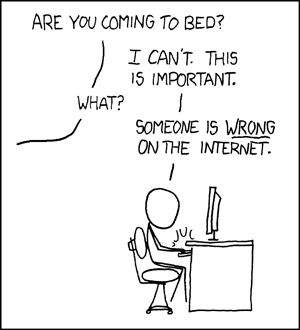
As I have been boxing things up, I did come across a few items that I have sort of forgotten about. Now there is one CD box set that never turned up, and I am hoping (against the odds) that I'll find it in the last week as everything else is boxed up and moved to the garage. A handful of the books so far have been placed on the soon-to-be-unveiled TBR list, newly refurbished for Toronto. However, I had completely forgotten that I had stashed away a 6(!) volume set of the short stories of Roger Zelazny. Once I saw it, it came flooding back that I had slowly acquired the set (fairly easy to acquire in the US, but most of the volumes are much more expensive in Canada).
There is no question this was a real labor of love. Not only have all kinds of obscure material been collected here, even a few pieces from zines, but almost all of Zelazny's poems have been included. Interestingly, Zelazny had hoped to become a poet, but realized there was no money in it, and that it was easier breaking into short story writing in the SF/fantasy field (still probably true to this day). Having read some of these poems, I would have to say that was the wise career move.
I don't think I will ever feel quite as fondly about these volumes as The Last Defender of Camelot or Unicorn Variations, which I read as a teenager. I am not sure I ever owned Frost and Fire, whose main claim to fame is that it contained the novella 24 Views of Mt. Fuji, by Hokusai, possibly Zelazny's best late writing (when he had started to do a fair bit of collaborative writing and generally his work wasn't as strong).
While I thought I had read pretty much all of Zelazny, that is clearly not the case, and I missed out on a great number of stories (and apparently I missed out on one illustrated novel -- A Night in the Lonesome October*). I don't feel particularly obligated to rush through and read these in one go, but I think I'll read a few here and there, particularly ones that I liked as a teenager.
I don't have a lot of time to go into what I think makes Zelazny special, other than he worked a lot with myths and didn't just go straight into fantasy, and I respect that. He also was one of the more overtly literary writers** in the SF field, although of course that meant he generally was not up on the hard SF side of things. While they might reject the comparison, I tend to lump Zelazny in with Harlan Ellison and Samuel Delany (and possibly even Philip K. Dick, though he came more directly out of the pulp tradition). He also admitted that the whole Amber series was based on some ideas that he extracted from Philip Jose Farmer's World of Tiers (remember, it isn't stealing if you are simply inspired and build something great from others' work).
Of the novels, my very favorite is Roadmarks, followed by Lord of Light, Eye of Cat and Jack of Shadows. Anyway, I have a very soft spot in my heart for Zelazny, perhaps greater than for any other SF writer active in the 70s and 80s. And even so, I think this 6 volume set is just a bit too much. You'll have to be a fanboy (or fangirl) ahead of time to even consider tracking these books down. But it is still a cool set, and I'm sure I'll get through it all some day.
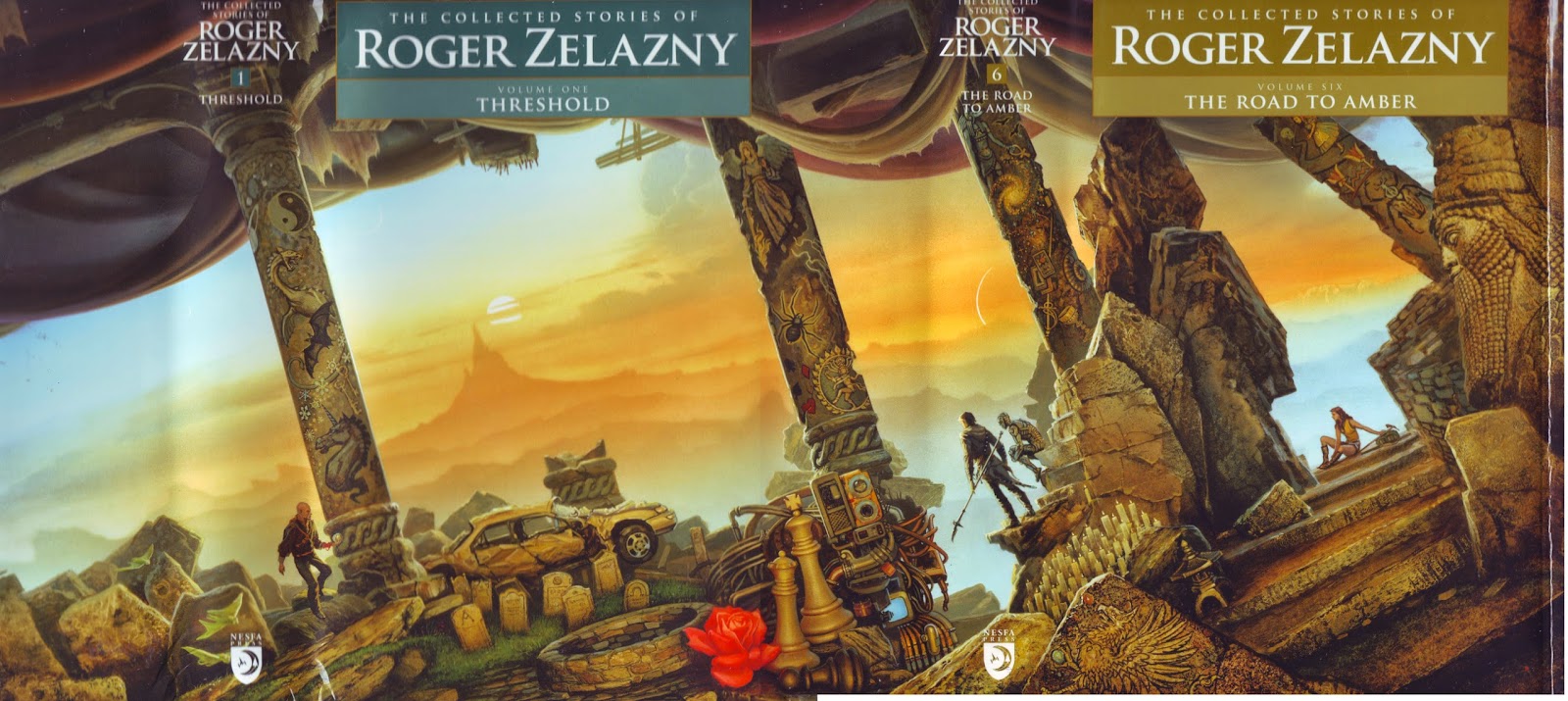
I especially like the way the cover sort of wraps around the whole set. This is the full cover (by famed illustrator Michael Whelan) as best as I could reconstruct it.
I do like how they gathered up all the afterwards to the stories that Zelazny wrote for his collections, particularly The Last Defender and Unicorn Variations. That is a particularly nice touch. The editorial notes for each story are all contained after Zelazny's afterwards, so they don't interrupt the flow. A good thing too, for some of the stories have a couple of pages of notes! Finally, they have quite a few non-fiction pieces that Zelazny wrote, mostly about the craft of being a writer. It is cool to have these gathered up across the various volumes.
* This, his last novel, has gone out of print, but apparently is being reissued (appropriately enough) this October. I think I'll pick up a copy.
** Zelazny made a real effort to read all the classics of Western literature, and obviously he later studied non-Western religions and mythology (and quite likely literature as well). He was set on this path by a high school teacher who convinced Roger and a close friend to read Ulysses, War and Peace and Remembrance of Things Past as they were the 3 greatest novels of all time -- boy, I just can't seem to escape Proust these days.
Tuesday, June 3, 2014
Monday, June 2, 2014
7th Canadian Challenge - 15th review - Unfamiliar Weather
This is actually the third book of poems by Chris Hutchinson that I read, but I figure I might as well review them in their proper (published) order. There is a fairly strong arc going from largely straight-forward poems (with perhaps an emphasis on lucidity and clarity -- the way I try to write my own poetry) to more focus on the language itself (sometimes at the expense of meaning) in Other People's Lives and A Brief History of the Short-Lived. While he doesn't quite reach John Ashbery territory by A Brief History, he is getting a bit close for my taste, and I personally think his best work is the middle volume, which I'll try to review this weekend. I'll keep a bit of an eye on his future volumes, but I expect he is moving in a direction that doesn't really interest me (a bit too academic and sterile).
Unfamiliar Weather is broken into four parts. I found the second part the most interesting, though I did like "Small Burdens" -- the multi-part poem that opens part one. In this collection and basically in his second collection, I generally thought the multi-part poems worked the best. That is also what I often find for George Bowering. Given that Hutchinson briefly lived in Vancouver, it is certainly possible he was inspired by Bowering.
"Small Burdens" takes up a different "thing" that often bothers people and devotes a calendar day to each one. So Monday is all about the weather: "Your eyes have starved all winter ... / ... / How you staggered delirious to meet the spring." Spring doesn't quite turn out as planned and the "you" of the poem only wants to go back to bed.
Tuesday brings up politics: "Today, bus fare went up again, it's rained / the last ten days of June and your neighbourhood floods / with heroin and cops. So where should you complain?" Writing to local politicians is essentially as futile as throwing stones "at the Milky Way."
Wednesday the poet takes public transport ("The Bus") and finds it lacking. Going on a date on Thursday is apparently nerve-wracking.
Friday (and not Monday?) brings up work as its own special burden: "Is this all there is? Squeezing life / into the cracks, into the small openings of the day."
I still don't quite get why going to the movies on Saturday is a burden, unless it is simply realizing that one's life will never be as glamourous. And Sunday is "art": "your small world spinning apart / around a deep-felt nothingness you consider / art..." This burden is considerably more abstract than the others. But it's a fun little series.
The second section seems to have mostly been written while in Vancouver, but looking back over his recent move across Canada.*
In "Translations," the poet speaks to a former lover:
Do you remember the summer
we spent in bed, how after love our eyes would wander
out the north window, unreel above Burrard Inlet? I used to imagine
the mountains were prehistoric waves about to smash this town to bits
we might reconstruct one day into an image of whatever future
we desired. What you envisioned I never thought to ask.
While the bus in the poems in the first section are local buses, Hutchinson also writes on long-distance bus trips and how they enable one to change one's life if one is willing to take a journey without looking back. Nearly all of the poems in this section speak to uprooting oneself from the East (apparently with Toronto as an intermediate destination) and traveling 5 provinces west, settling in Vancouver (at least as of the writing of these poems -- Hutchinson ultimately got a job in the States teaching poetry and moved South).
From "Lost in Transit": "The world is very small at the greyhound station. / Your destination is the size of a baggage tag, / your past, already fading like a bruise./ Lost in transit, everyone's a stranger / to themselves ..."
While this poem is a bit didactic, I can relate to this idea of uprooting oneself in the hopes of finding something better out there...
I would say that "At the Greyhound Station" covers much the same ground but is a bit more artistically satisfying:
Grounded here
at the Greyhound station, a woman
flicks her cigarette at the curb, shuffles her feet,
kicks at stones like annoying
afterthoughts or fragments of remorse
...
And I want our stories
to intertwine, fuse like two headlights
fixed on the road ahead ...
...
Cramped back into my seat
I am a solitary pilgrim again, the sky gone
faint behind the tint of my thin reflection
...
continually getting lost and falling in love
with a stranger's life.
I would agree with Hutchinson that imagining the lives of one's fellow passengers can be a game to pass the time. One is oddly vulnerable when travelling on these long-distance trips, and generally a bit more open to or receptive to others. Of course, that is only if one is travelling alone. And this may have been more true in the 1980s or even early 1990s before everyone had cell phone service that covered a bit chunk of rural Canada. There is definitely less "romance" in imagining a stranger's life when they are blurting it all out in a one-sided telephone conversation. Then they are just one more annoyance (or part of the "burden" of public transportation to return to the poem that kicked off this collection).
I thought the third and fourth sections were ok, but definitely did not live up to the heights of these cross-country migration poems of the second section. However, I did enjoy parts of the poem, "Variations on a Theme," which closed Unfamiliar Weather; it both tapped into the persistent ache of a dissatisfied soul and added one last dash of Can. con. to this collection:
Another glass to prolong the moment
since you can't sleep anyway; only
the cat is lost in its important slumber.
But listen: on the radio, Glenn Gould
hums off-key behind his piano--
the way you too sing
these crude little songs
to keep the whole universe
company.
* It is certainly a bit amusing to me that I am reversing Hutchinson's path -- from the States to Vancouver to Toronto. However, I plan on stopping there and not going on to Montreal...
Apparently, Hutchinson was just in Vancouver (last Wed.) doing a poetry reading in support of a fourth collection called Jonas in Frames. While this probably would have been interesting, I had some obligations I simply couldn't shake off. And apparently, I missed an earlier reading in Toronto, so I guess I will not be seeing him read live any time soon.
Unfamiliar Weather is broken into four parts. I found the second part the most interesting, though I did like "Small Burdens" -- the multi-part poem that opens part one. In this collection and basically in his second collection, I generally thought the multi-part poems worked the best. That is also what I often find for George Bowering. Given that Hutchinson briefly lived in Vancouver, it is certainly possible he was inspired by Bowering.
"Small Burdens" takes up a different "thing" that often bothers people and devotes a calendar day to each one. So Monday is all about the weather: "Your eyes have starved all winter ... / ... / How you staggered delirious to meet the spring." Spring doesn't quite turn out as planned and the "you" of the poem only wants to go back to bed.
Tuesday brings up politics: "Today, bus fare went up again, it's rained / the last ten days of June and your neighbourhood floods / with heroin and cops. So where should you complain?" Writing to local politicians is essentially as futile as throwing stones "at the Milky Way."
Wednesday the poet takes public transport ("The Bus") and finds it lacking. Going on a date on Thursday is apparently nerve-wracking.
Friday (and not Monday?) brings up work as its own special burden: "Is this all there is? Squeezing life / into the cracks, into the small openings of the day."
I still don't quite get why going to the movies on Saturday is a burden, unless it is simply realizing that one's life will never be as glamourous. And Sunday is "art": "your small world spinning apart / around a deep-felt nothingness you consider / art..." This burden is considerably more abstract than the others. But it's a fun little series.
The second section seems to have mostly been written while in Vancouver, but looking back over his recent move across Canada.*
In "Translations," the poet speaks to a former lover:
Do you remember the summer
we spent in bed, how after love our eyes would wander
out the north window, unreel above Burrard Inlet? I used to imagine
the mountains were prehistoric waves about to smash this town to bits
we might reconstruct one day into an image of whatever future
we desired. What you envisioned I never thought to ask.
While the bus in the poems in the first section are local buses, Hutchinson also writes on long-distance bus trips and how they enable one to change one's life if one is willing to take a journey without looking back. Nearly all of the poems in this section speak to uprooting oneself from the East (apparently with Toronto as an intermediate destination) and traveling 5 provinces west, settling in Vancouver (at least as of the writing of these poems -- Hutchinson ultimately got a job in the States teaching poetry and moved South).
From "Lost in Transit": "The world is very small at the greyhound station. / Your destination is the size of a baggage tag, / your past, already fading like a bruise./ Lost in transit, everyone's a stranger / to themselves ..."
While this poem is a bit didactic, I can relate to this idea of uprooting oneself in the hopes of finding something better out there...
I would say that "At the Greyhound Station" covers much the same ground but is a bit more artistically satisfying:
Grounded here
at the Greyhound station, a woman
flicks her cigarette at the curb, shuffles her feet,
kicks at stones like annoying
afterthoughts or fragments of remorse
...
And I want our stories
to intertwine, fuse like two headlights
fixed on the road ahead ...
...
Cramped back into my seat
I am a solitary pilgrim again, the sky gone
faint behind the tint of my thin reflection
...
continually getting lost and falling in love
with a stranger's life.
I would agree with Hutchinson that imagining the lives of one's fellow passengers can be a game to pass the time. One is oddly vulnerable when travelling on these long-distance trips, and generally a bit more open to or receptive to others. Of course, that is only if one is travelling alone. And this may have been more true in the 1980s or even early 1990s before everyone had cell phone service that covered a bit chunk of rural Canada. There is definitely less "romance" in imagining a stranger's life when they are blurting it all out in a one-sided telephone conversation. Then they are just one more annoyance (or part of the "burden" of public transportation to return to the poem that kicked off this collection).
I thought the third and fourth sections were ok, but definitely did not live up to the heights of these cross-country migration poems of the second section. However, I did enjoy parts of the poem, "Variations on a Theme," which closed Unfamiliar Weather; it both tapped into the persistent ache of a dissatisfied soul and added one last dash of Can. con. to this collection:
Another glass to prolong the moment
since you can't sleep anyway; only
the cat is lost in its important slumber.
But listen: on the radio, Glenn Gould
hums off-key behind his piano--
the way you too sing
these crude little songs
to keep the whole universe
company.
* It is certainly a bit amusing to me that I am reversing Hutchinson's path -- from the States to Vancouver to Toronto. However, I plan on stopping there and not going on to Montreal...
Apparently, Hutchinson was just in Vancouver (last Wed.) doing a poetry reading in support of a fourth collection called Jonas in Frames. While this probably would have been interesting, I had some obligations I simply couldn't shake off. And apparently, I missed an earlier reading in Toronto, so I guess I will not be seeing him read live any time soon.
Friday, May 30, 2014
The Studhorse Man Challenge (closes June 18)
It was quite a while back that I reviewed Robert Kroetsch's The Studhorse Man. I don't think I did a very good job in conveying why I think this is Kroetsch's best novel. So I'll give it another shot.
Quite a few of Kroetsch's novels are mid-20th C. postmodern novels, featuring wildly unreliable narrators. While many pomo novels trace their roots back to Sterne's Tristram Shandy, the more immediate antecedent is probably John Barth or Robert Coover. Interestingly, all three (Barth, Coover and Kroetsch) sort of came to the same turning point of adopting postmodern conventions in the late 60s. Maybe it really was just something in the water...
Anyway, Gone Indian and to a lesser extent Badlands have narrators that undercut the main thrust of the story, but The Studhorse Man in the only one where the narrator is actively stalking Hazard Lepage (the main character), intending to do him in if possible, so that he can marry Hazard's fiancee Martha. Sadly, Martha is the narrator's cousin, and she doesn't really take to this idea.
Kroetsch's novels do have a bit of the manly man about them, maybe just a bit too stereotypically soaked in the rhetoric of how Canadian men tamed the frontier. Some readers are definitely put off by this, but it does seem most appropriate in this novel, which is essentially the Odyssey on the Canadian frontier, though one might argue that Hazard is trying to return to a simpler time rather than returning home. Hazard views the mechanization of Canadian farms and the subsequent redundancy of horses in the West as a terrible thing, and he struggles to breed his blue stallion with other worthy mares before it is too late.
The adventures themselves are quite amusing, as Hazard gets himself into one scrape after another. It is very hard to convey humour in a review, and I suppose you'll just have to trust that it is a funny novel. But it's still better to go ahead and read it.
As it happens, I have a spare copy to give away (a yellowed but still quite readable copy), so I am going to start a challenge for it. This book is free to a Canadian address, but unfortunately, due to rising postage I'll have to charge a nominal fee ($3 Can) to US or European addresses. The challenge will be open for 3 weeks (until June 18), although if I don't get sufficient entries I may choose to extend the challenge for up to another two weeks.
In the comments, tell me your favourite Robert Kroetsch novel (aside from The Studhorse Man) and give one thing you liked about it. I'll pick my favourite entry and send the book out shortly after that. (While you should let me know which country you want the book mailed to, it's probably safer not to put your full address in the comment itself, and I'll get it from the winner afterwards.)
Good luck!
Quite a few of Kroetsch's novels are mid-20th C. postmodern novels, featuring wildly unreliable narrators. While many pomo novels trace their roots back to Sterne's Tristram Shandy, the more immediate antecedent is probably John Barth or Robert Coover. Interestingly, all three (Barth, Coover and Kroetsch) sort of came to the same turning point of adopting postmodern conventions in the late 60s. Maybe it really was just something in the water...
Anyway, Gone Indian and to a lesser extent Badlands have narrators that undercut the main thrust of the story, but The Studhorse Man in the only one where the narrator is actively stalking Hazard Lepage (the main character), intending to do him in if possible, so that he can marry Hazard's fiancee Martha. Sadly, Martha is the narrator's cousin, and she doesn't really take to this idea.
Kroetsch's novels do have a bit of the manly man about them, maybe just a bit too stereotypically soaked in the rhetoric of how Canadian men tamed the frontier. Some readers are definitely put off by this, but it does seem most appropriate in this novel, which is essentially the Odyssey on the Canadian frontier, though one might argue that Hazard is trying to return to a simpler time rather than returning home. Hazard views the mechanization of Canadian farms and the subsequent redundancy of horses in the West as a terrible thing, and he struggles to breed his blue stallion with other worthy mares before it is too late.
The adventures themselves are quite amusing, as Hazard gets himself into one scrape after another. It is very hard to convey humour in a review, and I suppose you'll just have to trust that it is a funny novel. But it's still better to go ahead and read it.
As it happens, I have a spare copy to give away (a yellowed but still quite readable copy), so I am going to start a challenge for it. This book is free to a Canadian address, but unfortunately, due to rising postage I'll have to charge a nominal fee ($3 Can) to US or European addresses. The challenge will be open for 3 weeks (until June 18), although if I don't get sufficient entries I may choose to extend the challenge for up to another two weeks.
In the comments, tell me your favourite Robert Kroetsch novel (aside from The Studhorse Man) and give one thing you liked about it. I'll pick my favourite entry and send the book out shortly after that. (While you should let me know which country you want the book mailed to, it's probably safer not to put your full address in the comment itself, and I'll get it from the winner afterwards.)
Good luck!
Thursday, May 29, 2014
Literary noodlings including a riddle
I'll start off with the riddle, though it isn't mine (and it's a bit more of a puzzle than a proper riddle).
I'm partway through Martin Amis' Other People. It's hard to say exactly what is going on here. It is written from the perspective of a patient with total amnesia, slowly relearning the rules of society. While this may not be the intent, it feels very inspired by Clockwork Orange, in that society has largely broken down and citizen's homes are not particularly safe castles any longer.
Anyway, the patient, who calls herself Mary, is taking in all the information she can (like a somewhat slower version of the alien (Milla Jovovich) in The Fifth Element):
Books were difficult. She read The Major Tragedies of William Shakespeare. It was about four men made up of power, mellifluousness and hysteria; they lived in big bare places that frightened them into speech; they were all cleverly murdered by women, who used an onion, a riddle, a handkerchief and a button.
The riddle is obviously the witches' riddle in Macbeth and the handkerchief is Desdemona's from Othello. (As I thought I made clear, Othello is by far my least favourite of the four major tragedies.)
But who was killed by an onion (or even a leek)? It sounds like something more appropriate for one of the comedies, the appearance of a leek in Henry V notwithstanding. Since there are only four kings (or three kings and a prince), this presumably excludes Julius Caesar and Anthony and Cleopatra from the "Big Four" tragedies. Tears from onions, btw, do make an appearance in Anthony and Cleopatra, but not in any fatal sense. Most likely it is the poisoned "union" which is dropped into the goblet in Hamlet. Supposedly, this is a large pearl, which would look just like a pearl onion. I wouldn't at all be surprised if there are editions of Hamlet that print onion instead of union, but I don't have time for any more literary sleuthing.
So this basically leaves Lear killed by a button? I have to admit, this is particularly sly on Martin Amis' part. As with all things Shakespearean, there are major debates about what is meant by Lear's next to last lines: "Pray you undo this button. Thank you, sir." Some people assume Lear is choking on some part of his outfit, whereas it could mean to undo a button on the cloth covering Cordelia or even to undo the buckle by which the fool was hung (though presumably he would have said buckle rather than button). In many ways, this is fairly close to the last moments of Cervantes' Don Quixote, and here the old king throws off the raiment of madness, recovers lucidity and dies. However, few people would assume that it was literally the button that killed him (or rather the only thing keeping him anchored to life) and even fewer would say that it was definitely Cordelia's button, which seems to be Mary's conclusion. While Amis surely doesn't completely accept Mary's reading (or epic misreading) of the play(s), he is able to bring together some interesting ideas together, such as it's really always the woman's fault in Shakespeare no matter who carries out the deed (though this does not necessarily mean they have more power). I found this about as interesting in its own way as what Caryl Churchill comes up with in Top Girls, but written with such economy. So far, nothing else in Other People has been as brilliant. I remember not really caring for Night Train (another relatively late Amis novel) but perhaps I will give it another shot next year. On the agenda for mid July, however, is a one-day visit to Stratford to check out Lear (so I'll be able to see this twice in three years after never having seen it performed live). I will certainly keep my eye on the button...
I have just about 150 pages left with Proust. I am going to celebrate so much when this is over. I am at a particularly bad section where he isn't satisfied with dropping hints about the madeline cookie, he needs to come up with other things that trigger his memory, like an uneven sidewalk reminding him of a trip to Venice or a stiff napkin reminding him of other parties at the Guermantes' mansion. Each one of them reinforces the memories that the other one triggered. Enough, we get it already. While this wouldn't have been for everyone under the best of circumstances, it could have been boiled down to 400-500 pages of intense thoughts on memory, painting, literature (but cut the musings on music, which were never very convincing) and maybe a bit on how people allow their perceptions of artists and others in their social circle to be shaped and shifted by those higher in stature in these same circles, and possibly a bit on how difficult it was to find good servants in those days. I would have kept most of the material on Saint-Loup, cut nearly all the material on Palamède (which reeks very strongly of self-loathing), and maybe kept 25% of the Albertine saga (which is very troubling on other grounds). That might have been a great piece of work. But that's not what we are faced with. I am truly at a loss why people feel Remembrance is the epitome of the novel. To me it is far too mimetic, i.e. we are dragged along with the Narrator in these epic feats of remembrance, when in fact for the most part, we could be told about them once or twice, and say to ourselves, yes, this is something I too have experienced. I do think it is an artistic failure on those grounds. Anyway, I'll probably have one more post on this when I finally cross the finish line this weekend. Then that will be it, and Proust will be out of my life -- forever.
I've now gathered the four volumes of Amphigorey. I wasn't even aware until very recently of the final one (Amphigorey Again). There is no question that they begin to drop off in quality after Amphigorey and Aphigorey Too. The earlier ones have dark moments but also a lot of whimsey. I find the later ones are kind of dark for darkness' sake, a bit of going through the motions, since it was so clear what was expected of him. That doesn't mean I'm not glad to have the set after all these years, but I'll probably return to the first volume the most for inspiration. I wonder if anyone has actually taken one of the books as a kind of storyboard (or springboard) and written a proper story with actual motivations. I imagine it could be done, though it's not really the kind of exercise that would motivate me.
I'm not sure what will finally motivate me. I have some good ideas, but am a bit burned out on writing longer pieces, since I am writing very long technical pieces at work (when I am not writing proposals), and I am having trouble facing writing anything longer than a blog piece when I am off the clock. Hopefully, that will turn around soon, as I would much rather be doing mathematical modeling at work and writing other, more entertaining things at home.
I'm partway through Martin Amis' Other People. It's hard to say exactly what is going on here. It is written from the perspective of a patient with total amnesia, slowly relearning the rules of society. While this may not be the intent, it feels very inspired by Clockwork Orange, in that society has largely broken down and citizen's homes are not particularly safe castles any longer.
Anyway, the patient, who calls herself Mary, is taking in all the information she can (like a somewhat slower version of the alien (Milla Jovovich) in The Fifth Element):
Books were difficult. She read The Major Tragedies of William Shakespeare. It was about four men made up of power, mellifluousness and hysteria; they lived in big bare places that frightened them into speech; they were all cleverly murdered by women, who used an onion, a riddle, a handkerchief and a button.
The riddle is obviously the witches' riddle in Macbeth and the handkerchief is Desdemona's from Othello. (As I thought I made clear, Othello is by far my least favourite of the four major tragedies.)
But who was killed by an onion (or even a leek)? It sounds like something more appropriate for one of the comedies, the appearance of a leek in Henry V notwithstanding. Since there are only four kings (or three kings and a prince), this presumably excludes Julius Caesar and Anthony and Cleopatra from the "Big Four" tragedies. Tears from onions, btw, do make an appearance in Anthony and Cleopatra, but not in any fatal sense. Most likely it is the poisoned "union" which is dropped into the goblet in Hamlet. Supposedly, this is a large pearl, which would look just like a pearl onion. I wouldn't at all be surprised if there are editions of Hamlet that print onion instead of union, but I don't have time for any more literary sleuthing.
So this basically leaves Lear killed by a button? I have to admit, this is particularly sly on Martin Amis' part. As with all things Shakespearean, there are major debates about what is meant by Lear's next to last lines: "Pray you undo this button. Thank you, sir." Some people assume Lear is choking on some part of his outfit, whereas it could mean to undo a button on the cloth covering Cordelia or even to undo the buckle by which the fool was hung (though presumably he would have said buckle rather than button). In many ways, this is fairly close to the last moments of Cervantes' Don Quixote, and here the old king throws off the raiment of madness, recovers lucidity and dies. However, few people would assume that it was literally the button that killed him (or rather the only thing keeping him anchored to life) and even fewer would say that it was definitely Cordelia's button, which seems to be Mary's conclusion. While Amis surely doesn't completely accept Mary's reading (or epic misreading) of the play(s), he is able to bring together some interesting ideas together, such as it's really always the woman's fault in Shakespeare no matter who carries out the deed (though this does not necessarily mean they have more power). I found this about as interesting in its own way as what Caryl Churchill comes up with in Top Girls, but written with such economy. So far, nothing else in Other People has been as brilliant. I remember not really caring for Night Train (another relatively late Amis novel) but perhaps I will give it another shot next year. On the agenda for mid July, however, is a one-day visit to Stratford to check out Lear (so I'll be able to see this twice in three years after never having seen it performed live). I will certainly keep my eye on the button...
I have just about 150 pages left with Proust. I am going to celebrate so much when this is over. I am at a particularly bad section where he isn't satisfied with dropping hints about the madeline cookie, he needs to come up with other things that trigger his memory, like an uneven sidewalk reminding him of a trip to Venice or a stiff napkin reminding him of other parties at the Guermantes' mansion. Each one of them reinforces the memories that the other one triggered. Enough, we get it already. While this wouldn't have been for everyone under the best of circumstances, it could have been boiled down to 400-500 pages of intense thoughts on memory, painting, literature (but cut the musings on music, which were never very convincing) and maybe a bit on how people allow their perceptions of artists and others in their social circle to be shaped and shifted by those higher in stature in these same circles, and possibly a bit on how difficult it was to find good servants in those days. I would have kept most of the material on Saint-Loup, cut nearly all the material on Palamède (which reeks very strongly of self-loathing), and maybe kept 25% of the Albertine saga (which is very troubling on other grounds). That might have been a great piece of work. But that's not what we are faced with. I am truly at a loss why people feel Remembrance is the epitome of the novel. To me it is far too mimetic, i.e. we are dragged along with the Narrator in these epic feats of remembrance, when in fact for the most part, we could be told about them once or twice, and say to ourselves, yes, this is something I too have experienced. I do think it is an artistic failure on those grounds. Anyway, I'll probably have one more post on this when I finally cross the finish line this weekend. Then that will be it, and Proust will be out of my life -- forever.
I've now gathered the four volumes of Amphigorey. I wasn't even aware until very recently of the final one (Amphigorey Again). There is no question that they begin to drop off in quality after Amphigorey and Aphigorey Too. The earlier ones have dark moments but also a lot of whimsey. I find the later ones are kind of dark for darkness' sake, a bit of going through the motions, since it was so clear what was expected of him. That doesn't mean I'm not glad to have the set after all these years, but I'll probably return to the first volume the most for inspiration. I wonder if anyone has actually taken one of the books as a kind of storyboard (or springboard) and written a proper story with actual motivations. I imagine it could be done, though it's not really the kind of exercise that would motivate me.
I'm not sure what will finally motivate me. I have some good ideas, but am a bit burned out on writing longer pieces, since I am writing very long technical pieces at work (when I am not writing proposals), and I am having trouble facing writing anything longer than a blog piece when I am off the clock. Hopefully, that will turn around soon, as I would much rather be doing mathematical modeling at work and writing other, more entertaining things at home.
Sunday, May 25, 2014
Vancouver, not gonna miss you
This was just such an unbelievably frustrating day. It just encapsulated so much of what I dislike about Vancouver and am so glad to be leaving this behind.
The bus system let me down very badly coming and going this afternoon. Vancouver has such a great rail system and such a weak, weak bus system, even for people living in the urbanized core. There are things I have decided to pass on, just because I have to make a bus-to-bus transfer and these are generally quite dreadful here. Toronto bus service is fairly poor out in the burbs, but the streetcar service certainly appears to be far ahead of Vancouver bus service. Not that I won't have complaints in Toronto (I always do).
But it really is the crappy arts scene that drives me crazy here. The quality generally is poor, though the chamber music can be ok and the symphony is on the rise (and quite possibly the Toronto symphony is on the decline). But everything is just so amateurish. And it's usually crammed into these hard to get to places. I can't stand going to the Cultch or Granville Island, and I'm not even that crazy about Bard on the Beach. Nothing is centralized and easy to get to. With the exception of Queen Elizabeth Hall (which has some of the worst seating arrangements I've seen in a long time) and the Vancouver Playhouse (all but abandoned after its resident theatre company shut down), nothing is walking distance from a rail line.
Nobody advertises properly. I just found out that there was a performance of Goodnight Desdemona out in New West, which I would have gone to see, but there was no notice. I doubt very much that this Gruesome Playground Injuries is going to get sufficient press (the last I looked you don't see if from the main Pacific Theatre page, only if you go through back channels, i.e. you already know what you are looking for, which totally defeats the purpose).
But mostly I am really pissed that I was going to see this concert today which was listed as $10. Well, it turns out it was $10 if you booked ahead but was $20 at the door. A bit of a discount may make some sense (though actually they take a bigger cut at the door than for on-line sales), but 100% mark-up seems ridiculous, and the guy kind of gave me some attitude when it was obvious that I thought their pricing policies sucked. So I left and went home early, quite upset. It is clear I will never see an event in St. Andrew-Wesley Church.* I've tried and tried, and you just kept letting me down. Frankly, good riddance crappy Vancouver arts scene.
As an update on the move, I am probably 1/3 done with the shelves, including one book case dedicated to art books (and quite heavy ones at that).
The remaining books do look forlorn.
The bus system let me down very badly coming and going this afternoon. Vancouver has such a great rail system and such a weak, weak bus system, even for people living in the urbanized core. There are things I have decided to pass on, just because I have to make a bus-to-bus transfer and these are generally quite dreadful here. Toronto bus service is fairly poor out in the burbs, but the streetcar service certainly appears to be far ahead of Vancouver bus service. Not that I won't have complaints in Toronto (I always do).
But it really is the crappy arts scene that drives me crazy here. The quality generally is poor, though the chamber music can be ok and the symphony is on the rise (and quite possibly the Toronto symphony is on the decline). But everything is just so amateurish. And it's usually crammed into these hard to get to places. I can't stand going to the Cultch or Granville Island, and I'm not even that crazy about Bard on the Beach. Nothing is centralized and easy to get to. With the exception of Queen Elizabeth Hall (which has some of the worst seating arrangements I've seen in a long time) and the Vancouver Playhouse (all but abandoned after its resident theatre company shut down), nothing is walking distance from a rail line.
Nobody advertises properly. I just found out that there was a performance of Goodnight Desdemona out in New West, which I would have gone to see, but there was no notice. I doubt very much that this Gruesome Playground Injuries is going to get sufficient press (the last I looked you don't see if from the main Pacific Theatre page, only if you go through back channels, i.e. you already know what you are looking for, which totally defeats the purpose).
But mostly I am really pissed that I was going to see this concert today which was listed as $10. Well, it turns out it was $10 if you booked ahead but was $20 at the door. A bit of a discount may make some sense (though actually they take a bigger cut at the door than for on-line sales), but 100% mark-up seems ridiculous, and the guy kind of gave me some attitude when it was obvious that I thought their pricing policies sucked. So I left and went home early, quite upset. It is clear I will never see an event in St. Andrew-Wesley Church.* I've tried and tried, and you just kept letting me down. Frankly, good riddance crappy Vancouver arts scene.
As an update on the move, I am probably 1/3 done with the shelves, including one book case dedicated to art books (and quite heavy ones at that).
The remaining books do look forlorn.
Here is the growing pyramid of boxes in the garage. I'm a little scared of how big the pile will be in six weeks.
* Other things I will never do:
Go to Whistler
Go to Squamish
Ski in Vancouver & environs
Snowshoe up on Grouse
Visit Burnaby Village Museum
See the Vancouver Aquarium
Things I don't plan on doing again:
Go back to SFU
Go again to Science World
Going back to the Museum of Vancouver
Go back to the Cultch
Go see any of the films at VIFF
Listen to the Pacific Rim String Quartet (as they appear to have disbanded)
Skate at the ice rink at Robson Square
Things I might do one last time:
Go to UBC
Go see the VSO play at the Orpheum
Go to the Vancouver Art Gallery
Go around the SkyTrain loop (I really ought to video this on a nice day)
Go to Granville Island (for the Jazz Fest)
Do the Grouse Grind (a bit unlikely, however)
Go to the Sun Yat-Sen Gardens (ditto).
Saturday, May 24, 2014
Literary disappointments
As I've been reflecting on what I've been reading over the past 5-6 years (here and here), I see quite a few books that were terrific, but also a lot where I could see some literary merit or something of interest, but the whole thing didn't quite gel for me. I suspect that I am getting more critical in my late middle age, as I start wondering if it really was worth the time to read this particular novel vs. another (and more pressingly instead of getting through a truly huge backlog of movies that I ought to watch), to say nothing of doing more creative writing on my own. There isn't much point in griping about books that just missed by a bit. Those are almost certainly books that I just read at the wrong time, and I would have enjoyed them more if I wasn't so stressed or what have you. Still, it does make me wonder if I should be reading a bit more in the comic vein or to stick to shorter novels for the time being. My TBR pile, even the interim one, is still overloaded with serious, challenging books.
While I don't really dwell on it, there are some books that I just find (or found) very unsatisfying. I thought I would examine them a bit to see if there was a common thread.
Number one has to be Proust. I just find this almost unreadable in terms of the really off-putting length and density of text that is just too much for the very slight story to bear. The whole thing seems out of proportion to me, and I do think it must be the most over-rated novel or series of novels in literary history (with many critics of the mid 20th C. saying that it was the epitome of the novel). Beyond this, I've decided that while it is not essential for me to "like" all the characters in a novel or even just the main ones, I can't be in a position where I detest them all, which is how I feel about the really unpleasant people running through Proust.
I am getting a bit tired of the really feckless characters in Barbara Comyns' novels, though they are usually balanced by a serious character or a kind of appalling self-involved artistic type. Still, these novels are short, and I don't have to live with these characters for too long, so it makes looking in on their world bearable. No question that I would never want to live near any of them in real life, however. Now I did find the balance off in Molly Keane's Treasure Hunt where the feckless characters really seem to overwhelm (and are deliberately undermining) the two sensible characters (the younger generation) in their attempt to keep their Irish estate from being taken over by the bank essentially. I really did dislike two of the characters (and the sullen servants weren't much better), so this was a book I struggled with. I know this was supposed to be a frothy comedy perhaps somewhat in the vein of Arsenic and Old Lace (and actually Treasure Hunt was originally a play that ran for a year in London -- with Gielgud directing), but I just found myself getting steamed up a bit too often to actually enjoy it.
I'm not crazy about books that rely too heavily on coincidence. Yes, life can be a bit unpredictable, but it usually doesn't end up with characters all criss-crossing and bumping into each other at exactly the right (or wrong) moment. I really found myself disgusted with The Sea Captain's Wife after some truly incredible coincidence occurred to redirect the plot. While it didn't quite live up to my overall expectations for other reasons, I actually felt that Dickner's Nikolski had an acceptable level of coincidence.
There's a different kind of plot that actually annoys me a bit more and that is watching a villain spin amazing webs to trap the protagonist and being so clever that they can make anything work for them and thus they actually thrive on coincidences. This is epitomized (to me) by Othello. I actually find Othello a quite disappointing play because in addition to Iago's almost super-human ability to turn coincidence to his benefit, it also requires his wife to stay silent when she has opportunities to clear up the various misunderstandings. So there are several people with strong moral failings here, but also dramatically I don't care that much for this formulation (not that this has never happened in "real life"). I thought that Elizabeth Jane Howard's Falling depended too much on Henry (a con artist) being essentially a modern day incarnation of Iago. However, he pushes a bit too hard (to try to ensnare his latest victim) and things unravel a bit more quickly than he expected. It's hard to quite put my finger on the problem here, but it didn't quite measure up. (However, I should note that I did not have nearly as strong negative reaction to Falling as to these other books.)
The worst is when a book is going along pretty well but then the ending completely spoils the book. Either it is just too implausibly upbeat (some have criticized Adam Bede for this) or it comes out of the blue and has no real relation to the rest of the plot (this is how I felt about The Mill on the Floss, which I felt had a terrible ending that really did piss me off and undermined the book's strengths). Conversely, Gadda's That Awful Mess on Via Merulana kind of limped across the finish line without actually solving the mysteries adequately. I thought That Awful Mess was another one of those novels, like Remembrance, with a completely outsized literary reputation relative to its actual merit.
Some books are just too bleak for me at a particular time in my life. This was the case with Cormac McCarthy's The Road which I just couldn't enjoy. Hilary Mantel's Beyond Black was fairly bleak and it also insisted within the frame of the novel that we had to accept that paranormal activity was real, so this wasn't a book that did a lot for me. At the moment, I am finding Edward Gorey too bleak, but I'll probably feel differently later and enjoy it for its over-the-top bleakness. Edward Gorey doesn't expect to be taken seriously, but Cormac McCarthy does, and that makes a big difference...
Conversely, a book can be too frothy or too insubstantial for me at a particular time. Usually, I know ahead of time to not pick up those books when I am in one of "those moods."
If you read a huge number of books (as I try to) and work through the oeuvre of specific novelists, you can find they start repeating themselves -- and this somewhat devalues all their books. This may not be a problem for more casual readers. Saul Bellow definitely falls into this category, as does Hanif Kureishi; both seem to be working out their personal problems on the page. Barbara Comyns comes close, but she does recycle the situations a bit. Barbara Pym also comes uncomfortably close to having written the same novel over and over. The next time around, I will space her novels out more (than one a month). I'm sure there are other examples, but I can't think of them off hand. It really does make it even more impressive when thinking about those other authors with more than 5 or so novels who are able to shake things up and not fall into a rut.
I think the hardest thing is that I like books that are literary but if they cross that line into being "too literary," then I no longer enjoy them. For me, Nabokov falls into this camp: I just really don't like his characters, his preoccupations or his style. I will probably try to get through one or two more of the books "everyone" should read and then kick him to the curb.
To be fair, most of the books on these lists had something to offer me, even if it was something that I came to appreciate and/or enjoy a bit later. And there are long stretches where there were a lot of good books with only a few minor disappointments along the way. It is hardly a surprise that when I am working my way through "marginal" books where I expect only a few will win their way to a permanent space on the shelves that the hit ratio will be lower. There are in fact a few novels on the list that I have been looking forward to for some time and should get to them by late summer. (Now having unreasonably high expectations can itself be a serious problem (my expectations were certainly too high for Mohsin Hamid's The Reluctant Terrorist for example), but that's a topic for another day.)
While I don't really dwell on it, there are some books that I just find (or found) very unsatisfying. I thought I would examine them a bit to see if there was a common thread.
Number one has to be Proust. I just find this almost unreadable in terms of the really off-putting length and density of text that is just too much for the very slight story to bear. The whole thing seems out of proportion to me, and I do think it must be the most over-rated novel or series of novels in literary history (with many critics of the mid 20th C. saying that it was the epitome of the novel). Beyond this, I've decided that while it is not essential for me to "like" all the characters in a novel or even just the main ones, I can't be in a position where I detest them all, which is how I feel about the really unpleasant people running through Proust.
I am getting a bit tired of the really feckless characters in Barbara Comyns' novels, though they are usually balanced by a serious character or a kind of appalling self-involved artistic type. Still, these novels are short, and I don't have to live with these characters for too long, so it makes looking in on their world bearable. No question that I would never want to live near any of them in real life, however. Now I did find the balance off in Molly Keane's Treasure Hunt where the feckless characters really seem to overwhelm (and are deliberately undermining) the two sensible characters (the younger generation) in their attempt to keep their Irish estate from being taken over by the bank essentially. I really did dislike two of the characters (and the sullen servants weren't much better), so this was a book I struggled with. I know this was supposed to be a frothy comedy perhaps somewhat in the vein of Arsenic and Old Lace (and actually Treasure Hunt was originally a play that ran for a year in London -- with Gielgud directing), but I just found myself getting steamed up a bit too often to actually enjoy it.
I'm not crazy about books that rely too heavily on coincidence. Yes, life can be a bit unpredictable, but it usually doesn't end up with characters all criss-crossing and bumping into each other at exactly the right (or wrong) moment. I really found myself disgusted with The Sea Captain's Wife after some truly incredible coincidence occurred to redirect the plot. While it didn't quite live up to my overall expectations for other reasons, I actually felt that Dickner's Nikolski had an acceptable level of coincidence.
There's a different kind of plot that actually annoys me a bit more and that is watching a villain spin amazing webs to trap the protagonist and being so clever that they can make anything work for them and thus they actually thrive on coincidences. This is epitomized (to me) by Othello. I actually find Othello a quite disappointing play because in addition to Iago's almost super-human ability to turn coincidence to his benefit, it also requires his wife to stay silent when she has opportunities to clear up the various misunderstandings. So there are several people with strong moral failings here, but also dramatically I don't care that much for this formulation (not that this has never happened in "real life"). I thought that Elizabeth Jane Howard's Falling depended too much on Henry (a con artist) being essentially a modern day incarnation of Iago. However, he pushes a bit too hard (to try to ensnare his latest victim) and things unravel a bit more quickly than he expected. It's hard to quite put my finger on the problem here, but it didn't quite measure up. (However, I should note that I did not have nearly as strong negative reaction to Falling as to these other books.)
The worst is when a book is going along pretty well but then the ending completely spoils the book. Either it is just too implausibly upbeat (some have criticized Adam Bede for this) or it comes out of the blue and has no real relation to the rest of the plot (this is how I felt about The Mill on the Floss, which I felt had a terrible ending that really did piss me off and undermined the book's strengths). Conversely, Gadda's That Awful Mess on Via Merulana kind of limped across the finish line without actually solving the mysteries adequately. I thought That Awful Mess was another one of those novels, like Remembrance, with a completely outsized literary reputation relative to its actual merit.
Some books are just too bleak for me at a particular time in my life. This was the case with Cormac McCarthy's The Road which I just couldn't enjoy. Hilary Mantel's Beyond Black was fairly bleak and it also insisted within the frame of the novel that we had to accept that paranormal activity was real, so this wasn't a book that did a lot for me. At the moment, I am finding Edward Gorey too bleak, but I'll probably feel differently later and enjoy it for its over-the-top bleakness. Edward Gorey doesn't expect to be taken seriously, but Cormac McCarthy does, and that makes a big difference...
Conversely, a book can be too frothy or too insubstantial for me at a particular time. Usually, I know ahead of time to not pick up those books when I am in one of "those moods."
If you read a huge number of books (as I try to) and work through the oeuvre of specific novelists, you can find they start repeating themselves -- and this somewhat devalues all their books. This may not be a problem for more casual readers. Saul Bellow definitely falls into this category, as does Hanif Kureishi; both seem to be working out their personal problems on the page. Barbara Comyns comes close, but she does recycle the situations a bit. Barbara Pym also comes uncomfortably close to having written the same novel over and over. The next time around, I will space her novels out more (than one a month). I'm sure there are other examples, but I can't think of them off hand. It really does make it even more impressive when thinking about those other authors with more than 5 or so novels who are able to shake things up and not fall into a rut.
I think the hardest thing is that I like books that are literary but if they cross that line into being "too literary," then I no longer enjoy them. For me, Nabokov falls into this camp: I just really don't like his characters, his preoccupations or his style. I will probably try to get through one or two more of the books "everyone" should read and then kick him to the curb.
To be fair, most of the books on these lists had something to offer me, even if it was something that I came to appreciate and/or enjoy a bit later. And there are long stretches where there were a lot of good books with only a few minor disappointments along the way. It is hardly a surprise that when I am working my way through "marginal" books where I expect only a few will win their way to a permanent space on the shelves that the hit ratio will be lower. There are in fact a few novels on the list that I have been looking forward to for some time and should get to them by late summer. (Now having unreasonably high expectations can itself be a serious problem (my expectations were certainly too high for Mohsin Hamid's The Reluctant Terrorist for example), but that's a topic for another day.)
Saturday, May 17, 2014
Art of Google II (Mr. Penumbra's 24-Hour Bookstore)
Now the tables have turned. The novel -- Mr. Penumbra's 24-Hour Bookstore by Robin Sloan -- is definitely written by somebody who has drunk the Google Kool-Aid (far more than myself) and who probably did have some inside access at Google. Google employees are represented in very positive, nearly glowing terms, although some of them do ultimately come off as obsessed -- and a very few come with that light taint of self-righteousness. While it is not immediately apparent from the first few pages, Google and the spirit of Google is deeply entrenched in this novel; if you are a Google-hater, you will almost certainly want to pass this book by.
There will be plenty of MINOR SPOILERS AHEAD, so you have been warned.
I'd heard a bit of the buzz about this book when it suddenly appeared at the Burnaby Library in this area where they keep newish books, and I decided to check it out (a year or so ahead of when I was expecting to get to it). It turned out to be a fun and quite compelling book. I read it in a day and a half. I think a good analogy is if the "DaVinci's Code" was tackled by a group of programmers from Google. Certainly there were considerable implausibilities (and indeed the final reveal at the end is absurd, which I'll get to in a bit), but still entertaining.
The book is set in San Francisco. The main character, Clay, studied art history and typography. He is slowly teaching himself coding by setting up simple websites for a bagel shop where he was employed. This store goes under (perhaps in the wake of the crash of 2008), so he is starting to feel the pinch. He wanders into this incredible book store -- Mr. Penumbra's 24-Hour bookstore -- which is filled with towering shelves of books with very odd titles (that turn out to be in incomprehensible code). He impresses Mr. Penumbra and gets the job as the night clerk at the bookstore. I'll turn to the issue of the code later after the second spoiler warning.
One of the more interesting yet somewhat overplayed ideas was that Clay, while a bright guy, is basically useful because he has all these connections to people with really specialized skills and he knows how to deploy them in the right situations. His best friend (from middle school), Neel, is a wealthy web-entrepreneur with some programming skills though he employs a number of 1st rate programmers, who come in handy later. His special-effects guru room-mate (employed at ILM no less) basically builds him a replica of one of the store logbooks so he can take the original off to be scanned by Google.
And why does Clay have an in with Google? He placed the perfect ad on social media (or perhaps Google itself), which brings in Kat, a young woman who actually works for Google and is very intelligent but really intense. She spends a lot of her time thinking of ways to freeze her brain to achieve immortality. (Given that I wondered in high school if one's memory (and perhaps personality) could be stored on computer, I can relate. It's a fairly common trope in science fiction.)
Well, it turns out that there is a reason behind this madness, and Mr. Penumbra is secretly urging Clay on, while all the time officially telling him he needs to keep his nose out of this. A fairly substantial number of quest stories have this figure who feel the best way to motivate the hero is by discouraging them. The ones who persist are heroes.
While ultimately, Clay's cleverness seems too good to be true, I've actually experienced a bit of the power of connectedness myself. In my field, I stay in touch with a large number of professors and consultants. There have been two times in the past month where I was asked about filling a specific task/role on a project (or rather a bid on a project), and I was able to rope in a distinguished professor with the right qualifications. So there are people whose primary role is to be a connector/facilitator, which is basically how Clay is portrayed.
Ok, at this point, the review goes into
MAJOR SPOILER MODE
(Seriously, if you haven't read the book and don't want the ending revealed,
DO NOT KEEP READING DUE TO SPOILERS)
It turns out that there are many levels of secrets in this book. The first layer is that when one works through all the books on the shelves in the correct order then they form a connect-the-dots picture of the Founder. (While it didn't quite bother me at the time, they do on rare occasions add new books to the library, so I don't know if they just fill in the outline around the edges or what.)
There is a certain implausibility to this, since you would need many, many points to make a legible image. Given the description in the book of an old man with glasses, it might look something like this:
This is a 1000 dot connect the dot picture by Thomas Pavitte (visit his site here). I think you would need at least 300 dots to get the complexity described in the book and probably more like 600 or 700. While the very best code-breakers could probably go through a book a week, most seem to take a month or more. We are looking at 10 year investment at a minimum to progress to the next level. It is also totally unclear how they stick in the clue to go to the next book (for those people that are still writing the new ones), since it would seem to be a non-organic part of the book. (The books themselves are basically autobiographies of the people that make it to the next level.) But the clue to move on to the next book would not be an organic part of the book. Given that these folks are master code-breakers, it definitely seems they would figure out how to jump to the end. A totally different thought occurs to me and that is that a huge number of books have to be left unread or there won't be any "white space" to make the picture work. Maybe any book written in the last 400 years is just shelved in the white spaces, and thus no one is encouraged (or perhaps even allowed) to read the work, except the higher orders. Kind of a depressing thought. Frankly, I'm not sure Robin Sloan really worked through all the implications here.
Ok, so it turns out that with the help of Google, Clay is able to make the image appear in a matter of minutes by tracing the sequence of books checked out by the others (building off of their labor basically -- how typically Google).
While Mr. Penumbra is momentarily discouraged, he eventually decides that computer power has increased to the point it can be used to crack the Founder's book, which is encoded so well, that no one has broken it in 500 or so years. We also learn that in the higher orders of this cult Mr. Penumbra is a bit of a maverick. Even though the cult's funding comes from licensing fonts to corporations (hard to believe this would generate the millions required to keep these bookstores going, but a minor point not worth quibbling over), they are generally anti-technology. And why is this effort worth it for all these acolytes and masters? The Founder apparently achieved immortality and vanished in a poof of smoke among the books he had printed (or something like that).
So the plot really kicks into high gear. Mr. Penumbra gets them into the cult headquarters (semi-legitimately). Then Clay breaks back in and photographs the secret tome (and Mr. Penumbra's autobiography for good measure). They take this to Google, which throws the entire Google cloud at it for a minute or so. And they fail to break the code.
Now, this is where I think the book goes off the rails. Sloan is just trying to be so super-clever, showing how one insightful guy (armed with the knowledge of typeface design) can succeed where all the computing power in the world fails. He's John Friggin' Henry of the computer era. And it's absurd.
While everyone else is off licking their wounds from this misadventure (and not surprisingly this set-back causes Kat to break up with Clay), Clay manages to find the missing metal parts (punches) that were used to generate the font that underlies this whole venture. And it turns out that there is a clever substitution code embedded in the characters themselves (if you blow them up by a factor of 10 or so). But Sloan spoils it by saying that you can even see this if you blow up the computer font! Seriously? If that were true, then the substitution doesn't vary by letter. And this would be a trivial substitution code exercise that the cult would have broken within a year. Or even if he meant that you could just see the notch in the font (but that they only chose one of a half-dozen different variants with the notch in different places), there were simply not enough pixels for this to be done.
But let's ignore that part. There are basically a few possibilities. The Founder either passed on a set of punches (which would mean that each letter only had one notch -- so a simple substitution) or an entire case of type (where the notches moved around a bit on the different letters), though that doesn't sound like what Clay picked up from the storage center. It's very hard to believe that whatever he left was maintained in working order for 500 years, and it basically means that all the secret tomes were misprinted, since they surely weren't set exactly as the Founder set them. If anyone was let on to the importance of making sure all the imperfections of the font was maintained and that new editions of the secret tome had to be printed absolutely identically to the first one, then the jig would be up. So somebody would have actually known what was going on. I think there are just too many implausibilities to take this solution very seriously. And I still think there would have been enough recurring patterns, even if it was sort of a semi-random substitution code, that Google's computing power would have been able to eventually crack this.
Ultimately, I thought the solution to the riddle too clever by half, but it still was a very entertaining book. I loved the bit where Clay and Neel say it was all worth it just to enter a secret room under Manhattan. It is basically a lot of nerd wish-fulfillment (or nerd-service) where the smart kids are cool and the smartest of them all turns out to be smarter than anyone at Google and maybe the whole Internet itself!* I wouldn't at all be surprised to see it turned into a movie someday. Now whether I would go is a different story.
* And what is this review other than a long-winded way of saying I am have caught Robin Sloan out (and must be a bit smarter). Well, he's the smart one for doing something more tangibly creative. Oh, Internet, what have you turned me into?
To bring this back around to Google one last time, it is definitely worth checking out Randall Monroe's efforts to determine how many punchcards it would take to store all of Google's data (see the original page and the subsequent TED talk).
There will be plenty of MINOR SPOILERS AHEAD, so you have been warned.
I'd heard a bit of the buzz about this book when it suddenly appeared at the Burnaby Library in this area where they keep newish books, and I decided to check it out (a year or so ahead of when I was expecting to get to it). It turned out to be a fun and quite compelling book. I read it in a day and a half. I think a good analogy is if the "DaVinci's Code" was tackled by a group of programmers from Google. Certainly there were considerable implausibilities (and indeed the final reveal at the end is absurd, which I'll get to in a bit), but still entertaining.
The book is set in San Francisco. The main character, Clay, studied art history and typography. He is slowly teaching himself coding by setting up simple websites for a bagel shop where he was employed. This store goes under (perhaps in the wake of the crash of 2008), so he is starting to feel the pinch. He wanders into this incredible book store -- Mr. Penumbra's 24-Hour bookstore -- which is filled with towering shelves of books with very odd titles (that turn out to be in incomprehensible code). He impresses Mr. Penumbra and gets the job as the night clerk at the bookstore. I'll turn to the issue of the code later after the second spoiler warning.
One of the more interesting yet somewhat overplayed ideas was that Clay, while a bright guy, is basically useful because he has all these connections to people with really specialized skills and he knows how to deploy them in the right situations. His best friend (from middle school), Neel, is a wealthy web-entrepreneur with some programming skills though he employs a number of 1st rate programmers, who come in handy later. His special-effects guru room-mate (employed at ILM no less) basically builds him a replica of one of the store logbooks so he can take the original off to be scanned by Google.
And why does Clay have an in with Google? He placed the perfect ad on social media (or perhaps Google itself), which brings in Kat, a young woman who actually works for Google and is very intelligent but really intense. She spends a lot of her time thinking of ways to freeze her brain to achieve immortality. (Given that I wondered in high school if one's memory (and perhaps personality) could be stored on computer, I can relate. It's a fairly common trope in science fiction.)
Well, it turns out that there is a reason behind this madness, and Mr. Penumbra is secretly urging Clay on, while all the time officially telling him he needs to keep his nose out of this. A fairly substantial number of quest stories have this figure who feel the best way to motivate the hero is by discouraging them. The ones who persist are heroes.
While ultimately, Clay's cleverness seems too good to be true, I've actually experienced a bit of the power of connectedness myself. In my field, I stay in touch with a large number of professors and consultants. There have been two times in the past month where I was asked about filling a specific task/role on a project (or rather a bid on a project), and I was able to rope in a distinguished professor with the right qualifications. So there are people whose primary role is to be a connector/facilitator, which is basically how Clay is portrayed.
Ok, at this point, the review goes into
MAJOR SPOILER MODE
(Seriously, if you haven't read the book and don't want the ending revealed,
DO NOT KEEP READING DUE TO SPOILERS)
It turns out that there are many levels of secrets in this book. The first layer is that when one works through all the books on the shelves in the correct order then they form a connect-the-dots picture of the Founder. (While it didn't quite bother me at the time, they do on rare occasions add new books to the library, so I don't know if they just fill in the outline around the edges or what.)
There is a certain implausibility to this, since you would need many, many points to make a legible image. Given the description in the book of an old man with glasses, it might look something like this:
This is a 1000 dot connect the dot picture by Thomas Pavitte (visit his site here). I think you would need at least 300 dots to get the complexity described in the book and probably more like 600 or 700. While the very best code-breakers could probably go through a book a week, most seem to take a month or more. We are looking at 10 year investment at a minimum to progress to the next level. It is also totally unclear how they stick in the clue to go to the next book (for those people that are still writing the new ones), since it would seem to be a non-organic part of the book. (The books themselves are basically autobiographies of the people that make it to the next level.) But the clue to move on to the next book would not be an organic part of the book. Given that these folks are master code-breakers, it definitely seems they would figure out how to jump to the end. A totally different thought occurs to me and that is that a huge number of books have to be left unread or there won't be any "white space" to make the picture work. Maybe any book written in the last 400 years is just shelved in the white spaces, and thus no one is encouraged (or perhaps even allowed) to read the work, except the higher orders. Kind of a depressing thought. Frankly, I'm not sure Robin Sloan really worked through all the implications here.
Ok, so it turns out that with the help of Google, Clay is able to make the image appear in a matter of minutes by tracing the sequence of books checked out by the others (building off of their labor basically -- how typically Google).
While Mr. Penumbra is momentarily discouraged, he eventually decides that computer power has increased to the point it can be used to crack the Founder's book, which is encoded so well, that no one has broken it in 500 or so years. We also learn that in the higher orders of this cult Mr. Penumbra is a bit of a maverick. Even though the cult's funding comes from licensing fonts to corporations (hard to believe this would generate the millions required to keep these bookstores going, but a minor point not worth quibbling over), they are generally anti-technology. And why is this effort worth it for all these acolytes and masters? The Founder apparently achieved immortality and vanished in a poof of smoke among the books he had printed (or something like that).
So the plot really kicks into high gear. Mr. Penumbra gets them into the cult headquarters (semi-legitimately). Then Clay breaks back in and photographs the secret tome (and Mr. Penumbra's autobiography for good measure). They take this to Google, which throws the entire Google cloud at it for a minute or so. And they fail to break the code.
Now, this is where I think the book goes off the rails. Sloan is just trying to be so super-clever, showing how one insightful guy (armed with the knowledge of typeface design) can succeed where all the computing power in the world fails. He's John Friggin' Henry of the computer era. And it's absurd.
While everyone else is off licking their wounds from this misadventure (and not surprisingly this set-back causes Kat to break up with Clay), Clay manages to find the missing metal parts (punches) that were used to generate the font that underlies this whole venture. And it turns out that there is a clever substitution code embedded in the characters themselves (if you blow them up by a factor of 10 or so). But Sloan spoils it by saying that you can even see this if you blow up the computer font! Seriously? If that were true, then the substitution doesn't vary by letter. And this would be a trivial substitution code exercise that the cult would have broken within a year. Or even if he meant that you could just see the notch in the font (but that they only chose one of a half-dozen different variants with the notch in different places), there were simply not enough pixels for this to be done.
But let's ignore that part. There are basically a few possibilities. The Founder either passed on a set of punches (which would mean that each letter only had one notch -- so a simple substitution) or an entire case of type (where the notches moved around a bit on the different letters), though that doesn't sound like what Clay picked up from the storage center. It's very hard to believe that whatever he left was maintained in working order for 500 years, and it basically means that all the secret tomes were misprinted, since they surely weren't set exactly as the Founder set them. If anyone was let on to the importance of making sure all the imperfections of the font was maintained and that new editions of the secret tome had to be printed absolutely identically to the first one, then the jig would be up. So somebody would have actually known what was going on. I think there are just too many implausibilities to take this solution very seriously. And I still think there would have been enough recurring patterns, even if it was sort of a semi-random substitution code, that Google's computing power would have been able to eventually crack this.
Ultimately, I thought the solution to the riddle too clever by half, but it still was a very entertaining book. I loved the bit where Clay and Neel say it was all worth it just to enter a secret room under Manhattan. It is basically a lot of nerd wish-fulfillment (or nerd-service) where the smart kids are cool and the smartest of them all turns out to be smarter than anyone at Google and maybe the whole Internet itself!* I wouldn't at all be surprised to see it turned into a movie someday. Now whether I would go is a different story.
* And what is this review other than a long-winded way of saying I am have caught Robin Sloan out (and must be a bit smarter). Well, he's the smart one for doing something more tangibly creative. Oh, Internet, what have you turned me into?
To bring this back around to Google one last time, it is definitely worth checking out Randall Monroe's efforts to determine how many punchcards it would take to store all of Google's data (see the original page and the subsequent TED talk).
Subscribe to:
Posts (Atom)