While there is something particularly satisfying about checking off long novels, especially if these are ones that I have meant to read for a long time, such as Anna Karenina or Vanity Fair (and certainly Remembrance of Things Past, even though I didn't enjoy it much), there is also something to be said for shorter novels, say under 180 pages. These can usually be knocked off in a couple of days, and it is nice to feel one is actually making some progress.
On the other hand, the temptation is great to keep sneaking them into the reading queue, and that means more distractions and possible derailments for everything else on the list. But after all, I suppose it isn't like I have to read novels in any particular order.
As I have been looking over the Greek and Roman works, which I've largely left untackled up until now, I see that many of them are fairly short, though in several cases this is because the scrolls they were written on were lost or damaged.
I'm definitely looking into moving these up the queue
Juvenal The Satires
Horace Odes and Epodes (a big influence on Thackerey as well as Smollett)
Petronius The Satiricon ✓
Several of Plato's Dialogues are on the short side, though collectively they add up to well over 1500 pages! I've probably read 5 all the way through, plus snatches of The Republic. I do plan to correct this one of these days, but not immediately.
However, I had no idea that Aristotle's Poetics, was more like a 10 page essay (see here), so I've skimmed it and will reread it more carefully later in the week.
I was also quite surprised at how short Fontane's On Tangled Paths ✓ is. I'll likely wrap it up by tomorrow.
Many of Gide's novels are on the short side (as are Modiano's and Bove's), but if I stick to my plan, then I need to read the somewhat longer The Vatican Cellars ✓ before circling back to the much shorter Straight is the Gate and The Immoralist ✓ . That's ok; I can wait.
Durrenmatt has several short novels that seem quite interesting, as does Sciascia. Buzzati's The Tartar Steppe ✓ was shorter than I expected it, so I pulled that one way out of order.
I recently reread Bellow's Seize the Day ✓, and I'll also reread Dangling Man ✓ before too long.
I'm not sure whether Dinesen's Babette's Feast ✓ counts as a short novel or a novella, but I'll probably read that in a few months (actually it is just a middle-length story in Anecdotes of Destiny).
J.L. Carr's A Month in the Country ✓ is also fairly short, though to get to it, I have to read several much longer novels. For some reason, I plan on leaving the Carr in place, but I feel like I should move Juan Rulfo's Pedro Páramo ✓ up quite a few slots. (This will probably leave me wanting to move up some of the shorter works by Fuentes and/or Garcia Marquez, but I'll try to stay strong and resist.)
The one other short novel that is already sort of jumping the queue is ✓ Samuel Johnson's Rasselas. This is one of those works that is probably more read about than actually read. It is the legend of a prince who lived in "The Happy Valley," but he wanted to find out what life was like in the real world. At any rate, I was inspired to read this, since it is referenced in Jane Eyre, and I thought I should be able to squeeze it in before Jane Eyre rises to the top of the reading list (realistically about 2-3 months from now...). I don't know whether to be inspired or depressed that Johnson apparently managed to write this short novel in a week!
Monday, February 20, 2017

Sunday, February 19, 2017
Sunday in the Park (with kids)
It has been unseasonably warm this weekend, so I took advantage of this and took the kids to Withrow Park.

Almost all the snow had melted with a few random piles in the main park and then a big pile where they had stacked up all the snow when they had plowed to clear the area near the skating rink. (The rink was closed due to the temperature.) It was fairly soggy and muddy in spots, so I'm glad I insisted they wear boots.


I had thought my daughter would actually play on the swings, but in the end we just threw the frizbee around a bit and headed back home.
I don't go over to the park quite as often as I should, but maybe I'll make more of an effort this summer and fall. I just found out that the Driftwood Bard's bus tour will be coming through this summer with Othello. As I've mentioned before, this is one of my least favorite tragedies, since it relies far too much on coincidence -- and the unwillingness of Iago's wife to intervene -- and not enough on Othello's internal character flaws. Still, I'll probably go, since it is basically in my back yard, and perhaps I will take my son. I've been introducing him to Shakespeare's comedies, and maybe it is time to try one of the tragedies.
Anyway, now that we are back, I have about a day and a half left to take care of a few things, since Monday is a holiday. I have some actual work work, I'd like to get some reading done (Jefferson's Notes on the State of Virginia), maybe do some sewing and then to work on my newest play, Final Exam. I also probably should convert my Disney World play into a short story and submit it to the Toronto Star short story competition. And maybe do something with the family, like play Clue or Yahtzee or something, since it is Family Day after all. I won't get all of that done, but I can make a bit of a dent in a few items, so I had better go get started.
Too much a stickler?
I saw My Night with Reg this afternoon. It's very well acted, though in some ways it was dated. I learned it was actually first produced in 1994, but this is the Canadian premiere apparently! I had a couple of gripes with the third scene, which I'll get to after the appropriate SPOILER warnings. But really I think what threw me (both at the time and in thinking over the play later) is that the internal chronology seemed off. This is something that I actually spend a lot of time thinking about, particularly as it relates to my own work. I've addressed it to some extent in the second half of this post, but it is so important that I like to come back to it from time to time. Basically, if one is going to set a play in a particular time (especially if that time isn't "the present" whenever the play was written) it is really incumbent for the playwright to do the extra research, since it just doesn't take much to throw off the audience.
As far as I can determine from the internal markers of the play, the three main characters of the play (Guy, John and Daniel) were in university in 1972 or 1973 (since Ziggy Stardust (1972) was a big part of their lives). (It's not specified, but they are almost certainly Oxbridge graduates.) The first scene of the play is set in 1984 (that's the latest that even someone from the sticks, i.e. Eric, could claim that the Police's Synchronicity (1983) was the cool new sound). The second scene is a couple of years later, so 1986. The last scene is likely set in 1988, which would be just about right, since Daniel mentions that Guy has several photos from their uni days that are now 15 years old.
Now it's not impossible that they were Masters students, but I think that highly unlikely in John's case. Daniel and John seem to be the same age, though again, Daniel is now working as high-profile art historian, so maybe he was indeed a graduate student at the time. In the scene set roughly in 1986, Guy moans that he is nearly 40 when by most accounts he is probably not more than 35. (Again, I suppose he could have been a Masters student, along with John possibly, and in the early 70s, homosexual undergraduates and graduates mingled more due to being a despised minority group.)
Certainly, it is a bit strange that Guy, Daniel and Bernie all seem to be Yuppies which was more of a mid to late 30s thing in the mid 1980s (and if they were undergraduates in 1973, they would be closer to early 30s). So maybe most of them are mid 30s (and Guy even a year or two older) and John may be the youngest of the bunch. It isn't that you can't line up the ages, but I have to work at it, which really pulls me out of the play...
A much bigger issue to me is that in the mid-80s, the AIDs crisis was really raging, and information about the disease was scarce. Gay men were very hesitant to trust the government pronouncements, let alone public health messages. It was much closer to the scene depicted in Larry Kramer's The Normal Heart or Kushner's Angels in America. The tone of this play is much closer to late 80s/early 90s when gay life sort of began to return to normal and sex became ok again, so long as it was protected sex. My understanding is that there was still much uncertainty in 1984 and the big push for condoms wasn't until 1986 when more was known about the disease. (Here is a useful timeline.) In any event, some of the teasing that Guy gets about safe sex seems unlikely to have occurred under these circumstances, and I would have thought that between 1984 and 1986 (when everyone in the play except for Guy sleeps with Reg) casual gay sex would have been at an all-time low. Maybe human nature is just too hard to rein in, even with the threat of death looming over the bathhouses and the public parks and other avenues where casual sex could still be found. (Interestingly, while bathhouses were essentially all closed in San Francisco and New York by order of public health authorities, gay saunas apparently were not all shut down in London. So maybe it really was a different world over in the UK compared to North America.)
In terms of bigger SPOILERS,
I really didn't like the tired trope of Guy having unprotected (and actually unwanted) sex once and catching AIDS and everyone else being quite careless in their couplings with Reg, who also dies of AIDS, and yet they all seem ok. Oh, see how random and ironic Life is... (Also, I can't believe that no one in the play says or hints that they are going off to get tested, particularly in the second and third scenes.) I didn't like quite how pathetic Guy seems with his completely unrequited crush on John. It was just too much, though I thought John's difficulty in dealing with this affection (he only found out extremely late in Guy's illness) was well-acted. (The bit about Eric really wounding John by saying that he has gotten old was also a cliche, but it was believable...) On the whole, I enjoyed the play, but only the first two scenes. I didn't care for the last third. Still, I would have believed the play more if I didn't think the author was muddling up his timelines a bit.
In terms of applying the same criteria to my own work, I have a very short bit in "The Pitch" where I talk about a fictional group called Seniors for Parkdale. There actually is a fair bit of organizing in Toronto's Parkdale neighbourhood, so that is believable. What doesn't work is the idea that there is a train station within walking distance. The nearest GO station is Exhibition, which is quite a hike. Even if Liberty Village opens up, that would still not feel like a local station. On the other hand, Mimico does have a station and the overall land planning patterns might be more supportive of the kind of tower being pitched. Seniors for Mimico sounds a bit strange. As it happens, there is a proposed GO station in Park Lawn, which is essentially next door to Mimico. While the Park Lawn station is unlikely to happen for a few reasons, one could actually walk from the Park Lawn neighbourhood to Mimico. Anyway, The Pitch is a fantasy, not set in any particular city, but I still like having a ur-city in mind in case anyone ever asked me about the setting. So Seniors for Park Lawn it is.
I've written about trying to get the details correct for studying for the pre-1989 ACT in The Study Group. I've done the homework, and that is (slowly) proceeding. I'm actually going to insert a question about Jefferson's Notes on the State of Virginia, and I decided I might as well read the whole thing, since it is on my list of recommended non-fiction books to read.
Where things get tricky is in a play set in the future, i.e. Final Exam. I could basically assume that exams are fairly close to today or they might be a bit different. I originally had thought this should be The History Boys with a science fiction twist, so the lads (in a private school naturally) are all cramming for Oxford or Cambridge. (How completely weird that you can only apply to one or the other university. So much of higher education in England (but also France and Germany) forces you into a track early on, and particularly in England to decide your future course of studies at 17/18 when you really have so little idea of what you will want to do as an adult. Frankly, I think the North American model is vastly superior in being more flexible until the final years of university.)
For a variety of reasons, I have decided that the play should be moved to North America (and probably Toronto in fact) and, while the school will still be a posh, private one, it will admit boys and girls. At the end of the day, I decided it was just too hard for me to really get it right in terms of how English private education works (and there is no point in trying to just parrot The History Boys). However, this presents new challenges. It is certainly not likely that all the students will get into Oxford or Cambridge, or even that many will apply (no matter how much some people put Oxbridge up on a pedestal). Only something like 15 Canadians a year get into Oxford or Cambridge along with 25 or so from the U.S.
Apparently, for Canadian students with good grades, they don't even need to take the SAT or ACT to get into the top universities in Canada, though they would want to take the SAT if they wanted to go to a school in the U.S. I don't want to write a second play about prepping for a big standardized test like the SAT or ACT. So I poked around, and there is a fairly cumbersome process for Canadians or Americans who want to apply to UK schools, specifically Oxbridge. It basically boils down to, you need to take (and ace) 5 AP tests and then, depending on your subject area, you'll probably have to take a specialized test off of this list. What's particularly odd is that you must take the Classics Admissions Test (CAT) if going to Oxford for Classics, but if you want to do Classics at Cambridge, you actually do an hour-long translation of a text, presumably Greek or Latin. I think you would be very hard pressed to find an entire class interested in the classics nowadays, and the main teacher (in my play) is focused on English literature anyway. He might propose that they study for the English Literature Admissions Test (ELAT), which conveniently is good for Cambridge and Oxford.
In general, he will also promote the following AP Courses (from the full list here) as being particularly good in getting into Oxbridge or a top-level school in the U.S.:
While Cambridge is particularly good in Maths, I don't think he will promote that, mostly because he doesn't really follow mathematics and feels more generally that scientists and engineers will be better off studying in North America.
Anyway, the point isn't actually to make this about studying for these particular exams, but to consider a world where exams are no longer necessary (if not this school year, then certainly within the next two years). At that point, I just have to have the audience believe that this teacher knows his stuff (and thus buy into the world of the play), but, more importantly, that he is more than a little overwhelmed having to face up to an event that is going to change his world completely (and this applies even more strongly for the students). In my view, you need the underlying structure to hang together before you can get to the SF trappings.
As far as I can determine from the internal markers of the play, the three main characters of the play (Guy, John and Daniel) were in university in 1972 or 1973 (since Ziggy Stardust (1972) was a big part of their lives). (It's not specified, but they are almost certainly Oxbridge graduates.) The first scene of the play is set in 1984 (that's the latest that even someone from the sticks, i.e. Eric, could claim that the Police's Synchronicity (1983) was the cool new sound). The second scene is a couple of years later, so 1986. The last scene is likely set in 1988, which would be just about right, since Daniel mentions that Guy has several photos from their uni days that are now 15 years old.
Now it's not impossible that they were Masters students, but I think that highly unlikely in John's case. Daniel and John seem to be the same age, though again, Daniel is now working as high-profile art historian, so maybe he was indeed a graduate student at the time. In the scene set roughly in 1986, Guy moans that he is nearly 40 when by most accounts he is probably not more than 35. (Again, I suppose he could have been a Masters student, along with John possibly, and in the early 70s, homosexual undergraduates and graduates mingled more due to being a despised minority group.)
Certainly, it is a bit strange that Guy, Daniel and Bernie all seem to be Yuppies which was more of a mid to late 30s thing in the mid 1980s (and if they were undergraduates in 1973, they would be closer to early 30s). So maybe most of them are mid 30s (and Guy even a year or two older) and John may be the youngest of the bunch. It isn't that you can't line up the ages, but I have to work at it, which really pulls me out of the play...
A much bigger issue to me is that in the mid-80s, the AIDs crisis was really raging, and information about the disease was scarce. Gay men were very hesitant to trust the government pronouncements, let alone public health messages. It was much closer to the scene depicted in Larry Kramer's The Normal Heart or Kushner's Angels in America. The tone of this play is much closer to late 80s/early 90s when gay life sort of began to return to normal and sex became ok again, so long as it was protected sex. My understanding is that there was still much uncertainty in 1984 and the big push for condoms wasn't until 1986 when more was known about the disease. (Here is a useful timeline.) In any event, some of the teasing that Guy gets about safe sex seems unlikely to have occurred under these circumstances, and I would have thought that between 1984 and 1986 (when everyone in the play except for Guy sleeps with Reg) casual gay sex would have been at an all-time low. Maybe human nature is just too hard to rein in, even with the threat of death looming over the bathhouses and the public parks and other avenues where casual sex could still be found. (Interestingly, while bathhouses were essentially all closed in San Francisco and New York by order of public health authorities, gay saunas apparently were not all shut down in London. So maybe it really was a different world over in the UK compared to North America.)
In terms of bigger SPOILERS,
I really didn't like the tired trope of Guy having unprotected (and actually unwanted) sex once and catching AIDS and everyone else being quite careless in their couplings with Reg, who also dies of AIDS, and yet they all seem ok. Oh, see how random and ironic Life is... (Also, I can't believe that no one in the play says or hints that they are going off to get tested, particularly in the second and third scenes.) I didn't like quite how pathetic Guy seems with his completely unrequited crush on John. It was just too much, though I thought John's difficulty in dealing with this affection (he only found out extremely late in Guy's illness) was well-acted. (The bit about Eric really wounding John by saying that he has gotten old was also a cliche, but it was believable...) On the whole, I enjoyed the play, but only the first two scenes. I didn't care for the last third. Still, I would have believed the play more if I didn't think the author was muddling up his timelines a bit.
In terms of applying the same criteria to my own work, I have a very short bit in "The Pitch" where I talk about a fictional group called Seniors for Parkdale. There actually is a fair bit of organizing in Toronto's Parkdale neighbourhood, so that is believable. What doesn't work is the idea that there is a train station within walking distance. The nearest GO station is Exhibition, which is quite a hike. Even if Liberty Village opens up, that would still not feel like a local station. On the other hand, Mimico does have a station and the overall land planning patterns might be more supportive of the kind of tower being pitched. Seniors for Mimico sounds a bit strange. As it happens, there is a proposed GO station in Park Lawn, which is essentially next door to Mimico. While the Park Lawn station is unlikely to happen for a few reasons, one could actually walk from the Park Lawn neighbourhood to Mimico. Anyway, The Pitch is a fantasy, not set in any particular city, but I still like having a ur-city in mind in case anyone ever asked me about the setting. So Seniors for Park Lawn it is.
I've written about trying to get the details correct for studying for the pre-1989 ACT in The Study Group. I've done the homework, and that is (slowly) proceeding. I'm actually going to insert a question about Jefferson's Notes on the State of Virginia, and I decided I might as well read the whole thing, since it is on my list of recommended non-fiction books to read.
Where things get tricky is in a play set in the future, i.e. Final Exam. I could basically assume that exams are fairly close to today or they might be a bit different. I originally had thought this should be The History Boys with a science fiction twist, so the lads (in a private school naturally) are all cramming for Oxford or Cambridge. (How completely weird that you can only apply to one or the other university. So much of higher education in England (but also France and Germany) forces you into a track early on, and particularly in England to decide your future course of studies at 17/18 when you really have so little idea of what you will want to do as an adult. Frankly, I think the North American model is vastly superior in being more flexible until the final years of university.)
For a variety of reasons, I have decided that the play should be moved to North America (and probably Toronto in fact) and, while the school will still be a posh, private one, it will admit boys and girls. At the end of the day, I decided it was just too hard for me to really get it right in terms of how English private education works (and there is no point in trying to just parrot The History Boys). However, this presents new challenges. It is certainly not likely that all the students will get into Oxford or Cambridge, or even that many will apply (no matter how much some people put Oxbridge up on a pedestal). Only something like 15 Canadians a year get into Oxford or Cambridge along with 25 or so from the U.S.
Apparently, for Canadian students with good grades, they don't even need to take the SAT or ACT to get into the top universities in Canada, though they would want to take the SAT if they wanted to go to a school in the U.S. I don't want to write a second play about prepping for a big standardized test like the SAT or ACT. So I poked around, and there is a fairly cumbersome process for Canadians or Americans who want to apply to UK schools, specifically Oxbridge. It basically boils down to, you need to take (and ace) 5 AP tests and then, depending on your subject area, you'll probably have to take a specialized test off of this list. What's particularly odd is that you must take the Classics Admissions Test (CAT) if going to Oxford for Classics, but if you want to do Classics at Cambridge, you actually do an hour-long translation of a text, presumably Greek or Latin. I think you would be very hard pressed to find an entire class interested in the classics nowadays, and the main teacher (in my play) is focused on English literature anyway. He might propose that they study for the English Literature Admissions Test (ELAT), which conveniently is good for Cambridge and Oxford.
In general, he will also promote the following AP Courses (from the full list here) as being particularly good in getting into Oxbridge or a top-level school in the U.S.:
- AP English Literature and Composition
- AP French Language and Culture
- AP European History
- AP World History
- AP Biology or
- AP Chemistry
While Cambridge is particularly good in Maths, I don't think he will promote that, mostly because he doesn't really follow mathematics and feels more generally that scientists and engineers will be better off studying in North America.
Anyway, the point isn't actually to make this about studying for these particular exams, but to consider a world where exams are no longer necessary (if not this school year, then certainly within the next two years). At that point, I just have to have the audience believe that this teacher knows his stuff (and thus buy into the world of the play), but, more importantly, that he is more than a little overwhelmed having to face up to an event that is going to change his world completely (and this applies even more strongly for the students). In my view, you need the underlying structure to hang together before you can get to the SF trappings.
Wednesday, February 15, 2017
Small Wins
- I managed to get through another day at work, even after spending much of the night getting data ready for a mapping exercise.
- As a result of this exercise, I headed off what would have been a major problem for a big piece of modelling.
- I have only two outstanding items to tick off for the day. One is relatively straight-forward and can be wrapped up in 15 minutes. The other will take longer.
- I dropped by Regent Park Aquatic Centre on the way home from work. I did a few laps and then soaked in the whirlpool. I am not exercising enough, but it is a start. I may well integrate this whirlpool into more of trips home from work, particularly after I am biking again. (Regents Park is completely free to visit and do lap swimming. I don't think this is a particularly sensible policy, but I am willing to take them up on the offer...)
- I seem to have largely shaken off my cold, though if I was getting more sleep I probably would be healthier still... (I have been having such strange, detailed dreams lately when I am sleeping.)
- I finally heard back from a couple of actors. They will let me know soon if they think my pieces are worth putting on.
- I tracked down the missing pages for "Final Exam." I actually started writing it twice. Both openings have their strengths, so I am looking to see how much from each I can salvage. Due to a critical deadline, I am going to pause work on "The Study Group" and focus on "Final Exam," especially this weekend. If I am able to get halfway through it, I will count that as a major win.
Sunday, February 12, 2017
10th Canadian Challenge - 20th Review - Cruise Control
The full title of this poetry collection by Ken Howe is Cruise Control: a theogony. I came across it while deciding which version of Hesiod's Theogony I would check out from Robarts. Theogony literally means a story about the birth of the gods, and presumably Howe means to suggest that North Americans treat the automobile as divine, but somehow this doesn't really come through all that well. The closest is when he substitutes 10 gas stations across the country for the stations of the cross in the multi-part poem "Stations of the Highway." Each subsection has a reading, an exhortation and a prayer. He also wedges in some passages from Kerouac's On the Road, obviously the ur-text of any road trip novel. But it just falls flat. Either he's trying too hard, or, paradoxically, he needed to push even further, since this doesn't have anywhere near the intense emotions that a stations of the cross is supposed to evoke. Where is the equivalent of the scourging? And the crucifixion itself? I think to carry the metaphor to its logical conclusion there would have to be much more about abandoned cars just over the ridge from these gas stations and then the narrator would have to pass the scene of a horrific car accident on the highway near a station. That would have been a reasonable approximation of a secular and car-dominated stations of the highway. This is pretty weak in comparison.
I suppose it is unfair to criticize a book for what it is not, but in general, I think Howe squeezes far too much into this collection -- Marxist theory and in particular Frederic Jameson's take on postmodernism (a frankly barren approach in my opinion), random pop culture bits (like old Star Trek episodes), some name-dropping and then the underlying metaphors of the highway as the life-blood of the nation and/or economy. It's just too much, and I think peeling back some of these layers, particularly the philosophy, would have been wise.
That is not to say that Howe's poetry never works. One of the better poems is "Atlantis." Here is a short passage from it: "Doric columns, bones of coral made, rise out of the surplus value of submarine light, the visible manifestation of all irrevocably lost things..." The passage flows well, but was "surplus value" really necessary? It certainly shouldn't be used in this context, since Marx would argue that surplus value only makes sense in the context of a capitalist society, not a dead, underwater city. So it makes Howe sound very smart (though perhaps alienating potential readers) but is actually an improper use of the term. I generally don't think philosophy and poetry mix well in the first place, since the search for truth or at least inner logic is besides the point for poetry. I'm sort of working myself up into a lather over this collection, and it just isn't worth it.
This weird philosophical-poetical mix works somewhat better in "Notes on the Schonfeld Airport in Berlin": "All time flows into airports / but the airports are never filled. It / pools in departure lounges where travellers / inhale it like opium smoke as they await their connections."
Perhaps the most successful poem is "Chicago," though here the poem takes place on an elevated train about to go underground as it approaches the Loop: "The train plunges under the Earth. As the lights wink off in this car I see glazed faces in the next, hear the wails of unbaptized babies descending in sparks. But in the twinkling of an eye light again..."
I'm not quite sure what it says that my 3 favourite poems from Cruise Control don't involve cars on the highway at all, other than I think Howe took on a bit more than he could chew in the highway poems. A simpler approach, more focus on the Husky and Esso stations across Canada without the philosophical scaffolding would have been very welcome. One very small section of "On the Malignancy of the Automobile" suggests what might have been:
soft suspension numbing the brain, awakening
and confusing the esophagus.
"Stop the car!" I bellow,
"I gotta THROW UP!"
But when we pull over, stop,
my stomach stops right with it,
and, recovering sufferer,
I am kicked out into the ditch:
"Well, come on, puke! You said
you hadda puke, so PUKE!"
This would fit well in the excellent auto-themed collection In Cars by Kimmy Beach, and which I would recommend as a better starting place than Cruise Control.
The Very Snowy Day (Toronto)
I forgot to mention that the Distillery District is running something called the Festival of Lights. It goes for another month or so. After As You Like It, we wandered through it. We probably needed to stay another half an hour before the lights started coming on. I just didn't feel we had that much time to kill, especially as I still wasn't feeling that great. The big cat sculptures were cool anyway, though.



From the foot of the bridge, you normally can see the CN Tower. Not today!


I'm going to try to get comfortable and not go anywhere the rest of the day. I could use the rest anyway!


This thing looked straight out of The War of the Worlds. I assume the eye glowed and maybe there was sound as well.

Had we stuck around, this is what one of the rooftop installations would have looked like. Pretty cool.

Almost all the snow from Friday afternoon/evening melted over the course of Sat.
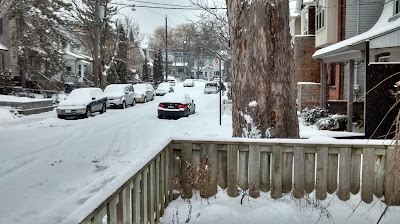
That didn't prepare me for the shock of today. I woke up and it was snowing fairly heavily. It basically snowed straight until 3 (and there is still a bit of a dusting coming down).
I asked my son if he wanted to go sledding, but he really didn't want to go out. I didn't either, though I ultimately shoveled and bought the groceries. Since I had to make an extra stop at the mall, I ended up having to shovel again on the way back. Then my son shoveled about half an hour ago. No idea how long it will stick around, but we may luck out and it will all be gone by Wed.
Here are a few shots of the neighbourhood.


I'm going to try to get comfortable and not go anywhere the rest of the day. I could use the rest anyway!
Saturday, February 11, 2017
10th Canadian Challenge - 19th Review - Red Wolf, Red Wolf
A short while back I reviewed W.P. Kinsella's Russian Dolls. One of the stories included ("Truth and History") was actually reprinted from his earlier (1987) story collection Red Wolf, Red Wolf, so I decided to check out Red Wolf, Red Wolf from the library. In some ways it is a bit more typical collection than Russian Dolls, in that a few sports stories are included. "Billy in Trinidad" is a short story featuring Billy the Kid playing a pick-up game of baseball in Trinidad, Colorado. "Elvis Bound" revolves around a former baseball player (mostly in the minors but a few trips to the Big League) and his relationship with his Elvis-obsessed wife.
I particularly enjoyed the introduction where Kinsella talked a bit about the inspiration for some of these stories, whereas the linking material in Russian Dolls was more evidently fictional or meta-fictional. Interestingly, Kinsella says that he usually doesn't write truly autobiographical stories, but he does take short interactions with people he meets and then uses them as a starting point for stories, imagining their back stories or projecting them forward in time. (This technique was used several times in Russian Dolls, though here he claimed that his muse, Christie, was the one asking him to fill in the details.)
In the Red Wolf, Red Wolf introduction, Kinsella said that his single greatest influence was his grandmother, Baba Drobney, who was a great storyteller. He also said that he was indebted to Flannery O'Connor, whom he considers the best American short story writer. "Red Wolf, Red Wolf" is a tribute to her, imagining a scenario where one of her characters comes to life (somewhat akin to Pirandello's Six Characters in Search of an Author) and comes to live with her. The Red Wolf in the title stands in for the skin rashes that are often an outward mark of lupus. O'Connor suffered from lupus for the last 12 years of her life, ultimately dying at an early age (39) of complications from the disease. It is quite a tribute to her fortitude that she wrote 2 novels and 2 dozen short stories after her diagnosis.
Probably the most successful story in the collection is "Lieberman in Love," which is about a wealthy man torn between two women -- a prostitute and a married rental agent. Incidentally, this story is the only one from this collection included in The Essential W.P. Kinsella. "Lieberman in Love" became the basis for an Oscar-winning short firm, which is somewhat intriguing given how much sex is in the story, and it isn't clear to me how far the director actually took this.
Sex is also at the heart of "Elvis Bound." The former baseball player is happily married to his wife, except for one small thing -- she will only make love to him if she can see the big poster of Elvis in their bedroom. He finds this creepy. The resolution to this dilemma is unexpected and comic, if somewhat unlikely.
There were a few stories that didn't do very much for me, but the only one that I really didn't care for was "Something to Think About" which becomes an elaborate revenge fantasy where a woman expresses her distaste for the rigid application of church law when her husband can't be buried in the Catholic cemetery. It felt too much of a thought piece where Kinsella was working off his rage against people, particularly those of a religious bent, who make assisted suicide more difficult than it really ought to be. It becomes perhaps a bit eerie viewed in light of the fact that Kinsella ultimately died through physician-assisted death. In the mid 1980s, he most likely wouldn't have been thinking about that as something that would be directly relevant to him, though perhaps his family members had gone through painful deaths.
The most morally suspect story is "Evangeline's Mother," which is basically on the Lolita-theme with a middle-aged man seduced by his daughter's best friend. It isn't a particularly believable story and is fairly creepy/pervy.
Of the stories in Red Wolf, Red Wolf, Kinsella's favourite was "Mother Tucker's Yellow Duck," so it is a bit unclear why that wasn't added to The Essential W.P. Kinsella, unless he felt it hadn't aged quite as well as other stories. This basically recounts what it was like to be living on the West Coast at the tail end of the 60s, both in Victoria and Vancouver. One could scrape together the fare for the ferry to the mainland pretty easily (now it is over $17 for a walk-on fare!). Life was fairly easy going, though there were people who wanted to be movers and shakers even then, so they moved to Toronto... Kinsella makes some observations about how, even in Victoria, one was starting to see the emergence of Yuppies by the mid-80s. The narrator finds himself torn between longing for the hippy lifestyle and worrying that this life is too grasshopper-like. He needs to be making plans for the future, including what he will live on when he is retired, and ultimately he gravitates towards a career woman (who is going to help put him through university!) but still misses the freedom of his youth. I'd say this story shares some of the same traits as a typical Alice Munro story in that people grow and change and that usually means that couples that were well-suited for each other at one point are no longer suitable later on. How they handle this estrangement is really the critical issue.
Overall this is a good, not great, collection. I would probably start with The Essential W.P. Kinsella and then decide if you want to go back to the early collections, like Red Wolf, Red Wolf, to fill in all the other short stories that Kinsella wrote over his career.
Subscribe to:
Posts (Atom)