I basically don't listen to radio anymore, but in the past (probably mid 90s) for a few years in a row I would listen to one of the public radio stations out of New York City do an extended reading (4+ hours) of Joyce's Ulysses on June 16. Now if you poke around there are plenty of similar events, many of which can be listened to on demand (and not just on June 16). This broadcast from Ireland is a reading of the entire book, though it doesn't appear you can actually skip around in the book, and the podcast cannot apparently be restarted to the beginning, so it isn't quite as enticing as it could be... But maybe they'll replay it next year...
In any case, I've read Ulysses twice -- once for university (and I admit that it is much easier to understand the book if you have someone to guide you through it!) and then once for fun. I'd like to think I'll read it a third time, but it certainly isn't at the top of my reading list. Just a couple of years ago, I saw a staging of Stephen Dietz's Bloomsday, which is basically about an older man (a literature professor) retracing his steps as a young man visiting Dublin and taking a Bloomsday tour and meeting a young woman (the tour guide actually) and falling in love. Time folds in on itself and the professor actually gives advice to his younger self. And then at last year's Fringe, I saw a piece that featured four woman portraying different aspects of Molly Bloom, trading off amongst themselves as they read the closing monologue. Yes! I said Yes!
Speaking of youthful experiences (and prejudices) imprinting themselves on the brain, I still remember that Ulysses: The Corrected Text (published in 1984) was still a bit of a shooting star in the academic world as I was entering university, though there were some whispers that this version (the Gabler edition) didn't quite live up to the billing. I spent just a bit of time digging into this and decided that I would stick with the Random House/Vintage edition from 1961. I was fortunate that the professor that was leading the seminar on Joyce allowed us to read either version. And nothing since then has shaken my original decision. As this blog argues, despite even more errors having been uncovered, the Gabler is still the version that Joyce scholars use, but the book generally preferred by readers is the Random House/Vintage edition. And somewhat incredibly it appears that the Gabler edition is out of print, but is still the version that scholars use!
At any point, while it is definitely a bit of a mountain to scale, I would recommend tackling Ulysses at least once in your life.
Tuesday, June 16, 2020

Monday, June 15, 2020
Poetry Follow-up
A day or two after that last post on poetry, I realized that I had heard one other relatively famous poet: Gwendolyn Brooks. She was giving a reading in Evanston in 1996, though I'm not entirely sure what she was promoting. Possibly a new printing of her collected poems, Blacks. I actually managed to get her to sign my copy of Blacks, so I am a bit chagrined I forget her the other day.
I was definitely more attuned to poetry through my twenties and even early 30s. While I am definitely doing more play-writing than poetry-writing these days, I still prefer reading poetry to reading published plays. At any rate, as I mentioned, poetry is generally not available in the various e-book collections, though Archive.org has a fair number of obscure volumes available for 2 week loans. (I have to admit that Archive.org plays fast and loose with copyright laws, but they do seem to be the only game in town for poets like Paul Blackburn and Maxine Kumin for example. And there is something a bit unfair about these poetry books (particularly the long out-of-print ones) only being available to readers in large cities or those that have access to a really good university library.)
While I don't really have a lot of spare time for reading, I am going to try to dive into some of my favourite poets over the next few months. While this list changes constantly,* right now I'd say my top 10 poets are:
- Paul Blackburn
- Anne Sexton
- Frank O'Hara
- Philip Levine
- Adrienne Rich
- Charles Simic
- August Kleinzhaler
- Ted Berrigan
- Audre Lorde
- Sharon Olds neck-and-neck with John Berryman for the last slot
My favourite Canadian poets are George Bowering and Robert Kroetsch, though I like Atwood's poetry as well (and I recently reminded myself that Dennis Lee is not to be overlooked either).
While generally I prefer getting the Collected Works for these various poets, it can be a real challenge for those poets still living, and it generally means that they put out updated Selected Poems from time to time. In a few cases, it can actually be worth having a Collected Poetry and then a very good focused work. I'm thinking of Frank O'Hara's Lunch Poems or Paul Blackburn's The Cities, both of which are often much easier to get into than their collected works. Here's a short appreciation of Blackburn's The Cities. I was actually about half an hour away from buying a copy of Blackburn's The Cities, even though I own a copy of his Collected Poems, when I came across it in a box of books downstairs (I had been digging around looking for Joyce Cary's The Horse's Mouth incidentally, which I did eventually turn up). That would have been most embarrassing to have two copies of it, though I would have tried to get the spare copy into a deserving library.
I probably will not be able to pull it off, but I hoping that next week I finish reviewing this Chinese urbanism workbook and then wrap up four half written reviews for the Canadian challenge. That would leave me with 4 more to go to get up to magic number 13. The only way I could possible do that is if I focus on Canadian poetry exclusively, perhaps sticking with the books I actually ordered in the Brick Books sale. But most likely I won't have the energy, since I am stretched pretty thin these days between work and stressing over coronavirus.
* Perhaps I should be a bit more embarrassed that Faye Kicknosway isn't a bit higher in the mix, though I think my biggest issue is that her poetic output is on the slim side (5 or 6 chapbooks, 1 slightly longer collection and then 2 selected poetry volumes). I do have quite a few books by Maxine Kumin and Gary Snyder, but they are much more poets of the wilderness/countryside, and I am thoroughly an urban reader. Other urban poets that didn't quite make the cut are David Ignatow, Alan Dugan, Aaron Kramer, Charles Reznikoff, Eileen Myles and Jim Carroll.
* Perhaps I should be a bit more embarrassed that Faye Kicknosway isn't a bit higher in the mix, though I think my biggest issue is that her poetic output is on the slim side (5 or 6 chapbooks, 1 slightly longer collection and then 2 selected poetry volumes). I do have quite a few books by Maxine Kumin and Gary Snyder, but they are much more poets of the wilderness/countryside, and I am thoroughly an urban reader. Other urban poets that didn't quite make the cut are David Ignatow, Alan Dugan, Aaron Kramer, Charles Reznikoff, Eileen Myles and Jim Carroll.
Wednesday, June 10, 2020
Missed Connections with the Poets
I apologize for repeating some stories I have surely told elsewhere on the blog, but I thought I would pull them together in one place.


I go to very few poetry readings anymore (well, I mean a few months ago obviously). I'm sure I could have gone more often when living in Chicago or New York, but the high water mark for my involvement in poetry was while at university in Ann Arbor in the very early 90s. (Looking at the list of poets who came through in Donald Hall's memoirs, the scene was really something in the 1960s and 70s, with all the major poets coming through on reading tours, but it had really slowed down when I was in university.)
The most significant poet coming through, that I can recall, was Adrienne Rich in my junior year. I actually had her sign The Fact of a Doorframe, which was then stolen from my rental apartment, and shortly after her death I picked up a different signed volume off of Bookfinder.com. Allen Ginsberg was supposed to make it out but I think he had a health scare of some sort, so that was disappointing. Jim Carroll who was the "opener" read for the whole time, and it was fine, but it wasn't Ginsberg. Actually, now that I think back, I believe Derek Walcott came through, right around the time Omeros came out, and I almost certainly went to that, even though there were some fairly nasty pre-"Me Too" rumours circulating about him (and about most male poets, to be honest). I'm slowly going through old journals from my undergraduate years, and I expect I should be able to confirm this at some point.
In term of other poets, I've seen Margaret Atwood and Michael Ondaatje, though in both cases, reading from their novels, not poetry.* I did see Amiri Baraka reading once, and Charles Simic twice. I certainly don't recall Philip Levine coming in from Detroit for a reading, though I may have just missed it. Later, I believe Robert Kroetsch had been scheduled to fly to Toronto for a literary festival, and I might have made that reading, but then he died in a car crash. I've certainly seen a few good "regional poets" but I think that is the list of all the really prominent poets I've seen. Given the general state of poetry, there won't be too many more up and coming poets that become household names.
The summer between my sophomore and junior years, I was part of something called the New England Literature Program where 30 or so UM students went off to a camp in New Hampshire and communed with nature and read writers with strong links to New England (even reaching as far as Boston...): Thoreau, Emerson, Hawthorne, Dickinson, Robert Frost, etc. There were some contemporary writers as well, like David Budbill, Donald Hall and Jane Kenyon. I suspect that the program originally came about because Hall and Kenyon had strong ties to Ann Arbor (Hall was an English professor at UM for many years and Kenyon was a native of Ann Arbor). I believe that most years, there was actually a gathering or a party at the Hall-Kenyon residence, but Jane Kenyon had been ill for some time and we didn't go that summer, unfortunately; she died of cancer only a few years later. So that was an unfortunate missed connection. I found this video of Hall reading his poem "Kicking the Leaves," which is set in Ann Arbor but looks ahead to the next stage of his life after Ann Arbor.
While I was at UM, I took several poetry writing courses with Ken Mikolowski, who was not only a writing instructor but the editor of The Alternative Press with his wife Ann Mikolowski. I might have, but I don't remember meeting Ann. The Alternative Press was quite something. Each issue came in a manila envelope and was stuffed with postcards and bumper stickers and so on, all with poems printed on them. There were also usually one or two one-of-a-kind postcards where the poets would do a little doodle or drawing and personalize each one. More on the Alternative Press can be found here. I managed to subscribe for two years (4 issues) but then between my perpetual moving from state to state and the poor state of the internet at that time, my subscription lapsed. Maybe in a future post, I'll reveal some of the hidden gems from those issues.
At any rate, Ken did seem to have connections to most of the active major poets in the US. He brought Jim Gustafson and John Sinclair in for readings, and I believe he was somehow involved in the Allen Ginsberg/Jim Carroll reading. I believe that every couple of years Faye Kicknosway came in for a reading, but it was just not to be. I never saw her read. The last I heard she had moved to Hawaii and largely given up writing (or at least publishing new pieces**), so the odds of ever seeing her read live are quite remote at this point. In some ways, she is probably the most interesting poet that I would only have found out about through taking Ken's class. I would eventually have encountered Jim Carroll and Ted Berrigan (another somewhat obscure poet that Ken championed) on my own but probably not Fay Kicknosway. As I was prepping to write this post, I decided that I probably ought to pick up more of her chapbooks, as she did most of the illustrations. I already owned A Man is a Hook. Trouble, Nothing Wakes Her and The Cat Approaches, along with her selected poems Mixed Plate.


I had had an earlier selected volume (All These Voices), and recently I realized there are several poems in All These Voices that are not in Mixed Plate, but I had given All These Voices away to a friend. Now it's possible that with the individual chapbooks, I am not really missing any poems, but I decided I would go ahead and re-order All These Voices, along with She Wears Him Fancy in Her Night Braid, The Violence of Potatoes and Asparagus, Asparagus, Ah Sweet Asparagus. In a couple of cases, these were actually signed editions, so I'll have a very good Kicknosway collection when this is all said and done, even though I never did have the chance to go to a reading and have her sign my book personally.
* And Grace Paley reading a short story or two, though she is not really known for her poetry these days, despite being a fine poet.
** And then I ran across these poems, so I guess she is still in the game after all.
Deadlines Missed
I've definitely been flirting with deadlines for probably as long as I can remember. I suppose most people do this, but most of my career has been in consulting where your work life is juggling a few too many deadlines and primarily responding to the clients that are the most assertive in reminding you that deadlines are approaching...
Academic life wasn't too different though the stakes for missing a deadline are generally a bit lower. You miss out on a conference or for applying for a grant (with a low chance of success). There was a fairly recent deadline that came and went for a virtual transportation conference, and while I would have liked to put in a paper, they wanted the whole paper, not just a strong abstract. And I simply couldn't do it. I will see if I can repackage that same idea/nascent paper and turn it in to TRB, which has a fixed deadline of Aug 1. I think there is a reasonable chance I can make that deadline.
As far as creative writing deadlines, I had a fairly long history of being a day late for Sing-for-Your-Supper, though they usually let it slide. This past week was the same thing, though they did not take my piece. I have to admit, I think it was not really the lateness, but they didn't like this new piece as much as the others. That said, there has been a bit of a changing of the guard and the newer reader has left to be replaced with a reader from several years back. That's going to be a bit of an issue for me. I had maybe 40-50% success rate with this reader, but 95% with the one that just left. Bummer. And while I mostly write the kind of quirky pieces that they like, I was trying more of a traditional piece (in fact it was half of a TV pilot). I think I'll clean it up and try to strengthen it a bit more and send to the other cold reads series which in fact does lend itself to TV pilots and such. So while I was more than a bit frustrated my piece wasn't taken, 3 of the 4 pieces were solid, and it was a pretty entertaining evening overall.
I have more or less given up on book reviewing on this blog. Never say never, as I have three or maybe even four reviews in draft, but I don't really feel compelled to write them out, and I just don't get as much of a thrill of having them on the blog. I think the community of Canadian reviewers has pretty much died out, at least as far as I am concerned, and I definitely am not going to sign up for another go around in July. I have one actual academic book review that is a few weeks late. This is a case where I was going to do a joint review and one of the publishers never got the book to me, despite claiming it went out, and I frankly don't like the one book I do have in hand (it is more of a workbook than a proper academic book), so I'm really struggling to say something productive about it, but I'll wrap that up fairly soon.
Because everything all more or less blends together while sheltering at home, and I don't have anything remotely fun on the horizon (for months and months and months), it's very easy to forget about the deadlines for on-line shows. I actually missed out on seeing a friend's piece for a virtual fringe, and I'm going to have to really push myself to get psyched up for Luminato, which is this weekend. Life is just frankly depressing these days, even with the nicer weather (finally!). It doesn't pay to dwell on it, but I am deeply unhappy now, and it is hard to muster up much enthusiasm for anything, let along spend the energy to meet a (frequently artificial) deadline.
Academic life wasn't too different though the stakes for missing a deadline are generally a bit lower. You miss out on a conference or for applying for a grant (with a low chance of success). There was a fairly recent deadline that came and went for a virtual transportation conference, and while I would have liked to put in a paper, they wanted the whole paper, not just a strong abstract. And I simply couldn't do it. I will see if I can repackage that same idea/nascent paper and turn it in to TRB, which has a fixed deadline of Aug 1. I think there is a reasonable chance I can make that deadline.
As far as creative writing deadlines, I had a fairly long history of being a day late for Sing-for-Your-Supper, though they usually let it slide. This past week was the same thing, though they did not take my piece. I have to admit, I think it was not really the lateness, but they didn't like this new piece as much as the others. That said, there has been a bit of a changing of the guard and the newer reader has left to be replaced with a reader from several years back. That's going to be a bit of an issue for me. I had maybe 40-50% success rate with this reader, but 95% with the one that just left. Bummer. And while I mostly write the kind of quirky pieces that they like, I was trying more of a traditional piece (in fact it was half of a TV pilot). I think I'll clean it up and try to strengthen it a bit more and send to the other cold reads series which in fact does lend itself to TV pilots and such. So while I was more than a bit frustrated my piece wasn't taken, 3 of the 4 pieces were solid, and it was a pretty entertaining evening overall.
I have more or less given up on book reviewing on this blog. Never say never, as I have three or maybe even four reviews in draft, but I don't really feel compelled to write them out, and I just don't get as much of a thrill of having them on the blog. I think the community of Canadian reviewers has pretty much died out, at least as far as I am concerned, and I definitely am not going to sign up for another go around in July. I have one actual academic book review that is a few weeks late. This is a case where I was going to do a joint review and one of the publishers never got the book to me, despite claiming it went out, and I frankly don't like the one book I do have in hand (it is more of a workbook than a proper academic book), so I'm really struggling to say something productive about it, but I'll wrap that up fairly soon.
Because everything all more or less blends together while sheltering at home, and I don't have anything remotely fun on the horizon (for months and months and months), it's very easy to forget about the deadlines for on-line shows. I actually missed out on seeing a friend's piece for a virtual fringe, and I'm going to have to really push myself to get psyched up for Luminato, which is this weekend. Life is just frankly depressing these days, even with the nicer weather (finally!). It doesn't pay to dwell on it, but I am deeply unhappy now, and it is hard to muster up much enthusiasm for anything, let along spend the energy to meet a (frequently artificial) deadline.
Friday, June 5, 2020
Outside the Comfort Zone
I sometimes wonder what my 20 year-old self would think of my 50 year old-self. Aside from being astonished at how fat I had gotten (and saddened but not surprised by the male pattern baldness), he would probably be saddened by all the compromises I have made along the way. That's just life grinding you down, I would probably reply. I've stuck to a fair number of principles but not all. I was much more an avid socialist in my youth, and more than anything else, I've come to realize that there is no democratic path that will lead to a more equal society (for all kinds of reasons, but at root, most North Americans still have a kind of lottery-based thinking that leads them to think that if they hit it rich then they want to keep their earnings, which is then amply reinforced by the money that the actual rich throw at the politicians -- but if the masses didn't fundamentally cling onto their dreams then they could easily vote in socialist politicians). And then I basically lost interest in trying to change a system that was impossible to change: Don Quixote, I am not. (Though I have finally launched into reading the newish Grossman translation of Quixote, so that's something.)
I was also much more attuned to racial equality (and anti-police brutality) campaigns in my youth. I'd say with more experience under my belt, I am just too pessimistic about positive change in this area to be more than a passive supporter of these initiatives. I am also extremely wary of people with massive white privilege explaining how much they "get it" and plastering a big black square on their blogs and Facebook pages and Twitter feeds. The whole point is to listen and reflect, and not try to interject and show what a woke supporter you are. But it's obviously a fine line because if you don't say anything at all, then that also looks like you are opposed to the cause of the day.
I'll just stop there to try to keep from interjecting myself even further into someone else's cause, but I will first provide a link to stream Burnett's Killer of Sheep, and then a short discussion of Spike Lee's Pass Over and finally below that provide the links that the Theatre Centre has pulled together.
Killer of Sheep - not free but only $8.50 for a 3 day rental, which is not too steep given what an important film this is.
Spike Lee's Pass Over is a filmed version of Antoinette Nwandu's play Pass Over, which is basically a reworking of Waiting for Godot mixed with discussion of police brutality against minorities. It should be available on Amazon Prime. There is a short review of the film in the Guardian. In fact, Pass Over just played in Toronto a few months ago, basically just down the street from me, and I debated going and ultimately passed. My younger self absolutely would have gone and doesn't really understand and would have upbraided my older, jaded self for not being interested and open enough to go. Honestly, I don't really have a good comeback to that.
Theatre Centre links:
I was also much more attuned to racial equality (and anti-police brutality) campaigns in my youth. I'd say with more experience under my belt, I am just too pessimistic about positive change in this area to be more than a passive supporter of these initiatives. I am also extremely wary of people with massive white privilege explaining how much they "get it" and plastering a big black square on their blogs and Facebook pages and Twitter feeds. The whole point is to listen and reflect, and not try to interject and show what a woke supporter you are. But it's obviously a fine line because if you don't say anything at all, then that also looks like you are opposed to the cause of the day.
I'll just stop there to try to keep from interjecting myself even further into someone else's cause, but I will first provide a link to stream Burnett's Killer of Sheep, and then a short discussion of Spike Lee's Pass Over and finally below that provide the links that the Theatre Centre has pulled together.
Killer of Sheep - not free but only $8.50 for a 3 day rental, which is not too steep given what an important film this is.
Spike Lee's Pass Over is a filmed version of Antoinette Nwandu's play Pass Over, which is basically a reworking of Waiting for Godot mixed with discussion of police brutality against minorities. It should be available on Amazon Prime. There is a short review of the film in the Guardian. In fact, Pass Over just played in Toronto a few months ago, basically just down the street from me, and I debated going and ultimately passed. My younger self absolutely would have gone and doesn't really understand and would have upbraided my older, jaded self for not being interested and open enough to go. Honestly, I don't really have a good comeback to that.
Theatre Centre links:
Support Black and Indigenous-led Services
Donate to Anishnawbe Health Toronto
Anishnawbe Health Toronto’s mission is to improve the health and well-being of Aboriginal People in spirit, mind, emotion and body by providing Traditional Healing within a multi-disciplinary health care model.
Anishnawbe Health Toronto’s mission is to improve the health and well-being of Aboriginal People in spirit, mind, emotion and body by providing Traditional Healing within a multi-disciplinary health care model.
Donate to Black Health Alliance
The Black Health Alliance is a community-led registered charity working to improve the health and well-being of Black communities in Canada. Their mission is to reduce the racial disparities in health outcomes and promote health and well-being for people from the diverse Black communities in Canada with emphasis on the broad determinants of health, including racism.
The Black Health Alliance is a community-led registered charity working to improve the health and well-being of Black communities in Canada. Their mission is to reduce the racial disparities in health outcomes and promote health and well-being for people from the diverse Black communities in Canada with emphasis on the broad determinants of health, including racism.
Donate or become a member of the Black Legal Action Centre
The Black Legal Action Centre delivers legal aid services to low and no income Black Ontarians. They work to combat individual and systemic anti-Black racism by providing legal representation, giving public legal information sessions, and engaging in test case litigation, law reform and community development to improve the laws that affect low-income people.
The Black Legal Action Centre delivers legal aid services to low and no income Black Ontarians. They work to combat individual and systemic anti-Black racism by providing legal representation, giving public legal information sessions, and engaging in test case litigation, law reform and community development to improve the laws that affect low-income people.
Donate to Black Youth Helpline
The Black Youth Helpline serves all youth and specifically responds to the need for a Black youth specific service, resourced to promote access to culturally appropriate supports for youth, families, schools and other youth serving institutions.
The Black Youth Helpline serves all youth and specifically responds to the need for a Black youth specific service, resourced to promote access to culturally appropriate supports for youth, families, schools and other youth serving institutions.
Donate to Council Fire
Council Fire provides counselling, material assistance and other direct services to First Nations people as well as to encourage and enhance spiritual and personal growth.
Council Fire provides counselling, material assistance and other direct services to First Nations people as well as to encourage and enhance spiritual and personal growth.
Donate to Native Women’s Resource Centre Toronto
The Native Women’s Resource Centre of Toronto (NWRCT) is a community-based organization dedicated to providing resources and support to urban Indigenous women and their families. NWRCT delivers culturally relevant programs and services that empower and build the collective capacity and self-sufficiency of Indigenous women.
The Native Women’s Resource Centre of Toronto (NWRCT) is a community-based organization dedicated to providing resources and support to urban Indigenous women and their families. NWRCT delivers culturally relevant programs and services that empower and build the collective capacity and self-sufficiency of Indigenous women.
Donate to Thunder Women Healing Lodge Society
Thunder Women Healing Lodge Society is a Community-driven project raised out of concern and recognition of the need to break the cycle and support the healing, rehabilitation and meaningful re-integration of Aboriginal women offenders.
Thunder Women Healing Lodge Society is a Community-driven project raised out of concern and recognition of the need to break the cycle and support the healing, rehabilitation and meaningful re-integration of Aboriginal women offenders.
Wednesday, June 3, 2020
Phoning It In
I think I am still in that phase of being overwhelmed by choice due to all the e-books that are available. I'm sure I'll eventually get used to this and just focus on the ones that supplemented my previous reading program. It does look like close* to all of the NYRB Classics (or at least the ones of main interest to me) are available as e-books and are at the Toronto Library. It is much rarer for Modern Library books to be in the system, and as far as I can tell there are no LOA e-books in the Toronto system. As expected, they have good to great coverage of Margaret Atwood, Robertson Davies, Alice Munro and Mavis Gallant. There are certainly some weird exceptions, so only about half of Timothy Findley's novels are available and very few novels by Jack Hodgins or Susan Swann or Morley Callaghan, though virtually all of Callaghan's short stories are available. Robert Kroetsch is particularly ill-served in the e-book transition. A lot of George Bowering's fiction has made it over, but almost none of his poetry, which is unfortunate, as his reputation basically will (or rather should) rest on his poetry. Almost no Earle Birney or Al Purdy is in the system at all. Basically, with the exception of Atwood and Dennis Lee (and the poets who have books from Brick Books), poetry is extremely poorly served in the e-book system. This is generally the case for US poets as well with John Berryman, Theodore Roethke, Robert Lowell, Robert Bly and Robert Creeley dropping completely out of e-print and Donald Hall only being represented by his essays on aging and not his poetry. Allen Ginsberg and Sylvia Plath do have reasonable coverage. It looks like about 2/3 of James Wright's poems are in his 1971 Collected Poems, which is available, but Above the River, which is his "Complete Poems," is not available. I know this shouldn't be a complete surprise, but it will likely have lasting impacts on their reputations. Of course I am repeating myself, and there isn't anything I can do about this for the culture as a whole. I simply have to be willing to remember to go off and seek out the physical books when it comes to poetry or plays.
A few months before the crisis, I finally installed the Libby app on my phone and read a couple of science fiction books by the Strugatsky brothers and Hanif's Red Birds (which I hated) and then eventually Toni Morrison's Home. I do try (now) to leave one or two books on the phone for when I am waiting in a long line to enter a store. I managed to get most of the way through Neil Gaiman's Norse Mythology, though I finished that up at home. I'm debating starting in on Don Quixote, though I know I won't be able to make it through the whole thing on that tiny screen.
One thing that is interesting in terms of what is available is the mid-list authors that I have neglected. At one point I owned a complete or nearly complete set of Walker Percy novels, but I never managed to crack any of them, not even The Moviegoer. I also have neglected Thornton Wilder, though in this case, I have at least seen his major plays, Our Town and By the Skin of Our Teeth. While I don't want to make any "promises" that I can't keep, I will try to sneak a couple of these books onto my main reading list, though it has been completely derailed by the effort to just get through (and then get rid of) books on the To Be Read and Discarded pile.
I probably won't actually purge most of the fiction books, even when I have an e-book backup, until the next move, but at that point, I will be truly ruthless. Some of these books have been moved upwards of 10 times (and have survived major purgings of books along the way), and I don't feel like moving them again if I have a reasonable alternative this time around. That's the plan at any rate...
* One recent Ana Kavan book, Machines in the Head is an exception. The library is supposed to be getting the newest Krzhizhanovsky volume, Unwitting Street, and I believe I am first in line when it shows up. I'll just have to keep monitoring if Lady Macbeth of Mtsenk by Nikolai Leskov and The Hearing Trumpet by Leonora Carrington show up this fall, but the odds are fairly good.
A few months before the crisis, I finally installed the Libby app on my phone and read a couple of science fiction books by the Strugatsky brothers and Hanif's Red Birds (which I hated) and then eventually Toni Morrison's Home. I do try (now) to leave one or two books on the phone for when I am waiting in a long line to enter a store. I managed to get most of the way through Neil Gaiman's Norse Mythology, though I finished that up at home. I'm debating starting in on Don Quixote, though I know I won't be able to make it through the whole thing on that tiny screen.
One thing that is interesting in terms of what is available is the mid-list authors that I have neglected. At one point I owned a complete or nearly complete set of Walker Percy novels, but I never managed to crack any of them, not even The Moviegoer. I also have neglected Thornton Wilder, though in this case, I have at least seen his major plays, Our Town and By the Skin of Our Teeth. While I don't want to make any "promises" that I can't keep, I will try to sneak a couple of these books onto my main reading list, though it has been completely derailed by the effort to just get through (and then get rid of) books on the To Be Read and Discarded pile.
I probably won't actually purge most of the fiction books, even when I have an e-book backup, until the next move, but at that point, I will be truly ruthless. Some of these books have been moved upwards of 10 times (and have survived major purgings of books along the way), and I don't feel like moving them again if I have a reasonable alternative this time around. That's the plan at any rate...
* One recent Ana Kavan book, Machines in the Head is an exception. The library is supposed to be getting the newest Krzhizhanovsky volume, Unwitting Street, and I believe I am first in line when it shows up. I'll just have to keep monitoring if Lady Macbeth of Mtsenk by Nikolai Leskov and The Hearing Trumpet by Leonora Carrington show up this fall, but the odds are fairly good.
Tuesday, June 2, 2020
Christo - Finally Under Wraps
I definitely would not say that I have a particularly close connection to the artist Christo, who passed away just a couple of days ago. But I have a few near or missed connections, which I may as well share.
I came onto the scene well after his wrapping of the MCA in Chicago back in 1968-69. This was his first major wrap accomplished in the US. The MCA website has some interesting details about the project. As it happens this is the original location of the MCA, on Ontario St. I managed to make it there twice, including one time for a Andres Serrano exhibit. In a lot of ways, I still preferred this location, which was much more scaled back and almost a secret just for those in the know, over the large building that now sits just east of the pumping station. That doesn't mean I have enjoyed some of the exhibits in the enlarged space, but I do feel that there is so much pointless wasted space in the building itself that I just can't approve of it. The grassy area in back of the new museum is nice though, and I've listened to a few jazz concerts there.
I never really paid that much attention to what Christo was up to, but for some reason or other, I heard about his proposed project in Central Park - the Gates, which apparently took years, if not decades, to finally get off the ground. I remember being pretty ambivalent about it, feeling that it was a lot of fuss to justify this project, since Central Park wasn't really supposed to be commercialized. While it does help that Christo and Jeanne Claude did pay for the materials and the installation themselves (and never had major corporate sponsors), I would be surprised if they covered all the security for the project, to say nothing of all the time that city bureaucrats spend dealing with permits and approvals...
Nonetheless, I actually made it out to New York on Feb. 12, 2005 and saw The Gates for myself, in fact I saw some of the unfurling of the gates and walked along for a while in the "parade" they had going. (I think given the size of the installation, there were multiple openings. I'm quite sure I wasn't watching Christo himself unfurl anything.) It was a bit more interesting in person than I had imagined, and I feel I more or less got into the spirit of the thing. While I probably did take a few photos, these are not mine.


At this point, I can't remember if I had needed to go to New York on a business trip and conveniently arranged to make out on the opening weekend, or if it truly was a bit random, and I just happened to go at that time, and then decided I might as well head over to Central Park. In any event, they were passing out small squares of the fabric that made up the "gates," and I still have two of these squares (which almost makes up for not snagging a porcelain sunflower seed or two from Ai Weiwei's Tate London exhibit when they were still letting the public walk through it). I was doing some cleaning up of my archives and came across one of them last night, which seems especially propitious.

What's even more amusing, at least to me, is that over the winter they were doing some major reconstruction of the street one street down from my house. For whatever reason they had to wrap the poured concrete up in orange fabric, so for one night, we had our own personalized Christo experience.

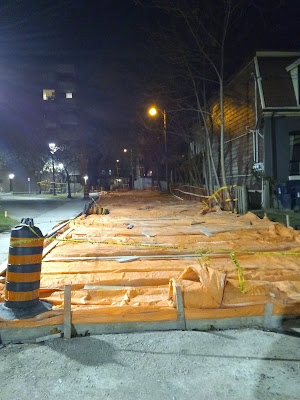
I'm sure he would have approved.
Update (6/5) As I was doing other cleaning, I came across my Northwestern commencement booklet from 1998 when I received my MS degree. It turns out that Christo and Jeanne-Claude were granted honorary doctorates at that ceremony, though I don't believe they actually spoke more than a few words of thank you. It doesn't appear that they wrapped anything in Evanston that year, though there was a Christo and Jeanne-Claude exhibit at the Block Gallery in 2000 (possibly set in motion in 1998). I was living in New York in 2000 so didn't get around to that exhibit. So that is another very tenuous connection. That (1998) actually was a pretty good year for Northwestern with a lot of "catches." They also awarded honorary doctorates to Tony Kushner and Justice Ruth Bader Ginsberg. Justice Ginsberg gave the commencement speech. I did stumble across the speech as printed in the student newspaper, but I don't have it at my fingertips and oddly it doesn't appear to be in their on-line archives. If I run across it again, I will scan it and post it on its own page on the blog.
I came onto the scene well after his wrapping of the MCA in Chicago back in 1968-69. This was his first major wrap accomplished in the US. The MCA website has some interesting details about the project. As it happens this is the original location of the MCA, on Ontario St. I managed to make it there twice, including one time for a Andres Serrano exhibit. In a lot of ways, I still preferred this location, which was much more scaled back and almost a secret just for those in the know, over the large building that now sits just east of the pumping station. That doesn't mean I have enjoyed some of the exhibits in the enlarged space, but I do feel that there is so much pointless wasted space in the building itself that I just can't approve of it. The grassy area in back of the new museum is nice though, and I've listened to a few jazz concerts there.
I never really paid that much attention to what Christo was up to, but for some reason or other, I heard about his proposed project in Central Park - the Gates, which apparently took years, if not decades, to finally get off the ground. I remember being pretty ambivalent about it, feeling that it was a lot of fuss to justify this project, since Central Park wasn't really supposed to be commercialized. While it does help that Christo and Jeanne Claude did pay for the materials and the installation themselves (and never had major corporate sponsors), I would be surprised if they covered all the security for the project, to say nothing of all the time that city bureaucrats spend dealing with permits and approvals...
Nonetheless, I actually made it out to New York on Feb. 12, 2005 and saw The Gates for myself, in fact I saw some of the unfurling of the gates and walked along for a while in the "parade" they had going. (I think given the size of the installation, there were multiple openings. I'm quite sure I wasn't watching Christo himself unfurl anything.) It was a bit more interesting in person than I had imagined, and I feel I more or less got into the spirit of the thing. While I probably did take a few photos, these are not mine.


At this point, I can't remember if I had needed to go to New York on a business trip and conveniently arranged to make out on the opening weekend, or if it truly was a bit random, and I just happened to go at that time, and then decided I might as well head over to Central Park. In any event, they were passing out small squares of the fabric that made up the "gates," and I still have two of these squares (which almost makes up for not snagging a porcelain sunflower seed or two from Ai Weiwei's Tate London exhibit when they were still letting the public walk through it). I was doing some cleaning up of my archives and came across one of them last night, which seems especially propitious.

What's even more amusing, at least to me, is that over the winter they were doing some major reconstruction of the street one street down from my house. For whatever reason they had to wrap the poured concrete up in orange fabric, so for one night, we had our own personalized Christo experience.


I'm sure he would have approved.
Update (6/5) As I was doing other cleaning, I came across my Northwestern commencement booklet from 1998 when I received my MS degree. It turns out that Christo and Jeanne-Claude were granted honorary doctorates at that ceremony, though I don't believe they actually spoke more than a few words of thank you. It doesn't appear that they wrapped anything in Evanston that year, though there was a Christo and Jeanne-Claude exhibit at the Block Gallery in 2000 (possibly set in motion in 1998). I was living in New York in 2000 so didn't get around to that exhibit. So that is another very tenuous connection. That (1998) actually was a pretty good year for Northwestern with a lot of "catches." They also awarded honorary doctorates to Tony Kushner and Justice Ruth Bader Ginsberg. Justice Ginsberg gave the commencement speech. I did stumble across the speech as printed in the student newspaper, but I don't have it at my fingertips and oddly it doesn't appear to be in their on-line archives. If I run across it again, I will scan it and post it on its own page on the blog.
Subscribe to:
Posts (Atom)