I managed to see a great many of the top European cities during my relatively short sojourn there (2005-7). I think I will list the cities that I would like to see in potential linked-up tours, but then I will simply mark with an x if this would actually be a return visit. I think we're still a minimum of 3 years away before I would consider taking the kids, since my idea of a vacation to these places is mostly to take in the cultural sites, and that simply won't work if they 1) don't have the stamina or 2) are completely resistant to the idea of spending so many hours in museums. I can tell that Madrid, Vienna, Berlin and Munich would all be major challenges. Paris, Amsterdam and Prague have more attractions to compensate for the museums, but that does assume we could schedule a day off from museum-going...
These aren't precisely ranked, but just trips that I would like to take before I get too old to enjoy them.
Paris(x) - London(x) - Oxford - Cambridge(x)
(The trip we would probably make first.)
Germany: Munich - Frankfurt - Cologne - Berlin(x) - Leipzig? - Dresden??
Italy: Rome(x) - Florence - Venice - Milan?
Spain: Madrid(x) - Barcelona
Amsterdam(x) - Rotterdam?
Prague(x)
Brussels ?
Geneva ? - Zurich ?
Vienna(x) ??
Stockholm ??
Russia: St. Petersburg - Moscow
(As mentioned before, this is very low on the list, but never say never.)
Cairo
(As much as I would love to see the Pyramids, I don't foresee a stable situation in Egypt anytime soon.)
Mexico City ?
(To see the great murals, particularly by Diego Rivera)
Beijing ?? - Shanghai ?? - Hong Kong ??
(Most likely I would only go in conjunction with work, just as I doubt I would visit Australia if there wasn't a work connection.)
Thursday, September 3, 2015

Wednesday, September 2, 2015
Shifting artistic reputations
I had plenty of opportunity to ponder just why do I spend so much time in art museums on this trip. But that question is usually easily answered when I turn the corner and see another masterwork. I actually find that I can identify a few dozen artists by their visual style, including quite a few of the abstract expressionists! I know of people that can do this for jazz musicians (and there are some who claim to be able to do this for soloing classical performers), but I simply do not have that kind of ear, which certainly begs the question of why do I listen to this kind of music when my ear just does not recognize these distinctions. Sadly, this is not an era where having a very good eye for visual arts carries many tangible rewards...
I've spent some time thinking about how I would rate artists,* basically from the Impressionist era on up. It is a bit of a fool's errand, since it is all so personal. There are general trends of course, and I will discuss briefly how my views do or do not align with the mainstream. At any rate, mainstream views of art change over time (though perhaps less quickly than the literary canon), and certainly my tastes have shifted. (I don't rate Franz Kline nearly as high now as I used to, for example.) For better or worse, this is my list of my favorite artists:
Franz Kline, Mark Tobey, Robert Motherwell, Clyfford Still, Helen Frankenthaler & Adolph Gottlieb
Then in a big jumble from 23-45 I have another bunch of artists that would be difficult to rank:
Joseph Cornell
Camille Pissarro
Jean-Édouard Vuillard
Romare Bearden
George Segal
Roy Lichtenstein
Lawren Harris
Jasper Johns
René Magritte
John Sloan
Jackson Pollack
Lee Krasner
Joan Mitchell
Ben Nicholson
Stanley Spencer
Tom Thomson
Max Weber
Joan Miró
Juan Gris
Georges Braque
Lee Bontecou
Louise Bourgeois
Claes Oldenburg/Red Grooms (tie)
I'm sure I'm forgetting a few, but these are generally the artists who have inspired me enough to buy one (or more) monographs on their work. From this you can tell that I really don't care that much about art prior to the Impressionists, though I do have a soft spot for Rembrandt, Vermeer, Titian, el Greco, Goya and Hieronymus Bosch. If I were to open up the list, they would certainly push out a few of these artists. Nonetheless, I generally don't care much for rural landscapes (with the exception of Monet and Cezanne), so I was generally underwhelmed and even a little bored by the current AGO exhibition. I do tend to like urban scenes (Pissarro and John Sloan and Caillebotte to a certain extent and even Stuart Davis at a certain point in his career).
I definitely favor painters, though there are a few sculptors on the list. I decided to skip over photographers completely (perhaps another list for another day).
While I do like abstract expressionism, I tend to sort of absorb it quickly and move on. Quite a few of the abstract expressionists are a bit interchangeable, and they kind of fall into and out of favor depending on the piece (I suppose I do tend to rank Franz Kline and Mark Tobey towards the top). Pollock and Krasner and Mitchell are just a bit lower, whereas I am just not as interested in Rothko or de Kooning and I actively dislike Cy Twombly, who is actually more out of the Pop era, but has a style more akin to the expressionists, at least some of the time.
I generally like figurative painters who are not entirely straight-forward. This probably explains why Chagall and Beckmann are so high (probably the one area where I depart the most from conventional wisdom). I don't like the simple Pop artists, but I find Rosenquist's juxtapositions interesting. If I was only looking at their early work, I probably would not have put either Lichtenstein or Jasper Johns on the list, but both came up with more interesting work as they matured. I particularly like Johns's take on the Four Seasons (apparently if I could come up with $175,000 I could buy the set...)

Am I completely consistent? Of course not. There are a few artists here who are on the list mostly on the strength of a single painting, such as Max Weber's Chinese Restaurant at the Whitney.
But there are other one-hit wonders I have left off. I think for Paul Gauguin there are just as many paintings that interest me as make my skin crawl a bit, though ultimately, it's probably just a feeling that I should not reward colonization or colonizers that truly keeps him off my list.
This is probably the most intriguing painting from the earlier part of his career (typically on display at the Albright-Knox):
For some reason, this doesn't rank (with me) quite as highly as Chagall's somewhat similar treatment, which is on view at the Art Institute of Chicago.
While it is tempting, I will try to resist the temptation to put up my favorite one or two paintings by all the artists on the list. I'm sure I'll figure out a way at some point to get my favorites on the blog one way or another.
I will end with a somewhat labored comparison between birth and death as portrayed by Beckmann and Chagall.
Again, the Chagall painting can be viewed in Chicago.
It is certainly arguable that death is ever-present as this peasant woman goes into labour, but it is just as interesting how there is such a jumble of activity around her, and in fact, she is somewhat off-center.
Beckmann's Birth painting is a somewhat simpler composition, though there are certainly quite a few bystanders.
Beckmann's Death is closer in spirit to Chagall, with reversed figures hugging the ceiling.
(I was fortunate enough to see both of these at the 2003 MoMA show.)
To close out, I will end with Chagall's The Falling Angel, which is in a private collection, but is occasionally lent to major museums. I have not seen it in person.
The color schemes are different, and Beckmann uses a much thicker line throughout, but somehow I see quite a few similarities (filling the frame with candles, skulls, musical instruments, magical birds and other animals) in the dream-like, sometimes nightmarish paintings by these two, who are both so high on my list of favorite artists.
* I suppose this is a companion piece to my ranking of art museums from the early days of this blog. That's still a solid list though I might bump Museo Reina Sofía down several slots and move the St. Louis Museum of Art up a few. I still haven't seen the Hermitage nor the Uffizi. I'm far more likely to get around to the latter than the former, at least in the near future.
I've spent some time thinking about how I would rate artists,* basically from the Impressionist era on up. It is a bit of a fool's errand, since it is all so personal. There are general trends of course, and I will discuss briefly how my views do or do not align with the mainstream. At any rate, mainstream views of art change over time (though perhaps less quickly than the literary canon), and certainly my tastes have shifted. (I don't rate Franz Kline nearly as high now as I used to, for example.) For better or worse, this is my list of my favorite artists:
- Pablo Picasso
- Henri Matisse
- Paul Cezanne
- Vincent Van Gogh
- Max Beckmann
- Marc Chagall
- Wassily Kandinsky
- Giorgio de Chirico
- Georgia O'Keeffe
- Stuart Davis
- Gustave Caillebotte
- Paul Klee
- James Rosenquist
- Philip Guston
- Edward Hopper
- Claude Monet
Franz Kline, Mark Tobey, Robert Motherwell, Clyfford Still, Helen Frankenthaler & Adolph Gottlieb
Then in a big jumble from 23-45 I have another bunch of artists that would be difficult to rank:
Joseph Cornell
Camille Pissarro
Jean-Édouard Vuillard
Romare Bearden
George Segal
Roy Lichtenstein
Lawren Harris
Jasper Johns
René Magritte
John Sloan
Jackson Pollack
Lee Krasner
Joan Mitchell
Ben Nicholson
Stanley Spencer
Tom Thomson
Max Weber
Joan Miró
Juan Gris
Georges Braque
Lee Bontecou
Louise Bourgeois
Claes Oldenburg/Red Grooms (tie)
I'm sure I'm forgetting a few, but these are generally the artists who have inspired me enough to buy one (or more) monographs on their work. From this you can tell that I really don't care that much about art prior to the Impressionists, though I do have a soft spot for Rembrandt, Vermeer, Titian, el Greco, Goya and Hieronymus Bosch. If I were to open up the list, they would certainly push out a few of these artists. Nonetheless, I generally don't care much for rural landscapes (with the exception of Monet and Cezanne), so I was generally underwhelmed and even a little bored by the current AGO exhibition. I do tend to like urban scenes (Pissarro and John Sloan and Caillebotte to a certain extent and even Stuart Davis at a certain point in his career).
I definitely favor painters, though there are a few sculptors on the list. I decided to skip over photographers completely (perhaps another list for another day).
While I do like abstract expressionism, I tend to sort of absorb it quickly and move on. Quite a few of the abstract expressionists are a bit interchangeable, and they kind of fall into and out of favor depending on the piece (I suppose I do tend to rank Franz Kline and Mark Tobey towards the top). Pollock and Krasner and Mitchell are just a bit lower, whereas I am just not as interested in Rothko or de Kooning and I actively dislike Cy Twombly, who is actually more out of the Pop era, but has a style more akin to the expressionists, at least some of the time.
I generally like figurative painters who are not entirely straight-forward. This probably explains why Chagall and Beckmann are so high (probably the one area where I depart the most from conventional wisdom). I don't like the simple Pop artists, but I find Rosenquist's juxtapositions interesting. If I was only looking at their early work, I probably would not have put either Lichtenstein or Jasper Johns on the list, but both came up with more interesting work as they matured. I particularly like Johns's take on the Four Seasons (apparently if I could come up with $175,000 I could buy the set...)

Am I completely consistent? Of course not. There are a few artists here who are on the list mostly on the strength of a single painting, such as Max Weber's Chinese Restaurant at the Whitney.
 |
| Max Weber, Chinese Restaurant, 1915 |
But there are other one-hit wonders I have left off. I think for Paul Gauguin there are just as many paintings that interest me as make my skin crawl a bit, though ultimately, it's probably just a feeling that I should not reward colonization or colonizers that truly keeps him off my list.
This is probably the most intriguing painting from the earlier part of his career (typically on display at the Albright-Knox):
 |
| Paul Gauguin, The Yellow Christ, 1889 |
For some reason, this doesn't rank (with me) quite as highly as Chagall's somewhat similar treatment, which is on view at the Art Institute of Chicago.
 |
| Marc Chagall, White Crucifixion1938 |
While it is tempting, I will try to resist the temptation to put up my favorite one or two paintings by all the artists on the list. I'm sure I'll figure out a way at some point to get my favorites on the blog one way or another.
I will end with a somewhat labored comparison between birth and death as portrayed by Beckmann and Chagall.
Again, the Chagall painting can be viewed in Chicago.
 |
| Marc Chagall, Birth, 1911-12 |
It is certainly arguable that death is ever-present as this peasant woman goes into labour, but it is just as interesting how there is such a jumble of activity around her, and in fact, she is somewhat off-center.
Beckmann's Birth painting is a somewhat simpler composition, though there are certainly quite a few bystanders.
 |
| Max Beckmann, Birth, 1937 |
Beckmann's Death is closer in spirit to Chagall, with reversed figures hugging the ceiling.
 |
| Max Beckmann, Death, 1938 |
(I was fortunate enough to see both of these at the 2003 MoMA show.)
To close out, I will end with Chagall's The Falling Angel, which is in a private collection, but is occasionally lent to major museums. I have not seen it in person.
 |
| Marc Chagall, The Falling Angel, 1923-47 |
The color schemes are different, and Beckmann uses a much thicker line throughout, but somehow I see quite a few similarities (filling the frame with candles, skulls, musical instruments, magical birds and other animals) in the dream-like, sometimes nightmarish paintings by these two, who are both so high on my list of favorite artists.
* I suppose this is a companion piece to my ranking of art museums from the early days of this blog. That's still a solid list though I might bump Museo Reina Sofía down several slots and move the St. Louis Museum of Art up a few. I still haven't seen the Hermitage nor the Uffizi. I'm far more likely to get around to the latter than the former, at least in the near future.
St. Louis Art Museum (Beckmann mania)
I spent the morning at our St. Louis office, meeting a few folks and talking about a project that was coming back to life. Then one of the folks in the office took me to lunch and actually dropped me off at the St. Louis Art Museum, which was awfully kind of him. It's a very nice museum (and free!) but it is in the middle of a large park, and it is quite a hike to the nearest Metrolink station. (The trolley from the museum to the station is just not frequent enough, and I ended up making the walk at the end of the visit, but, at that point, time was not such a pressing issue.)
This was my third visit to the museum, and the first since they completed a renovation/expansion. I was favorably impressed. They moved the European collection to the ground floor, and the modern/contemporary to the new gallery space, also on the main floor. I think this is the strongest part of their collection, and it was good to have it easily accessible. There were some interesting American paintings left upstairs (an early Philip Guston and Ben Shahn's The Red Stairway and an O'Keeffe and a Stuart Davis and a quite nice Norman Lewis piece) but in general the highlights are all on the main floor.
 |
| Ben Shahn, The Red Stairway, 1944 |
 |
| Norman Lewis, Twilight Sounds, 1947 |
 |
| Stuart Davis, Feasible #2, 1949-51 |
Unlike in years past, they have spread the Max Beckmann paintings out a bit. There was still a solid core in the central room, but there were a few other ones in different rooms. I believe there were 13 Beckmanns on display in various parts of the museum, including the triptych The Acrobats. Astonishingly, they have 39 paintings and a number of prints/etchings, making this truly the greatest Beckmann collection in the world.
I agree that seeing all 39 would probably be a bit exhausting, but it must be quite difficult to decide which to show and which to put in storage. The only ones that I am aware of that I do feel should have been on display are The Dream and Masquerade. I probably saw them on a previous visit, but simply cannot be certain. (However, I just checked and both were on view in the 2003 Beckmann exhibition at MoMA Queens, so I have seen them in person. Notably, The Acrobats was not part of that exhibit, nor was Hotel Lobby (from the Albright-Knox collection.)) This means that I have now definitely seen 7 of the 9 triptychs and most likely I did see Blindman's Bluff while in Minneapolis to make it 8 of 9, but I'll just have to make sure I see it next time I am in the Twin Cities.
 |
| Max Beckmann, The Dream, 1921 |
 |
| Max Beckmann, Masqerade, 1948 |
In terms of the Beckmann on display, it is a total embarrassment of riches. I'll just put up 4 that really caught my attention.
 |
| Max Beckmann, The Harbor of Genoa, 1927 |
 |
| Max Beckmann, Studio (Nude and Sculpture), 1946 |
The Harbor of Genoa is a relatively early painting, whereas Studio was painted while Beckmann was still in exile in Holland. Due to postwar shortages, it is painted on bed linen, incredibly enough. Beckmann and his wife were able to leave Europe and move to the U.S. in 1947 (first Saint Louis where he taught art (filling in as Philip Guston's replacement!) and then New York).
 | |||
| Max Beckmann, Fisherwomen, 1948 |
And of course, there is the triptych Acrobats, which is even more dream-like.
 |
| Max Beckmann, Acrobats, 1939 |
 | ||
| Lucas Cranach the Elder, Judgement of Paris, 1530 |
 |
| Claude Monet, Water Lilies, c 1915-26 |
 |
| Giorgio de Chirico, The Transformed Dream, 1913 |
 |
| Juan Gris, Still Life with Guitar, 1920 |
 |
| Otto Muller, Three Girls in a Wood, 1920 |
 |
| Emilio Vedova, Factory, 1949 |
 |
| Ben Nicholson, Half Moon, 1959 |
I thought the modern paintings were interesting (Guston, Hofmann, Kline, Motherwell, and even George Segal), but not quite blog-worthy, as they weren't the best I've seen of these artists. However, I do offer up this minor homage to Thomas Struth of some visitors taking a photo of one of the modern pieces (Robert Colescott's Christina's Day Off), which itself is quite amusing.

All in all, this is quite an incredible museum; in my view, it ranks just slightly below the Art Institute of Chicago for title of best art museum in the Midwest.
Monday, August 31, 2015
Biking in Toronto
I know I've mentioned that I am biking fairly often in Toronto, though I don't know how much I've actually written about the conditions. I'd have to say that biking here is ok, not great. I am clearly not up for biking year-round here, so that makes it a lot more like Chicago unlike Vancouver or Cambridge where I basically did bike year-round.
Vancouver was interesting, since if you were biking north of King Edward (roughly 25th Ave), then cars were reasonably wary of you and gave you a bit of extra space, but the drivers south of King Edward were generally very suburban in outlook and drove far too fast for the local conditions. Toronto drivers are fairly aggressive, not dissimilar to Chicago drivers. In general, both Vancouver and Chicago have wider streets which make it easier to carve out marked lanes for cyclists. There are a few streets I try to avoid at all costs, primarily Queen and King, since between the narrow streets, parked cars and street cars, cycling is a huge challenge. Unfortunately, the Trump Tower suffered some kind of malfunction today (so many punch lines...) and Adelaide St. was closed off, which meant I had no choice but to go up Queen for a stretch.
The conditions of bike lanes in Toronto is often poor, particularly Shuter Street, which I take essentially every day I ride. But Dundas isn't too bad nor are the new bike lanes on Richmond and Adelaide. I do like the fact that Toronto is much flatter than Vancouver, though there are still some hills, particularly if you are heading north.
The bike racks (or rather bike rings) throughout the city are a particularly lousy design, but the city seems to have doubled-down on them. Every time I think it couldn't get worse, I go find some place that has bike racks from the 1970s or something. The one by the No Frills on Carlaw are perhaps the worst bike racks I've seen in my life.
So things could definitely be better...
I was working quite late today (and then took a bit more time to get my contribution off to Sing-for-Your-Supper* before heading home) and it was actually dark before I left. Though I had bike lights, it was really uncomfortable making the ride home. Not only did a cop car almost turn into me (without signaling), a van came extremely close to clipping me, while I was on the bridge crossing the Don River. I just can't see doing much more of this cycling in the dark, whereas I had a somewhat safer (yet hilly!) route in Vancouver that I could handle in the dark. Cambridge was interesting, as I was so freaked out by going through this park in the dark that I changed my entire route in the winter, but it was still reasonably safe. Of course, I say that but the only time I was hit by a car was in Cambridge, plus the time I clipped a car that passed me and then pulled all the way to the left, blocking my path. So many drivers, so many assholes...
* While I don't want to go flouncing about, this is the last time I will submit anything to Sing-for-Your-Supper if this piece is not accepted. I simply have more important things to do, and the longer pieces I want to work on won't fit their format anyway. I did think this new piece was amusing, though a bit under-developed. At one point I envisioned a whole chorus chanting something about the river rising (perhaps a bit of a reaction to thinking that the Louisiana section of Svitch's piece was the weakest and that I could do something a bit more interesting), but I substituted a homeless man who sort of sings/hums Johnny Cash's Five Feet High and Rising. (Check that out here.) If I had a few more pages I would probably have had the Clarice character start fantasizing about restarting the human race with the two (gay) men that ended up in her clutches. Probably just as well to leave that somewhat implied but just out of frame. I am reasonably proud that I knocked out the 10 pages of dialogue in just about 2 hours. You can read it here, and I will certainly post again if it is accepted.
Sunday, August 30, 2015
Last gasps of August
I'm actually glad that we have one more day of August,* but it is definitely starting to feel like fall. I wouldn't say this was a particularly lazy day, but I didn't push quite as hard as I often do, and I can picture actually relaxing a bit on the weekends in Sept. and Oct. (though one will actually be kind of busy helping out on a block party and then I make one more long weekend trip to Stratford). I'm sort of debating whether to buy a hammock for the backyard porch or if I wouldn't use it enough until next year.
I took my daughter to the Textile Museum, and I enjoyed the exhibit on Artist Textiles. I even have bought the catalog for my step-mother who is a textile artist in North Carolina. The exhibit runs one more month and is quite nice, though I would probably recommend going on Wed. evening, when it is pay what you can. Then we went over to the AGO and saw a few paintings, and went to the family area, though mostly she wanted to play ping pong. I guess her creative juices had been exhausted in Milwaukee.
Sunday I did the groceries and I even trimmed the tree in the front yard. (I hope I didn't trim too much and inadvertently kill it, but I think it looks pretty hearty.) I had time to run down and see Jeffrey by Paul Rudnick at the Red Sandcastle Theatre. It plays for one more weekend. I enjoyed it, but I think it would have gone over a bit better with a bigger audience. I felt that it was just a bit like Fierstein's Torch Song Trilogy -- it is never entirely clear what is real and what is imagined and what is a slightly amped up version of reality. I didn't mind that too much in Torch Song, but here the main dilemma is a gay man (an actor/waiter) falling in love with an HIV+ bartender, but petrified of being hurt when this potential boyfriend gets ill. Many of the more touching scenes between them fall right after the fantasy moments, which somewhat undercuts them. The director actually played just about everything straight, except for a scene where another friend has just died of AIDS and comes back to give Jeffrey relationship advice, while I gather the movie version played up the fantastical elements. I wouldn't ever argue that only certain people get to write about certain topics, but I have to say it was a bit easier to swallow some of the main character's weaknesses when I confirmed that Rudnick was gay (the same way I was more willing to accept Kushner writing about a (largely) morally bankrupt gay character in The Intelligent Homosexual's Guide...). I still am not sure I buy the bit about the Catholic priest or the ending where Jeffrey finally agrees that to live life one has to make oneself open to experiencing pain and suffering but at the same time allowing love to grow, even in the face of uncertainty. It was a lot of personal growth in about a 5-10 minute span. Anyway, it was worth seeing. I'll probably see their production of Larry Kramer's The Normal Heart next year, even though I have already seen the play. (I think this company seems to specialize in gay theatre.)
After all this, we had a nice moment where three of us went outside and sat on the deck and read. I finished Elizabeth Taylor's A View of the Harbour and just started Barbara Comyns's The Juniper Tree. This is the first book of the long pile of books that the library sent me. I will really have to step up the pace if I am going to get through most of them, and it has certainly disrupted my reading list. I guess that is it for now. Tomorrow I will try to write up another museum visit from the recent trip to the States.
* That gives me another day to write something for Sing-for-your-supper. I have an interesting idea I've been kicking around, but if this isn't accepted, it is the last time I bother. It's not entirely wasted writing time, however. I think of all the things that got rejected, several have at least helped me improve my dialogue and pacing.
Saturday, August 29, 2015
Buffalo (art) on the move
I believe I discussed this a while back, but we had attempted to visit the Albright-Knox Museum in Buffalo on the trip we made to Niagara/Buffalo to deal with our permanent resident paperwork (which had to be processed at a border crossing). Due to unusually long border delays and bad Google directions, we weren't able to make it to the museum. That was particularly unfortunate as they had temporarily reinstalled 80 of their masterworks, which were about to go back on tour. In Dec., I made it to the museum on my own and found that they still had some amazing pieces. I wrote about that here.
To kick off this long trip, I decided I would go through Buffalo en route to St. Louis. Not only would the plane fare be cheaper, but I could visit the Albright-Knox again. I also knew that their traveling exhibition would be in Milwaukee, which we planned to visit before returning to Chicago. So I'll combine both of these museum visits into one longish post, and write about the other museums I visited separately.
The bus down wasn't too bad, though the promised wireless wasn't working. I was totally beat from preparing for the trip (not just packing but doing some cleaning as well). I had planned to do a fair bit of reading, but just didn't have the energy so I mostly slept on the way down.
Downtown Buffalo was depressing as ever, but it didn't take too long to get to the museum on the local bus system. They had a massive exhibit on video art take over the special collections side, and some were quite interesting, including 3 full pieces by William Kentridge (I sat through two of them). I think my problem with video art is that you have so little control over them; you so frequently come in during the middle and have to wait for the piece to loop through. That's not so bad for a 5 minute piece, but some of these pieces were substantially longer. (In a different gallery they were playing these long-form pieces that were very similar to the Krewmaster cycle (including in length) but were animated.) I did spend a fair bit of time inspecting the different pieces before I went back to the main gallery.
I have to admit that this time wasn't as good as the previous visit. Quite a number of the pieces I'd seen were packed away (possibly to make space for the masterworks which should be returning in October). Generally, the abstract expressionists were still there and a few others I remembered, like Milton Avery's Bucolic Landscape. However, the large room filled with Clyfford Still was now filled with much lower quality paintings. On the other hand, they had a few solid pieces from the Pop era and beyond.
I was pleased to see George Segal's Cinema and pieces by Rauschenberg and Rosenquist.

The Nomad piece is particularly multi-media with a plastic bag of some type hanging from the top and a broken chair at the bottom. It put me in mind of a balloonist having a very, very bad day... I don't even know that I've ever seen or heard of this piece before, since I am unaware of Rosenquist doing the multi-media thing, whereas it is quite expected from Rauschenberg, though his piece in the museum (Ace) was actually fairly restrained. Anyway, those new Pop-era pieces were basically the highlight of the Buffalo leg of the trip, and I will definitely want to hold off on another trip to the Albright-Knox until they reintegrate the masterworks which were on view in Milwaukee.
With that, I will skip over more than a week of calendar time to get to the Milwaukee trip. I had no end of trouble trying to book the tickets on the Amtrak website, but this isn't a route that gets oversold, so we just walked over in the morning and bought tickets for the 10:30 train. This dropped us off just before noon, and we were met by my cousin who lives in Wisconsin. We drove over to the Milwaukee Art Museum and ended up eating there in the cafe.
I was somewhat surprised and a bit disappointed to learn that the entire main collection of the Milwaukee Art Museum was offline with the galleries being renovated and the art then being reinstalled at some point in the late fall. Well, it may just mean that if we are in Chicago for more than a week next summer, we'll make another trip up.
It also meant that we focused our attention on the special exhibit, i.e. the paintings on loan from the Albright-Knox. This was an impressive core collection, and I do hope that most of it is on display the next time I visit Buffalo.
The best way to get a sense of the paintings on loan from the collection is to buy or borrow the catalog titled The Long Curve (some details here). (Obviously it is better to go in person if that is an option...) I was pleased that because the Albright-Knox allows photography, they didn't put any restrictions on photography in the special exhibit (other than no flash photos), which I thought was very generous of them. I will post just a few that struck me, but really all the pieces were quite nice.
After viewing the exhibit, my cousin drove back home and we went to do some art of our own, which I've memorialized here. Then we met another friend who lives in Milwaukee at the Public Market to catch up a bit, and then walked back to the Amtrak station. A pleasant & not overwhelming day trip to Milwaukee. I'll have to keep this in mind to not try to overload the kids on these various trips, even though it cuts against my nature.

At any rate, this wasn't the end of my museum going, as I managed to sneak one more quick peek at the Chicago Cultural Center on Monday and a very short trip to the MCA on Tuesday. I'll be discussing these trips, as well as the longer trips to the St. Louis Art Museum and the Art Institute of Chicago, in the near future. But for now, I'll think I'll end with my son pondering the ineffable in the form of Rothko's Orange and Yellow.
To kick off this long trip, I decided I would go through Buffalo en route to St. Louis. Not only would the plane fare be cheaper, but I could visit the Albright-Knox again. I also knew that their traveling exhibition would be in Milwaukee, which we planned to visit before returning to Chicago. So I'll combine both of these museum visits into one longish post, and write about the other museums I visited separately.
The bus down wasn't too bad, though the promised wireless wasn't working. I was totally beat from preparing for the trip (not just packing but doing some cleaning as well). I had planned to do a fair bit of reading, but just didn't have the energy so I mostly slept on the way down.
Downtown Buffalo was depressing as ever, but it didn't take too long to get to the museum on the local bus system. They had a massive exhibit on video art take over the special collections side, and some were quite interesting, including 3 full pieces by William Kentridge (I sat through two of them). I think my problem with video art is that you have so little control over them; you so frequently come in during the middle and have to wait for the piece to loop through. That's not so bad for a 5 minute piece, but some of these pieces were substantially longer. (In a different gallery they were playing these long-form pieces that were very similar to the Krewmaster cycle (including in length) but were animated.) I did spend a fair bit of time inspecting the different pieces before I went back to the main gallery.
I have to admit that this time wasn't as good as the previous visit. Quite a number of the pieces I'd seen were packed away (possibly to make space for the masterworks which should be returning in October). Generally, the abstract expressionists were still there and a few others I remembered, like Milton Avery's Bucolic Landscape. However, the large room filled with Clyfford Still was now filled with much lower quality paintings. On the other hand, they had a few solid pieces from the Pop era and beyond.
I was pleased to see George Segal's Cinema and pieces by Rauschenberg and Rosenquist.

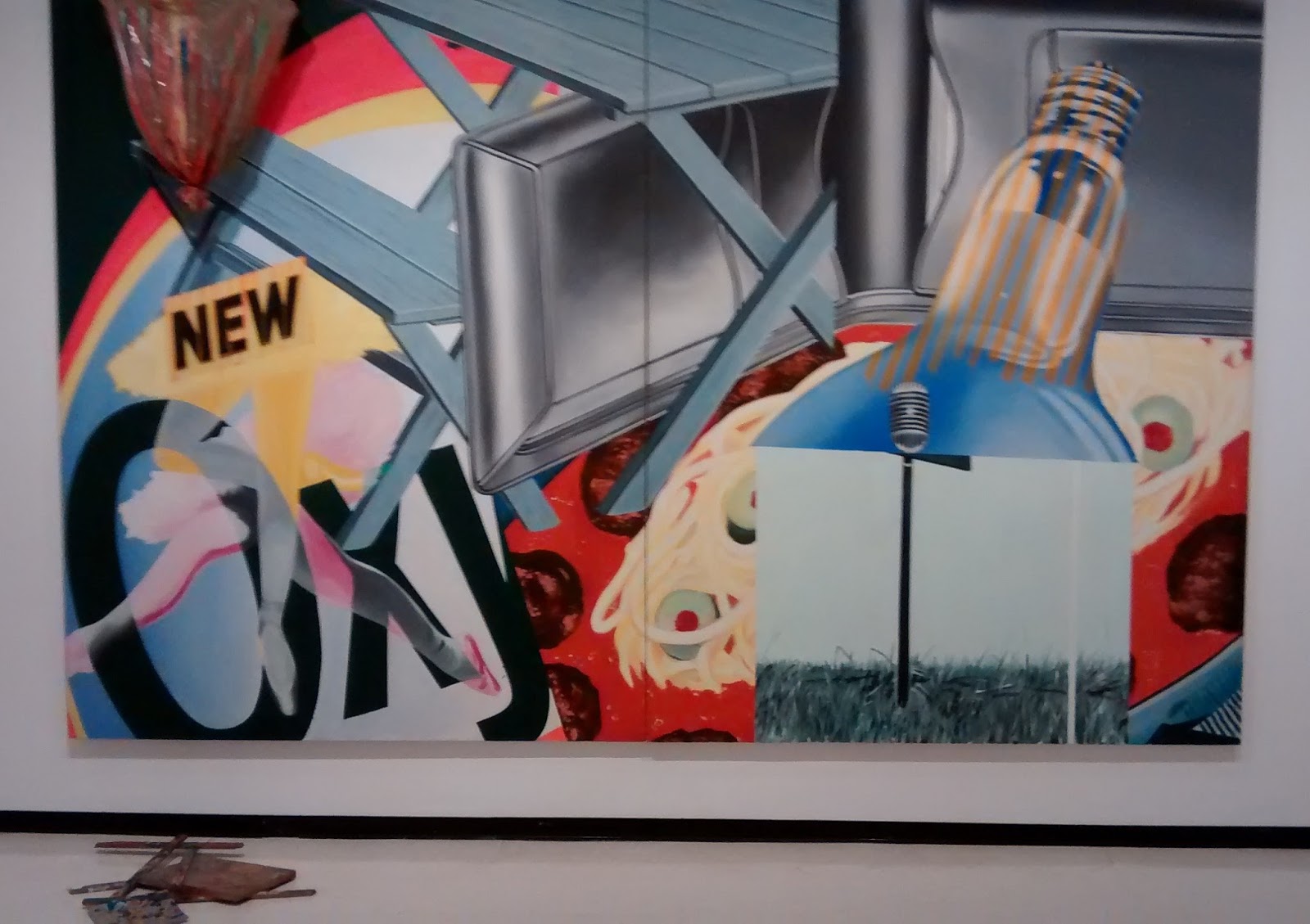 |
| James Rosenquist, Nomad, 1963 |
The Nomad piece is particularly multi-media with a plastic bag of some type hanging from the top and a broken chair at the bottom. It put me in mind of a balloonist having a very, very bad day... I don't even know that I've ever seen or heard of this piece before, since I am unaware of Rosenquist doing the multi-media thing, whereas it is quite expected from Rauschenberg, though his piece in the museum (Ace) was actually fairly restrained. Anyway, those new Pop-era pieces were basically the highlight of the Buffalo leg of the trip, and I will definitely want to hold off on another trip to the Albright-Knox until they reintegrate the masterworks which were on view in Milwaukee.
With that, I will skip over more than a week of calendar time to get to the Milwaukee trip. I had no end of trouble trying to book the tickets on the Amtrak website, but this isn't a route that gets oversold, so we just walked over in the morning and bought tickets for the 10:30 train. This dropped us off just before noon, and we were met by my cousin who lives in Wisconsin. We drove over to the Milwaukee Art Museum and ended up eating there in the cafe.
I was somewhat surprised and a bit disappointed to learn that the entire main collection of the Milwaukee Art Museum was offline with the galleries being renovated and the art then being reinstalled at some point in the late fall. Well, it may just mean that if we are in Chicago for more than a week next summer, we'll make another trip up.
It also meant that we focused our attention on the special exhibit, i.e. the paintings on loan from the Albright-Knox. This was an impressive core collection, and I do hope that most of it is on display the next time I visit Buffalo.
The best way to get a sense of the paintings on loan from the collection is to buy or borrow the catalog titled The Long Curve (some details here). (Obviously it is better to go in person if that is an option...) I was pleased that because the Albright-Knox allows photography, they didn't put any restrictions on photography in the special exhibit (other than no flash photos), which I thought was very generous of them. I will post just a few that struck me, but really all the pieces were quite nice.
 |
| Wassily Kandinsky, Fragment I for Composition VII, 1913 |
 |
| Stuart Davis, New York Waterfront, 1938 |
 |
| Max Beckmann, Hotel Lobby, 1950 |
 |
| Helen Frankenthaler, Tutti-Fruitti, 1966 |
After viewing the exhibit, my cousin drove back home and we went to do some art of our own, which I've memorialized here. Then we met another friend who lives in Milwaukee at the Public Market to catch up a bit, and then walked back to the Amtrak station. A pleasant & not overwhelming day trip to Milwaukee. I'll have to keep this in mind to not try to overload the kids on these various trips, even though it cuts against my nature.

At any rate, this wasn't the end of my museum going, as I managed to sneak one more quick peek at the Chicago Cultural Center on Monday and a very short trip to the MCA on Tuesday. I'll be discussing these trips, as well as the longer trips to the St. Louis Art Museum and the Art Institute of Chicago, in the near future. But for now, I'll think I'll end with my son pondering the ineffable in the form of Rothko's Orange and Yellow.
 |
| Mark Rothko, Orange and Yellow, 1956 |
Friday, August 28, 2015
9th Canadian Challenge - 2nd Review - Street of Riches
Street of Riches is the 4th novel by Gabrielle Roy (or at least the fourth translated one), coming hot on the heels of The Cashier. It is definitely in a different key than either The Tin Flute or The Cashier, as it isn't particularly tragic and it isn't concerned with matters of grace and/or redemption through suffering. I only skimmed the intro (for some reason the New Canadian Library introductions often have significant spoilers to the point I think they probably ought to just move them to the back). However, the author of the intro made a point of comparing this relatively early novel by Gabrielle Roy to Anne of Green Gables. I assume that Anne of Green Gables (or for that matter Little House on the Prairie) is relatively elegiac, celebrating a rural way of life that was already disappearing during the authors' lives (and accelerating far beyond what anyone might have expected back in the 1950s). It is possible that this book is perhaps slightly more melancholy than those other series.
Clearly Roy made some changes, but this is a fairly autobiographical piece. She did grow up in a Francophone colony in the west (Manitoba). Her father was a minor government official who did indeed resettle immigrants from Europe in various small towns out west and was laid off (perhaps due to a change in the ruling federal party, as suggested by the novel). Roy did start out as a teacher though was far more adventurous than the main character here and moved to Europe to study theatre (and make a living as a writer?) though she was forced to return to Canada due to the outbreak of WWII. She moved to Montreal and the rest is history...
Minor SPOILERS follow.
I don't know enough about Gabrielle's brothers and sisters to know how much is drawn directly from them, but in Street of Riches we encounter a sister who becomes a nun (and finally gives Gabrielle the yellow ribbon she so desires) and another sister who is stricken by scarlet fever or a similar disease and becomes feeble-minded and is placed in an institution. It is generally regarded as a small mercy that she passes away relatively soon after this.
One of the more amusing stories ("The Gadabouts") is about how the narrator's mother desires to go travelling so badly that she saves up money from taking sewing jobs in town and then places her other children (aside from the narrator) with neighbours or in long-term care and goes back east to Quebec on the train. (The father is away on one of his long work trips in the other direction.) Interestingly, all is forgiven after this adventure is uncovered when the mother tells her husband about how his home town looks and that she met all his living relatives and convinced them that he was an important bureaucrat and yet living in Manitoba was dreadful compared to the conditions in Quebec. Presumably, Gabrielle caught some of her mother's adventurous spirit.
While Roy recognizes that she never really understood her father and why he considered his work so important, she does paint a moving portrait of him ("The Well of Dunrea"), while at the same time, suggesting that if he had been somewhat more open-hearted at home, he would have had a more fulfilling family life. Perhaps the single most melancholy story is "By Day and by Night," which shows how sad he became after his career was cut short. He also became an insomniac and often tried to get his children to stay up with him and tempt them away from the daylight hours that their mother kept. I can well understand this attraction to the evening hours, which generally are my favourite hours.
This is a relatively slight book and with seemingly simple stories, but I did like many of them, particularly "The Gadabouts" and "By Day and by Night." I would certainly recommend it to anyone who liked Anne of Green Gables, but wanted something that had just a bit more depth to it.
Interestingly, this edition came with a bonus. Someone left behind a hand-written recipe for strawberry punch (with lots and lots of liquor) apparently from the 1970s (back when they knew how to party without all these new-fangled pharmaceuticals).
I can't vouch for the recipe, but it looks ok if one is mostly looking for fruit-flavoured liquor.

Subscribe to:
Posts (Atom)