Sunday, November 22, 2015

Ottawa -- part 2 (with more photos)

I didn't dwell on it, but I thought it was actually kind of neat that the kids first visited Ottawa after the fall of Harper.  Anyway, hopefully next time we'll score some tickets to the Parliament Building tour.  It's hard to say what the best part of the trip was, since we saw so much.  I think both the kids enjoyed the Aviation and Space Museum but agreed it would be a one-time visit.


My daughter really liked the Children's Museum, and I have to say it was probably one of the better ones I've seen in a while, though the play it encouraged was definitely more centered around learning about other cultures than moving blocks around or trying out pneumatic tubes or what have you (a bit more physics oriented).  My son feels that he is too old for a children's museum and just wanted to get through it at quickly as possible.  I thought the main area of the Museum of History (formerly the Museum of Civilization) was nice, but a bit one-note.  Essentially everything except an odd gallery of postage stamps was about First Nations culture, and, even within that framework, it was dominated by First Nations from the Pacific Northwest.  I saw very little that explored the peoples of the Arctic or near Arctic.


As a total aside, I was joking with my son about how the house he wanted to build -- totally open plan -- sounded like a wigwam.  He said he needed more space than that, so I said he should build a two story wigwam.  We riffed on that for a while and decided that The Split-level Wigwam sounded much funnier.  I think I will lift it and stick it in my novel somewhere.

My favorite museum was naturally the National Gallery.  As I mentioned, I enjoyed the Monet exhibit.  Probably my second favorite (after the one actually in the National Gallery collection) was this one from the Musee d'Orsay.

Claude Monet, The Coal-Dockers, 1875

My daughter was generally a bit bored in the National Gallery, but did enjoy the workstation where she was able to make her own art.  She also liked the big spider sculpture by Louise Bourgeois that was outside the entrance (my wife did not like this at all, especially when she saw there were spider eggs about the size of ostrich eggs up inside the sculpture).

Louise Bourgeois, Maman, 1999

Interestingly, it does not appear I posted any photos from my solo trip to the National Gallery (except a couple of Lawren Harris paintings here).  Many came out ok that time, though I was able to get better photos of a few paintings this time, include the Tom Thomson and A.Y. Jackson paintings below (my son particularly liked the Jackson).  I still couldn't get a good shot of Yvonne Housser's Cobalt, however.  Well, maybe third time lucky on our next visit.

Tom Thomson, Autumn's Garland, 1915-16

A.Y. Jackson, The Red Maple, 1914

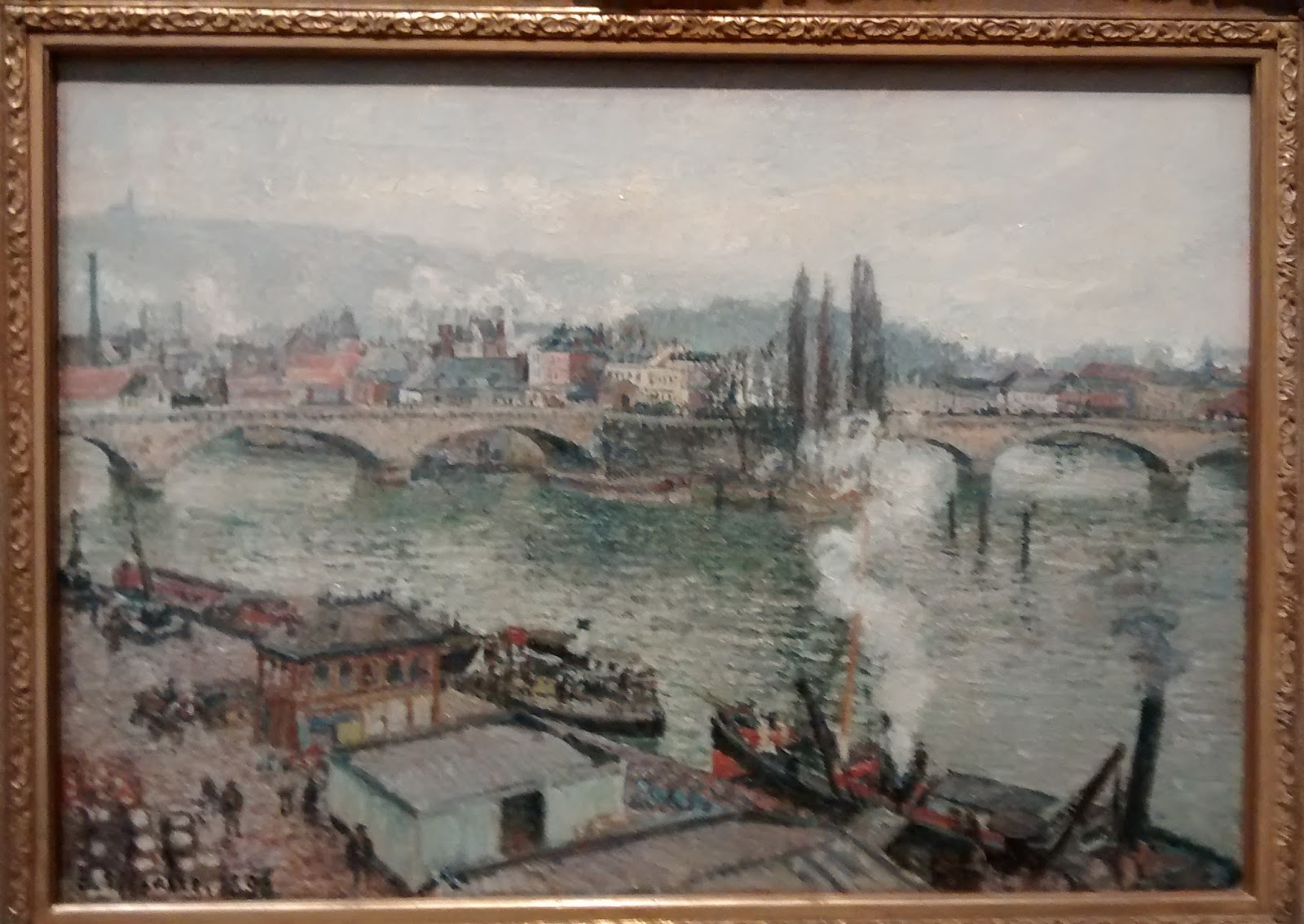
I can't possibly post all the interesting paintings, but I will add this Pissarro painting which prominently features a bridge, since it ties together so well with the Monet exhibit.

Camille Pissarro, The Stone Bridge in Rouen, Dull Weather, 1896

I was also pleased that I managed to get some better shots of George Segal's The Gas Station and Cales Oldenburg's Bedroom Ensemble.


We were getting a bit weary, but we pushed on to the Museum of Nature.  Clearly the big draw was the dinosaur bones, but the other floors had interesting exhibits as well, including this huge tarantula (that predictably thrilled my daughter and left my wife flustered).


I think that sufficiently covers the trip.  As I already mentioned Kingston was ok, but probably not a place I will visit again without a very good reason.

Saturday, November 21, 2015

No Time for Wilde

I suppose that is a bit misleading.  I just managed to get to Lady Windermere's Fan at George Brown on Thurs.  I have been working quite late for two weeks now and actually briefly debating seeing if I could switch tickets to a different date (since next week should be marginally less busy).  However, it appears that this is the last week, and there may not even be a Sunday matinee.  So that means if you haven't seen it (or planned to and gotten your tickets early), this is the last chance and you may indeed have timed out.

I enjoyed Lady Windermere's Fan quite a bit (concurring with this review), though the one small issue I had was that the characters are all supposed to be of all ages, and here they were all played by people in their early 20s.  Anyway, I actually cabbed it down, making it with 5 minutes to spare, though they held the door another 5 minutes or so.  Still, cutting it too close has been a way of life for me for a bit too long.

I had no idea how many of Wilde's famous epigrams are loaded into this play, which is quite clever and very entertaining.  My favorite was "All of us are in the gutter, but some of us are looking at the stars."  But I liked it even more when Wilde had another character flat out mock the first one for using such poetic language.  I still think The Importance of Being Earnest is a slightly better play, but I would be up for seeing this another time at some point down the road.  I wasn't sold on An Ideal Husband and will probably forgo seeing that again.  I think the only significant play by Wilde I have left to see is A Woman of No Importance.  I vaguely remember having the chance to see this, but didn't for some reason.  I probably will at some point, however.

I guess I will report back that I came teasingly close to winning the Fringe Lottery.  (I was working late again of course and had to skip the party, so I just followed the draw on Twitter.)  They pulled OS126, but I had ON126...  Apparently, there are 3 times the slots for the short program than the long program (75-90 minutes), which makes sense since it is so much easier to program around the short ones.  Still, in my case, I couldn't squeeze Straying South into 60 minutes. Still, it is something to keep in mind to aim for the 60 minute slot next year, even though I am pretty sure there are more entries and thus more competition.  Oh well.  I'll just have to finish the script and try to figure out a way to put this up myself.

Anyway, it looks like I can get at least a little sleep this weekend, which would be a good thing.

Though in fact, tomorrow I will be seeing Alan Bennett's Talking Heads (part 2) which also only has a few more days left in its run, so you have been warned.

Thursday, November 19, 2015

Back to our regular scheduled programming

I mentioned a while ago that I had a plan to read through the core novels of Nabokov, Narayan and Mahfouz.  The last time I stuck to this plan was about 2 years ago while I was in Vancouver, but thinking ahead to life in Toronto.  I ended up first swerving over to mostly cover Barbara Comyns and Molly Keane instead, since these novels were easier to get out of the library out west for some reason.  I also attempted to go through more of my TBRD pile, so I wouldn't have to move quite so many books.  Then I had a 6 month digression through Russian novels.  Interestingly, Ondaatje's The Cat's Table reminds me more than a little of Narayan's Swami and Friends, though I won't get too deep into that here, since I still am behind on the review of The Cat's Table.  While I could say that this partially inspired me to get back to the 3 authors, that really isn't true.  I finally have come back around to them on my massive reading list.

While I suspect I will read just a few more of the Nabokov novels and then drop him (as he just doesn't appeal to me), I do expect to eventually finish with Narayan and Mahfouz.  Narayan seems to be growing on me as he builds up a picture of his fictional town, Malgudi.  I don't dislike Mahfouz, but I generally liked his longer, more realistic novels.  He more or less gave up that style after the Cairo Trilogy and moved into shorter novels that sometimes were almost fables or parables.  I think I only have one novel in his early style left to go (The Mirage, which fortunately is in the Toronto Public Library).

Whether it was necessary or not, I actually skimmed Mahfouz's Cairo Modern (which I like quite a bit as it is pretty cynical, though not as cynical as Albert Cossery gets!) and Khan Al-Khalili.  I may eventually reread Midaq Alley, but in this case I would read it properly.  While I enjoyed The Cairo Trilogy, it was pretty daunting to actually crack it open (1300 pages!).  I don't imagine I'll read that again, but never say never.  I don't plan on reading The Beginning and the End again, since I found it too upsetting, particularly the fate dealt out to some of the female characters. (This is somewhat kept in check in The Cairo Trilogy where the sheer scope of the narrative somewhat, but not entirely, makes up for the unhappy lot of most of the women.)

I am half-reading, half-skimming Narayan's early novels as well, and I am currently at The English Teacher, which recounts a personal tragedy that befell Narayan and his family.  After this I will finally be able to start reading Mr. Sampath.  I suspect I will be able to get through all of Narayan's novels by some point in 2016 or early 2017.  Mahfouz might take a bit longer, simply because he wrote so much more.  Still, I do find getting back to (and completing) old resolutions is rewarding, even if only at the personal level.

Monday, November 16, 2015

Back from Ottawa

We made it out to Ottawa and back over a long weekend.  In general, it would have been better to stick to our original plan and drive out there, though that basically wasn't really an option.  (We ended up spending a fortune in cab fare.)

I think next time we will try to fly there and back.  While the train isn't terrible, the odds of us breaking the journey and getting out in Kingston next time are pretty slim.  I'll have a more in-depth post shortly with some photos, but I'll just go over the highlights.

I had to push through a lot of work in the morning before we left and ended up working on the plane to Ottawa as well.  However, I was able to email a few things out and then take care of the rest on the phone.  So I think I was able to keep a few projects on track, even though I was away for the day.  (I tried not to feel too guilty about that; I have been working far too hard these past few weeks.)

We took a cab directly to the Canadian Museum of Aviation and Space.  It is by a private airport on the north side of Ottawa.  In general, I think the Ottawa Airport is kind of remote, but this ride just felt interminable, esp. with grumbling from the backseat and then the rain kept getting heavier and heavier.  Fortunately, no one got car sick.  It was an ok museum, but it was about 90% planes and 10% space.  I suppose that is what happens when a country doesn't really have a space program and all its astronauts hitch rides on other countries' rockets.  They do have the original Canadarm on display, which was pretty neat.


It was a much shorter cab ride to the hotel fortunately.  We basically crashed for a bit, then walked over the bridge to see Parliament and grab some food.  My wife and I enjoyed our food more than the kids did.  It turns out if we had only gone one or two more blocks there would have been far more options.

Sat. we woke up early and tried to find the Tim Hortons only to find that the mall it was in was completely shut in the morning (I had assumed it was on the side since the website said it was open 24 hours, which was totally false).  We wandered about for 20 minutes, finally stumbling upon a McDonald's. (I had a general idea of its location from looking at a map of Gatineau in the evening.)  This made people less grumpy, and we got to the Museum of History just a few minutes after 9:30.  My daughter really liked the Children's Museum, which takes up much of the main floor.  After this, we went through the Terry Fox special exhibit, which was moving.  I don't honestly remember how much Terry Fox was on the news in 1980, but I think I probably saw him once or twice (at that time Michigan tended to be tied into Ontario in a way that most of the Midwest is not (perhaps excepting Wisconsin and Minnesota)). It's always a moving and sad story.  It is a terrible shame that he didn't see his goal through or, for that matter, benefit from the amazing improvements in prosthetics.

I actually learned quite a bit about the process of Confederation, particularly the background as to why this was such a pressing issue (and this was after getting introduced to the subject on my recent trip to Charlottetown).  There are a couple of things of interest -- first, even though Charlottetown served as the equivalent of Philadelphia in the process of Canadian Confederation, P.E.I. actually stayed out of Canada for quite some time, while Nova Scotia and New Brunswick signed up right away.  Second, there were addition conventions in Quebec City and then finally in London after everything was hashed out.  Queen Victoria had to give her royal ascent to Canada becoming a country.  Also, Ottawa was a brokered location (much like D.C. was) -- Kingston, Montreal, Quebec City and Toronto all vied to be the capital of Canada.  I guess from a totally selfish perspective, I would have preferred Kingston, since it would be easier to reach (Ottawa is just so far off the beaten path).

The main exhibits in the Museum of History were almost entirely devoted to First Nations culture.  It felt a bit like the Museum of Natural History in New York or the Field Museum for that matter.  However, both of these museums have dinosaurs, and in Ottawa those are all in the Museum of Nature.  I probably would not go back to the Museum of History unless there was a really interesting special exhibit on.  As I noted, we missed the Greek exhibit (which is going to be at the Field Museum in the spring).  There is a potentially interesting exhibit on Vikings coming to Ottawa soon, and we might go, though I haven't entirely decided.

There is also a tiny exhibit on Canadian stamps, which seemed a bit out of place.  It might just be a hobby horse of one of the curators or major patrons (just like the paperweights at the Art Institute of Chicago).  There are a few really nice stamps with images from Canadian artists, though I am not planning on restarting a stamp collection (the one from my youth is long discarded in some move).  I also liked this stamp from 1976, though I can't recall for sure if I saw it as a child.


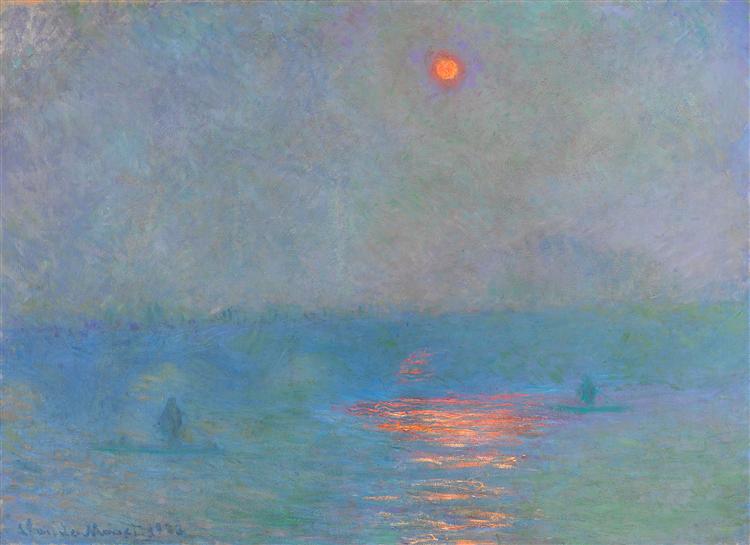
After this we walked over the bridge and went to the National Gallery.  We started with the Monet special exhibit, which was quite nice.  I think my single favourite was actually this late Monet which is actually part of the National Gallery collection.  (I find it a bit Turner-esque though far less violent.)  Oddly enough that one was not reproduced particularly well in the catalogue that accompanied the exhibit, or I probably would have bought the book.  (This also was not on display on my last visit to the National Gallery, though it might have been on loan to the other co-hosts of the exhibit.)

Claude Monet, Waterloo Bridge: the Sun in Fog, 1903

I'll plan to post a bit more on the National Gallery later.  I took the family around half of the galleries, focusing on the Group of 7 and other 20th Century art, both Canadian and international.  I was glad that I found the George Segal installation, since I thought that had been removed.

We then walked over to Parliament.  Unfortunately, there were no more tour tickets.  On our next visit, we will stay on the Ottawa side (never again Hull!) and try to get the tour tickets first.  Then we'll decide about the Museum of Nature and/or the Museum of History.  We probably won't go back to the Museum of Aviation, as that is kind of a one-time thing.  It was probably ok to skip the tour.  We had already done a lot of walking, and we had a fair ways to go to get to the Museum of Nature.  (My daughter really, really wanted to go to this, which was one reason we had done such a short visit to the National Gallery.)

It's a nice museum with dinosaur bones and what have you.  It also has an impressive geology section, which is more informative than the ROM for instance.  I'd say I like the Field Museum better or even the Museum of Natural History (which is just overwhelming), but it was good.  My wife and son were a bit exhausted, however, so we'd have to pace ourselves better on the next trip.

We came back via train on Sunday morning.  As I hinted we got out at Kingston and went to the Agnes Etherinton Arts Centre at Queen's.  That was nice, though quite small.  It is more than a little ironic I had to go there to see the Hart House collection.  (As I mentioned here, I would have preferred to see it in Toronto or even at Museum London.)  I noticed that one of the Lawren Harris paintings was missing, and after some sleuthing, I realized that it is in The Idea of North show, and that I will finally see it when it comes to the AGO next year.  So I guess Kingston just misses out.

Lawren Harris, Isolation Peak, Rocky Mountains, 1930 (not on view in Kingston)

While I like the look of the Queen's University campus, I was really put off by the fact essentially all the restaurants only opened at 3 pm (or were closed entirely).  That seems a cruel tease.  We gave up on seeing any more of Kingston and took a cab back to the train station.  Unfortunately, they had no seats together on the next train, so we just sat around in the train station and read or played on tablets and laptops (I was the unconnected one).  I finished my second book of the trip (Manu Joseph's The Illicit Happiness of Other People) and decided I would probably not come through Kingston again unless 1) I absolutely had to and 2) I had a car at my disposal.

So a good but exhausting trip all in all.

Tuesday, November 10, 2015

Spark and O'Brien

I decided that since I do seem to be reading Muriel Spark on an intermittent basis, I probably ought to track her as well.  I have to admit that so far I have not really cottoned to her.  I recall not really liking the structure of The Prime of Miss Jean Brodie and the way in which Spark revealed the student who betrayed her.  Some people have commented that if you don't like sly humour, then perhaps Spark isn't for you.  I don't know about that, but it is true that I didn't find the story about an inappropriate teacher to be all that enthralling, though I suppose it was more of a revelation when it came out (1961).

I also have to admit that in general, I started to like Muriel Spark less the more I knew about her, including her turn to Catholicism in her mid 30s and her feud with her own son where she disinherited him.  Many people seem to agree with me that the essays in The Informed Air do her little justice, though it does make me wonder about how seriously I should take someone who thinks hard and long about the Book of Job, and yet still remains a committed Christian.  I also found her unbelievably snobby in her defense of Marcel Proust, basically saying that those of us who didn't care for him were just not sensitive enough.  So those are two serious strikes against her in my book.

Nonetheless, the novels remain, and there are several that probably should be read by anyone who wants a thorough survey of 20th Century literature in English.  In addition to the books I own, I will probably some day tackle Memento Mori, The Girls of Slender Means and The Mandelbaum Gate (and just possibly The Public Image).  If I still am struggling to enjoy her or at least appreciate her novels, then I will throw in the towel.

I debated adding her here with Iris Murdoch, but decided it was best to start a clean post.

Muriel Spark - novels and short stories
    The Comforters (1957)
    Robinson (1958)
R    Memento Mori (1959)
    The Ballad of Peckham Rye (1960)
    The Bachelors (1960)
R    The Prime of Miss Jean Brodie (1961)
    The Girls of Slender Means (1963)
    The Mandelbaum Gate (1965)
    The Public Image (1968) (shortlisted for Booker Prize)
    The Driver's Seat (1970)
    Not to Disturb (1971)
    The Hothouse by the East River (1973)
    The Abbess of Crewe (1974)
    The Takeover (1976)
    Territorial Rights (1979)
    Loitering with Intent (1981) (shortlisted for Booker Prize)
    The Only Problem (1984)
R    A Far Cry From Kensington (1988)
R    Symposium (1990)
    Reality and Dreams (1996)
    Aiding and Abetting (2000)
    The Finishing School (2004)
    Complete Short Stories (2001)

So as to not leave her too lonely, I added Edna O'Brien, who is also a Catholic novelist, though one who has had a complicated relationship with Irish readers (in fact many of her books were banned by the Irish Censorship Board and even burned in various communities).  I don't know a lot about her, though at first glance it looks like some of her books would appeal to me.  Reading her work is not a very high priority at the moment, but I will still track it below.

Novels
O  1960: The Country Girls (Country Girls Trilogy 1)
O  1962: The Lonely Girl, aka Girl with Green Eyes (Country Girls Trilogy 2)
O  1964: Girls in Their Married Bliss (Country Girls Trilogy 3)
R  1965: August Is a Wicked Month
O  1966: Casualties of Peace
    1970: A Pagan Place
    1971: Zee & Co.
R  1972: Night
O  1977: Johnny I Hardly Knew You
    1988: The High Road
    1992: Time and Tide
    1994: House of Splendid Isolation
    1996: Down by the River
    1999: Wild Decembers
    2002: In the Forest
    2006: The Light of Evening
    2016: The Little Red Chairs

Short story collections
    1968: The Love Object and Other Stories
    1974: A Scandalous Woman and Other Stories
    1978: Mrs Reinhardt and Other Stories
    1982: Returning
O   1985: A Fanatic Heart
O   1990: Lantern Slides
O  2011: Saints and Sinners
    2013: The Love Object: Selected Stories, a fifty-year retrospective

Edit (11/13): I think at one point I owned A Fanatic Heart, which was an earlier volume of her selected stories.  In fact, there is still a slim chance that I still own this, but have it buried in a box downstairs.  I'm not sure whether it is worth looking for it.  There is only a little overlap with The Love Object, so at some point I may acquire both.  I did see Saints and Sinners is widely available for $0.01 (plus shipping), so I'll probably pick that up and later decide about The Country Girls Trilogy.*

* It looks like if I tackle The Country Girls Trilogy, I should read the reissued version with a new epilogue.  (I was trying hard to convince myself just to get this out of the library and not buy it, but I eventually succumbed.  I haven't reordered A Fanatic Heart yet.  I have just enough will power to at least look through some boxes for it...)

Monday, November 9, 2015

9th Canadian Challenge - 8th Review - Who Do You Think You Are?

Most Canadians will know this collection of stories by Alice Munro by its original title, though many Americans will know it as The Beggar Maid instead.  What I hadn't quite understood when I started reading the stories is that this is actually the second novel-in-stories that Munro completed.  Lives of Girls and Women also feature one main character, Del, in all the stories.  This book is the one that most people talk about as Munro's missing novel.  However, Who Do You Think You Are? (WDYTYA) features Rose and Flo, her step-mother, in all the stories as well, yet it is not discussed nearly as often as a missing novel, as far as I can tell.  This is particularly interesting as two or three of the stories cover a wide timespan.  But the main reason I consider this a novel is that some of the middle stories hardly make sense unless you've read the other ones to find out more about Rose's background.  There is a lot of background missing in "Wild Swans," for instance, which is actually one of the more disturbing stories of the bunch (even if you do have Rose's backstory).  Thus, I think I will have to review this as a novel, more than a collection of stories, which means SPOILERS AHEAD.

Do You Really Want to Read the SPOILERS?

To return to the sweeping scope of the stories, the opening story "Royal Beatings" lets the reader see Flo as a youngish bride who ultimately ends up as a bitter old lady in a retirement home.  The older, wiser version of Rose realizes that Flo acted as she did partly out of ignorance and a general unhappiness on how Rose rejected her as a mother figure and viewed her solely as a step-mother.  While it is not clear that Rose ever tried to drive a wedge between her father and Flo, Flo surely saw that as a possibility.  Needless to say, even mothers and daughters with firmer biological ties can sometimes have incredibly fraught and difficult relationships. Off the top of my head, I can think of Atwood's Lady Oracle and Barbara Comyn's The Juniper Tree, but I'm pretty sure there are other stories by Munro that fit the bill.  After all, there are quite a few novels about conflicts between fathers and son (who don't really want to follow the instructions their father push upon them), and it is just a likely for there to be conflict between the females in the household, even if it is often subtler.

Munro's first two collections have a complicated, but largely positive view of growing up in rural Ontario, though it does seem that Del in Lives of Girls and Women was too attracted to an uneducated country bumpkin and ruined her life chances.  Obviously, I am over-simplifying the set-up, but Munro paints a much bleaker view of rural life and its limitations in WDYTYA?  I was actually a bit shocked when I came to "Privilege" (the second story) where she is describing the situation in the rural school Rose attends. Munro makes this sound like some Hobbesian nightmare where the teacher turns a blind eye to all the terrors that the older kids inflict on the younger kids -- and the younger kids inflict on each other. It's practically Lord of the Flies set in Hanratty, Ontario.*  The relationship between Rose and her step-mother Flo isn't much better, though it does improve after Rose moves away.  Playing with time enters this story in a subtle way.  Much of "Privilege" focuses on how Rose finds herself in awe of one of the older girls in school and essentially wants to be in her entourage.  She even steals candy from Flo's store to suck up to this older girl, who rejects this puppy love.  Flo mocks Rose and doesn't understand why she is making such a big deal about the older girl.  At the end of the story, Rose reflects back and can't really understand either, though she sort of understands that she was looking for glamourized female role models, since she was not getting encouragement at home.  Munro and Atwood (particularly in Cat's Eye) are quite good on showing how our memories of the past change over time and we may downplay things (or forget/repress events) that were once incredibly important to us as children.

The title story closes the book.  Again, we are treated to a somewhat disturbing story about small town life, centered around Milton Homer, a strange man that Rose knew (but knew enough to largely steer clear of while she was a girl).  Of all the fairly wild young men in the village, he is particularly disturbed, as he disrupts parades and even baptisms.  Eventually he ends up in an old folks' home, where Flo is staying, as there is apparently nowhere else to institutionalize him.  The story is actually fairly complex in that in thinking about Milton Homer brings up related thoughts about going to high school (not many of the children in Hanratty did that) and how her teacher was actually one of Milton Homer's aunts.  It must have been an endless disappointment to her and her sister as they tried unsuccessfully to keep him in check.  Nonetheless, in her own classroom, butter would hardly melt in her mouth.  What is particularly pathetic is the way she punishes Rose one day for trying to be better than her station (she has memorized a poem without writing it down).  "Who do you think you are?" she asks Rose. On the one hand, at that time, Canadians suffered from tall-poppy syndrome, where anyone who was a bit better than anyone else was cut down to size, so the teacher could simply be trying to prepare Rose for this world, but Munro really seems to be indicating that the teacher is indignant that Rose is showing off a bit.  One of her classmates did an impressive impersonation of Milton Homer (though apparently was never caught by the teacher), and this is the second prong of the story, as Rose catches up with this fellow student on one of her rare returns to Hanratty to visit Flo.  His life was not a particularly happy one.  While Hanratty was definitely tamed after WWII (as suburban sprawl from Toronto eventually raised the "tone" of the place), it still seems to be a pretty dead-end location, and clearly Rose was better off leaving.  Still, it is a pretty downbeat story to end on.

I found the stories set in Rose's early days in Hanratty to be pretty dark, though things improve a bit as she goes to high school, aside from occasionally running afoul of the teacher, as in the title story, or getting mocked for putting on airs as in "Half a Grapefruit."  The stories of Rose as an adult are unsatisfying (to me) for different reasons, which I will get to shortly.

The one story that the book sort of hinges upon is quite unsettling in a different way.  I think I had previously read "Wild Swans" in an anthology, since the story seems quite familiar.  Rose is going on a short visit to Toronto for the first time on her own.  It isn't entirely clear how old she is, but probably she is a junior or senior in high school.  She has won an essay contest that comes with a cash prize, and therefore she can go on this trip to bring back some special goods for Flo that you can't find outside "the city." (One of the more interesting things about Flo is that she worked in Toronto near Union Station for a short time but apparently wanted to return to small village life.)  Rose is going to stay with one of her father's relatives (he had actually passed away several years before, making life at home even more difficult for Rose).  Flo warns Rose in a somewhat serious manner to watch out for "white slavers" who will force her into prostitution, and Rose is somewhat relieved when an older minister sits beside her on the train.  After a short discussion about her plans and an admonition to keep an eye on the landscape to see if any wild swans are about, he falls asleep with his newspaper covering his lap and part of Rose's as well.  She feels fingers on her thigh and thinks she must be imagining things, but she doesn't move away either or speak up.  I thought in the version I read before Munro never makes it clear if it is only her imagination or not, but maybe I am misremembering.  In this version, Rose tells herself she will not open her legs and then she does, and he fingers her for miles while she bites her tongue and tries to keep her breathing in check.  Granted Rose is quite inexperienced in the ways of sexual congress and perhaps it was indeed less than it seemed, though under any circumstances, this is pretty bad.  She doesn't say anything partly because she can't believe it is happening, but she is quite curious about sex.  She has already fantasized about having sex (and being dominated -- pounded in her own words) by her high school French teacher, and is somewhat primed to accept sexual advances.  I can certainly understand why people have trouble with this story, since it sort of validates Humbert Humbert, i.e. the young girl really was asking for it.  (Curiously one of Alan Bennett's Talking Heads monologues features a similar pedophile with the same kind of self-justification.)  At any rate, budding female sexuality is something not handled all that well in fiction, at least in part because so many critics are fundamentally anti-sex (and authors just shy away from the criticism they know they will receive).  I did find this article focused on the growing sexual awareness of Rose to be worth reading.

If WDYTYA had basically stopped at Rose's high school years or even her early college career (so apparently she does better for herself than Del ever did), it would be a difficult and fairly dark book, but still one for which I had a reasonably high regard.  However, I don't know if it is simply the spirit of the times (mid 70s) or Munro working out her anger at how her marriage fell apart, but I really don't like the adult Rose and her often terrible choices.

She has a somewhat unusual relationship with a graduate student, Patrick.  In "The Beggar Maid," Rose gets engaged, breaks it off, then asks him to take her back.  It isn't clear why, even to her, other than she seems to have a sense that she is so far removed from his social sphere that it will never work.  And this is before she realizes just how rich his family is, which she learns when they move to British Columbia to be near them.  No one from home can believe that she landed such a rich husband, and Flo in particular is baffled.  They see it the same as if she won the lottery, and Rose herself feels a bit like a beggar maid in a fairy tale, but she is also wise enough (at some level) to realize that the happy ending in these stories is so unlikely.  To fit in, she must transform herself and live the way her rich relations feel is correct, even though it doesn't feel right to her.  It doesn't help that Patrick reconciles with his father and starts working in the family business and promptly becomes quite conservative.  (Above all, this irks me as I find it a bit slanderous against her real-life husband, Jim Munro, who ran an independent bookstore in Victoria.)

Rose doesn't know what she wants, but she doesn't want this, and eventually she separates from her husband.  She has an affair (a very unsatisfactory one that is hardly ever consummated) with a friend's husband.  I wouldn't judge her so harshly, but in "Mischief" and in "Providence" she can't find a baby sitter, and ends up dragging her daughter, Anna, along with her as she tries to engage in extramarital sex.  In one of these stories, I believe it is "Providence," Anna is getting quite ill, but Rose still is focused on her own needs and not at all upon her daughter.  I basically hated her at that point, and wasn't much interested in the remaining stories.  It seems best all the way around when Anna moves back in with her father and step-mother, who presumably is not as terrible to her as Flo was to Rose.  In "Simon's Luck," we see Rose having success in an unlikely career as an actress, first on the radio and then the television.  She finally seems to have found a potential romantic partner, and then he dies on her.  "Spelling" mostly focuses on Rose coming in for a visit to Flo and being somewhat overwhelmed by the sorry lives that the elderly are leading in the old folks' home.  (Maybe I am just projecting a bit, but I found this a very depressing story with not much of a point other than growing old is horrible.)

I find it hard to rate the book as a whole.  It was fairly dark in many places, and Rose disappointed me in many ways when we saw the adult she turned into.  I thought it was a bit glib to try to blame this all on her difficult childhood or even excuse her bad behaviour (particularly in how poorly she cared for Anna), which occasionally I felt Munro was doing.  Apparently there are some nuggets of wisdom to be gained along the way as one marches to the grave, but it doesn't amount to all that much in the end.  The final two stories in the book really remind me a lot of Beckett in their overall bleakness.  I'm not sure everyone else would agree, but I found them a real downer, particularly in the way they close out the book.  In short, it is a book worth reading, but not if one is looking for mere diversion or distraction from life's worries...


* The stories are set in small town Ontario - Hanratty, which is actually Wingham, Ontario.  A place small enough that everyone knows everyone, and many people were very, very unhappy that Alice Munro would write about their darkest secrets.  Actually reading the article is interesting, as the journalist is more than a little surprised that the family that had a dark secret exposed (a baby accidentally scalded to death when an older sister was left in charge) doesn't feel that having their baby immortalized in print should somehow take the pain away.  I'm not saying that there aren't some people who would feel that way, but it is a very small and probably overly intellectual clique that finds that much solace in literature.  Far more people would feel that this is an unwelcome and unseemly intrusion on their misery.

Sunday, November 8, 2015

Being handy

While I have handled most of the immediate tasks from the move (though I only have purchased the sewing machine and have not actually sew up the new curtains), it turned out that the light in the study was just not adequate.  It was some track lighting from Ikea, but the filaments that held the bulbs on were not strong enough.  One of them snapped off while I was changing the bulb, and then another bulb burned out.  I decided enough was enough, and I decided to change the lighting fixture.  My wife wasn't sure I was up to the task, but this is a relatively simple home improvement job.  Or at least it should have been.

I don't even like track lighting particularly, so I found a simple overhead light.  What is different about this is that the lighting unit is all one piece with a LED lamp inside, so there are no bulbs to change.  Supposedly this will last up to 30 years, though I have my doubts.  I suppose I'll have to see if there is some warranty card.

It looked like a 20 minute project, though just as I was about to get the bracket mounted to the electrical box, the screw head sheared off.  It appears to be a cheaply made aluminum screw, which annoyed me to no end.  It would have cost $0.15 more to put in steel screws or something a bit sturdier.  Then it took close to 45 minutes removing the broken-off screw from the bracket.


I also think it was foolish not to have some kind of hook built into the bracket to rest the unit while connecting the wiring.  So that took longer than expected, since I essentially had to do everything with one hand, while holding the unit up by the mounting bracket.

Still, it seems to be working well.  Here are the before and after photos.


The rest of the day was spent getting groceries, taking my daughter swimming, buying a rake to rake up the many leaves in the yard, and now I can take a bit of a break, though not as long as I would like...