In one of the posts a while back, I discussed going to see 3 plays in Chicago. Despite a minor scare Sat. afternoon, I did manage to make all three. (And it turns out that Yankee Tavern played Chicago an entire year ago, so I didn't just miss it.) Had we stuck around another few days, I might have gone to see Long Day's Journey into Night at Court Theatre. I heard good things about it, but could not make it (and I saw a good production in Chicago 6 or 7 years ago). It looks like that will run until April 10 if interested.
I enjoyed all 3 plays I did see. I would probably recommend Brecht's Galileo first, though it does run 2 hours and 45 minutes. Then Dreams of the Penny Gods at Halcyon, and finally The Flick at Steppenwolf. I knew what I was getting into with The Flick, which is 3 hours of realistic banter between low-level employees at a struggling movie theatre in Worcester, Mass (not far from Boston). Actually, while The Flick is not my idea of a well-constructed play, it is interesting seeing the stretching of theatrical conventions (as well as seeing a play so deeply about the lives of workers as workers). I would say the same thing about Conor McPherson's Port Authority, which is much less traditionally theatrical than his other plays, such as The Seafarer. I can also see why audiences who don't really know what they are getting in for with The Flick are leaving at intermission. I was a bit surprised that the young guy next to me left, while the couple on the other side (who had taken their coats and everything with them) came back. It runs through May 8 at Steppenwolf.
As I discussed in my post about trying to help bring certain productions to Toronto, I think The Flick would work beautifully over at the Aztec Theatre on Gerrard. I'd still kick in a few bucks to try to make it happen, but I don't feel the need to see it a second time. (I do hope that the company that is supposed to put on The Aliens actually lives up to that, since I want to see it; the plot reminds me just a bit of Bognosian's subUrbia.) I've told a couple of theatre companies here they should consider Yankee Tavern. Maybe one of them will bite. I'm actually willing to make a bigger effort to try to bring Stupid F***ing Bird to Toronto (skipping it may have been my biggest mistake from the previous trip to Chicago in August 2015), so if anyone is interested in trying to co-produce this, let me know in the comments.
I can't really discuss Dreams of the Penny Gods much without spoiling it, but I will say it is a dark play (perhaps a bit bleak though there are certainly some comic aspects to it) about a dysfunctional family. Most of the characters view religion as a way out of their problems, in one way or another. The set is really quite interesting, as the family makes its living renting out storage lockers and they live on site, so everything is cluttered. I'll come back around and discuss some aspects of the plot, but this should give you some sense of whether this is of interest. The play runs through all of April, so there is plenty of time to go check it out. Details here.
I don't know that one can really spoil the plot of Brecht's Galileo, since it is drawn so much from his life, particularly the fact that the Catholic Church forced Galileo to recant his writings about the earth not being the center of the universe. But the play is a bit more ambitious than this. On the one hand, it shows that the church itself was divided with some reformers or at least some priests not completely opposed to science. Brecht suggests that the Pope knew the truth but ultimately forced the recantation to forestall uprisings in the north of Italy. In other words, politics were far more central than theology to the decision to persuade Galileo (by showing him the instruments of torture and letting his imagination do the rest). That said, there is one memorable scene (Act I, Scene 6) where an older Cardinal completely loses it when he is forced to think about humanity's insignificance if indeed the Earth is not at the center of the universe. It was quite an interesting dissection of egotism and to some degree why religious impulses develop in the first place: "Mankind is the crown of creation, as every child knows, God's highest and dearest creature. How could He take something so miraculous, the fruit of so much effort, and lodge it on a remote, minor, constantly elusive star? ... {No, impossible.} [The earth] is the centre of the universe, I am at the centre and the eye of the Creator falls upon me and me alone."
The staging is great, with video projections at times that helped illustrate some of the celestial mechanics for instance. Still the play is too long, and most of that comes down to Brecht's writing. There are four scenes right before the intermission that basically convey the exact same information with only minor variations. At least two of them could have been combined or excised completely. (I've been dealing with this in one of my plays where an actor told me that things were just dragging and that a scene or two should be trimmed, since the audience would already have made that leap and didn't need so much repetition. I'm not always so sure about that -- I'm finding audiences are just kind of thick -- but I have come to agree that a quicker pace is almost always justified.)
Things move along much more quickly in the second half. We see that Galileo is willing to sacrifice his daughter's happiness in the pursuit of scientific truth. Towards the end, there are some discussions about how scientists probably ought to think more about the implications of their research on society (to this day, many scientists do not agree with accepting such restrictions, even self-imposed). Certainly it is depressing watching conservative political parties turn anti-science to a degree that is quite astonishing (back in the 1970s when the Republicans were relatively moderate they were quite supportive of scientific research (though harnessed in the service of industry) and were willing to protect the environment); those days are long-gone, and the Conservatives in Canada are certainly not much better. Thus, it feels appropriate to focus on the anti-science aspects of the script and downplay the (very) rare moments where Galileo does worry about where his ideas will lead. To a certain extent the producers of the play do this by linking the dates in Galileo's life to what was going on in the U.S. from the 1930s to 1950s (particularly the McCarthy hearings), but the point is somewhat lost at the end, since I have no idea what Mexican/US border 1953 was supposed to signify. Some of the dates seem to mesh with the tribulations of J. Robert Oppenheimer (as well as Brecht himself being called to testify before the Un-American Activities Committee), but of course the atomic bomb had already been unleashed long before 1953.
But I digress... I wasn't crazy about the puppet show scene in the second act, since it just was so tonally off from the rest of the production (though it was probably the most Brechtian thing about the whole play). I'll have to see just what is actually written in the script.* The one other place I thought Brecht made a huge blunder is when Galileo's young assistant gets in an argument with the Grand Duke (who at the time was a boy of 9) and they actually tussle on the ground and an astrolabe is broken. There is no way this would have possibly have transpired like that, as the assistant would have been thrown in jail and quite likely whipped. Remy Bumppo are faithful to the script here, but it is just absurd.
Still, these are relatively minor quibbles, and I am very glad to have finally seen the play. It runs until May 1, and I would recommend any Brecht fans in Chicagoland to go.
With that, I will sign off temporarily, but I'll discuss Dreams of the Penny Gods in a bit more detail in a follow-up post, but as I mentioned that review will have spoilers.
* Brecht does set this up as a separate scene with performers at a carnival spoofing the Pope, so making it a puppet show is not a huge stretch. The scene's function is basically to show that Galileo's challenging of Papal authority in the matter of astronomy was filtering down to the general public, which severely upset the authorities and ultimately caused them to take a harder line with Galileo.
Saturday, April 2, 2016

Monday, March 28, 2016
New York-Boston trip highlights
I haven't even managed to fill in the highlight from our trip to New York and Boston, and we have just returned from Chicago! Something tells me that I am just not going to be able to keep up with the blogging in any meaningful way, at least not until the transition to the new job is complete.
Anyway, we basically did cover all the events in this itinerary, though the weather wasn't great on Monday or Tuesday, so we skipped walking around Harlem. We also did make it down to our old neighborhood in Brooklyn (edge of Gravesend and Kings Highway). That definitely looked a bit different than I remembered it.
I'll just put down a few reflections on the trip and perhaps later I can add a post or two that are more picture-heavy.
I thought it was good taking the kids on a bit of a walking tour of Manhattan the first day. We essentially covered Times Square to Washington Square Park.


I was kind of surprised that neither of the kids wanted to see the Vikings exhibit in Times Square, especially since my daughter studied it in school, but perhaps it was precisely for that reason it was just too much like school. Anyway, it isn't like they didn't get plenty of culture in over the trip. As it happens, the Vikings exhibit runs through early September, and I'll certainly consider making a stop on my solo trip to New York this summer, though it isn't at the top of the agenda.
I tried to convince my son to come along to the Metropolitan Museum of Art Saturday evening, but he was quite worn out from all the walking. I actually didn't stay the entire allotted time but I got in about 90 minutes, mostly focusing on the 20th Century wing (and Beckmann's The Beginning was back on view), though I made sure to see the Rembrandts and Vermeers. I also saw the Islamic galleries and made a very short visit to the Temple of Dundar. I think this may be the first time I completely skipped the American wing and the rooms of Asian art. It was a bit strange not having a really big exhibition on view at the Met. My single biggest regret of this visit is that my photos of the Thomas Hart Benton mural didn't turn out that well, and I simply didn't see the Winter 2015 Bulletin that had some great reproductions. There should still be some on sale on my next trip (or they will be on sale somewhere in New York if I just can't make the Met on my next trip).
Sunday was completely taken up with our visit to Brooklyn. It was really great seeing our relatives out there, whom we hadn't seen in 10 years. My wife also managed to see her friend, while I took the kids through the Brooklyn Museum. I was so disappointed with the Brooklyn Museum, as the entire American painting section was closed and 90% of the European paintings.* The Coney Island exhibit was ok, but not earth-shattering. Interestingly, my daughter really liked the museum, since it had full scale rooms with furniture of different periods. Knowing this, I will try to take her to the Met one day and focus on all the period rooms. She would also like the Newark Museum perhaps even more. (I had hoped to make a visit, but since it is closed Mondays and Tuesdays(!), it just wasn't possible to make it work, given our schedule.)
Monday was largely given over to a visit to MoMA, which was fun. I was able to show them some of the most important paintings in the collection: Van Gogh's Starry Night, Picasso's Les Demoiselles d'Avignon, Matisse's The Red Studio and so on. Sadly, Beckmann's Departure was not on view. (On the other hand, James Rosenquist's F-111 was, and that is rarely on view, so I guess it was an ok trade-off.) There was a large Jackson Pollack exhibit, as well as an interesting display on Japanese architecture. I think that was my daughter's favorite part of the museum, though she also was quite interested in these dancers on the steps and on the main floor, doing these really, really slow movements.


I'm already struggling to remember the details, but I think after this, we just walked over to Grand Central Station (it wasn't really nice enough out for another long walking tour).
I dropped the family off and then met an old work colleague. We had dinner and then went to the Jazz Standard to see the Mingus Big Band. They did quite a few great tunes, particularly Nostalgia in Times Square (and Ronnie Cuber who originally orchestrated the piece was on hand to kick it off) and Haitian Fight Song. Those were my two favorites for the night. I will say that the weather was not ideal, and getting rained on for much of the day has meant that I simply have not been able to shake off this cough. I probably do need to step out and see the doctor soon.
Tuesday was spent in the Museum of Natural History and then we went to lower Manhattan and checked out Wall Street and Battery Park City, so that the kids could at least say that they saw the Statue of Liberty. We didn't go into the WTC memorial museum, but we did see the outdoor memorial, which is fairly impressive. I thought it was interesting how the new PATH station feels a bit like going inside a whale. I would have taken more photos of the inside, but frankly I didn't want to possibly get the police on my case for taking photos in a restricted site. Finally, we headed out to a hotel near the Newark Airport, so that we wouldn't be dealing with trying to reverse commute out to the airport on NJ Transit during the morning rush.


Wednesday we flew to Boston and the weather finally improved a bit in Boston, particularly Thurs. and Friday. We saw a saw a fair bit of history trail and took it into North End of Boston. As it happened, we were the last guests to slip into Paul Revere's house. My daughter liked that as well. They did want to throw the tea into the harbor, but unfortunately, we didn't get there in time, and the lines were just too long.

They were tired and crashed at the hotel, and I walked over and checked out the MFA Wednesday evening. I don't think I have a whole lot to add, other than it is a very impressive museum, and I saw a lot of it, but skipped over a fair bit as well. I saved the best for last, going up to the top floor which had the Lawren Harris exhibit, as well as a very nice Stuart Davis painting.
If I had known everything in advance, I might have cut the Freedom Trail down a bit to allow me to get to and from the MFA in time to go see a free concert just down the street (halfway between MFA and our hotel in fact). They were doing Shostakovich's 5th Symphony and something else I have forgotten. On the other hand, I was really having trouble controlling my cough that evening, so probably on the whole it was just as well I skipped this.
Thurs. we did get out to Cambridge and checked out Harvard and particularly the Fogg Art Museum. I was pleased that they had a few Beckmann paintings on view, particularly The Acrobats. While we hadn't walked all that much on Thurs., the family was still pretty tired, and I went to the Isabella Gardner Museum on my own. It was an ok visit, but definitely it didn't live up to other visits when more of the art was on display and the rooms didn't seem so dim. I wrote a bit about the visit already, so I'll just skip ahead to Friday.
Friday was the last day of the trip, and everyone was getting a bit tired and cranky. Anyway, we packed up and took everything over to the Museum of Science. I think the kids enjoyed it, and they probably learned something as well... The big lightning exhibit was pretty cool. I was not able to get a good shot, but this one from Instagram user kellym7609 is impressive.

And that was that. After the lightning show, we had lunch and managed to track down a cab. We went to the airport and had a pretty uneventful flight home. The kids got to rest up, but I had to go into work and take care of a number of things, including doing most of the packing up of the office. Somewhere along the line, I just need a day or two to do nothing but laze around. Maybe this upcoming weekend. Fingers crossed.
* While there is no question I wasn't going to be satisfied with the closing down of the American collection, I was particularly looking forward to showing the kids one of the massive Stuart Davis paintings to see what they thought. I don't even know if I have any photos of these paintings, since I haven't been back in 10 years and the photo policy may not have been quite as open (though I guess it was mid 90s that most museums started letting visitors take photos).
I like Stuart Davis's Pad No. 4 (also in the Brooklyn Museum), but The Mellow Pad is particularly epic and needs to be seen in person to grasp its scale.
Curiously, the large scale Davis paintings weren't on view at the Met either, though some smaller ones were. I wonder if all of these are undergoing conservation and/or are en route to the Whitney in preparation for the big Stuart Davis show, though that doesn't open until June. Hard to say. I certainly hope to see them at that time, and perhaps the one I posted above from the MFA and potentially the one that the Art Institute of Chicago has. With 100 or so paintings in the show, it will be a fairly big deal.
Anyway, we basically did cover all the events in this itinerary, though the weather wasn't great on Monday or Tuesday, so we skipped walking around Harlem. We also did make it down to our old neighborhood in Brooklyn (edge of Gravesend and Kings Highway). That definitely looked a bit different than I remembered it.
I'll just put down a few reflections on the trip and perhaps later I can add a post or two that are more picture-heavy.
I thought it was good taking the kids on a bit of a walking tour of Manhattan the first day. We essentially covered Times Square to Washington Square Park.


I was kind of surprised that neither of the kids wanted to see the Vikings exhibit in Times Square, especially since my daughter studied it in school, but perhaps it was precisely for that reason it was just too much like school. Anyway, it isn't like they didn't get plenty of culture in over the trip. As it happens, the Vikings exhibit runs through early September, and I'll certainly consider making a stop on my solo trip to New York this summer, though it isn't at the top of the agenda.
I tried to convince my son to come along to the Metropolitan Museum of Art Saturday evening, but he was quite worn out from all the walking. I actually didn't stay the entire allotted time but I got in about 90 minutes, mostly focusing on the 20th Century wing (and Beckmann's The Beginning was back on view), though I made sure to see the Rembrandts and Vermeers. I also saw the Islamic galleries and made a very short visit to the Temple of Dundar. I think this may be the first time I completely skipped the American wing and the rooms of Asian art. It was a bit strange not having a really big exhibition on view at the Met. My single biggest regret of this visit is that my photos of the Thomas Hart Benton mural didn't turn out that well, and I simply didn't see the Winter 2015 Bulletin that had some great reproductions. There should still be some on sale on my next trip (or they will be on sale somewhere in New York if I just can't make the Met on my next trip).
Sunday was completely taken up with our visit to Brooklyn. It was really great seeing our relatives out there, whom we hadn't seen in 10 years. My wife also managed to see her friend, while I took the kids through the Brooklyn Museum. I was so disappointed with the Brooklyn Museum, as the entire American painting section was closed and 90% of the European paintings.* The Coney Island exhibit was ok, but not earth-shattering. Interestingly, my daughter really liked the museum, since it had full scale rooms with furniture of different periods. Knowing this, I will try to take her to the Met one day and focus on all the period rooms. She would also like the Newark Museum perhaps even more. (I had hoped to make a visit, but since it is closed Mondays and Tuesdays(!), it just wasn't possible to make it work, given our schedule.)
Monday was largely given over to a visit to MoMA, which was fun. I was able to show them some of the most important paintings in the collection: Van Gogh's Starry Night, Picasso's Les Demoiselles d'Avignon, Matisse's The Red Studio and so on. Sadly, Beckmann's Departure was not on view. (On the other hand, James Rosenquist's F-111 was, and that is rarely on view, so I guess it was an ok trade-off.) There was a large Jackson Pollack exhibit, as well as an interesting display on Japanese architecture. I think that was my daughter's favorite part of the museum, though she also was quite interested in these dancers on the steps and on the main floor, doing these really, really slow movements.


I'm already struggling to remember the details, but I think after this, we just walked over to Grand Central Station (it wasn't really nice enough out for another long walking tour).
I dropped the family off and then met an old work colleague. We had dinner and then went to the Jazz Standard to see the Mingus Big Band. They did quite a few great tunes, particularly Nostalgia in Times Square (and Ronnie Cuber who originally orchestrated the piece was on hand to kick it off) and Haitian Fight Song. Those were my two favorites for the night. I will say that the weather was not ideal, and getting rained on for much of the day has meant that I simply have not been able to shake off this cough. I probably do need to step out and see the doctor soon.
Tuesday was spent in the Museum of Natural History and then we went to lower Manhattan and checked out Wall Street and Battery Park City, so that the kids could at least say that they saw the Statue of Liberty. We didn't go into the WTC memorial museum, but we did see the outdoor memorial, which is fairly impressive. I thought it was interesting how the new PATH station feels a bit like going inside a whale. I would have taken more photos of the inside, but frankly I didn't want to possibly get the police on my case for taking photos in a restricted site. Finally, we headed out to a hotel near the Newark Airport, so that we wouldn't be dealing with trying to reverse commute out to the airport on NJ Transit during the morning rush.


Wednesday we flew to Boston and the weather finally improved a bit in Boston, particularly Thurs. and Friday. We saw a saw a fair bit of history trail and took it into North End of Boston. As it happened, we were the last guests to slip into Paul Revere's house. My daughter liked that as well. They did want to throw the tea into the harbor, but unfortunately, we didn't get there in time, and the lines were just too long.

They were tired and crashed at the hotel, and I walked over and checked out the MFA Wednesday evening. I don't think I have a whole lot to add, other than it is a very impressive museum, and I saw a lot of it, but skipped over a fair bit as well. I saved the best for last, going up to the top floor which had the Lawren Harris exhibit, as well as a very nice Stuart Davis painting.
 |
| Lawren Harris, Icebergs, Davis Strait, 1930 @ McMichael Collection |
 |
| Edward Hopper, Drug Store, 1927 |
 |
| Stuart Davis, Hot Still-Scape forSix Colors -- 7th Avenue Style, 1940 |
If I had known everything in advance, I might have cut the Freedom Trail down a bit to allow me to get to and from the MFA in time to go see a free concert just down the street (halfway between MFA and our hotel in fact). They were doing Shostakovich's 5th Symphony and something else I have forgotten. On the other hand, I was really having trouble controlling my cough that evening, so probably on the whole it was just as well I skipped this.
Thurs. we did get out to Cambridge and checked out Harvard and particularly the Fogg Art Museum. I was pleased that they had a few Beckmann paintings on view, particularly The Acrobats. While we hadn't walked all that much on Thurs., the family was still pretty tired, and I went to the Isabella Gardner Museum on my own. It was an ok visit, but definitely it didn't live up to other visits when more of the art was on display and the rooms didn't seem so dim. I wrote a bit about the visit already, so I'll just skip ahead to Friday.
Friday was the last day of the trip, and everyone was getting a bit tired and cranky. Anyway, we packed up and took everything over to the Museum of Science. I think the kids enjoyed it, and they probably learned something as well... The big lightning exhibit was pretty cool. I was not able to get a good shot, but this one from Instagram user kellym7609 is impressive.

And that was that. After the lightning show, we had lunch and managed to track down a cab. We went to the airport and had a pretty uneventful flight home. The kids got to rest up, but I had to go into work and take care of a number of things, including doing most of the packing up of the office. Somewhere along the line, I just need a day or two to do nothing but laze around. Maybe this upcoming weekend. Fingers crossed.
* While there is no question I wasn't going to be satisfied with the closing down of the American collection, I was particularly looking forward to showing the kids one of the massive Stuart Davis paintings to see what they thought. I don't even know if I have any photos of these paintings, since I haven't been back in 10 years and the photo policy may not have been quite as open (though I guess it was mid 90s that most museums started letting visitors take photos).
I like Stuart Davis's Pad No. 4 (also in the Brooklyn Museum), but The Mellow Pad is particularly epic and needs to be seen in person to grasp its scale.
 |
| Stuart Davis, The Mellow Pad, 1945-1951 |
Curiously, the large scale Davis paintings weren't on view at the Met either, though some smaller ones were. I wonder if all of these are undergoing conservation and/or are en route to the Whitney in preparation for the big Stuart Davis show, though that doesn't open until June. Hard to say. I certainly hope to see them at that time, and perhaps the one I posted above from the MFA and potentially the one that the Art Institute of Chicago has. With 100 or so paintings in the show, it will be a fairly big deal.
Thursday, March 24, 2016
Commute of destiny
Last night I was coming back from The Public Servant (which I enjoyed immensely), and I looked down the street and saw that a police car was blocking off half of King Street. This doesn't look good, I thought, and I walked over to the streetcar stop. The eastbound lanes weren't being blocked, but I thought it was pretty likely that service had been suspended in both directions. Fortunately, I installed a transit tracker app and it said that indeed all the King streetcars were running along Queen St. (I am not at all big on apps, but this one pays off from time to time.) It said it was due to a collision, which I assumed meant a car had hit a streetcar, and they were investigating. It wasn't until I was home that I found out that a car had hit a pedestrian and she had been taken to the hospital, but it indeed was so serious that they were going to close down King to do some investigations.
This on its own would have made the trip feel just a bit like that from the "The Dull Life of a City Stockbroker" sketch. But it was what happened (or might have happened to me) on the other end that really sealed the deal. I found out that someone had been shot and killed right around Carlaw and Queen St., which is where you pick up the Pape bus after getting off the streetcar. I think I must have left the intersection about 20 minutes before it happened. While the odds are extremely low that I would have run across the suspect, I am still glad I wasn't there. I have no idea what they did to the bus route, since they closed off Carlaw all the way north to Dundas.
I had actually considered going to the Shoppers Drugs, but I saw the bus coming. That delay would have brought me uncomfortably close to the incident.
What would have put me squarely into the timeframe of the incident is if I had stuck around after the play for the talk back. I was tempted. I am going to be a government employee in only another week and a half, and there were quite a few moments that rang very true in the play (the youthful analyst who has her dreams of doing something for Canada slowly ground down by the bureaucracy, the focus on process over content, the difficulty in obtaining all the required signatures and sign-offs, even the crazy warren-like nature of so many government offices). There is no question that the Harper administration was particularly soul-sucking for career bureaucrats who disagreed with pretty much everything he stood for -- and he returned their contempt in spades. There is a moment when one of the embittered long-timers remembers how great things were for policy wonks under Pierre Trudeau. What I didn't want to hear (and I thought there would be a lot of it during the talk back) was how everyone would sit around and congratulate themselves for kicking Harper out of power -- and how life was magically going to be better under Justin. Perhaps I am being unfair, but that was what I thought would go down. In any case, it was a good decision to skip it, as otherwise I would have been caught up in some bad craziness in Leslieville.
I would certainly recommend the play to anyone who works in an office environment, particularly for the government (well, anyone with a bit of a sense of humour and/or who doesn't think Harper was right to muzzle government scientists and analysts). The Public Servant runs through April 3.
This on its own would have made the trip feel just a bit like that from the "The Dull Life of a City Stockbroker" sketch. But it was what happened (or might have happened to me) on the other end that really sealed the deal. I found out that someone had been shot and killed right around Carlaw and Queen St., which is where you pick up the Pape bus after getting off the streetcar. I think I must have left the intersection about 20 minutes before it happened. While the odds are extremely low that I would have run across the suspect, I am still glad I wasn't there. I have no idea what they did to the bus route, since they closed off Carlaw all the way north to Dundas.
I had actually considered going to the Shoppers Drugs, but I saw the bus coming. That delay would have brought me uncomfortably close to the incident.
What would have put me squarely into the timeframe of the incident is if I had stuck around after the play for the talk back. I was tempted. I am going to be a government employee in only another week and a half, and there were quite a few moments that rang very true in the play (the youthful analyst who has her dreams of doing something for Canada slowly ground down by the bureaucracy, the focus on process over content, the difficulty in obtaining all the required signatures and sign-offs, even the crazy warren-like nature of so many government offices). There is no question that the Harper administration was particularly soul-sucking for career bureaucrats who disagreed with pretty much everything he stood for -- and he returned their contempt in spades. There is a moment when one of the embittered long-timers remembers how great things were for policy wonks under Pierre Trudeau. What I didn't want to hear (and I thought there would be a lot of it during the talk back) was how everyone would sit around and congratulate themselves for kicking Harper out of power -- and how life was magically going to be better under Justin. Perhaps I am being unfair, but that was what I thought would go down. In any case, it was a good decision to skip it, as otherwise I would have been caught up in some bad craziness in Leslieville.
I would certainly recommend the play to anyone who works in an office environment, particularly for the government (well, anyone with a bit of a sense of humour and/or who doesn't think Harper was right to muzzle government scientists and analysts). The Public Servant runs through April 3.
Sunday, March 20, 2016
Exhausting books (and movies)
I think I am on the edge of a collapse due to exhaustion, and I am hoping to get some rest on Sunday. Probably the trip should have been one day shorter. That probably would have meant skipping the Isabella Gardner Museum in the evening, but as I noted, it really was not a visit under ideal conditions. While I would not say I am soured on the museum, my previous visits were far more rewarding.
During the trip, I was reading and hoping to finish Smollett's The Adventures of Roderick Random. While it is far from the longest book I have read, I am finding it particularly exhausting and just wish it would end. My plan is to push on for one more day, which should do it. I'll read the first 50 pages of Peregrine Pickle and then the inset story "The Memoirs of a Lady of Quality." Bizarrely enough this is actually written by someone else (the Viscountess Vane). There are certainly other well-known digressions in older novels (Dostoevsky and particularly Tolstoy* are known for dropping the story for dozens if not 100+ pages and talking about history or natural history or philosophy), though Smollett may be the only case I'm aware of where he drops somebody else's writing into his work.
In any case, this has inspired me to think about books (and movies) that are just exhausting because they are somewhat repetitive and the extra length seems to be padding and not really essential to the plot, leading to tedium on my part. This is actually quite a different thing from the "literature of exhaustion," i.e. postmodern literature that emerged from a feeling that everything had already been written before and all good plots used up. Postmodern novels can be boring (and sterile for sure) but they at least usually have the good grace to wrap things up within 250 pages.
I see that I have used the phrase "one damn thing after another" in describing the movie Gravity, and that is also an apt description of The Martian. I think the main theme was established fairly early on, and in both cases, several of the episodes could have been cut out and the films would not have suffered and might have been better. (I suppose it is always subjective. One might well ask whether in King Lear or Kurosawa's Ran it was really necessary to repeat the disenchantment with the second daughter, though to me that drives home what a foolish choice Lear made. If he had 4 or 5 daughters and the same thing happened with each, then this would be unnecessary repetition!)
So many episodic novels of the Victorian era are basically one thing piled onto another with the hero or heroine just barely avoiding the worst vicissitudes of fate, though Roderick Random suffers so many beatings along with other reversals of fortune that one wonders how he can keep bouncing back. I suspect Smollett was drawing on the Medieval idea of the Wheel of Fortune, since most of Random's good outcomes are as equally likely as the bad outcomes. In particular, Random never seemed to learn anything from these various adventures and was still as hot-headed as ever towards the end of the novel. This is not completely unknown behavior in these episodic novels, though in the better ones, the characters do arrive at a better knowledge of the world around them and acquire some self-knowledge. I am finding Random to still be a total prat who basically deserves most of the bad things that happen to him, and I really don't like him. Reading about characters that one doesn't like is exhausting -- when one is put into the position of identifying with them because they are the main character. (It's not so bad when they are clearly a villain.)
I've heard that Peregrine Pickle is actually worse on that account with Peregrine just doing whatever he feels like with no true accountability, so will just skim a bit of the beginning where it is still funny and isn't the morally compromised novel it becomes by the middle.** Smollett's Humphry Clinker, on the other hand, is a much better novel and perhaps the title character actually learns something along the way. (This will definitely be the last dealings I have with Smollett, as he is clearly not to my taste. Nonetheless, I did have a vision that Rik Mayall and Adrian Edmundson could have done a pretty amazing version of Roderick Random if they had put their mind to it, like Steve Coogan did with Tristram Shandy, though they could have done it as a straight-up version.)
What I don't like about these novels is that they are essentially shapeless, particularly if there is no internal character growth. One thing happens, then another (generally unrelated), then another. Eventually the novel ends, but it could have been 100 pages shorter (definitely my preference for Roderick Random) or longer. On the other hand, if there is a clear structure in place, I generally can read longer novels without feeling total exhausted, though as I noted, there is almost no stand-alone novel over 600 pages that wouldn't be better if 50-100 pages were cut out. Looking over my list of long novels, the ones that exhausted me the most were DeLillo's Underworld, Pynchon's Mason & Dixon, Silko's The Almanac of the Dead, and Gunther Grass's The Tin Drum. I didn't really care for Of Human Bondage or Middlemarch, though there was more narrative shape to both and my problems with the books didn't really come down to sheer exhaustion from reading them. On the other hand, in the non-fiction category, Solzhenitsyn's The Gulag Archipelago is the epitome of one horrible event piled onto another piled onto another. While I realize his intent was to make an impression in the historical record and not come up with a "readable" history of Stalin's reign of terror, reading this was often exhausting, and it took me a long time to get through the final volume, as I was frankly bored by the end.
To avoid dragging this out any longer (and to go get some rest), I will end here.
* I would not say I am looking forward to the last chunk of War and Peace which is almost entirely a digression, but I'll get through it once.
** Perhaps it goes without saying that if the writing was truly stunning, I would leave aside my moral interpretations of these novels, but Smollett doesn't move me to that degree.
During the trip, I was reading and hoping to finish Smollett's The Adventures of Roderick Random. While it is far from the longest book I have read, I am finding it particularly exhausting and just wish it would end. My plan is to push on for one more day, which should do it. I'll read the first 50 pages of Peregrine Pickle and then the inset story "The Memoirs of a Lady of Quality." Bizarrely enough this is actually written by someone else (the Viscountess Vane). There are certainly other well-known digressions in older novels (Dostoevsky and particularly Tolstoy* are known for dropping the story for dozens if not 100+ pages and talking about history or natural history or philosophy), though Smollett may be the only case I'm aware of where he drops somebody else's writing into his work.
In any case, this has inspired me to think about books (and movies) that are just exhausting because they are somewhat repetitive and the extra length seems to be padding and not really essential to the plot, leading to tedium on my part. This is actually quite a different thing from the "literature of exhaustion," i.e. postmodern literature that emerged from a feeling that everything had already been written before and all good plots used up. Postmodern novels can be boring (and sterile for sure) but they at least usually have the good grace to wrap things up within 250 pages.
I see that I have used the phrase "one damn thing after another" in describing the movie Gravity, and that is also an apt description of The Martian. I think the main theme was established fairly early on, and in both cases, several of the episodes could have been cut out and the films would not have suffered and might have been better. (I suppose it is always subjective. One might well ask whether in King Lear or Kurosawa's Ran it was really necessary to repeat the disenchantment with the second daughter, though to me that drives home what a foolish choice Lear made. If he had 4 or 5 daughters and the same thing happened with each, then this would be unnecessary repetition!)
So many episodic novels of the Victorian era are basically one thing piled onto another with the hero or heroine just barely avoiding the worst vicissitudes of fate, though Roderick Random suffers so many beatings along with other reversals of fortune that one wonders how he can keep bouncing back. I suspect Smollett was drawing on the Medieval idea of the Wheel of Fortune, since most of Random's good outcomes are as equally likely as the bad outcomes. In particular, Random never seemed to learn anything from these various adventures and was still as hot-headed as ever towards the end of the novel. This is not completely unknown behavior in these episodic novels, though in the better ones, the characters do arrive at a better knowledge of the world around them and acquire some self-knowledge. I am finding Random to still be a total prat who basically deserves most of the bad things that happen to him, and I really don't like him. Reading about characters that one doesn't like is exhausting -- when one is put into the position of identifying with them because they are the main character. (It's not so bad when they are clearly a villain.)
I've heard that Peregrine Pickle is actually worse on that account with Peregrine just doing whatever he feels like with no true accountability, so will just skim a bit of the beginning where it is still funny and isn't the morally compromised novel it becomes by the middle.** Smollett's Humphry Clinker, on the other hand, is a much better novel and perhaps the title character actually learns something along the way. (This will definitely be the last dealings I have with Smollett, as he is clearly not to my taste. Nonetheless, I did have a vision that Rik Mayall and Adrian Edmundson could have done a pretty amazing version of Roderick Random if they had put their mind to it, like Steve Coogan did with Tristram Shandy, though they could have done it as a straight-up version.)
What I don't like about these novels is that they are essentially shapeless, particularly if there is no internal character growth. One thing happens, then another (generally unrelated), then another. Eventually the novel ends, but it could have been 100 pages shorter (definitely my preference for Roderick Random) or longer. On the other hand, if there is a clear structure in place, I generally can read longer novels without feeling total exhausted, though as I noted, there is almost no stand-alone novel over 600 pages that wouldn't be better if 50-100 pages were cut out. Looking over my list of long novels, the ones that exhausted me the most were DeLillo's Underworld, Pynchon's Mason & Dixon, Silko's The Almanac of the Dead, and Gunther Grass's The Tin Drum. I didn't really care for Of Human Bondage or Middlemarch, though there was more narrative shape to both and my problems with the books didn't really come down to sheer exhaustion from reading them. On the other hand, in the non-fiction category, Solzhenitsyn's The Gulag Archipelago is the epitome of one horrible event piled onto another piled onto another. While I realize his intent was to make an impression in the historical record and not come up with a "readable" history of Stalin's reign of terror, reading this was often exhausting, and it took me a long time to get through the final volume, as I was frankly bored by the end.
To avoid dragging this out any longer (and to go get some rest), I will end here.
* I would not say I am looking forward to the last chunk of War and Peace which is almost entirely a digression, but I'll get through it once.
** Perhaps it goes without saying that if the writing was truly stunning, I would leave aside my moral interpretations of these novels, but Smollett doesn't move me to that degree.
Saturday, March 19, 2016
The vagaries of memory
We are back from the trip to New York and Boston. It was jam-packed, and we are all exhausted. I actually cut quite a few things off the initial list, and there were three evenings that I went off to see a museum on my own in the evening without trying to guilt trip any of the rest of the family to come along. Still, my wife was keeping track of our steps/miles and we were well above 10,000 steps (approximately 5 miles) every day except the last one. We probably did walk close to 30 miles over the vacation, and I wouldn't be at all surprised if I was over 35 miles. If I can get a more accurate total I will put it in.
I don't really know how much I will be able to cover in the blog, as I am getting a bit weary of always being a few posts behind, but I'll probably write about a few highlights and get at least a few photos posted.
On the flight to Boston, my wife asked me how many times had I visited Boston, and I am not entirely sure. It is probably between 5-8, being a bit closer to 8. It was her first time, since we had planned to make the trip the weekend after 9/11, and understandably didn't really want to go after that...
After combing my memory, I recall an early trip to pick up my father who was on sabbatical at Tufts. (This was back in the day when parents couldn't just arrange to take kids out of school for "educational purposes," (like taking kids to see Spring Training), let alone home-school them. Still, I imagine there were some difficult discussions back then when the idea first was broached.) Then a few years later, I somehow convinced my parents that I was going to go to an Ivy, so we did a tour of most of them. I know we saw Harvard, Princeton, Yale, Brown and probably Cornell. We didn't visit Columbia as far as I recall.
Then I ended up in Boston for a few days in the summer between my sophomore and junior years at UMich. I believe that would have been the summer of 1989.
I'm pretty sure that I went for another visit at some point after my move to the East Coast in 1991, maybe in 1992 when I had a break from temping in the city over summer break (I was a public school teacher but worked most of the summer).
I went up to Boston in 1995 or so to attend the wedding of one of the young women I knew through volunteering for the East Side High School Color Guard.
Then I moved to Chicago for grad school and didn't get to Boston nearly as much. After I became a consultant and moved back to New York in 2000, I was sent off to Newton, Mass. for software training, but had the evenings free and spent a fair bit of time in Boston.
Then several years later, I joined Cambridge Systematics, and I was sent to Boston at least once for project management training and perhaps a second time. I think that is all the trips I've made to Boston, but I may be missing one more. That seems to add up to 7 different trips (before this one) though it could even be as high as 9.
Why is this really on my mind so much? Thurs. evening I stopped in at the Isabella Gardner Museum. I think it was a bit of a mistake to visit in the evening, as many of the galleries just are not lit as well as I would like, and everything just seemed murky and dim. Also, the second floor was being renovated and was closed off, though some of the most important pieces were on display in the new wing. On top of everything else, they had a bar area completely blocking off access to Sargent's El Jaleo. I understand you can't get right up next to it, but I wasn't able to get anywhere near the rope (another 8 feet or so was barred by the drinks table and the milling crowd), so I have borrowed someone else's photo.
So it wasn't really the best visit this time around. I hadn't really realized that my taste and Gardner's taste were so divergent (though I certainly liked El Jaleo and wished I could have gotten closer...).
I hadn't done much research before the trip, and I sort of made a fool of myself asking about the Vermeer to one of the guards. Well, in one of the most infamous art heists of all time, 13 paintings were stolen from the Gardner Museum in 1990, including the Vermeer and one of the Rembrandts. It's fairly likely that the paintings still exist somewhere, and there has been a bit of a lead recently in what is a very cold case, but I am not sure I would wager these paintings will be recovered in my lifetime. I do hope so, obviously.
I then tried to cast my mind back to whether I actually had visited the Gardner on one of the three trips prior to 1990.* I suspect we would have gone on that first visit, and I'll check with my father to see if he remembers, since it seems like something my mother would have wanted to do. I also probably went in 1989, though I'll have to see if I kept a diary of that trip.
Where things get really weird is that I was paging through the excellent guide to the museum. (I definitely should have read this before the visit instead of afterwards back in the hotel!) There is a photo of the way the Rembrandt portrait is laid out that triggered a memory I had.
Or more of a shadow memory, where you remember something that you once remembered a lot better, but it is kind of hazy when you try to really remember the details. I was convinced that on my first visit to Victoria, BC (in 1994), I went into this small house that was actually a gallery, and that there were small gem-like paintings (perhaps Dutch) when you came down around the stairs. On a subsequent visit to Victoria (in 2013) I couldn't find anything that remotely matched that. And while Victoria is quite nice, it would be completely shocking to me if this artistic treasure was completely hidden. They just never had the kind of collectors with serious money out on the Pacific Northwest.
But flipping through the Gardner Museum guide, it is not at all impossible that I somehow shrunk the mansion to something a bit more modest but kept a few of the Dutch masterpieces in the back of my mind. I could of course be completely mistaken, and I wasn't conflating two different museums. Still, I would say the odds are better than 50-50 that I did see The Concert at some point prior to the heist.
My guess is that it will be a while before my next visit to Boston, but now that we have relocated to Toronto (and the kids are getting to be fairly seasoned travelers), trips to New York, DC and perhaps Philadelphia will become an annual or at least semi-annual tradition. (I just have to make sure they are in better shape next time before we set out...)
* I'm sure I visited the Gardner on the trip in 2000, but that would have been too late for the Vermeer.
I don't really know how much I will be able to cover in the blog, as I am getting a bit weary of always being a few posts behind, but I'll probably write about a few highlights and get at least a few photos posted.
On the flight to Boston, my wife asked me how many times had I visited Boston, and I am not entirely sure. It is probably between 5-8, being a bit closer to 8. It was her first time, since we had planned to make the trip the weekend after 9/11, and understandably didn't really want to go after that...
After combing my memory, I recall an early trip to pick up my father who was on sabbatical at Tufts. (This was back in the day when parents couldn't just arrange to take kids out of school for "educational purposes," (like taking kids to see Spring Training), let alone home-school them. Still, I imagine there were some difficult discussions back then when the idea first was broached.) Then a few years later, I somehow convinced my parents that I was going to go to an Ivy, so we did a tour of most of them. I know we saw Harvard, Princeton, Yale, Brown and probably Cornell. We didn't visit Columbia as far as I recall.
Then I ended up in Boston for a few days in the summer between my sophomore and junior years at UMich. I believe that would have been the summer of 1989.
I'm pretty sure that I went for another visit at some point after my move to the East Coast in 1991, maybe in 1992 when I had a break from temping in the city over summer break (I was a public school teacher but worked most of the summer).
I went up to Boston in 1995 or so to attend the wedding of one of the young women I knew through volunteering for the East Side High School Color Guard.
Then I moved to Chicago for grad school and didn't get to Boston nearly as much. After I became a consultant and moved back to New York in 2000, I was sent off to Newton, Mass. for software training, but had the evenings free and spent a fair bit of time in Boston.
Then several years later, I joined Cambridge Systematics, and I was sent to Boston at least once for project management training and perhaps a second time. I think that is all the trips I've made to Boston, but I may be missing one more. That seems to add up to 7 different trips (before this one) though it could even be as high as 9.
Why is this really on my mind so much? Thurs. evening I stopped in at the Isabella Gardner Museum. I think it was a bit of a mistake to visit in the evening, as many of the galleries just are not lit as well as I would like, and everything just seemed murky and dim. Also, the second floor was being renovated and was closed off, though some of the most important pieces were on display in the new wing. On top of everything else, they had a bar area completely blocking off access to Sargent's El Jaleo. I understand you can't get right up next to it, but I wasn't able to get anywhere near the rope (another 8 feet or so was barred by the drinks table and the milling crowd), so I have borrowed someone else's photo.
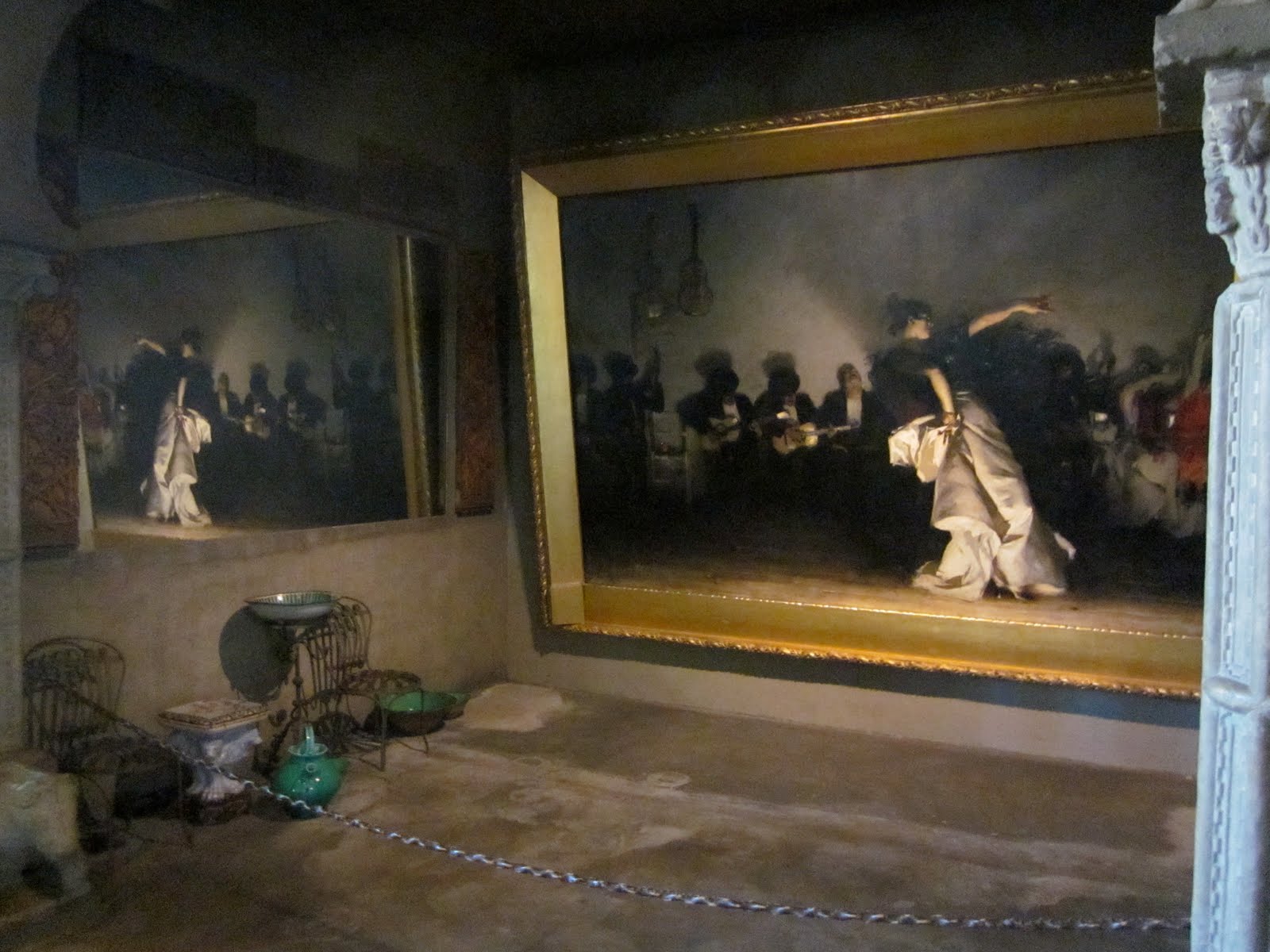 |
| John Singer Sargent, El Jaleo, 1882 |
So it wasn't really the best visit this time around. I hadn't really realized that my taste and Gardner's taste were so divergent (though I certainly liked El Jaleo and wished I could have gotten closer...).
I hadn't done much research before the trip, and I sort of made a fool of myself asking about the Vermeer to one of the guards. Well, in one of the most infamous art heists of all time, 13 paintings were stolen from the Gardner Museum in 1990, including the Vermeer and one of the Rembrandts. It's fairly likely that the paintings still exist somewhere, and there has been a bit of a lead recently in what is a very cold case, but I am not sure I would wager these paintings will be recovered in my lifetime. I do hope so, obviously.
 |
| Johannes Vermeer, The Concert, ca. 1664 (still missing) |
I then tried to cast my mind back to whether I actually had visited the Gardner on one of the three trips prior to 1990.* I suspect we would have gone on that first visit, and I'll check with my father to see if he remembers, since it seems like something my mother would have wanted to do. I also probably went in 1989, though I'll have to see if I kept a diary of that trip.
Where things get really weird is that I was paging through the excellent guide to the museum. (I definitely should have read this before the visit instead of afterwards back in the hotel!) There is a photo of the way the Rembrandt portrait is laid out that triggered a memory I had.
Or more of a shadow memory, where you remember something that you once remembered a lot better, but it is kind of hazy when you try to really remember the details. I was convinced that on my first visit to Victoria, BC (in 1994), I went into this small house that was actually a gallery, and that there were small gem-like paintings (perhaps Dutch) when you came down around the stairs. On a subsequent visit to Victoria (in 2013) I couldn't find anything that remotely matched that. And while Victoria is quite nice, it would be completely shocking to me if this artistic treasure was completely hidden. They just never had the kind of collectors with serious money out on the Pacific Northwest.
But flipping through the Gardner Museum guide, it is not at all impossible that I somehow shrunk the mansion to something a bit more modest but kept a few of the Dutch masterpieces in the back of my mind. I could of course be completely mistaken, and I wasn't conflating two different museums. Still, I would say the odds are better than 50-50 that I did see The Concert at some point prior to the heist.
My guess is that it will be a while before my next visit to Boston, but now that we have relocated to Toronto (and the kids are getting to be fairly seasoned travelers), trips to New York, DC and perhaps Philadelphia will become an annual or at least semi-annual tradition. (I just have to make sure they are in better shape next time before we set out...)
* I'm sure I visited the Gardner on the trip in 2000, but that would have been too late for the Vermeer.
Saturday, March 12, 2016
The rise and fall of the consulting class
It's been an interesting perspective to watch as engineering consultancies have been increasingly squeezed by competition, domestic and particularly international. Many of the perks have been removed, and certainly pressure to complete tasks on time is much higher and the need to be fully chargeable is extremely important. Many employees that would have slid by in the past (say 10 years ago) are being furloughed, even at the larger firms. Perhaps especially at the larger firms. I realize that the public never really appreciates this, simply pointing to the increasing expense of infrastructure projects as if consultants were simply pulling a fast one.
What is particularly novel (and perhaps a bit disheartening for long-time consultants) is that consultancy has less prestige than it ever had. (At least some people did relish the idea of working on multiple key projects across the country.) And, at least in the States (though not really in Canada) the public sector has begun to increase its compensation to the point where it is not absurd for talented engineers and planners to migrate to MPO and state DOTs. Of course, the most talented usually opted for academia after a couple of years in the trenches as a consultant.
I probably would not encourage my children to become consultants, at least not to plan to do it for a long time. The main reason this is on my mind is that I have decided to move back to the public sector, starting in April. There are all kinds of other pressures, particularly when the outcomes the agency I am joining are quite visible and often the decisions taken are often highly criticized. Overall, it seems like the right move for me, but I can't really get into all the details. I won't even vow never to return to consulting, though at the moment it seems unlikely, as I would like to finish out my career in a place that feels a bit more stable.
What is particularly novel (and perhaps a bit disheartening for long-time consultants) is that consultancy has less prestige than it ever had. (At least some people did relish the idea of working on multiple key projects across the country.) And, at least in the States (though not really in Canada) the public sector has begun to increase its compensation to the point where it is not absurd for talented engineers and planners to migrate to MPO and state DOTs. Of course, the most talented usually opted for academia after a couple of years in the trenches as a consultant.
I probably would not encourage my children to become consultants, at least not to plan to do it for a long time. The main reason this is on my mind is that I have decided to move back to the public sector, starting in April. There are all kinds of other pressures, particularly when the outcomes the agency I am joining are quite visible and often the decisions taken are often highly criticized. Overall, it seems like the right move for me, but I can't really get into all the details. I won't even vow never to return to consulting, though at the moment it seems unlikely, as I would like to finish out my career in a place that feels a bit more stable.
Wednesday, March 9, 2016
Incredibly intimate theatre
I've seen quite a few shows that were really up close and personal with the actors, including most of the events at the Campbell House Museum, and Wolf Manor's Richard III left the audience really close to the action. I saw Lear really close up as well in Vancouver (I believe the company was the Honest Fishmongers). In most of these cases, you have two rows of seats around the stage, and if you choose you can be in the second row (generally a good decision if there will be swordplay or blood gushing as in so many of Shakespeare's historical plays).
For Conor McPherson's Port Authority, they turned the downstairs room into a pub (with a working bar no less), and you could sit at any table you chose. If you showed up early that is. We made it inside by about 7:15 and most of the tables had been taken, though we could have had seats with our backs to the performers, which then means turning the seat around and is generally a bit awkward. That left the two tables up front, right next to the three chairs where the performers would be. I would say we were within 5 feet of the performers and they often looked right at us, though only occasionally talking directly to us. This was definitely a bit of a different play where the focus was on characters who by their own admission kind of let things happen to them, i.e. they weren't doers for the most part. That is a bit different from many plays, particularly American plays, though sometimes you have a character like Willy Loman realize that he no longer is a mover and shaker and that realization is the tragedy -- for an American audience especially. Two of the three characters seemed more content with their lot, at least in terms of their occupations, but then they still had unrealized longings for something (or someone) that just seemed out of reach.
I would actually recommend one table back from where we were (where you thought if you reached out you would touch the actors), but there is no question that this is an intimate evening anywhere in the room. It also means that there are not a lot of seats at each performance. I would be surprised if they have more than 36 spaces per show. Nonetheless, the actors did ask us to spread the word, so if you are interested, you should check here to see if there are any further slots open for the last week of performance.
I don't really know why this is called Port Authority, aside from Dublin actually having a port, and at one point one character discusses taking a long walk down to where you could see the sea stretching out endlessly.

For Conor McPherson's Port Authority, they turned the downstairs room into a pub (with a working bar no less), and you could sit at any table you chose. If you showed up early that is. We made it inside by about 7:15 and most of the tables had been taken, though we could have had seats with our backs to the performers, which then means turning the seat around and is generally a bit awkward. That left the two tables up front, right next to the three chairs where the performers would be. I would say we were within 5 feet of the performers and they often looked right at us, though only occasionally talking directly to us. This was definitely a bit of a different play where the focus was on characters who by their own admission kind of let things happen to them, i.e. they weren't doers for the most part. That is a bit different from many plays, particularly American plays, though sometimes you have a character like Willy Loman realize that he no longer is a mover and shaker and that realization is the tragedy -- for an American audience especially. Two of the three characters seemed more content with their lot, at least in terms of their occupations, but then they still had unrealized longings for something (or someone) that just seemed out of reach.
I would actually recommend one table back from where we were (where you thought if you reached out you would touch the actors), but there is no question that this is an intimate evening anywhere in the room. It also means that there are not a lot of seats at each performance. I would be surprised if they have more than 36 spaces per show. Nonetheless, the actors did ask us to spread the word, so if you are interested, you should check here to see if there are any further slots open for the last week of performance.
I don't really know why this is called Port Authority, aside from Dublin actually having a port, and at one point one character discusses taking a long walk down to where you could see the sea stretching out endlessly.
Subscribe to:
Posts (Atom)