There have been so many celebrity deaths lately that one simply cannot keep up. I am quite abashed that I didn't learn of Brian Bedford's passing until two weeks later (and I am not posting until another week has gone by). He died from cancer on
Jan 13, basically right between Bowie and Rickman, so that squeezed out all other celebrity deaths for a while. He was 80. The Star had a nice obit.
I believe I only saw him twice in various Stratford productions, including
a powerful Julius Caesar in an otherwise muddled production. I also saw him in School for Scandal (with Steven Sutcliffe as well), which was excellent.
He had
slowed down and more or less stopped performing by 2013, and I've
only been able to start going to Stratford on a regular basis since
2014. But he left a very strong legacy at Stratford -- and very limited
work in films or TV, which unfortunately means he will not leave much
of a trace in the general culture. He did have a role in the movie
Nixon and was the voice of Robin Hood in the Disney movie, which is
probably the height of his fame. There is a filmed version of The Importance of Being Ernest, which is probably quite good, and I may get it, but comparing Bedford in drag as Lady Bracknell to all the bigger roles he had over his career, it is a bit anti-climatic.
It is likely that Stratford has some other DVDs available, though probably
not for the roles I'd be most interested in (School for Scandal being the tops). But I'll check around this
summer when I go down.
I've pretty much settled that I am only going down for John Gabriel Borkman. Arthur Miller's All My Children is a fine play, and I am sure it is a good production, but I think this is a play that is fairly dependent on the twist at the end, so it isn't one that lends itself to seeing multiple times. I would definitely go see Death of a Salesman again, even though I "know" the ending, but I just cannot summon up the same enthusiasm for All My Children. Plus, I probably will have to be cutting back at least a bit on entertainment expenses. I may change my mind if the reviews are stunning, but I doubt it. I'd actually be more likely to go to a couple of the Shaw productions, depending upon reviews, but that isn't likely either.
I think I'll end this post before it gets even more off-track. I did find an image of him in School for Scandal, looking just a bit forlorn.
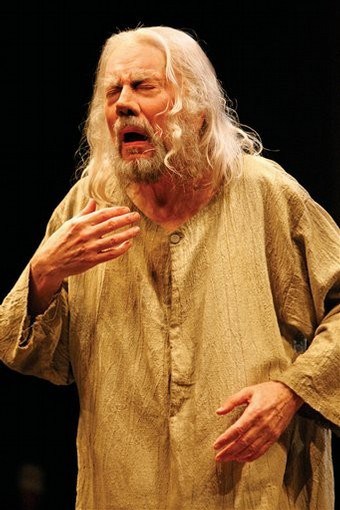
And here's a better photo of Bedford as Lear, probably from 2007. This is a production that I would very much like to have seen, but Chicago is just far enough from Stratford (and Chicago has so much going on) that it didn't cross my mind to make the trip. As I said, I will see if Stratford puts together a DVD of Lear or even a greatest hits package of Bedford pacing the boards. RIP
Friday, February 5, 2016
Thursday, February 4, 2016
The Return of the Return of Kronos
I suppose I could have called this Breaking News - Classical pt 2. or "Really Long-term Classical Events" or something. Anyway, as I mentioned in this post, Kronos Quartet is coming to Toronto in May.
Yesterday I received word that the TSO had released their 2016-17 season and they were trying hard to get people to subscribe early. So I poked around and saw Kronos Quartet. At first, I assumed they were just cross listing the concert at Koerner Hall, but no, Kronos is going to be coming back in March, 2017. Very, very exciting.
In general, this is a fairly interesting season. They are doing some Beethoven (Symphonies 4, 6 and 7), though I haven't decided if I will go. Dvorak's 9th and his Cello Concerto (I'll go to both of those concerts). And Orff's Carmina Burana. I'm not sure whether I have heard this in concert or not, but I certainly haven't heard it recently. One of the more amusing duplications is that they are doing Milhaud's La création du monde, just like Esprit Orchestra in March. The TSO's program is far more interesting to me than Esprit's. (I know it is a personal failing, but I so rarely enjoy pieces for choir or even choir and orchestra, with Carmina Burana and Beethoven's 9th Symphony among the exceptions that I do enjoy.) Also, the tickets for Esprit are just a bit higher than I want to pay, particularly for a number of unknown pieces that I suspect I won't enjoy. So I think I will bail on the Esprit concert in March and check out Milhaud later in the year (early November).
I think the only major drawback is that they are not getting quite as interesting soloists. Basically it is James Ehnes and Emmanuel Ax. But that is a relatively minor complaint.* It would definitely be nice if their seasons continue to be a bit more adventurous. (I haven't really gotten into all the details, but the season has Britten and Dutilleux and Szymanowski. Actually the chance to see Szymanowski's Violin Concerto No. 2 paired with Carmina Burana makes this a very appealing concert.)
Now if only they could make Roy Thompson Hall a bit more appealing...
* Apparently it is a conscious choice to try to focus on Canadian musicians rather than international stars, according to this article on the new season. Probably not the route I would go, but every so often you run up against Canadian nationalism in these settings. In some ways, I find it even more problematic at art museums where the need to promote living artists (who need to make a living) ought to be a lower priority than "enduring artistic merit," whatever that is...
Yesterday I received word that the TSO had released their 2016-17 season and they were trying hard to get people to subscribe early. So I poked around and saw Kronos Quartet. At first, I assumed they were just cross listing the concert at Koerner Hall, but no, Kronos is going to be coming back in March, 2017. Very, very exciting.
In general, this is a fairly interesting season. They are doing some Beethoven (Symphonies 4, 6 and 7), though I haven't decided if I will go. Dvorak's 9th and his Cello Concerto (I'll go to both of those concerts). And Orff's Carmina Burana. I'm not sure whether I have heard this in concert or not, but I certainly haven't heard it recently. One of the more amusing duplications is that they are doing Milhaud's La création du monde, just like Esprit Orchestra in March. The TSO's program is far more interesting to me than Esprit's. (I know it is a personal failing, but I so rarely enjoy pieces for choir or even choir and orchestra, with Carmina Burana and Beethoven's 9th Symphony among the exceptions that I do enjoy.) Also, the tickets for Esprit are just a bit higher than I want to pay, particularly for a number of unknown pieces that I suspect I won't enjoy. So I think I will bail on the Esprit concert in March and check out Milhaud later in the year (early November).
I think the only major drawback is that they are not getting quite as interesting soloists. Basically it is James Ehnes and Emmanuel Ax. But that is a relatively minor complaint.* It would definitely be nice if their seasons continue to be a bit more adventurous. (I haven't really gotten into all the details, but the season has Britten and Dutilleux and Szymanowski. Actually the chance to see Szymanowski's Violin Concerto No. 2 paired with Carmina Burana makes this a very appealing concert.)
Now if only they could make Roy Thompson Hall a bit more appealing...
* Apparently it is a conscious choice to try to focus on Canadian musicians rather than international stars, according to this article on the new season. Probably not the route I would go, but every so often you run up against Canadian nationalism in these settings. In some ways, I find it even more problematic at art museums where the need to promote living artists (who need to make a living) ought to be a lower priority than "enduring artistic merit," whatever that is...
Wednesday, February 3, 2016
Showdown at High Tea
This is just a silly title. It is a bit forced, not totally unlike a Quentin Tarrantino movie where everything is shoehorned into one over-stuffed movie. (I've actually been thinking quite a bit about The Hateful 8 since I saw it last Saturday, and I'll end this post with a coda related to the film.)
What the title is supposed to represent is how I have been recently inspired to read a number of authors who are all largely in the High Modernist vein. (I've also been reading Bove, and despite some influence of Kafka, he strikes me as a realist author, who was not explicitly a modernist, though actually Armand, one of Bove's earlier novels reminds me very much of Sartre's existential fiction.) On the one hand you have relatively refined genteel fiction coming from Woolf, Musil and Proust (with Woolf and Proust both returning again and again to write about tea parties and other soirees), and then you have Faulkner crashing about in the underbrush, with all his tales of hunting and how relatively modestly well-off whites will cling to their title to the land in the face of increasing pressure from modern society (to say nothing of the familial demands over time*).
But Faulkner surely was a modernist, even though his preoccupations were completely different from Woolf and Musil. I'm sure there are close to a thousand monographs written on literary modernism and its key proponents. For me, one of the chief hallmarks is that the interior voice tends to dominate and take precedence over outwardly observable actions and dialog. By that I mean that the novel from Austen through George Eliot featured a lot of interaction between characters but also commentary from the omniscient narrative voice on the inner motivations of these characters (and this was particularly prominent, even oppressive, in Eliot's Middlemarch). However, one could argue that the inner motivations more or less aligned with the outward actions, or in cases where there was a discrepancy (either someone adhering to social conventions even though they didn't wish to or someone intentionally deceiving another person), these could be understood by someone with a basic grasp of human psychology.
The modernists tend to break with this convention in different ways. Some are essentially asserting that inner states are mutable and constantly shifting. If a person can hardly know him- or herself, what chance is there to convey this to others, either in writing (epistolary fictional forms) or via speech**? I saw quite a bit of this towards the end of Musil's The Confusions of Young Törless, where Törless is frustrated with himself not being able to explain his actions to his teachers. One response is to write encyclopedic works, showing the inner thoughts responding to various stimuli. (At least this is my take at what is the essence of Proust and Musil's The Man Without Qualities: the impossibility of fully explaining oneself to others.)
A second approach is to focus on inner monologue and try to show how there are gaps between the inner thoughts and the outer actions, but to get less caught up in the question of whether the inner self is stable (or even particularly concerned about conveying interior thoughts to others). This is certainly how I read Woolf, particularly Mrs. Dalloway and to a lesser extent To the Lighthouse (where we get inside the heads of several characters if I remember correctly).
Jacob's Room is a bit different, where we get short snippets of conversation (and perhaps some inner thoughts) all linked to Jacob. It's sort of like Jacob is a spotlight (or better yet an x-ray spotlight) and we only can find out what is going on with the other characters when Jacob comes close to them or interacts with them in some other way. Clearing out Jacob's room after he has died in World War I counts as part of this exercise. I have to admit, I just didn't care much for this, as I had to work too hard, imagining there was some sort of thematic unity behind the way Woolf sequenced the different vignettes. After all, it wasn't strictly chronological. There are a couple of times the empty room is referred to in the middle of the book. Maybe there wasn't much of a scheme at all and it really was kind of random meandering through Jacob's life. (Or was it? There are certainly moments in Joyce's Ulysses where it probably seems Blook is wandering aimlessly through Dublin, though he is really retracing Odysseus's travels. You never really know with the modernists, but I wasn't enjoying Woolf's novel enough to put any more work into it when it resisted my initial efforts at finding some narrative thread.) Others like it quite a bit and liken the effect to watching a stone skip over the surface of a pond, but I was kind of bored throughout. I did think Jacob's short encounter with a prostitute was one of the better scenes. For my taste, Mrs. Dalloway isn't so relentlessly experimental and is generally the more rewarding read. I've put it at the tail end of my very long to read pile, with some additional Faulkner, incidentally. I'll have to see how I respond to it 20+ years after my first reading, and I'll go ahead and reread Mrs. Dalloway's Party at the same time.
Faulkner, at least in his early novels, is going for a different effect. The interior voice can be so dominant that it is very hard to understand what is "actually" going on. Since a person normally doesn't refer to him or herself by name in their own thoughts, Faulkner likewise often obscures who is talking to whom, and just launches into the conversation. I couldn't even tell in some cases if the conversation was a real one, but set in the past, or if it was simply an imagined conversation. Faulkner is one of the better novelists, though hardly the only one, to explore the Rashomon effect where different people can experience the same event completely differently,† to say nothing of how they remember it later, which is again different from how they might speak about it later to others. The Sound and the Fury is the epitome of this where there are four different narrative voices, but it comes up in Go Down, Moses as well, particularly in "The Bear." To be honest, I wasn't that grabbed by "The Bear." I got really tired of all the hunting in Go Down, Moses and could easily have left the hunting scenes out (there would still be plenty in "Was" and "Delta Autumn"). I think in general with Faulkner, I will read the book through on my own, and then if I ever get to a second reading, I will refer to various on-line sites where people have worked out the genealogy in these stories. I could get some of it, but some of it was just too tangled, certainly in part because it was so shameful to talk about having half-brothers that were born from Black slaves or servants that it was discussed in a very roundabout way if ever at all. Interestingly, my copy of Go Down, Moses completely fell apart while I was reading it, so this summer I'll probably pick up a copy of the LOA volume that collects it and Intruder in the Dust (a kind of sequel) and A Fable. I've added enough Faulkner to my reading list, that I will have covered all the "important" novels by 2020. Something to look forward to certainly, and I may cheat a bit here or there by moving Faulkner up a bit periodically. Despite the seriousness of many of the novels, there are many comic episodes in Faulkner. In Go Down, Moses, "Was" and "The Fire and the Hearth" both had very comic passages, though the funniest Faulkner I have read to date is The Reivers.
Coda: I think this post has gone on long enough, and I will return to The Hateful 8, which features an impressive mix of styles. It is a Western, but also a thriller in some sense, and there are also characteristics of the locked room mystery with most people having some secrets from each other. There are a few moments that are absurdly bloody, but other than that, I liked it quite a bit, and thought it actually tackled post Civil War conditions in a way that wasn't completely stupid, though obviously not as profoundly as Faulkner. Where QT's movie is a bit different from Faulkner is that the perspective of the whites still licking their wounds from their defeat is mixed with Yankees and Westerners who mostly just wanted to avoid picking sides. In Faulkner, everything is filtered through a Southern's perspective. I thought the song that ran over the credits was just incredible: Roy Orbison's There Won't Be Many Coming Home. I don't mind admitting that I wasn't aware of the song until now. I can almost imagine a scenario where Quentin loved the song so much that he had to come up with a vehicle to feature it. Well perhaps not, but you never know. I'll try to embed it below, but here's a direct link to it on Youtube.
* I haven't read the Snopes trilogy, but I've read a few of the other books with links to the Sartoris clan, and it becomes obvious how in this society that drew so heavily upon English traditions some form of primogeniture was essential to keep estates from being split up into tiny bits that were completely unproductive. In Go Down, Moses Faulkner shows how things get very complicated when primogeniture isn't followed because it doesn't seem fair, and quite a few white men had children with their slaves (and later Black servants), but these descendants were almost entirely excluded from their birthright. It is actually notable that one man set aside a $1000 bequest for his illegitimate son, and this has consequences for binding the mixed race descendants to the estate. Faulkner seems to suggest that the children who moved away are generally no better off than those who stay. What is also a bit different in this novel (or rather series of linked stories) is that the "pure" white side of the family has very few offspring, so the estate doesn't keep getting chopped up as would normally happen. Though there is a moment in "Delta Autumn" where Uncle Ike bemoans how a whole town has sprung up where there was originally only a small sawmill and railroad depot carved out of the land of one of his neighbors.
** It is arguable that this is going on in some Ibsen and Strindberg plays. It is also an issue that preoccupied Joyce in Portrait of the Artist as a Young Man, as well as Exiles, which is a play written along the lines of Ibsen's plays. I've just seen it, however, and I have to agree with the critics that say it is badly written. Maybe it is just as well he worked out his issues in his marriage here (baldly and badly) and then was able to come up with a far better and more nuanced portrayal of a couple with fidelity issues in Ulysses.
† I can't believe that I passed up the chance to plug Durrell's The Alexandria Quartet where three of the books are written from different characters' perspectives, in some cases significantly reversing what the reader thought he (or she) knew from the previous book.
What the title is supposed to represent is how I have been recently inspired to read a number of authors who are all largely in the High Modernist vein. (I've also been reading Bove, and despite some influence of Kafka, he strikes me as a realist author, who was not explicitly a modernist, though actually Armand, one of Bove's earlier novels reminds me very much of Sartre's existential fiction.) On the one hand you have relatively refined genteel fiction coming from Woolf, Musil and Proust (with Woolf and Proust both returning again and again to write about tea parties and other soirees), and then you have Faulkner crashing about in the underbrush, with all his tales of hunting and how relatively modestly well-off whites will cling to their title to the land in the face of increasing pressure from modern society (to say nothing of the familial demands over time*).
But Faulkner surely was a modernist, even though his preoccupations were completely different from Woolf and Musil. I'm sure there are close to a thousand monographs written on literary modernism and its key proponents. For me, one of the chief hallmarks is that the interior voice tends to dominate and take precedence over outwardly observable actions and dialog. By that I mean that the novel from Austen through George Eliot featured a lot of interaction between characters but also commentary from the omniscient narrative voice on the inner motivations of these characters (and this was particularly prominent, even oppressive, in Eliot's Middlemarch). However, one could argue that the inner motivations more or less aligned with the outward actions, or in cases where there was a discrepancy (either someone adhering to social conventions even though they didn't wish to or someone intentionally deceiving another person), these could be understood by someone with a basic grasp of human psychology.
The modernists tend to break with this convention in different ways. Some are essentially asserting that inner states are mutable and constantly shifting. If a person can hardly know him- or herself, what chance is there to convey this to others, either in writing (epistolary fictional forms) or via speech**? I saw quite a bit of this towards the end of Musil's The Confusions of Young Törless, where Törless is frustrated with himself not being able to explain his actions to his teachers. One response is to write encyclopedic works, showing the inner thoughts responding to various stimuli. (At least this is my take at what is the essence of Proust and Musil's The Man Without Qualities: the impossibility of fully explaining oneself to others.)
A second approach is to focus on inner monologue and try to show how there are gaps between the inner thoughts and the outer actions, but to get less caught up in the question of whether the inner self is stable (or even particularly concerned about conveying interior thoughts to others). This is certainly how I read Woolf, particularly Mrs. Dalloway and to a lesser extent To the Lighthouse (where we get inside the heads of several characters if I remember correctly).
Jacob's Room is a bit different, where we get short snippets of conversation (and perhaps some inner thoughts) all linked to Jacob. It's sort of like Jacob is a spotlight (or better yet an x-ray spotlight) and we only can find out what is going on with the other characters when Jacob comes close to them or interacts with them in some other way. Clearing out Jacob's room after he has died in World War I counts as part of this exercise. I have to admit, I just didn't care much for this, as I had to work too hard, imagining there was some sort of thematic unity behind the way Woolf sequenced the different vignettes. After all, it wasn't strictly chronological. There are a couple of times the empty room is referred to in the middle of the book. Maybe there wasn't much of a scheme at all and it really was kind of random meandering through Jacob's life. (Or was it? There are certainly moments in Joyce's Ulysses where it probably seems Blook is wandering aimlessly through Dublin, though he is really retracing Odysseus's travels. You never really know with the modernists, but I wasn't enjoying Woolf's novel enough to put any more work into it when it resisted my initial efforts at finding some narrative thread.) Others like it quite a bit and liken the effect to watching a stone skip over the surface of a pond, but I was kind of bored throughout. I did think Jacob's short encounter with a prostitute was one of the better scenes. For my taste, Mrs. Dalloway isn't so relentlessly experimental and is generally the more rewarding read. I've put it at the tail end of my very long to read pile, with some additional Faulkner, incidentally. I'll have to see how I respond to it 20+ years after my first reading, and I'll go ahead and reread Mrs. Dalloway's Party at the same time.
Faulkner, at least in his early novels, is going for a different effect. The interior voice can be so dominant that it is very hard to understand what is "actually" going on. Since a person normally doesn't refer to him or herself by name in their own thoughts, Faulkner likewise often obscures who is talking to whom, and just launches into the conversation. I couldn't even tell in some cases if the conversation was a real one, but set in the past, or if it was simply an imagined conversation. Faulkner is one of the better novelists, though hardly the only one, to explore the Rashomon effect where different people can experience the same event completely differently,† to say nothing of how they remember it later, which is again different from how they might speak about it later to others. The Sound and the Fury is the epitome of this where there are four different narrative voices, but it comes up in Go Down, Moses as well, particularly in "The Bear." To be honest, I wasn't that grabbed by "The Bear." I got really tired of all the hunting in Go Down, Moses and could easily have left the hunting scenes out (there would still be plenty in "Was" and "Delta Autumn"). I think in general with Faulkner, I will read the book through on my own, and then if I ever get to a second reading, I will refer to various on-line sites where people have worked out the genealogy in these stories. I could get some of it, but some of it was just too tangled, certainly in part because it was so shameful to talk about having half-brothers that were born from Black slaves or servants that it was discussed in a very roundabout way if ever at all. Interestingly, my copy of Go Down, Moses completely fell apart while I was reading it, so this summer I'll probably pick up a copy of the LOA volume that collects it and Intruder in the Dust (a kind of sequel) and A Fable. I've added enough Faulkner to my reading list, that I will have covered all the "important" novels by 2020. Something to look forward to certainly, and I may cheat a bit here or there by moving Faulkner up a bit periodically. Despite the seriousness of many of the novels, there are many comic episodes in Faulkner. In Go Down, Moses, "Was" and "The Fire and the Hearth" both had very comic passages, though the funniest Faulkner I have read to date is The Reivers.
Coda: I think this post has gone on long enough, and I will return to The Hateful 8, which features an impressive mix of styles. It is a Western, but also a thriller in some sense, and there are also characteristics of the locked room mystery with most people having some secrets from each other. There are a few moments that are absurdly bloody, but other than that, I liked it quite a bit, and thought it actually tackled post Civil War conditions in a way that wasn't completely stupid, though obviously not as profoundly as Faulkner. Where QT's movie is a bit different from Faulkner is that the perspective of the whites still licking their wounds from their defeat is mixed with Yankees and Westerners who mostly just wanted to avoid picking sides. In Faulkner, everything is filtered through a Southern's perspective. I thought the song that ran over the credits was just incredible: Roy Orbison's There Won't Be Many Coming Home. I don't mind admitting that I wasn't aware of the song until now. I can almost imagine a scenario where Quentin loved the song so much that he had to come up with a vehicle to feature it. Well perhaps not, but you never know. I'll try to embed it below, but here's a direct link to it on Youtube.
* I haven't read the Snopes trilogy, but I've read a few of the other books with links to the Sartoris clan, and it becomes obvious how in this society that drew so heavily upon English traditions some form of primogeniture was essential to keep estates from being split up into tiny bits that were completely unproductive. In Go Down, Moses Faulkner shows how things get very complicated when primogeniture isn't followed because it doesn't seem fair, and quite a few white men had children with their slaves (and later Black servants), but these descendants were almost entirely excluded from their birthright. It is actually notable that one man set aside a $1000 bequest for his illegitimate son, and this has consequences for binding the mixed race descendants to the estate. Faulkner seems to suggest that the children who moved away are generally no better off than those who stay. What is also a bit different in this novel (or rather series of linked stories) is that the "pure" white side of the family has very few offspring, so the estate doesn't keep getting chopped up as would normally happen. Though there is a moment in "Delta Autumn" where Uncle Ike bemoans how a whole town has sprung up where there was originally only a small sawmill and railroad depot carved out of the land of one of his neighbors.
** It is arguable that this is going on in some Ibsen and Strindberg plays. It is also an issue that preoccupied Joyce in Portrait of the Artist as a Young Man, as well as Exiles, which is a play written along the lines of Ibsen's plays. I've just seen it, however, and I have to agree with the critics that say it is badly written. Maybe it is just as well he worked out his issues in his marriage here (baldly and badly) and then was able to come up with a far better and more nuanced portrayal of a couple with fidelity issues in Ulysses.
† I can't believe that I passed up the chance to plug Durrell's The Alexandria Quartet where three of the books are written from different characters' perspectives, in some cases significantly reversing what the reader thought he (or she) knew from the previous book.
Saturday, January 30, 2016
9th Canadian Challenge - 14th Review - The Age
There is a lot going on in Nancy Lee's The Age, which is a Vancouver-based book, though it isn't until towards the end that Lee gets specific about the location of places when she writes about a march for peace through the downtown where things gets a bit out of hand. Part of my resistance throughout the book is that I basically didn't feel that this was really about Vancouver, but Vancouver standing in for a random U.S. city, as it does so often nowadays in the movies (though it certainly didn't back in 1987 or so which is the time in which the book is set*). There were a number of things that just didn't feel authentic to me, though I must admit I wasn't even thinking of visiting Vancouver until the mid 90s (and I hadn't visited Seattle either). I wasn't all that taken with the main character, Gerry. I understand she was written as an attention-starved adolescent who makes a number of bad decisions along the way in search of love and other human contact, but I really never warmed up to her. Despite that, this is a compelling story (though it did feel like a novel that was written with at least one eye towards turning it into a screenplay...). However, I had some serious misgivings about the ending (or rather multiple resolutions), which I will get to after the obligatory SPOILER warnings. If I was rating on a 5-star system (which I basically never do), I would go with 3.5 stars. Had Lee stuck the landing, as it were, I would have gone up to 4. So that's sort of a weak positive recommendation, but you may feel my objections are too picky, so I will explain my reasoning.
To really dig into this book, I have to reveal the ending, so truly don't read on if SPOILERS bother you.
SPOILERS (last warning)
As others have noted, this is a novel where parent are absent, either physically, mentally, emotionally or some combination of all three. I'm not going back to check, but I believe that neither of Gerry's parents is named, though other parents are named.
Gerry's problems all seem to arise from her feelings of rejection that her father has divorced her mother, moved to California, started a new family and broken off all contact with Gerry. It is hard to imagine a more terrible move by a parent. Towards the very end of the novel when Gerry is recovering from a suicide attempt, her mother begs Gerry's father (on the phone) to come and see his daughter and he basically puts her off and says "Later." Even if his guilt and resentment over being dragged back into a situation he had left (and then probably doubling down on guilt) were coming to a head, how could you abandon a child in that much need? It is unfathomable to me. I'm sure there are such people in the world, but I didn't really like having my nose rubbed in it.
Second, there is a touchy yet a bit easy (cheap and easy?) scene where Gerry's mother says that she wasn't "stuck" with Gerry, she fought to keep her (frankly, this seems untrue given what we overhear on the phone conversation with Gerry's father but so be it). Gerry finally feels sufficiently loved and starts to re-evaluate her relationship with her mother. I mean really? Gerry's mother is a bit of a pill (mostly due to stress from over-working) but she regularly showed Gerry affection throughout the novel, and Gerry mostly parried it or rejected these overtures in the ways that teenagers do (that is so infuriating to their parents). Frankly, I didn't think Lee had structured the novel well enough to earn this scene. So that was an issue I had with the book.
We only meet the parents of Gerry's best friend Ian once or twice. They are mostly pleasant ciphers, though the mother's pot growing business explains why Ian is a pothead, who makes questionable decisions throughout the novel. Ian is a few years old than Gerry, and she has the hots for him, though he sees her as a kid sister. In fact, he frequently points out that he used to babysit her, though he is dating Lark (a girl basically Gerry's age) as well as fooling around with Megan, one of the radicals.
Megan lives with her basically comatose father, Clem. He is an old school radical (I guess from the Weathermen era, though he seems to have more in common with the Wobblies), but did a long stint in prison and never really recovered. Megan is one of a new group of radicals who are against nuclear arms and appear to think that setting off a bomb to blow up the lobby of a building that has vague military-industrial connections, using the downtown peace rally as a cover, is going to accomplish something useful. Obviously, that is inane, but fairly consistent with the logic of the Weathermen and other groups of the radical left. Where the logic completely fails me is why Vancouver and not Seattle, which I already discussed a bit in this post.
The other two radicals are Michelle and Andri. If I recall correctly, Andri is a former Soviet dissident (he's from Belarus), and he frequently talks about how soft prisoners have it in North America. Later on, he decides that Gerry ought to plant the bomb since she would only be charged as a juvenile if she is caught. Michelle seems nice but quite pliable. It is a little hard to see how she got caught up in all this, particularly as she and Andri are having a baby, but she is sort of portrayed as a bubble-headed liberal who just really wants peace, by any means necessary. So you can see that solid parental figures are definitely lacking in this novel, and the yong'uns have gone off the rails.
Oh, I forgot another entire side plot with Gerry getting close to Henry, her paternal grandfather, who is a news anchor in Vancouver, as well as being an accomplished cat burglar. He breaks into his ex-wife's house a few times during the course of the novel. He was definitely an interesting (if amoral) character, but it kind of strained plausibility in an already improbable novel where up until the last few pages, it appears Henry staged his own death.
I generally had a hard time accepting this was a novel about Vancouver. In part because I came to Vancouver late, and it had gentrified to the point where you wouldn't have slacker gangs hanging about in the city, since that demographic has largely decamped to Surrey by this point. But also, I have the distinct impression that Gerry rides her bike through some wooded areas on her way from Clem's house to her house, but this also has to be close enough to downtown that she pops in and out of downtown (scoping out the building they are going to try to bomb) on a short trip. The geography just doesn't add up. If Clem and Megan live in Kits (or even more likely near the UBC Endowment Lands where they won't be disturbed in their bomb making), then this is a 30+ minute trip by bike. Maybe I am just missing something, but I couldn't get the mental map in my head to make sense.*
My biggest problem, however, was with the march, where the presence of Black Flag anarchists causes things to get completely out of hand with drastic consequences, though they still might not have been so dire if Megan hadn't been so inspired by the anarchists to the point she wigged out. I don't know about Ms. Lee, but I did go on a few anti-war marches in the late 1980s, slightly after when this book is set, and they were fairly low-key events. She is completely conflating the anti-WTO riots in Seattle from 1999 with this peace rally in Vancouver from a decade and a half earlier. It really irked me, and it kept taking me out of the book to essentially argue with the author that her narrative made no sense, since Vancouver simply was not a hotbed of anarchism in the mid 80s. So for me, the book pretty much unraveled at that point, and I was no longer all that interested in it. I do think it is a cautionary tale for authors tackling recent historical fiction that the details matter -- but also that no matter how careful you are, there will be some reader that comes along and says that it doesn't square with his or her memory of that era.† I think some people will definitely eat this up, but it just didn't do it for me. However, I will say that it is a testament to Ms. Lee's writing that even though I really didn't care for Gerry (far too bratty for my taste at the start of the book), I wanted to see how things turned out.
* Actually according to this interview piece, the book is set in 1984, but I am almost certain I read a passage in the book saying that the Vancouver Expo of '86 was over. I may have misread it and the point was that the city was gearing up for the Expo, and thus the first waves of gentrification hadn't hit.
** I am sure part of the problem is that I either can picture Vancouver in the late 1950s through 1960s, courtesy of Fred Herzog, or I know Vancouver after it had almost entirely gentrified after 2000. Nancy Lee actually grew up in Vancouver in the 1980s (though it isn't clear from interviews if she had arrived by 1984, though at one point she implies it), so she should know better, but it still doesn't feel right to me.
† There are a few interesting bits in this interview, including how she completely rewrote The Age several times, including changing Gerry from a young boy to a young girl. She indicates that Vancouver had a massive peace march in 1984, but I still am having a lot of trouble believing that the anarchists spoiled the march a decade before that happened in Seattle.
In fact, even a couple of days later I am still irritated by this. There isn't a lot of material on the web (since the mid 1980s exist in this weird pre-internet space), but a few article confirm that roughly 100,000 marched for peace in Vancouver, making it the biggest peace march in Canadian history. They were there to push Vancouver to pass an amendment to ask the federal government (led by Trudeau in the last month of his final term...) to withdraw from any further joint tests of anti-ballistic missile systems. How Canadian, how polite...
What I can't find is any news that there were any major disruptions or outside agitators. Everything seemed to go pretty well, and people certainly seemed chill for the most part. Here are a couple of photos from Common Ground indicating how mellow everyone was.
I just can't help but feel it was a mistake for Ms. Lee to hijack this event and make an alternative history version of it, which is why I don't think I will ever really warm up to The Age.
To really dig into this book, I have to reveal the ending, so truly don't read on if SPOILERS bother you.
SPOILERS (last warning)
As others have noted, this is a novel where parent are absent, either physically, mentally, emotionally or some combination of all three. I'm not going back to check, but I believe that neither of Gerry's parents is named, though other parents are named.
Gerry's problems all seem to arise from her feelings of rejection that her father has divorced her mother, moved to California, started a new family and broken off all contact with Gerry. It is hard to imagine a more terrible move by a parent. Towards the very end of the novel when Gerry is recovering from a suicide attempt, her mother begs Gerry's father (on the phone) to come and see his daughter and he basically puts her off and says "Later." Even if his guilt and resentment over being dragged back into a situation he had left (and then probably doubling down on guilt) were coming to a head, how could you abandon a child in that much need? It is unfathomable to me. I'm sure there are such people in the world, but I didn't really like having my nose rubbed in it.
Second, there is a touchy yet a bit easy (cheap and easy?) scene where Gerry's mother says that she wasn't "stuck" with Gerry, she fought to keep her (frankly, this seems untrue given what we overhear on the phone conversation with Gerry's father but so be it). Gerry finally feels sufficiently loved and starts to re-evaluate her relationship with her mother. I mean really? Gerry's mother is a bit of a pill (mostly due to stress from over-working) but she regularly showed Gerry affection throughout the novel, and Gerry mostly parried it or rejected these overtures in the ways that teenagers do (that is so infuriating to their parents). Frankly, I didn't think Lee had structured the novel well enough to earn this scene. So that was an issue I had with the book.
We only meet the parents of Gerry's best friend Ian once or twice. They are mostly pleasant ciphers, though the mother's pot growing business explains why Ian is a pothead, who makes questionable decisions throughout the novel. Ian is a few years old than Gerry, and she has the hots for him, though he sees her as a kid sister. In fact, he frequently points out that he used to babysit her, though he is dating Lark (a girl basically Gerry's age) as well as fooling around with Megan, one of the radicals.
Megan lives with her basically comatose father, Clem. He is an old school radical (I guess from the Weathermen era, though he seems to have more in common with the Wobblies), but did a long stint in prison and never really recovered. Megan is one of a new group of radicals who are against nuclear arms and appear to think that setting off a bomb to blow up the lobby of a building that has vague military-industrial connections, using the downtown peace rally as a cover, is going to accomplish something useful. Obviously, that is inane, but fairly consistent with the logic of the Weathermen and other groups of the radical left. Where the logic completely fails me is why Vancouver and not Seattle, which I already discussed a bit in this post.
The other two radicals are Michelle and Andri. If I recall correctly, Andri is a former Soviet dissident (he's from Belarus), and he frequently talks about how soft prisoners have it in North America. Later on, he decides that Gerry ought to plant the bomb since she would only be charged as a juvenile if she is caught. Michelle seems nice but quite pliable. It is a little hard to see how she got caught up in all this, particularly as she and Andri are having a baby, but she is sort of portrayed as a bubble-headed liberal who just really wants peace, by any means necessary. So you can see that solid parental figures are definitely lacking in this novel, and the yong'uns have gone off the rails.
Oh, I forgot another entire side plot with Gerry getting close to Henry, her paternal grandfather, who is a news anchor in Vancouver, as well as being an accomplished cat burglar. He breaks into his ex-wife's house a few times during the course of the novel. He was definitely an interesting (if amoral) character, but it kind of strained plausibility in an already improbable novel where up until the last few pages, it appears Henry staged his own death.
I generally had a hard time accepting this was a novel about Vancouver. In part because I came to Vancouver late, and it had gentrified to the point where you wouldn't have slacker gangs hanging about in the city, since that demographic has largely decamped to Surrey by this point. But also, I have the distinct impression that Gerry rides her bike through some wooded areas on her way from Clem's house to her house, but this also has to be close enough to downtown that she pops in and out of downtown (scoping out the building they are going to try to bomb) on a short trip. The geography just doesn't add up. If Clem and Megan live in Kits (or even more likely near the UBC Endowment Lands where they won't be disturbed in their bomb making), then this is a 30+ minute trip by bike. Maybe I am just missing something, but I couldn't get the mental map in my head to make sense.*
My biggest problem, however, was with the march, where the presence of Black Flag anarchists causes things to get completely out of hand with drastic consequences, though they still might not have been so dire if Megan hadn't been so inspired by the anarchists to the point she wigged out. I don't know about Ms. Lee, but I did go on a few anti-war marches in the late 1980s, slightly after when this book is set, and they were fairly low-key events. She is completely conflating the anti-WTO riots in Seattle from 1999 with this peace rally in Vancouver from a decade and a half earlier. It really irked me, and it kept taking me out of the book to essentially argue with the author that her narrative made no sense, since Vancouver simply was not a hotbed of anarchism in the mid 80s. So for me, the book pretty much unraveled at that point, and I was no longer all that interested in it. I do think it is a cautionary tale for authors tackling recent historical fiction that the details matter -- but also that no matter how careful you are, there will be some reader that comes along and says that it doesn't square with his or her memory of that era.† I think some people will definitely eat this up, but it just didn't do it for me. However, I will say that it is a testament to Ms. Lee's writing that even though I really didn't care for Gerry (far too bratty for my taste at the start of the book), I wanted to see how things turned out.
* Actually according to this interview piece, the book is set in 1984, but I am almost certain I read a passage in the book saying that the Vancouver Expo of '86 was over. I may have misread it and the point was that the city was gearing up for the Expo, and thus the first waves of gentrification hadn't hit.
** I am sure part of the problem is that I either can picture Vancouver in the late 1950s through 1960s, courtesy of Fred Herzog, or I know Vancouver after it had almost entirely gentrified after 2000. Nancy Lee actually grew up in Vancouver in the 1980s (though it isn't clear from interviews if she had arrived by 1984, though at one point she implies it), so she should know better, but it still doesn't feel right to me.
† There are a few interesting bits in this interview, including how she completely rewrote The Age several times, including changing Gerry from a young boy to a young girl. She indicates that Vancouver had a massive peace march in 1984, but I still am having a lot of trouble believing that the anarchists spoiled the march a decade before that happened in Seattle.
In fact, even a couple of days later I am still irritated by this. There isn't a lot of material on the web (since the mid 1980s exist in this weird pre-internet space), but a few article confirm that roughly 100,000 marched for peace in Vancouver, making it the biggest peace march in Canadian history. They were there to push Vancouver to pass an amendment to ask the federal government (led by Trudeau in the last month of his final term...) to withdraw from any further joint tests of anti-ballistic missile systems. How Canadian, how polite...
What I can't find is any news that there were any major disruptions or outside agitators. Everything seemed to go pretty well, and people certainly seemed chill for the most part. Here are a couple of photos from Common Ground indicating how mellow everyone was.
I just can't help but feel it was a mistake for Ms. Lee to hijack this event and make an alternative history version of it, which is why I don't think I will ever really warm up to The Age.
Wednesday, January 27, 2016
Shakespeare only (Canadian Stage 2016-17)
I was tempted to title this post the increasing irrelevancy of Canadian Stage, but I felt that was just a bit too harsh. After all, many people like this sort of spectacle, fusing dance and theatre and singing and what have you. I generally do not. I can enjoy it in small bits (basically Robert LePage) but the rest of the time, I want plays where the dialogue and plot are first and foremost. The artistic director of Canadian Stage is not interested in that, so it is hardly surprising that I look over each season and find at most one play that I might be willing to see. Here is the current brochure. The LePage spectacle 887 is quite interesting, and I would encourage people to go, but I saw it during Panamania last year.
The only straight-forward play they are doing is Nick Payne's Constellations, and I read that already and thought it was completely dreadful. The best way I can think of describing it is a sketch where they play a scene between a couple one way, then rewind it just slightly and play it another way, and then go off in a different direction. Then you break and something about their relationship is fundamentally altered. I imagine it was supposed to be a dramatic representation of quantum universes running in parallel (sort of what I imagined Possible Worlds would be), but the way it plays out (or at least reads on the page) is so tedious and the stakes are so low. I don't know if I am being hypocritical in that I want to see Caryl Churchill's Love and Information where there is no meaningful plot either, just lots of snatches of dialogue and scenes that dissipate into the ether. (I'm surprised that Canadian Stage isn't putting this on, as it seems right up their alley, but perhaps the season after this.) All I know is that I read Constellations, and I hated it and have no interest in finding out if it does work better when actually mounted.
There isn't anything else in their regular season that is of any interest. I do think The Public Servant sounds interesting, but this is more of a case where they are renting out their space to a different company. I have no idea how they are doing with their sales and subscriptions, but my personal view is that I simply will never be that interested in the company until they turf the current AD for someone who is more mainstream.
However, I am generally interested in their summer offering: Shakespeare in High Park (despite the seating being so uncomfortable in the park). This year they are doing Hamlet and All's Well That Ends Well. I'll probably see Hamlet, despite having seen it twice last summer. It's a bit more of a debate if I should take my son, but perhaps. I don't think he would be all that interested in All's Well, and I'll plan on going by myself to that, even though it isn't a play that I love or even like all that much. But I want to support Shakespeare in High Park (if not the rest of the Canadian Stage productions). I was pretty sure I would manage to get around to seeing some Shakespeare in "Shakespeare 400," and it looks like I have 3 productions to see already, even before Driftwood announces whatever they are doing this year. (I have a sinking feeling it will be Othello, but you never know.)
The only straight-forward play they are doing is Nick Payne's Constellations, and I read that already and thought it was completely dreadful. The best way I can think of describing it is a sketch where they play a scene between a couple one way, then rewind it just slightly and play it another way, and then go off in a different direction. Then you break and something about their relationship is fundamentally altered. I imagine it was supposed to be a dramatic representation of quantum universes running in parallel (sort of what I imagined Possible Worlds would be), but the way it plays out (or at least reads on the page) is so tedious and the stakes are so low. I don't know if I am being hypocritical in that I want to see Caryl Churchill's Love and Information where there is no meaningful plot either, just lots of snatches of dialogue and scenes that dissipate into the ether. (I'm surprised that Canadian Stage isn't putting this on, as it seems right up their alley, but perhaps the season after this.) All I know is that I read Constellations, and I hated it and have no interest in finding out if it does work better when actually mounted.
There isn't anything else in their regular season that is of any interest. I do think The Public Servant sounds interesting, but this is more of a case where they are renting out their space to a different company. I have no idea how they are doing with their sales and subscriptions, but my personal view is that I simply will never be that interested in the company until they turf the current AD for someone who is more mainstream.
However, I am generally interested in their summer offering: Shakespeare in High Park (despite the seating being so uncomfortable in the park). This year they are doing Hamlet and All's Well That Ends Well. I'll probably see Hamlet, despite having seen it twice last summer. It's a bit more of a debate if I should take my son, but perhaps. I don't think he would be all that interested in All's Well, and I'll plan on going by myself to that, even though it isn't a play that I love or even like all that much. But I want to support Shakespeare in High Park (if not the rest of the Canadian Stage productions). I was pretty sure I would manage to get around to seeing some Shakespeare in "Shakespeare 400," and it looks like I have 3 productions to see already, even before Driftwood announces whatever they are doing this year. (I have a sinking feeling it will be Othello, but you never know.)
Monday, January 25, 2016
Saturday, Bloody Saturday
It was an interesting weekend for sure, but particularly Saturday.
I stopped by the Toronto Reference Library. I haven't been by in a long time, but I wanted to see this exhibit on Maurice Sendak, celebrating 50 years since the publication of Where the Wild Things Are.
But first, I ran the gauntlet of the used books for sale in the lobby. I don't know how often they are there, since there is another book sale place inside the library proper. There were some really great looking books. If I had perfect foresight, I would have not preordered Mutis's The Adventures and Misadventures of Maqroll, since they were selling it for $1. I ended up getting it to give as a gift. They also had Edugyan's Half-Blood Blues. While this is very low on my list of Canadian fiction to read, it was pretty hard to pass up for $1. Who knows -- maybe I'll run another book giveaway one of these days.
I then saw the exhibit. It was ok, though not really worth going out of one's way. While it was supposedly going to cover other aspects of Sendak's art, basically all the works on display had a Wild Thing in there somewhere or other. Still, I liked these two pieces.
The first is a poster he designed for the Brooklyn Children's Museum, and the second is some conceptual art for a production of Prokofiev's The Love of Three Oranges.
I then talked to the information desk. They weren't entirely sure, but thought that if the library had a novel in its collection but it was treated as reference, then they wouldn't be able to put in an interlibrary loan for it. In fact, I just looked now, and to qualify for ILL, you must be "unable to travel to the owning library to read it," which strikes me as completely unreasonable. There is no way I am going to sit down and read a 300 page novel in the Reference Library. They are just being obnoxious in turning so many of these novels into reference items in the first place. While the depth of the collection is better than the Vancouver Public Library, in many ways I preferred dealing with VPL, not just with respect to ILL, but in general their on-line presence was better. It didn't take nearly as long to qualify to put a reserve on a DVD for instance.
Well, this was completely disappointing, though a bit later in the day I found that I can request books from UT-Downsview even with an alumni card, which is good, since they store a lot of the more obscure books out there. I managed to request two novels by Bove and the third doesn't appear to be anywhere in the system, so I guess I can put an ILL request for it in at the Toronto Public Library.
I did a bit of shopping at the Eaton Centre, then headed to work for a bit. Then I went off to see The Hateful 8. Not surprisingly, it is very, very violent, but it basically is cartoonish violence. The outdoor cinematography is quite well done. And I was ultimately swayed by the fact that it was scored by Ennio Morricone. I really did try to listen for the music, but there was often so much going on on screen that I let it fade into the background. While Samuel Jackson probably should have received an Oscar nod, the nominations that it did get: Best Cinematography, Best Soundtrack and Best Supporting Actress (Jennifer Jason Leigh) were all well-deserved. I would doubt Leigh gets the Oscar, but I think they are the odds-on favorite for the other two awards.
I haven't seen all that many of QT's films (and probably none since Jackie Brown) but this was entertaining and suitably over the top, even though I did have to distance myself from the ultra-violence. Also, there is one narrative trick that didn't go over all that well -- I wish QT could have found a more elegant solution than a voice over. But relatively minor quibbles.
While it may not have been a direct reference, I kept thinking that this was influenced by The Revenger's Tragedy. Apparently, everyone now says that this is by Middleton, but when I was in college it was Tourneur's Revenger's Tragedy. The other connection I was making, and this is a bit far-fetched is Melville's The Confidence Man, where there is a trickster on board a Mississippi steam boat. In the book, there are hints that the confidence man is somewhat demonic, or at least that is how I remember it. I actually liked this book quite a bit and am tentatively scheduled to read it in 2017. If it holds up, I'll add it to my recommended book list. In this movie, basically no one is being completely straight-forward about their motivations and there are some people who are not who they claim to be. This was simultaneously the most intellectually stimulating and bloodiest movie I am likely to see anytime soon. (Fortunately, all the blood in the post title was just fictional.)
I stopped by the Toronto Reference Library. I haven't been by in a long time, but I wanted to see this exhibit on Maurice Sendak, celebrating 50 years since the publication of Where the Wild Things Are.
But first, I ran the gauntlet of the used books for sale in the lobby. I don't know how often they are there, since there is another book sale place inside the library proper. There were some really great looking books. If I had perfect foresight, I would have not preordered Mutis's The Adventures and Misadventures of Maqroll, since they were selling it for $1. I ended up getting it to give as a gift. They also had Edugyan's Half-Blood Blues. While this is very low on my list of Canadian fiction to read, it was pretty hard to pass up for $1. Who knows -- maybe I'll run another book giveaway one of these days.
I then saw the exhibit. It was ok, though not really worth going out of one's way. While it was supposedly going to cover other aspects of Sendak's art, basically all the works on display had a Wild Thing in there somewhere or other. Still, I liked these two pieces.
The first is a poster he designed for the Brooklyn Children's Museum, and the second is some conceptual art for a production of Prokofiev's The Love of Three Oranges.
I then talked to the information desk. They weren't entirely sure, but thought that if the library had a novel in its collection but it was treated as reference, then they wouldn't be able to put in an interlibrary loan for it. In fact, I just looked now, and to qualify for ILL, you must be "unable to travel to the owning library to read it," which strikes me as completely unreasonable. There is no way I am going to sit down and read a 300 page novel in the Reference Library. They are just being obnoxious in turning so many of these novels into reference items in the first place. While the depth of the collection is better than the Vancouver Public Library, in many ways I preferred dealing with VPL, not just with respect to ILL, but in general their on-line presence was better. It didn't take nearly as long to qualify to put a reserve on a DVD for instance.
Well, this was completely disappointing, though a bit later in the day I found that I can request books from UT-Downsview even with an alumni card, which is good, since they store a lot of the more obscure books out there. I managed to request two novels by Bove and the third doesn't appear to be anywhere in the system, so I guess I can put an ILL request for it in at the Toronto Public Library.
I did a bit of shopping at the Eaton Centre, then headed to work for a bit. Then I went off to see The Hateful 8. Not surprisingly, it is very, very violent, but it basically is cartoonish violence. The outdoor cinematography is quite well done. And I was ultimately swayed by the fact that it was scored by Ennio Morricone. I really did try to listen for the music, but there was often so much going on on screen that I let it fade into the background. While Samuel Jackson probably should have received an Oscar nod, the nominations that it did get: Best Cinematography, Best Soundtrack and Best Supporting Actress (Jennifer Jason Leigh) were all well-deserved. I would doubt Leigh gets the Oscar, but I think they are the odds-on favorite for the other two awards.
I haven't seen all that many of QT's films (and probably none since Jackie Brown) but this was entertaining and suitably over the top, even though I did have to distance myself from the ultra-violence. Also, there is one narrative trick that didn't go over all that well -- I wish QT could have found a more elegant solution than a voice over. But relatively minor quibbles.
While it may not have been a direct reference, I kept thinking that this was influenced by The Revenger's Tragedy. Apparently, everyone now says that this is by Middleton, but when I was in college it was Tourneur's Revenger's Tragedy. The other connection I was making, and this is a bit far-fetched is Melville's The Confidence Man, where there is a trickster on board a Mississippi steam boat. In the book, there are hints that the confidence man is somewhat demonic, or at least that is how I remember it. I actually liked this book quite a bit and am tentatively scheduled to read it in 2017. If it holds up, I'll add it to my recommended book list. In this movie, basically no one is being completely straight-forward about their motivations and there are some people who are not who they claim to be. This was simultaneously the most intellectually stimulating and bloodiest movie I am likely to see anytime soon. (Fortunately, all the blood in the post title was just fictional.)
Sunday, January 24, 2016
Breaking news -- classical edition
I just received an email from the Royal Conservatory that they are launching a 21st Century Music Festival this May. Details should be here. There are several interesting concerts in the series, but the one that leaped out at me was that Kronos Quartet was coming to town on May 25, and they have a special guest: Tanya Tagaq. So this seems like a pretty big deal. They don't make it to Toronto that often, whereas they have been to Vancouver a few times since I started paying attention. I suspect this is going to sell out, so I actually booked my ticket before writing the post, though there were plenty of seats the last time I checked.
I was just at the Amici Ludwig concert which mostly featured Beethoven chamber pieces for winds. It was quite a nice concert, particularly the quintet that ended the show. I am tempted to go to their jazz cross-over concert on Feb. 28, but I will probably be down at Brock on that day. To me the most interesting piece is Milhaud's La Création du Monde, though this is a "reduced" version.
There will be a chance to see the orchestra version on March 31 during the Esprit Orchestra's concert at Koerner Hall. I'd probably prefer the orchestral version, and I do hope to make this concert, though I haven't gotten tickets yet. This could be a rare chance to catch both versions, and I would encourage that for any serious musicologists in Toronto.
A few other events, brought over from my other events page.
March 5 Brett Dean Viola Concerto (TSO) There are actually a few concerts in the TSO's new music festival, though this is the one I am most likely to get to, but I will already be out and about most of the afternoon, so it may not be justifiable to be out in the evening as well.
April 10 Pacifica Quartet (Hamilton) - all Beethoven String Quartet concert. I've seen Pacifica several times, and they always put on a good show. I intend to travel down for this.
April 14, 2016 Steve Reich at 80 concert (Soundstreams @ Massey Hall, Toronto) This is also fairly likely to sell out, and I have booked my ticket already. This will also make the first show I've seen in Massey Hall, so it's good it is going to be so memorable.
mid May Tales of Two Cities concert by Tafelmusik. This looks like fun, but I may not be able to squeeze it in.
May 25 Kronos Quartet w/ Tanya Tagaq Koerner Hall (Toronto) So exciting, I am repeating it twice.
I was just at the Amici Ludwig concert which mostly featured Beethoven chamber pieces for winds. It was quite a nice concert, particularly the quintet that ended the show. I am tempted to go to their jazz cross-over concert on Feb. 28, but I will probably be down at Brock on that day. To me the most interesting piece is Milhaud's La Création du Monde, though this is a "reduced" version.
There will be a chance to see the orchestra version on March 31 during the Esprit Orchestra's concert at Koerner Hall. I'd probably prefer the orchestral version, and I do hope to make this concert, though I haven't gotten tickets yet. This could be a rare chance to catch both versions, and I would encourage that for any serious musicologists in Toronto.
A few other events, brought over from my other events page.
March 5 Brett Dean Viola Concerto (TSO) There are actually a few concerts in the TSO's new music festival, though this is the one I am most likely to get to, but I will already be out and about most of the afternoon, so it may not be justifiable to be out in the evening as well.
April 10 Pacifica Quartet (Hamilton) - all Beethoven String Quartet concert. I've seen Pacifica several times, and they always put on a good show. I intend to travel down for this.
April 14, 2016 Steve Reich at 80 concert (Soundstreams @ Massey Hall, Toronto) This is also fairly likely to sell out, and I have booked my ticket already. This will also make the first show I've seen in Massey Hall, so it's good it is going to be so memorable.
mid May Tales of Two Cities concert by Tafelmusik. This looks like fun, but I may not be able to squeeze it in.
May 25 Kronos Quartet w/ Tanya Tagaq Koerner Hall (Toronto) So exciting, I am repeating it twice.
Subscribe to:
Posts (Atom)


