Thursday, November 2, 2017

Another Halloween in the books

I suppose we really lucked out this year.  It was crisp, even a bit on the chilly side, but it didn't rain on Halloween itself.  It rained the following two days (and frankly the weekend looks like it will get rained out as well).  Last year it was clear as well, and perhaps the year before that.  I vaguely recall that it rained on Halloween in 2014.  It's just not much fun when you have to go trick-or-treating with an umbrella over your costume (to say nothing of the parents who generally end up with the umbrellas).

I managed to get home just before 6.  I saw one grandfather with a couple of kids in tow, but the trick-or-treating hadn't really started.  I was taking my daughter and one of her school friends around.  My wife and son (but mostly my son) were going to stay home and hand out candy.  Our neighbourhood has a fairly compressed schedule -- trick-or-treating is almost exactly from 6 to 7:45, and then the lights start going out and the party is over.  Actually quite a few of the families then head over to Langley for the big show (15 years' running now!).  Other streets keep doling out the candy longer, but I think it is nice that we don't have to stick too close to the door all evening long.

I mentioned that we don't do a whole lot in terms of decoration.  Due to that, and also the fence, we probably only get 2/3rd of the trick-or-treaters that my neighbours get, but it is still a fair number, which is nice but not overwhelming.  We typically end up with some candy left over.

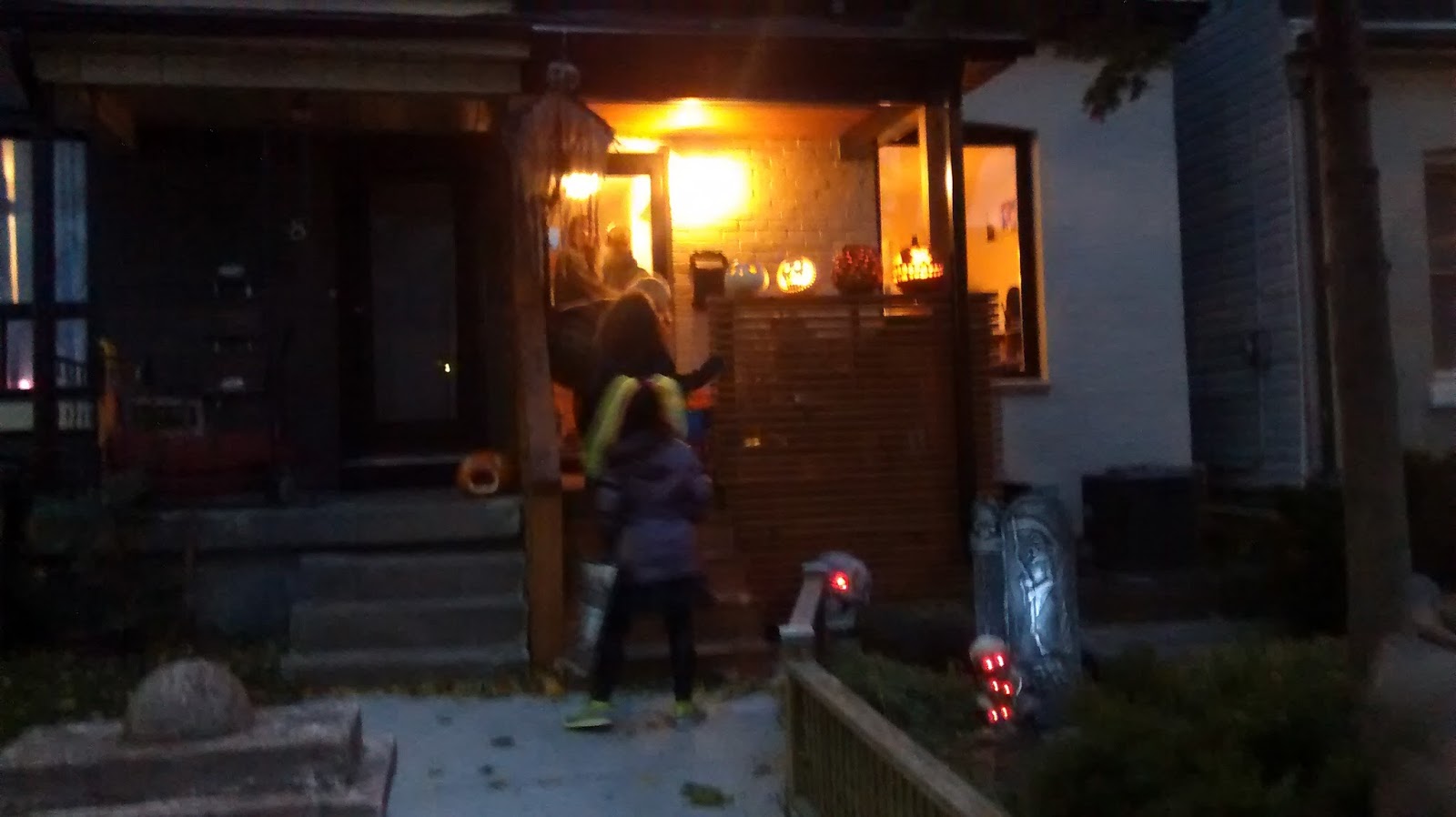
Here are a few shots from the evening.


Monday, October 30, 2017

11th Canadian Challenge - 10th review - Moral Disorder

I have to assume that Atwood's Moral Disorder and Other Stories was inspired by Munro's The Lives of Girls and Women.  Both are collections of short stories about a single female character (Nell in the case of Moral Disorder) and their immediate families.  However, the connection might actually be closer to Who Do You Think You Are? (also all about one girl -- and her fraught relationship with her step-mother), in the sense that the scrambled chronology allows the authors to move back and forth in time, and in particular showing how the main character must deal with aging parent(s).  One thing that is odd is about half the stories in Moral Disorder are written in first-person perspective and half in third-person. 

I would say that on the whole there is more humour in Moral Disorder, or at least a lighter touch.  That said, there are definitely tense and difficult moments between women, such as when Nell mouths off to her mother (about not wanting to take care of her baby sister) and gets slapped hard or when Oona (Nell's partner's ex-wife) starts making trouble between them.  One thing that I do like about Atwood is that she doesn't sugar-coat the fact that women can be terrible to each other (not that I think the moments I have referenced really rise to that level).  This is a bit of a recurring theme of Lady Oracle and Cat's Eye, though Cat's Eye the focus is on younger children behaving badly.  Munro occasionally delves into this (as in Who Do You Think You Are?) but my overall (perhaps unfair) impression of Munro's work is that she sees male-female relationships as inherently more difficult than female-female ones, and I don't think Atwood would agree with that.

The stories are set in Boomer territory, so Nell comes of age in the 1960s, which means that she benefited from women entering the workforce in a wider variety of roles (Nell is a bit of an itinerant academic who does some work as an editor (and ghost writer?) and instructor) but also from living at a time when the workforce did seem wide open and the cost of living was generally low.  Cultural norms were changing as well, and many marriages were foundering on the rocks of free love.  Indeed, Oona and Tig had a bit of an open marriage (despite having two children) but Oona decided she wanted more freedom, and more or less auditioned Nell to take her place (in "Monopoly").  Not that everyone was completely on board with these changes.  Nell's parents disapprove of her living out of wedlock with Tig.  (Indeed, I can't tell if they ever did officially get married, though it seems likely.)

One interesting aspect of Moral Disorder is that Atwood shows how people can change their minds (which happens a great deal in real life but not always in fiction), and Oona comes to feel she got the raw end of the bargain.  While Oona and Nell have long ago stopped talking, Oona uses the children to guilt Nell into buying a house and letting Oona move in as a tenant ("The Entities").  The story actually goes in quite a different direction than I was expecting, given that Nell is too much of a pushover in general.  This tendency to just be too nice is also on display in "The White Horse," where Nell and Tig are living out in the country and doing a pretty poor job of living off the country and taking in animals that are more trouble than they are worth.  I have to admit that I have so little connection to the country that I was somewhat bored by "The White Horse" and "Moral Disorder."  I was very glad when they sold up and moved back to Toronto.

The last two stories basically focus on Nell's aging parents, though in the case of "The Boys at the Lab" it is more of a memory piece where Nell remembers her father and his work as a biologist, living in the woods.  This is of a piece with Cat's Eye, so I suspect Atwood is writing another tribute to her father, though from a different angle.  The focus is on memory and trying to recover what was known as opposed to what was unknowable.  Her mother is generally not able to answer the questions Nell asks, and her father had passed on several years back.  I suppose more than anything it is a reminder that one should ask these questions while members of the older generation still have all their marbles.

The single biggest surprise to me is how small a role Nell's daughter plays in these stories.  She is an adult "busy with her own life, elsewhere" in the first story in the collection "The Bad News."  Then the next 4 stories are mostly about Nell's childhood and very early adulthood, prior to meeting Tig (with some flash-forwards to the present).  The next three are about meeting Tig and moving to the farm.  We find out that Nell wants a baby in "Moral Disorder", and then she is going to have a baby in "The White Horse."  However, unless I have completely blanked on it, there are no scenes of her with her daughter as a baby or a small child.  The next story is all about Oona coming back into Nell and Tig's life, and then the final two stories jump ahead in time to when Nell is dealing with her parents.  So that is a strange absence at the heart of this book.  Aside from a bit too much time spent in the countryside for my taste, this was an interesting book about an unconventional family, living through a period of significant cultural shifts.

Sunday, October 29, 2017

The Clinic

I decided that since it had been a full week, and I hadn't been getting any better, I ought to go over to a walk-in clinic.  It's somewhat harder to do this in Toronto than Chicago, where virtually all the Walgreens have a walk-in clinic, but it is doable.  (I wish Shoppers here had clinics, but I think very few of them do.)  Riverdale is fortunate in that there is a clinic (with Sunday hours) on the very edge (Broadview and Danforth).  After that, you either have to go to the Beach or into downtown.  While I had considered going downtown, I really didn't want to travel that far, particularly as I was still kind of tired.

As a side note, I like my neighbourhood quite a bit, particularly as it is the opposite of a food desert.  We have two decent grocery stores, which is much different than the situation on Danforth or Queen (at least in Riverdale/Leslieville).  There is one overpriced grocery store on Danforth and otherwise, you are picking up stuff at the Shoppers.  I am personally a bit disadvantaged in banks, as there is only a CIBC inside Gerrard Square and a RBC nearby, but that's still not too bad.  And Withrow Park is quite cool, particularly the summer programming (and the sledding hill isn't shabby either).  Only recently I read that Gord Downie moved to Carlaw Ave. so that he could play pick-up hockey games on the ice rink in Withrow.  How cool.  Where my neighbourhood really falls down is in its lack of a post office.  It's really odd that there isn't any store in Gerrard Square that has a small post office tucked inside.  If this were Vancouver, there would definitely be a post office nearby, probably in the mall, but for some reason, Canada Post seems to have cut a deal in Ontario that it gives right of first refusal to Shoppers or something.  I mean there are post offices in other stores, but they are mostly in Shoppers.  If you don't believe me, check out this map to see how you are out of luck if you are in the East Side and are living on Dundas or Gerrard or Kingston and need to walk to a post office (and even on Queen there is a really long stretch between post offices).  Ah well, I guess you can't have everything.


But back to the clinic.  I had expected to have to wait for quite a while, given how few Sunday clinics there are (and how cold/flu season is starting to kick in).  I was pleasantly surprised that almost no one else was there, and I was able to see the doctor in less than 15 minutes!  The good news is that I don't have strep throat and I don't have pneumonia (I didn't think I had pneumonia, but I did catch it last in 2007 or 2008, and I probably do need to take the vaccine against it).  The bad news is that he thinks my suppressed immune system let in some other lung infection, so I am on antibiotics for the next 10 days. 

I was able to fill the prescription at the mall (fortunately quite a few pharmacies in Toronto have Sunday hours).  Then I took a nap.  And then I did some laundry and took another nap.  At some point, I decided that this time around, I could skip Toronto Cold Reads, and then I went back to bed, before finally waking up for a very late dinner.  Now I definitely need to go next weekend, as there is another installation of 3Fest (and I believe my 3Fest plays will be Nov. 12, but that hasn't been completely established).  Here's hoping that I will finally have kicked this illness by next weekend.  I can't have every weekend go by where I get so little accomplished.

Saturday, October 28, 2017

Seven Siblings at Attic Arts Hub

It was really a bit of a last minute decision, but I ended up suiting up and biking over to Attic Arts Hub.  While I did enjoy myself, I hope that I don't regret it tomorrow in terms of my throat still being sore and not really healing up.

It was definitely a gamble, as the time had passed to get the tickets on Brown Paper Tickets, but I thought there was a chance I could get in.  I'd say my lifetime record for getting into sold out shows (and/or rush tickets) is about 70%.  And it definitely helps that Attic Arts Hub is about a 10 minute bike ride from my place.  If it had been on the west end, I wouldn't even have considered it.

As luck would have it, there were quite a few extra seats tonight for New World.  The last shows of the festival are all tomorrow, and I've heard that quite a few people are going, so it might be tough getting tickets, but here is the link if you want to see what's available for Sunday.  I talked very briefly to the artistic director, mostly to get a sense if they will do this next year (and in which case I will probably submit an extended version of The Re-Up).

I thought the Attic Arts Hub was a decent space, kind of like a loft space, so you couldn't do anything too elaborate in terms of a set, but it was a fairly open space.  Thus I didn't feel claustrophobic or all pressed up next to anyone as at the Assembly Theatre.  I could potentially switch the setting of The Study Group to an attic (rather than a basement) if the guy running the Kensington Market space decides not to renew his lease.  Also, Straying South is all set in a loft, and that could potentially be staged there, so I will consider that more seriously, but really only if I can hook up with a theatre company.  Self-producing is just too much of a gamble these days.

Anyway, on the whole it was worth going out, but now I have to rest up, then see how I feel in the morning.  Being sick sucks...


P.S. Now it appears that I waited too long to get tickets for the Art Bus.  Either it is truly sold out (not very likely) or it is just too late to get tickets through the system.  In this case, though, I think it would be too much of a risk to show up and try to get on the bus.  I will take this as a sign from the universe that I should rest up more, and then in early Nov. I will just rent a car and drive out to Kleinburg (and hopefully the leafs will still be turning their fall colours).  Driving there certainly will give me more control over how long I spend at the McMichael.  All that said, I still hope the Art Bus was enough of a success that they bring it back next summer.

Change of Plans 2

I had really hoped that I would be over this lingering cold/cough/whatever by now.  As usual, I had plenty of plans, starting with taking my daughter to Hoot and Howl, then biking over to Canadian Stage to try to see the matinee of Life After, then picking up my laundry, and the probably seeing the evening performance of one of the Seven Siblings' Future Fest plays.  Then tomorrow I would spend most of the day up at the McMichael Collection.

Well, my daughter was really dragging this morning, so we got to the Hoot and Howl late.  Then she decided midway through that she was having a good time after all (maybe after the candy rush kicked in), so we stayed longer than I expected.


This apple slinky was one of the only healthy options available (though to be fair they had burgers and samosas for sale outside).  But note the candy bracelet in the background...

Still, I'm glad she came around.  This will almost certainly be the last year we go, so it is good to have good memories of it, despite it being quite crowded per usual.  She also made a tie-dye t-shirt, which, assuming it comes out well, will be a more tangible reminder of this fall.


But the bigger issue is that the rain picked up a bit more, and at this point I would have to ride my bike in the rain to Canadian Stage only to find out if I could get one of the last tickets.  I'm pretty sure that would just undo the limited progress I have made to date on getting over this cold.  (In that sense, I was correct that if I was going to go to Life After, I should have gone midweek, but my cold just wouldn't have allowed for that.  Too bad.)

The rain is supposed to stop in a few hours, so I should be able to go get my dry cleaning.  I may also go to the mall to try to fill a prescription.  I have some time still to decide about Seven Siblings, but the theatre isn't too far from my house, so I'll just see how I am feeling in a few more hours.

I am leaning towards heading off to the McMichael tomorrow and taking a lunch and a book, but I haven't entirely decided.  It really depends if it is going to rain or not.  At the moment, the forecast is for overcast skies but no rain.  If that is still the forecast this afternoon, I'll probably order the tickets.  I'm a little concerned that I haven't heard anything about the Toronto Cold Reads line-up for Sunday, but I'll probably go one way or another.

I find it hard, even while a bit sick, to pull back and be reasonable.  Even dropping one event from a fairly packed schedule pains me a bit, but it is definitely worth it if, by not going, I don't let this cold linger on any longer than it already has.  I certainly could use more actual rest, not the "rest" where I end up answering emails and phone calls most of the day (like the last two Fridays where I was officially taking the day off).  I don't know -- maybe one day I will learn to actually rest when I say I need rest...

L'envoi: We stopped over at Hoot and Howl one more time on the way to the mall, since my daughter wanted to see the fire truck pull up.  Also, she scored a hot dog for lunch, so it was a pretty good day for her, despite the iffy weather.

Friday, October 27, 2017

11th Canadian Challenge - 9th review - You Went Away

I hadn't even been aware of this short novel -- You Went Away by Timothy Findley -- until I came across it at a book sale recently.  It seems as if Findley was taking a bit of a breather from the monumental Headhunter, though in fact he also completed The Piano's Man's Daughter prior to You Went Away.

At any rate, the conceit of the novel is that a handful of photos from an old album are on display, and the novel is linking them all together.  As many family members seem to vanish from a number of the photos (without returning later), the overall theme of the book is that loss is inevitable (though some people seem to hasten the inevitable).  Generally, the "going away" in the title refers to someone leaving for another country or dying (the ultimate foreign country, I suppose), though in one case it means someone putting so much emotional distance between another that they become strangers -- and thus are "lost" to each other.

While there are nowhere near as many characters as there are in Headhunter, there are still quite a few to keep track of.  The family at the centre of the novel is comprised of Graeme and Mi, their son, Michael, and daughter, Bonnie.  Graeme's mother, Ellen, is a relatively prominent character at the start of the novel, but less so after Graeme enrolls in the Air Force at the start of WWII.  At first, Graeme goes by himself to Camp Borden (near Barrie, ON) but eventually the family uproots to be near him.  Mi makes friends with the other people at Camp Borden, particularly Ivan, Graeme's roommate, and another couple, Roy and Eloise.  They also get to know the residents of a rooming house where Mi stays (there is no special housing for married men at Camp Borden!).

It probably shouldn't come as much of a surprise that Graeme fails as a father and as a husband, though perhaps somewhat surprising he is a bit more successful as an enlisted man, even if he is a bit too old to be sent to the front (or at least in the early phases of the war).  While the focus is different, there are some echoes of Roy's The Tin Flute, though the war emerges late in that novel, as opposed to right up front in You Went Away.  While the war is only after half over when Findley ends this novel, he still features a number of widows to drive home the costs of war on the home front.  Despite all this suffering, there is one couple who genuinely seem happy and even commit to having a baby (in the face of a world gone mad).  In that sense, this contains just a few more uplifting moments than many of Findley's novels.

Many sections of the novel are told from the perspective of Mi, and the reader can even directly read her inner thoughts.  Findley does just a bit of head-hopping, but the novel doesn't work quite as well when told from Graeme's or Matthew's perspectives.  Fortunately, these forays outside Mi's head are fairly rare.  On the whole this is a fairly melancholy piece, though there are a few flashes of humour or at least dry wit.  One of my favourite passages concerns a nurse who is staying at the rooming house along with Mi: "Just last week, she had come home from the Crazy Wing so tense, she behaved as if someone had handed her the entire war and had said: here -- deal with this."

Overall, I'd say You Went Away is for readers who like sad stories or those who want to immerse themselves in stories about Canada's role in WWII and the impact on the home front.  And of course readers who want to savour all of Findley's novels and short stories.

Thursday, October 26, 2017

The Chance at Assembly Theatre

I'll keep this fairly short, as I am fairly tired.  I'm back from seeing The Chance at Assembly Theatre, which was another Toronto world premiere of a George F. Walker play.  I think the review in The Star is spot on.  There is a lot to like about this play, particularly the interactions of the three female actors, but the ending is pretty nonsensical.  I think Walker should have been challenged to come up with a slightly more realistic way out of the jam (or rather I didn't mind how the first part of the climax unfolded, but not the change of heart that allows the second part to play out).  At this point, if you don't have tickets, you probably are not going to be able to see the show.  Even after adding two more shows, they are technically sold out (glad I got mine a while ago), but they probably can get some people in off the wait list.  They probably could have squeezed two or three more bodies last night.

I know just how difficult it is to find space to put on indy theatre in Toronto, but I am not a fan of this new space -- the Assembly Theatre.  As at The Red Sandcastle, Coal Mine and The Box, the restrooms are inside the theatre space itself (actually on the far side of the stage), so you can't go until the house opens.  Unlike these other theatres, they seemed to keep the house closed until very close to show time.  That just causes all kinds of back-ups.  In addition, the seats are small and too close together.  I found myself pressing up my seat neighbour quite a bit (and on my other side was a pillar).  And there is only a single aisle on the far left, so going to the washroom was an obstacle course!  Fortunately, the play was just an hour, so I didn't bother hitting the washroom, and I was able to keep my cough more or less under control.

Still, this is actually a worse layout than Red Sandcastle, Coal Mine or The Box.  And while it wasn't their fault, the TTC service was really bad last night (including even more diversions of the Queen streetcar down to King and back) and I got to the theatre just before the house opened, so I was stressed and had no time to find anything to eat.  So I wouldn't say I would never go back to a production at Assembly Theatre, but it will have to be a very special event or some play that I am just dying to see.