This double review is essentially a continuation of this review of the cartoonist Seth's imaginary worlds. Much of Seth's work is semi-autobiographical (particularly It's a Good Life if You Don't Weaken and Nothing Lasts, which is serialized in Palookaville,* issues 21-23 (so far)). These two books have flashes of Seth (he shows himself checking his hat at the Ontario office of the Great Northern Brotherhood of Canadian Cartoonists (GNBCC) and he is poking fun at his public persona with the character Jacob in Wimbledon Green), but they are essentially reflections on the art of cartooning. GNBCC focuses on the creators of comics, while Wimbeldon Green is a somewhat over-the-top exploration of comic book collectors. If I'm getting the chronology correct, Seth started working on GNBCC first but set it aside and wrote Wimbledon Green, and then returned to GNBCC and wrapped it up.
Despite both being about comic books, they are actually quite different in style and intent, though it is fair to say that both involve ontology in a fashion (in other words pondering the nature of existence and what is true). Seth has spoken before about his interest in hearkening back to an imagined past that never quite existed. In some ways this isn't all that different from what goes on Ben Katchor's Julius Knipl, though in that case we, the reader, are in the present looking at the somewhat rundown remnants of a more vibrant and even glorious city that once was a few decades ago (basically Brooklyn for Katchor). In GNBCC, Seth pulls this maneuver, talking about how the club was much better attended in the past, but at other times (particularly Clyde Fans) the action all takes place in a slightly skewed past that didn't really happen. In fact, the vast majority of GNBCC is Seth's discussion of the work of imaginary cartoonists, giving him a chance to briefly dabble in a number of styles. However, Seth really throws a screwball to the reader when he then introduces Doug Wright and his strip Nipper, since Wright was an actual, real-life Canadian cartoonist (and Seth has been championing his work in various ways). On the other hand, the Group of 7 certainly did exist, and probably some of them did a bit of cartooning on the side, but Lawren Harris did not create an illustrated novel, and Seth posits in GNBCC.
Wimbledon Green is less bound up in these kind of games, though the main conceit is that the main character, Mr. W. Green, may be alias for Don Green, who also was a comic collector. As the book opens, Wimbledon has vanished. Seth has a number of people who knew Wimbledon give their impressions of the man, and not surprisingly they diverge quite substantially. This is a bit like the Rashomon-effect, where each person has their own view of the situation (and a slightly different take on Wimbledon). Fuller's The Best of Jackson Payne employs a fairly similar approach and apparently Lavery's Sandra Beck does as well, though I haven't read that yet.
While I could sort of intellectually appreciate what was going on in Wimbledon Green, it just didn't capture my attention as much, probably because I don't have that much interest in the antics of a bunch of collectors who were willing to pay thousands of dollars for mint or near-mint copies of rare comics. I'm well aware that this occurs with some regularity now, but I still think it is silly. Probably the most interesting part of the book was when Seth actually draws some pages where Wimbledon talks about the ultra-rare comic Fine and Dandy, which is about two hobos and their adventures on the road. Then Seth takes the opportunity to sketch in a panel or two of this rare comic. Incidentally, these pages are in the Seth's Dominion package I reviewed previously. I just wasn't all that interested in the rest of the book.
In contrast, most of GNBCC is about these (mostly) imaginary cartoonists and their creations. Somehow this book or published sketchbook or what have you worked better for me than Wimbledon Green. On the whole it seems a bit more imaginative or at least different. The oddest thing in GNBCC is when the narrator discusses their archive, which is in the far north, and often can only be reached by dog sled! While there is some rationale for doing this for seeds in a seed vault, I can only imagine that the terrible climate and all the snow cannot be good for preserving precious paper documents. It just was more to my taste, but there is no point in belabouring this. I would say that anyone interested in Canadian cartoons and cartoonists probably should take a look at both Wimbledon Green and GNBCC.
* I think I have finally gotten the sequence straight in my mind. Palookaville 1-19 were stand-alone comic books, and beginning with Palookaville 20, Drawn and Quarterly started publishing these as hardback books (which libraries might actually carry). Issues 4-9 were collated into It's a Good Life if You Don't Weaken, and issues 5-19 were part of the Clyde Fans storyline (which seems to be wrapping up in Palookaville 23). That means the only way to read Palookaville 1-3 is to buy them as individual comics, which is a bit unfortunate as I would likely only read them once, and yet issues 2 and 3 seem at least somewhat intriguing.
Thursday, August 31, 2017

Wednesday, August 30, 2017
Return of the gym rat
It's sort of interesting how my physical activity goes in cycles. I was fairly active, including going to the gym and jogging (but no biking) in undergrad, while I basically only jogged right after I graduated. At U Toronto, I swam a bit and was ok about going to the gym (and I was in a recreational soccer league, but mostly ended up on the bench, so ultimately I quit). Interestingly, it was while I was going to Northwestern that I really got into quite good shape, since I was biking from Rogers Park into Evanston on a near daily basis, plus going to the gym and jogging and swimming. Perhaps it is not too surprising that I have never quite gotten back to that level of fitness.
After I got a full time job in Chicago, I stopped going to the gym, though I started riding my bike downtown and I probably did at least a bit of running. After we moved to New York, I stopped biking, though I jogged (most of the way to Coney Island a few times) and went to a gym about four blocks away. I didn't go as much as I should have, of course, and the consultant lifestyle did start catching up with me.
In England, I basically only biked to work, though I did that year-round which was nice. Actually, now that I think about it, I played soccer after work with my co-workers, though I really had trouble playing a full-time game that one time we had a serious game, playing against our Dutch office.
Back in Chicago again, I returned to the biking but somewhere along the way it seemed I developed bone spurs, so I stopped jogging. I tried to keep up with the gym and swimming, but it was 8 or so blocks to the gym, so just beyond the threshold where I could keep up with it on a regular basis. (We also had two small children, and this certainly impacted my ability to slip away to go to the gym...)
In Vancouver through early 2013, I had a long bike ride to work (with challenging hills) and I did a fair bit of swimming. I still remember this pool (and hot tub) with an amazing view of the mountains. That was pretty blissful. But then the office moved to a remote location, and I just couldn't bike to it. That was probably the moment things fell apart for me.
Moving to Toronto actually meant that I could start biking to work again, though I don't do it year-round. I tried to keep up with swimming at a local community centre, but the hours for lap swimming are generally inconvenient, and it really isn't the nicest facility. I've occasionally gone to the Regent Park Aquatic Centre, and indeed I hope to go tomorrow after work, but it hasn't been a major part of my routine.*
What has happened is that a gym opened up about two blocks away from me, and it was so inexpensive that I felt I had to try to see if I could start going again. I was really good the first three weeks, averaging 3 times a week. While I have fallen off that pace, I am still going twice a week (and in my defense, I have been able to bike to work 4-5 times per week, since August has been fairly dry while July was so wet). So my level of physical activity is actually on the high end of the scale (for me), yet it still feels sustainable. (My main beef with those weight-loss shows is that they end up putting these people into completely unsustainable routines, and they inevitably fall off the wagon and gain back almost all the weight.)
One thing I ought to do, however, is to have a doctor look at my arm, as it does feel like I sprained it, which means that I don't do as much with the weights as I would like when I do go to the gym. My heart rate seems pretty good these days, though I still haven't lost as much weight as I would like. I also think my blood sugars are a bit better balanced, though I haven't actually had them tested. I'm trying not to get too discouraged. I think if I keep at it, and make sure that I in fact do go to the gym more after I stop riding my bike for the season (usually around November), then I'll be closer to where I want to be by next spring (and should be able to drop at least one shirt size). It usually is the winter that is the real killer for me, so I am grateful to have better options to stay in shape this winter. I just have to take advantage of them.
* I did after work, though I only swam a very few laps, since I am out of practice. Still, better to try to get back into it than to just give up.
After I got a full time job in Chicago, I stopped going to the gym, though I started riding my bike downtown and I probably did at least a bit of running. After we moved to New York, I stopped biking, though I jogged (most of the way to Coney Island a few times) and went to a gym about four blocks away. I didn't go as much as I should have, of course, and the consultant lifestyle did start catching up with me.
In England, I basically only biked to work, though I did that year-round which was nice. Actually, now that I think about it, I played soccer after work with my co-workers, though I really had trouble playing a full-time game that one time we had a serious game, playing against our Dutch office.
Back in Chicago again, I returned to the biking but somewhere along the way it seemed I developed bone spurs, so I stopped jogging. I tried to keep up with the gym and swimming, but it was 8 or so blocks to the gym, so just beyond the threshold where I could keep up with it on a regular basis. (We also had two small children, and this certainly impacted my ability to slip away to go to the gym...)
In Vancouver through early 2013, I had a long bike ride to work (with challenging hills) and I did a fair bit of swimming. I still remember this pool (and hot tub) with an amazing view of the mountains. That was pretty blissful. But then the office moved to a remote location, and I just couldn't bike to it. That was probably the moment things fell apart for me.
Moving to Toronto actually meant that I could start biking to work again, though I don't do it year-round. I tried to keep up with swimming at a local community centre, but the hours for lap swimming are generally inconvenient, and it really isn't the nicest facility. I've occasionally gone to the Regent Park Aquatic Centre, and indeed I hope to go tomorrow after work, but it hasn't been a major part of my routine.*
What has happened is that a gym opened up about two blocks away from me, and it was so inexpensive that I felt I had to try to see if I could start going again. I was really good the first three weeks, averaging 3 times a week. While I have fallen off that pace, I am still going twice a week (and in my defense, I have been able to bike to work 4-5 times per week, since August has been fairly dry while July was so wet). So my level of physical activity is actually on the high end of the scale (for me), yet it still feels sustainable. (My main beef with those weight-loss shows is that they end up putting these people into completely unsustainable routines, and they inevitably fall off the wagon and gain back almost all the weight.)
One thing I ought to do, however, is to have a doctor look at my arm, as it does feel like I sprained it, which means that I don't do as much with the weights as I would like when I do go to the gym. My heart rate seems pretty good these days, though I still haven't lost as much weight as I would like. I also think my blood sugars are a bit better balanced, though I haven't actually had them tested. I'm trying not to get too discouraged. I think if I keep at it, and make sure that I in fact do go to the gym more after I stop riding my bike for the season (usually around November), then I'll be closer to where I want to be by next spring (and should be able to drop at least one shirt size). It usually is the winter that is the real killer for me, so I am grateful to have better options to stay in shape this winter. I just have to take advantage of them.
* I did after work, though I only swam a very few laps, since I am out of practice. Still, better to try to get back into it than to just give up.
11th Canadian Challenge - 5th review - Homer in Flight
I'm not entirely sure how I ran across Homer in Flight, the debut novel by Rabindranath Maharaj, though most likely I found it while searching up literature about immigration in the Toronto Public Library system. I still expect to get around to writing a post (or perhaps several) about novels focused on the wide variety of immigrant experiences, but that is on the back burner for now. As I started in on the novel, I realized that it was published in 1997, and it seems to be set somewhat earlier than that. The recession of 1990-91 still seems to be lingering, as employment opportunities seem somewhat limited, particularly for immigrants with somewhat outdated skills and with heavy accents. Also, the issue of Toronto amalgamation (1998) does not surface at all, whereas it was a fairly hotly debated topic around the region, although perhaps the inside baseball of Provincial politics was not particularly interesting to new immigrants. In any event, virtually all of the action in the novel takes place outside old Toronto and in the suburbs, which is appropriate, as most new immigrants ended up in these places. (In that way, Toronto's demographic patterns are closer to Paris with the poor on the outskirts of the city and in the suburbs rather than New York or Chicago, which is largely the reverse, though these places certainly do have elite neighbourhoods near the centre.) While I was briefly living in Toronto around the same time as the Homer character, my experience of Toronto was so completely different, as I almost never left the core, and of course I was studying and wasn't allowed to work. Interestingly, immigration issues occasionally simmered under the surface for the international students, including a master's student who was trying to stay on in Toronto to stay with a girlfriend and then my own experience in having to leave the country by the end of August (after I wasn't accepted into the Ph.D. program). While my experiences were certainly less traumatic (and my culture shock not as extreme as Homer's), I do have experience in dealing with immigration officers.
What is interesting about the Homer's experience is that he doesn't come to Canada due to economic pressures (as was common in the early part of the 20th Century) nor is he a refugee fleeing a war-torn country (much more common towards the end of the 20th Century through today), but he generally is just fed up with living in Trinidad. He doesn't seem to be coming to Canada to try to make a lot of money, as many of his compatriots do but to try to get away from the crime and disorder and general corruption of Trinidad. What is somewhat under the surface is the racial tension of being a minority (of Indian descent) in the Caribbean and wondering whether he would be better off in a better run country, such as Canada. Given that his motives for coming to Canada are a bit unclear and he doesn't have any specific goals in mind, it isn't that surprising that he suffers from culture shock and generally seems to be in a depressive funk moreso than some of the other immigrants he encounters.
Yet Maharaj seems fairly even-handed, roughly half of the immigrants we encounter in the novel seem to be making a decent go of it in Canada (and certainly their children have adjusted) while the other half are in a funk or on welfare or both. If accurate, this would be an interesting departure, since pre-1960s immigrant literature generally held that the second generation was the most conflicted, and it was only the third generation that was fully assimilated into the host country (and even there if there were clear racial markers, it would make complete assimilation difficult). Why would assimilation of the children go faster in the 1990s? Is it because North American culture is so pervasive that the children are absorbed into it right away or that all of their friends share the same shallow materialism? The novel really doesn't speak to these issues, but they are worth considering.
There isn't a lot of plot to this novel, but I will be discussing some events that happen through the course of it, so SPOILERS ahead.
SPOILERS
I have to admit that I wasn't really that interested in Homer as a character. He was vaguely discontented about everything, which led him to leave his home for no particularly good reason and to cut his ties with his family (almost never writing back to his mother and missing his father's funeral). It shouldn't be that much of a surprise that he didn't find Canada lived up to his expectations (and finding a job was much harder than he expected), and he nearly returns to Trinidad but pulls himself together at the end.
What I really didn't like about him is that he had almost no spunk or drive. After a short time looking through the help wanted pages, he settles back and just sends out a bunch of ill-formatted resumes and, not surprisingly, doesn't get hired. He takes the easy way out time and time again, with only occasional departures from this pattern (when he moves out of a friend's apartment to find his own place for instance). He does bounce a bit all over the region, from Ajax to Etobicoke to Burlington and finally Hamilton. He actually lands a factory job through his friend, but after a few months decides he is becoming a "zombie" and quits without any prospects. I just found that really irresponsible, and that is probably when I stopped caring much about him and his ultimate fate.
Homer ends up in a desultory relationship with Vashti, another tenant in the building. She works at a bookstore and is taking night classes and generally has a bit more purpose in life. It seems she is trying to escape a failed love affair and settles for Homer. They get married and move in together, and, for a while, Homer is content, even though he still hasn't found a suitable job. As a side note, I realize immigration procedures change all the time, but it does seem odd that Homer qualified for immigration in the first place, since his skills were outdated and he shouldn't have gotten enough points to get his papers. Also several of the West Indians he meets are milking the welfare system, and he briefly considers this. When I got my papers, it was made very clear to me that applying for any kind of welfare would nullify my right to stay in Canada, so perhaps that has changed. What is very odd is that Homer never once considers checking with Employment Ontario or some other employment bureau. (When I am not all that engaged in the story, I tend to think about these tangential matters.)
To save money, they move into a basement apartment in her sister's house in Burlington. This is where Homer really shows his true colours, since he acts as a total ingrate, saying terrible things about this sister and her husband. Homer manages to spoil several parties and just generally acts like a bore. While some of this is surely due to misplaced pride, i.e. feeling humiliated that he can't really care for his family, he doesn't really take any meaningful action to get a job, though I suppose to be fair he does increase his networking at the temple, which indeed does lead to a job offer, which more or less lands in his lap, since he was quite unqualified to be hired as a school librarian. Even after he becomes respectable again (and eventually even self-publishes a book), it seems the break with his wife and her family is too profound, and he will go living on his own, as a misunderstood, under-appreciated fellow. And that's how the novel ends. Clearly, I wasn't moved by Homer's plight or his (economic) salvation, though other aspects of the novel interested me. Interestingly, Maharaj came to Canada in his late 30s, though he was better credentialed and didn't struggle quite as much as Homer, though there is a bit of a parallel in that he did teach high school in Hamilton. He has continued to write novels and won several awards with his most recent The Amazing Absorbing Boy (2010). This also involves immigration to Canada but the immigration of a young boy coming to Canada. I'll add it to my reading list and perhaps pair it with Bishop-Stall's Ghosted, whenever I get around to that one.
What is interesting about the Homer's experience is that he doesn't come to Canada due to economic pressures (as was common in the early part of the 20th Century) nor is he a refugee fleeing a war-torn country (much more common towards the end of the 20th Century through today), but he generally is just fed up with living in Trinidad. He doesn't seem to be coming to Canada to try to make a lot of money, as many of his compatriots do but to try to get away from the crime and disorder and general corruption of Trinidad. What is somewhat under the surface is the racial tension of being a minority (of Indian descent) in the Caribbean and wondering whether he would be better off in a better run country, such as Canada. Given that his motives for coming to Canada are a bit unclear and he doesn't have any specific goals in mind, it isn't that surprising that he suffers from culture shock and generally seems to be in a depressive funk moreso than some of the other immigrants he encounters.
Yet Maharaj seems fairly even-handed, roughly half of the immigrants we encounter in the novel seem to be making a decent go of it in Canada (and certainly their children have adjusted) while the other half are in a funk or on welfare or both. If accurate, this would be an interesting departure, since pre-1960s immigrant literature generally held that the second generation was the most conflicted, and it was only the third generation that was fully assimilated into the host country (and even there if there were clear racial markers, it would make complete assimilation difficult). Why would assimilation of the children go faster in the 1990s? Is it because North American culture is so pervasive that the children are absorbed into it right away or that all of their friends share the same shallow materialism? The novel really doesn't speak to these issues, but they are worth considering.
There isn't a lot of plot to this novel, but I will be discussing some events that happen through the course of it, so SPOILERS ahead.
SPOILERS
I have to admit that I wasn't really that interested in Homer as a character. He was vaguely discontented about everything, which led him to leave his home for no particularly good reason and to cut his ties with his family (almost never writing back to his mother and missing his father's funeral). It shouldn't be that much of a surprise that he didn't find Canada lived up to his expectations (and finding a job was much harder than he expected), and he nearly returns to Trinidad but pulls himself together at the end.
What I really didn't like about him is that he had almost no spunk or drive. After a short time looking through the help wanted pages, he settles back and just sends out a bunch of ill-formatted resumes and, not surprisingly, doesn't get hired. He takes the easy way out time and time again, with only occasional departures from this pattern (when he moves out of a friend's apartment to find his own place for instance). He does bounce a bit all over the region, from Ajax to Etobicoke to Burlington and finally Hamilton. He actually lands a factory job through his friend, but after a few months decides he is becoming a "zombie" and quits without any prospects. I just found that really irresponsible, and that is probably when I stopped caring much about him and his ultimate fate.
Homer ends up in a desultory relationship with Vashti, another tenant in the building. She works at a bookstore and is taking night classes and generally has a bit more purpose in life. It seems she is trying to escape a failed love affair and settles for Homer. They get married and move in together, and, for a while, Homer is content, even though he still hasn't found a suitable job. As a side note, I realize immigration procedures change all the time, but it does seem odd that Homer qualified for immigration in the first place, since his skills were outdated and he shouldn't have gotten enough points to get his papers. Also several of the West Indians he meets are milking the welfare system, and he briefly considers this. When I got my papers, it was made very clear to me that applying for any kind of welfare would nullify my right to stay in Canada, so perhaps that has changed. What is very odd is that Homer never once considers checking with Employment Ontario or some other employment bureau. (When I am not all that engaged in the story, I tend to think about these tangential matters.)
To save money, they move into a basement apartment in her sister's house in Burlington. This is where Homer really shows his true colours, since he acts as a total ingrate, saying terrible things about this sister and her husband. Homer manages to spoil several parties and just generally acts like a bore. While some of this is surely due to misplaced pride, i.e. feeling humiliated that he can't really care for his family, he doesn't really take any meaningful action to get a job, though I suppose to be fair he does increase his networking at the temple, which indeed does lead to a job offer, which more or less lands in his lap, since he was quite unqualified to be hired as a school librarian. Even after he becomes respectable again (and eventually even self-publishes a book), it seems the break with his wife and her family is too profound, and he will go living on his own, as a misunderstood, under-appreciated fellow. And that's how the novel ends. Clearly, I wasn't moved by Homer's plight or his (economic) salvation, though other aspects of the novel interested me. Interestingly, Maharaj came to Canada in his late 30s, though he was better credentialed and didn't struggle quite as much as Homer, though there is a bit of a parallel in that he did teach high school in Hamilton. He has continued to write novels and won several awards with his most recent The Amazing Absorbing Boy (2010). This also involves immigration to Canada but the immigration of a young boy coming to Canada. I'll add it to my reading list and perhaps pair it with Bishop-Stall's Ghosted, whenever I get around to that one.
Sunday, August 27, 2017
As summer winds down -- Ottawa
We actually left Friday evening, since the main point was to take a tour of Parliament. I had been told that Centre Block was shutting down at the end of this fall for 10 years(!), but apparently it is next year, so there is still time to catch the tour. I don't know for sure if we would have changed our plans had I known there was still a full year left. In any event, you have to get to the information booth quite early to see any tour at all (probably 10 am is already too late) and in order to be able to get the pick of the tours, you have to get there by 8 am. Here is the line at 9:15 or so, stretching around the block.

I went over with my son even before that, and in fact we were 5th in line.
I had been told that the changing of the guard would happen at 9:30, so I got tickets for a 10:30 tour. However, the website was wrong, and the last changing of the guard was a few days before, so that was disappointing.
The tour was quite nice, however, and it was a bit interesting that the tour was almost entirely made up of Canadians. We were one of the fortunate groups able to get onto the floor of the House of Commons and the Senate Chamber, as well as the Library. We took quite a few photos, but I'll just post a few, mostly those taken by my daughter.

 |
| House of Commons |
 |
| Senate Chambers |
 |
| Library of Parliament |
Then we walked over to the National Gallery.
The main collections had been shuffled a bit. I don't recall seeing this painting (vaguely reminiscent of Lawren Harris but painted by Yvonne Housser) or the Letendre either, though I might just be more attuned to her work due to the AGO exhibit.
 |
| Yvonne Housser, Rossport, Lake Superior, 1929 |
 |
| Rita Letendre, Tension on Black, 1963 |
This time around I got a better photo of Cobalt (also by Housser), and I can't resist ending with a proper Lawren Harris painting.
 |
| Yvonne Housser, Cobalt, 1931 |
 |
| Lawren Harris, Afternoon Sun, North Shore, Lake Superior, 1924 |
We spent close to 2 hours checking out the main collection. In the end, we skipped the photography exhibits, but I think we saw everything else. However, my phone battery completely died, and I was getting a bit tired of the early European paintings, so we really breezed through those rooms.**
Then we walked back to the hotel. While we were all fairly tired and weary from all the walking and, in several cases, from the early morning rising, I agreed to take my daughter to the Museum of Natural History, which was down the street. We spent probably 2 and a half hours there. The main draw for me was a new exhibit on the Arctic, but the dinosaurs were also interesting. I actually posted dinosaur pictures from the previous visit, but I will post a whale skeleton photo (which came out better than the photos from our ROM visit) and the slabs of ice (part of the Arctic exhibit).


We then had to decide whether to check out the Northern Lights exhibit where they were projecting lights onto the Centre Block of Parliament. If the hotel hadn't been so close, I'm sure I would have decided to skip it, but in the end we walked down. It is quite unusual in the sense that instead of just shooting off fireworks, they actually project a bit of a history lesson onto the walls. I was able to capture the whole sequence, but unfortunately, the sound didn't get captured (and the video files are too large to upload anyway). I'll just post a few of the more interesting bits we got as photos.


That was more than enough for one day!
We all crashed, then the next day walked over the bridge to Jacques-Cartier Park in Gatineau. I had heard good things about it, though I was a little upset that the park didn't open until 10. Even 9:30 would have worked a lot better (and given us some time to buy snacks for the train). Nonetheless, it was pretty cool, even though we had to get through quickly. Basically, there are all these sculptures made of various shapes, celebrating Canada, and then they are covered with different varieties of plants.


In the end, we made it to the train station with about 20 minutes to spare, before they started boarding. The ride back did feel pretty long, but eventually we made it back to Toronto. I have to admit that I don't feel particularly rested to start the work week, but I can perhaps catch up next weekend when we don't have a lot planned (fortunately), and I do have Monday off.
* Between canoeing the Humber and catching 3 different outdoor Shakespeare productions, I think I took pretty good advantage of the summer. I did miss out on She Stoops to Conquer out in Scarborough (one of these days I definitely need to check out the Scarborough Bluffs) and we didn't make it to Niagara Falls (probably next summer) or the Islands (largely because it was shut down half the summer, so again probably next summer). I'm not really sure I want to rent a cottage as the slower lifestyle doesn't appeal to me (and you pretty much have to drive several hours north). This summer, we spent 2.5 days in North Carolina at a similar pace, and that was really sufficient.
** I had been interested in the new catalogue that covered the reinstallation of the main galleries for Canada 150, but when I actually looked at it at the end of our visit, I was quite disappointed. Not only were the paintings completely scrambled chronologically, they had no labels, so for every single painting, you would have to go to the list of plates on the last page, which I thought was absurd. I could probably have lived with that, however, but it turned out 70% or more of the paintings were reproduced over a 2-page spread with a break in the middle of the painting. I can't bear it when images are reproduced this way, as you inevitably lose some important part of the painting (which naturally enough is usually right in the center of the painting). I actually thought it was an incredibly shoddy job and certainly a huge missed opportunity. Needless to say, I won't be ordering one of these books.
Tuesday, August 22, 2017
Eclipse-mania
If I had realized what a big deal it would have been, perhaps I should have shifted the entire trip over by 3 or so days. That way, we would have been in Greensboro on Monday and seen the eclipse at 95% or so. It actually got quite dark in Greensboro, though apparently not the total darkness that Asheville got.
At any rate, I did have the eclipse glasses with me at work, and I went down at 1:45 and checked it out. Then again from 2:05-2:08. A few people from work came down and we all took a quick peek to see a small chunk taken out of the sun. Unfortunately, we had a meeting scheduled from 2-4, so I had to miss the best part of the eclipse. Had it been a total eclipse or even 90% or so, I think I would have bailed on the meeting, but it wasn't so impressive that it was worth losing one's job...
My kids were able to see the eclipse fairly well and thought it was neat. My wife captured the phenomenon of the crescent shadows through the tree leafs. That was particularly cool, and I didn't see anything like that at Union Station.

The exciting news is that Buffalo is supposed to get a total eclipse in 2024, and it will be 90-95% in Toronto. (And the eclipse glasses made to the new standards are supposed to last that long; the older glasses only stayed safe for 3 years.) I suspect getting to Buffalo will be total madness on the day of and maybe even the day before (with huge lines at the border). However, it may be the case that staying on this side of the border, say at Fort Erie, we could see the total eclipse, though I can imagine that you'd still need to get down the night before to find a place to park (and the hotels will certainly be jacking up the price). Closer to the time, I'll decide how much effort I want to put into chasing the eclipse. I may well decide that what we see in Toronto is going to be impressive enough.
At any rate, I did have the eclipse glasses with me at work, and I went down at 1:45 and checked it out. Then again from 2:05-2:08. A few people from work came down and we all took a quick peek to see a small chunk taken out of the sun. Unfortunately, we had a meeting scheduled from 2-4, so I had to miss the best part of the eclipse. Had it been a total eclipse or even 90% or so, I think I would have bailed on the meeting, but it wasn't so impressive that it was worth losing one's job...
My kids were able to see the eclipse fairly well and thought it was neat. My wife captured the phenomenon of the crescent shadows through the tree leafs. That was particularly cool, and I didn't see anything like that at Union Station.

The exciting news is that Buffalo is supposed to get a total eclipse in 2024, and it will be 90-95% in Toronto. (And the eclipse glasses made to the new standards are supposed to last that long; the older glasses only stayed safe for 3 years.) I suspect getting to Buffalo will be total madness on the day of and maybe even the day before (with huge lines at the border). However, it may be the case that staying on this side of the border, say at Fort Erie, we could see the total eclipse, though I can imagine that you'd still need to get down the night before to find a place to park (and the hotels will certainly be jacking up the price). Closer to the time, I'll decide how much effort I want to put into chasing the eclipse. I may well decide that what we see in Toronto is going to be impressive enough.
Monday, August 21, 2017
Return to the Humber
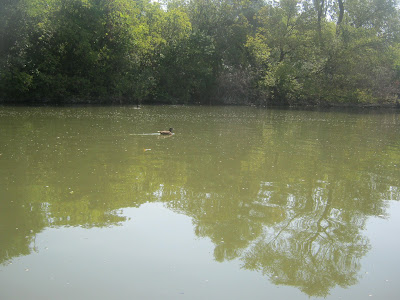
What a difference a year makes. Last year the Humber River was incredibly low, and this summer has been fairly wet. In fact, it rained last Thursday (while we were out of town). My daughter decided to bail on the canoe trip this year, so in the end we went without her. The river was quite high, and we didn't have any problem with scraping along the river bed. In fact, there were a few times where someone went by on a motorboat and rocked the canoe a bit. (Even motoring by slowly was a bit of an issue, given the water level.) Nonetheless, it was a fun, if somewhat exhausting, trip. This time around we went far enough to see the second bridge (technically this is where the place that rents the canoes insists that people turn around) and we had enough time to go into one of the inlets. We turned in the canoe 20-25 minutes early. I was soaking with sweat though, and it was a somewhat uncomfortable ride back downtown.
After the canoeing, we grabbed lunch and stopped in at the AGO briefly, then walked over to Nathan Phillips Square to check out India Day celebrations, then went home. In the evening we saw Shakespeare in the Ruff do A Midsummer's Night's Dream (definitely worth checking out if you live near Withrow Park). I'll write more about the rest of the day later, but I thought that if Vancouver wants to advertise about being a city where you can go from the beach to the mountains in one day, then Toronto is a city where you can canoe the Humber, go to an art gallery and an ethnic festival and still have time to do Shakespeare in the Park in the evening. I know which of the two cities I would prefer to live in...
I did all of the steering and much of the paddling. I only took a few photos here and there (and sadly I stopped taking a video about 30 seconds before a formation of geese passed overhead). My son took the majority of the photos.


.
All in all, quite a nice trip with great weather, and I expect we'll go again next summer, assuming it isn't as dry as 2016 was.
After the canoeing, we grabbed lunch and stopped in at the AGO briefly, then walked over to Nathan Phillips Square to check out India Day celebrations, then went home. In the evening we saw Shakespeare in the Ruff do A Midsummer's Night's Dream (definitely worth checking out if you live near Withrow Park). I'll write more about the rest of the day later, but I thought that if Vancouver wants to advertise about being a city where you can go from the beach to the mountains in one day, then Toronto is a city where you can canoe the Humber, go to an art gallery and an ethnic festival and still have time to do Shakespeare in the Park in the evening. I know which of the two cities I would prefer to live in...
I did all of the steering and much of the paddling. I only took a few photos here and there (and sadly I stopped taking a video about 30 seconds before a formation of geese passed overhead). My son took the majority of the photos.


 |
| The geese |


 |
| CN Tower peeking through in the distance |
 |
| Exploring the inlet |
 |
| Nearing the "finish line" |
All in all, quite a nice trip with great weather, and I expect we'll go again next summer, assuming it isn't as dry as 2016 was.
Sunday, August 20, 2017
Murakami's Octopus
As I mentioned in the previous post, the Takashi Murakami exhibit The Octopus Eats Its Own Leg is very strange, but I'm glad I saw it. It stays on at the MCA through Sept. 24. As far as I can tell, Chicago is the only US location for this career retrospective. Here and here are a couple of reviews that give some sense of what is covered in the show.
There are a couple of rooms with Murakami's work before he started dabbling in anime-inspired work. This one, inspired by Anselm Kiefer's work, was quite interesting.
I wasn't that interested in his flower paintings or his Kanye Bear material. My very favorite piece was this one with a lion and its cubs playing on a bridge of skulls. There is such a weird contrast between the playfulness of the animals and the grotesque skulls, but then also there are wide variations in the background treatments. It is actually a large piece but it is hard to get a sense of the scale.
.

However, this was completely dwarfed by the pieces in the next room -- 100 Arhats and Dragon in Clouds. Both were wall sized and it was pretty much impossible to really take them in due to the scale.

There are a couple of rooms with Murakami's work before he started dabbling in anime-inspired work. This one, inspired by Anselm Kiefer's work, was quite interesting.
 |
| Murakami, Nuclear Power Picture, 1988 |
 |
| Murakami, And Then, And Then, And Then and Then, And Then (Red), 1996 |
 |
| Murakami, 727, 1996 |
I wasn't that interested in his flower paintings or his Kanye Bear material. My very favorite piece was this one with a lion and its cubs playing on a bridge of skulls. There is such a weird contrast between the playfulness of the animals and the grotesque skulls, but then also there are wide variations in the background treatments. It is actually a large piece but it is hard to get a sense of the scale.
 |
| Murakami, Of Chinese Lions, Peonies, Skulls and Fountains, 2011 |
.

However, this was completely dwarfed by the pieces in the next room -- 100 Arhats and Dragon in Clouds. Both were wall sized and it was pretty much impossible to really take them in due to the scale.
 |
| Murakami, Dragon in Clouds--Indigo Blue, 2010 |

Subscribe to:
Posts (Atom)