Friday, December 4, 2015

Handicrafts

While it isn't something I indulge in very much, there is definitely something rewarding about being able to create something yourself instead of having it machine-made or made in a sweatshop in Asia.  I only wish I had realized quite how hard it would be to make a rug out of denim.  If I switched today over to cotton rags, I probably would be able to make another rug of the same size within a few months.  I doubt I will bother, however, as I have other things on my mind.

I still haven't broken out the sewing machine to do much more than a few test runs.  However, now that my father-in-law is gone, I have the space to set it back up again.

It really shouldn't take more than an hour or two to fix up the curtains the way I would like.  I know, famous last words.  That reminds me.  I have been picking up a few odds and ends at Michaels (a crafts store that opened up near work).  I should have picked up a seam ripper.  Oh well, another time.

I had a pretty good time at FabricLand, and I picked up this fabric to try to make a skirt for my daughter.  Once I get the hang of it, this should be a roughly 2 hour project.  It will take a bit longer than that on the first go-around of course, especially as I have decided it really ought to be lined.


I ended up getting twice the fabric I needed, so I'll do some other project with the rest and save some for quilting, though I don't want to get too far ahead of myself.

The other thing I am working on is one of those friendship bracelets.  There are a bunch of videos showing how they can be done on a round loom. 


It takes about 5 minutes to learn and 2-3 hours to do all the braiding (at least in my case there are many distractions).  This one is done. In fact it might actually be too long (for her thin wrists).


Of course my daughter wants three more.  I think I should be able to teach her over the weekend.  It will be something to keep her occupied.

If all goes well, I just need to buy some plain cotton backing and also some fabric for curtains in my daughter's room.

That will probably be enough craftiness for the season.

Thursday, December 3, 2015

Traveling for special events

It is generally not considered that odd to travel for a major sporting event or even a concert, though I got a few strange looks when I told people I was traveling down to L.A. primarily so that I could see the Kronos Quartet.  One generally does not travel all that far for classical music, instead going to support one's local chamber music ensembles and/or symphony (and perhaps hoping that a very good orchestra will be on tour and come through town).

While I don't keep precise track of their movements, I do occasionally check to see if Kronos Quartet will be playing nearby (not in 2016 unfortunately) or the Pacifica Quartet.  Now Pacifica rarely or perhaps has never played Toronto, though they are coming to London (Jan 29 and April 8) and Hamilton (April 10).  I think I'll be able to make the April 10 show, so I'll put it in my calendar of long-term events.

As far as Broadway goes, I've certainly combined museum and theatre trips, though I don't know that I would say I ever went to New York solely for a play.  Now I did try to go to Brooklyn for The Iceman Cometh, but that went horribly, horribly wrong, so I don't think I will do that again.  But I did go to San Francisco and Berkeley and Montreal to see Stoppard productions (Arcadia and the Coast of Utopia and Travesties, respectively), and I went to Ottawa to see an Arthur Miller play.  And I am leaning towards going to Peterborough* to see Les Belles Soeurs, so I definitely do travel to see a show, particularly if it isn't produced often.

I am much less likely to travel strictly for an art exhibit, but it depends on the circumstances.  I always try to bundle trips to cities with a visit to the art museum.  Our upcoming trip to Chicago is based somewhat on the fact that the Greek exhibit, which we kept missing, is going to be at the Field Museum.  I am fairly seriously considering going to Cleveland in December to catch a show about the Impressionists and their gardens.  Probably the biggest trip I even scheduled around art was to see the Max Beckmann exhibit at MoMA Queens, but I was able to make it coincide with a work trip, so it cost me almost nothing.  Ah, those were the days...

I have just booked travel to New York and Boston around the Toronto school board's spring break, and we will just miss an interesting mini-exhibit in Boston, though we will have a chance to preview the Lawren Harris exhibit that ends up at the AGO this summer.  Given that I am trying to pace myself and not totally exhaust the kids, I don't think we will go to more than one art museum a day in New York, which means crossing a lot off the list.  I've already decided that the Guggenheim isn't worth it, but it is a tougher call with the Whitney.  Just like MOMA, there is always plenty to see at the Whitney, but I am quite bummed that I will miss a Stuart Davis exhibit that opens in June and runs through September.  I am a huge fan of Stuart Davis (he's still in my top ten).  I think this might actually be worth traveling for, especially since I don't think I will be doing any overnight trips to Stratford this season (probably only seeing Strindberg's John Gabriel Borkman) and the family will probably go off to Chicago for a few weeks without me.  If I do make such a trip, then perhaps I would catch the László Moholy-Nagy show at the Guggenheim, though that is a much lower priority.  And while I am definitely thinking quite seriously about making this trip, I do see that the exhibit is going to be in DC at the National Gallery of Art in Winter 2016-Spring 2017, which is another strong possibility, particularly if I manage to get a paper into TRB 2017.

Still, one could run oneself ragged trying to keep up with all the art and theatre and concerts in one's hometown.  If I seriously scanned everything that happened across Ontario and then the top five or six cultural magnet cities in the US (New York, Washington DC, Chicago, San Francisco, Los Angeles and possibly Philadelphia or Boston), I would just always be sick to my stomach at how much I was missing out on.  Better to not look and only occasionally let the major events come to my attention.  I guess if I was a paid arts reviewer that might be a different story, but I am an amateur in the strictest sense of not being compensated for my thoughts.  I think that covers what I wanted to say for now.

* I had basically assumed I would have to drive, but I forgot that it is worth checking Greyhound and Megabus and even GO Bus.  It doesn't appear any of those would work for Peterborough, though I will check again closer to the time, but on the off, off, off chance I go to St. Catherine's in February, Megabus is having an ultra-low fare special.

Edit (1/1/2016): As I was following up on ordering an Archibald Motley catalog that had gone OOP but seems is being reprinted now, Amazon notified me about a new Norman Lewis catalog called Procession.  I like Normal Lewis, so I decided to follow up on this, whereupon I learned about a Norman Lewis exhibit, which just opened at PAFA (Pennsylvania Academy of the Fine Arts).  While I would love to visit Philadelphia, I doubt very much I can get there before the summer, by which time the exhibit will be in Ft. Worth.  I'm a bit bummed out that the touring schedule isn't flipped, since I will be going to Chicago in the summer, but I suppose I can find an excuse to travel to Chicago in the late fall next year.  I'm sure my wife would appreciate it if we went around Thanksgiving -- or even the week before or after just to save a bit on airline tickets.  (It is worth noting this is a big exhibit -- 90 paintings -- and while the upper floor of the Chicago Cultural Center can hold a lot of art, they still might have to trim it back a bit.  Nonetheless, I just can't see making it to Phily this spring.)

Tuesday, December 1, 2015

9th Canadian Challenge - 10th Review - Payback

Margaret Atwood's Payback (or really Payback: Debt and the Shadow Side of Wealth) is a printed version of her Massey lecture series from 2008.  There are 5 chapters, each corresponding to one roughly hour-long lecture.  Naturally, this also comes as an audio book, though I don't know whether they simply recorded the lectures (most likely) or had her re-record them after she did a bit more editing.  I have not checked out the audio version from the library as of yet, but I plan to do so soon.*

These lectures are vintage Atwood, covering different aspects of debt (moral as well as financial) and drawing on a wide range of sources.  She spends much of one lecture considering the idea of selling one's soul and how Dickens largely inverted the Faust legend in A Christmas Carol.  In general, she focuses on how ancient civilizations realized that debt that is so high that one cannot escape it (nor one's children either) is unproductive so there would be periodic debt holidays.  While this expunging of debt is still a feature of modern bankruptcy laws, there are a number of ways this principle is being eroded, perhaps most perniciously in the U.S. with its relatively new rules that student debt should survive bankruptcy.  Atwood is even-handed enough to point out that under any system, there are ne'er-do-wells that try to cheat their lenders (and sometimes even get a positive thrill out of doing so), drawing on real-world examples as well as Thackeray's Becky Sharp.  (Note to self, I really need to read this, and if all goes well, I should get to Vanity Fair by the end of 2016.)

The essays cover quite a bit of ground and are interesting and informative.  I did think she could have gone just a bit deeper into the potlatch culture of the Pacific Northwest where rivals tried to drive each other into debt through extravagant gift-giving.  Also, she references The Gift by Lewis Hyde but not the earlier The Gift by Marcel Mauss (which is certainly worth a quick read).  Hyde's book is more useful to her overall argument, however, as it is more tied into examples of the financial system, specifically about how usury (money-lending) used to be prohibited to Christians and Muslims but not Jews, which was the primary reason Jews were so successful at banking in Europe and bankrolled many emperors and popes.  Obviously, by the late 20th Century almost all prohibitions against usury were lifted in the Christian world at least.  In this interview, Atwood talks about some of the concerns she had and still has related to how humans have overtaxed their economic and environmental systems and are just sort of waiting around for the big payback when it all comes due.

I would recommend the first four chapters with no reservations but feel it is only fair to warn you that the last chapter (on environmental "debt") is a bit of a litmus test -- readers will either embrace it or be really turned off.  There are two strands of environmental thought -- with only a minority of environmentalists being optimistic and most being far more pessimistic about humans ever cleaning up their act and the planet.  At least in my view, Atwood is deeply pessimistic and yet perhaps secretly gleeful about the payback that is going to strike all those that ignored the warnings of the environmentalists (just call her Madame Cassandra).  That is certainly how I read the last chapter, which is the most divisive in the book.  If one does not like being hectored by environmentalists (and particularly if one is on the fence about global warming** and humanity's role in adding to the problem), then this chapter will be a total turn-off.  On the other hand, it reads a lot like preaching to the choir for those who believe we are nearing environmental collapse.  I thought it just a bit too strident, but I can't deny that we are very likely heading into a very painful period of payback, though of course, as Atwood herself notes, the costs will be unevenly distributed and those who suffer the most are the poorest to begin with.  On the whole Canada is likely to benefit from global warming, at least in contrast to many other nations.

* Edit (12/12): I've had a chance to listen to the lectures on CD, and they are the original lectures, which makes sense.  One bonus is that at the end of each lecture, there was a question and answer period, which has been edited down to 6-9 minutes per CD.  I assume that none of this back and forth made it into the printed version of the lectures, unless she put something in the footnotes.  So not only do you get a bit of Atwood actually interacting with the audience (presumably a very adoring crowd) but they will have edited out anyone who stands up and gives a thesis in the form of a question, which is all too common when interacting with intellectuals.

** I should hasten to add that if one really is a climate change denier, one probably would not be reading Atwood in the first place, though I suppose stranger things have happened.  I am firmly with the pessimists who think we already have passed the point of no return, despite all the good intentions on display in Paris this week.

Monday, November 30, 2015

9th Canadian Challenge - 9th Review - The Cat's Table

How could I resist making Michael Ondaatje's The Cat's Table my 9th review for the 9th Canadian Challenge?  There are no cats on board the ship the Oransay, or at least none that the narrator (Michael) describes.  There is a dog that his friends smuggle aboard after a port-of-call visit which plays a significant role in the story, but no cats.

I have not heard it but apparently Ondaatje has some interview where he admits many of the details are drawn from his youth, but then he is adamant this is not an autobiographical novel.  I think he is being needlessly precious, but I personally don't care if he was ever on a long boat trip from Columbo, Ceylon to England.  It might, however, explain some things if he was sent from one branch of the family to another as an unaccompanied minor with only a disinterested aunt to look in on him from time to time.  It is hard to believe this would happen today, though mostly due to the length of the trip (3 weeks) than the children travelling on their own, as this still occasionally does occur on airplane trips, for example.

In any case, Michael gets up to considerable mischief with two other boys he knew from school, Cassius and the somewhat reserved Ramadhin.  All 3 of them are taking their meals at "the cat's table," which is the table as far from the captain's table as possible.  The adults there are all slightly outcast.  To go any further out of the social graces of ship life, you wouldn't be eating with the passengers but with the crew.

Somewhat surprisingly, his father's family paid so little for Michael's ticket that he shares a cabin with a man who works on the boat.  He is one notch above the sailors but manages a shipboard dog kennel.  There are a few images that are particularly magical in this book, and one of them is Michael watching from the top bunk as his cabin-mate and 3 other men working on the ship play cards late at night under a blue light bulb that makes it seem they are half under water.

This is where The Cat's Table is stronger, showing children in a special liminal space, interacting with a subset of adults in a new way and learning some very interesting life lessons.  These intense interactions probably would not happen except for the peculiarities of ship life.  These scenes in Michael's cabin remind me in some ways of a few stories from Stuart Dybek's I Sailed With Magellan.

On the other hand, the daytime shenanigans of the three boys reminded me more than a little of Narayan's Swami and His Friends.  What is perhaps strange is that I found the antics more tolerable in The Cat's Table than I did in Swami where they rub me the wrong way a bit, maybe precisely because of the topsy-turvy nature of the cruise.  (Or maybe I've just read too much Bakhtin for my own good...)

I would say, however, that the structure of the novel is a bit strange -- recounting these shipboard events in what feels largely like real time (even though we know it is set in Michael's past), but then it takes on more of a retrospective feel, talking about how one of the three drifted away (and became significant UK artist).  I would even say it is needlessly complex, since it starts on ship, then moves to the present twice and then on the final return to the trip, everything is written in this hybrid style where things are unfolding in what seems to be real time but the watcher knows what will happen.  Is it just Ondaatje's typical flirting with postmodernism, or is it his way of dressing up a fairly straight-forward coming of age story with reveals that are less profound than those in Ford Madox Ford's The Good Soldier?  The Guardian reviewer was generally not impressed with this shifting around of chronological events, feeling that Ondaatje hadn't quite pulled it off.  I liked the novel a bit better as a wistful look back at how a time in one's life could change one profoundly.  However, I must admit I would have preferred a novel just focused on the trip week trip without all the fussy bits where Michael is catching the reader up with what happened to him and his fellow passengers.

To talk about this means at least some SPOILERS will be revealed.

SPOILERS ahoy!

The reader finds out that the boy with the sensitive health condition (again perhaps an ironic echo from The Good Soldier) dies in a strange manner.  In the aftermath, Michael became close with his friend's sister and eventually they married.  However, only a few chapters later we find they divorced.

Then the novel switches back to memories of the voyage, but more clearly rethinking those events in light of newly revealed information, particularly his cousin's involvement with an acrobatic team.  It turns out the troupe was secretly trying to rescue a prisoner being sent to England to be tried and hung.  Then we switch back to the present where Michael has moved to Canada, and, out of the blue, his cousin contacts him and he meets her on Vancouver Island.  What seems to be going on here, even if not 100% acknowledged by the narrator, is that he has been in love with his cousin Emily his whole life but he still doesn't get to act on it.  That is really the big secret that hangs over his retelling of stories from his distant past and more recent events.  Since this is an improper if not technically forbidden love, his life remains unfulfilled.  At least that is my somewhat pessimistic take on the novel.  (Whereas the childhood sections are far sunnier and generally upbeat, so judicious editing could make this a much happier if less thoughtful book.)  Anyway, The Cat's Table is quite enigmatic and more than a little elegaic.  Given that it has made me think quite a bit about the way we relive the past and recreate ourselves in our mind's eye, I would recommend it even though I wouldn't say it is one of the best books I read this year.

Sunday, November 29, 2015

The Very Busy Day: Barker, Turner, Lear and Mirvish

As the title indicates, today was a busy, busy day.  I had actually hoped to leave a bit earlier so that I arrived at Robarts by 10, but I guess it was closer to 10:30.  I suppose that's ok.  I was up much of the night working.

Anyway, I ran up into the stacks and checked out Howard Barker Plays One and Plays Two.  Plays Two is the volume with The Castle in it, and I'd like to read the script now that I've seen the play.  They had quite a few volumes in this series, but I can only check books out for two weeks at a time, so I have to pace myself.

I debated back-tracking to get the subway down to Dundas, but they rarely have an attendant on duty at the St. George entrance, and it would have been another couple of blocks to walk to the staffed entrance (which was essential since I had a daily TTC pass).  I ended up walking from St. George to the AGO.  I believe I got there just a bit after 11, so I recovered at least a bit of time.

I had hoped that enough time had passed that the Turner exhibit would be easy to maneuver, but it was quite crowded, and in fact there was a somewhat ridiculous art lecturer with a big crowd, which actually prevented me from seeing a couple of the paintings.  Well, I will be going back a few times.  This was really more of a quick preview for me.

It is a good show, though in my case, I must have seen all these paintings before either at the Tate Britain or the National Gallery in London.  One nice and surprising aspect was since the paintings on view come from public collections (primarily Tate Britain), visitors were actually allowed to take photos.  My photo of The Blue Rigi didn't turn out very well, so I'll try again next time.  This is a painting that was kept in Britain, and the public was encouraged to contribute money for the purchase price.  I believe I gave a pound or two back during that campaign.

Here are two others that I liked that came out a bit better.

J.M.W. Turner, Bridge and Goats: "The Ponte Delle Torri, Spoleto," ca. 1840-45

J.M.W. Turner, Rough Sea with Wreckage, ca. 1840-45

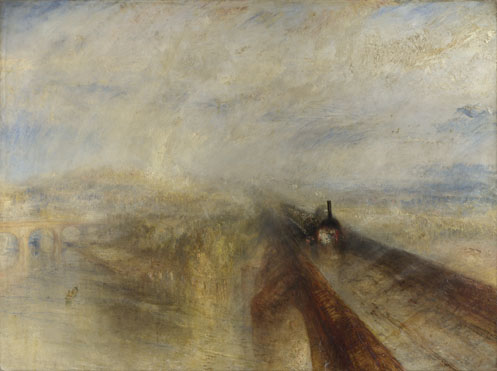
I had a quick look at the catalog, and it is nice, though I have two and 1/3 books on Turner already, so I probably don't need this one.  I did note as I was going through it that there are a few paintings only on view in Los Angeles, and quite a few only on view in London, including one of Turner's most famous paintings: Rain, Steam and Speed (see below).

J.M.W. Turner, Rain, Steam and Speed – The Great Western Railway, 1844

While I think it unfortunate people visiting the Toronto show don't get to see all the paintings, there is still a great deal to take in.  I'll try to make sure I get back a few times and plan on taking the kids at least once.

I continued heading south and grabbed some lunch, then stopped in at work.  I didn't have much time, but I got a few things done.  Then I walked back up to Queen to catch the streetcar to Bathurst.  I was going to see King Lear at Theatre Passe Muraille.  I heard that it was going to be 3.5 hours, not just 3 hours, and my heart sank a little.  I think I am at the point where I spend more time thinking about the structure of the play, and why does Shakespeare do so much doubling -- two fathers ready to assume the worst about their children, two suitors (only one of whom is true), two characters that disguise themselves (and Kent not even that well, since Cordelia sees through his disguise instantly, but no one else does apparently), 3 characters that are licensed to dispense hard truths (the fool, Kent in disguise, Poor Tom), 4 or more banishments, etc..  I've found it hard to get into Lear, since I don't really see him as a king that ever deserved to be given such absolute loyalty from Kent.  We only see him in decline, and with all the Lears I've ever seen, he seems so accustomed to getting his own way and so unpleasant when crossed that I don't see it possible that he ever was a great and noble king.  He is a doddering old fool throughout who would be best put out to pasture.  (To some extent, I feel the same way with productions of Macbeth that really stress the witches' role in the proceedings, since I think this approach excuses Macbeth of too much.)  This certainly limits my emotional investment in the play, though I agree it is a significant problem for the elderly to get accustomed to a new role after "retirement."  Fortunately, most seniors do move into their new roles without causing so much bloodshed.  I also felt this production was just too long, and I was ready for it to be over midway through the second act.  Some people were tearing up at the Cordelia death scene, but I was just ready to go by that point.  At the same time, while I agree with many of the criticisms in this review (the pointless setting in Canada 1837, the silly battle scene and the endless cracks of thunder during the storm scene) this was much closer to a 3 star production, not a 2 star one.  Still, I'm probably done with seeing Lear from now on.  I wonder if that means I am down to just Hamlet and Macbeth among the major tragedies.  I have already pretty much sworn off The Merchant of Venice and Othello, though it isn't an irrevocable vow in the case of the latter.

I was fortunate in getting a seat on the Bathurst streetcar, and it wasn't completely crowded the way that the Spadina one usually is.  I managed to hop off just before Bloor and I had 15 minutes to spend in Honest Ed's (I had hoped to have closer to 45).  I find this place fascinating and tacky all at the same time.  While Honest Ed's kind of seems stuck in the 70s, it reminds me of my time here in the early 90s.  While I didn't go in all that often, I did come out this way for the movies at the Bloor.  (I really miss the large number of used book stores and second-run movie houses that were around Toronto in the early 90s.  I think Toronto still has a bit more than its share, relative to Chicago for instance, but a lot have closed down.)  I was hoping to get some cheap sneakers, but what they had wasn't suitable.  Still, I picked up some deck shoes for casual Fridays at work.  I did not have enough time to get to Fabricland, but I'll definitely take a look at some point in the next few weeks.  Honest Ed's is going to stay open for business until the end of 2016, so I'll have a chance to introduce my family to it at least once.  It will definitely be the end of an era when it goes.  (I'll probably shed more genuine tears over its passing than I did today over Cordelia and Lear, though that has more to do with my own slow march into the grave.)

So that was my very busy day.  Just rereading everything makes me a bit tired, so perhaps I ought to take another nap...

Saturday, November 28, 2015

The Castle at the Storefront

It seems I am emerging from the fog of work more or less unscathed.  Though I was so exhausted last night that I didn't use one of my Black Friday coupons.  C'est la vie.  Even though I longed to take a catnap on Friday after work, I pressed on and made it up to the Storefront to see The Castle on its opening weekend.  (There are two weeks to go, and I suspect there will be a fair bit of buzz about this play, so you might want to go here and find out more about it and perhaps book early.  There is even a coupon code for $10 tickets the rest of the weekend, but you'll have to go there to get the code.)  I'm glad I went, as it was definitely a charged play that kept me fully awake and engaged with the material, though then I crashed like a complete zombie after I got home. 

There is a fair though somewhat unsympathetic review in Mooney's already, and I suspect Now and the Star will weigh in soon.  I am quite impressed that they managed to snag actors with a wide range of experience, both from the Toronto independent theatre scene and the Stratford crowd and somehow it hangs together.  I agree that the script is challenging.  It has many moments that are just ludicrous, and it is approaching Monty Python and the Holy Grail territory.  Then there are more serious discussions of power, including the military architect who says, quite accurately in this play at least, that building a castle will eventually attract people who will attack it.  I really loved the theological discussions between the lord of the manor -- who was nonplussed on his return from the Crusades to find that his wife had basically turned the place into a feminist commune -- and the priest who had abandoned the church (figuratively and literally) and had to be press-ganged back into service (starting with mucking out the church, as it had been turned into a kind of barn or stable).  The scenes between the lord and the priest, as well as the architect, the lord and the lord's right-hand man were absolute highlights.  They had a bit of wackiness to them, but then real meaning (or perhaps a steeliness of purpose) underneath.  The castle builder was droll, but more comic relief than anything.  I thought Claire Burns was good as the witch, but the role itself was sometimes a bit unsatisfactory.

As the Mooney reviewer indicates, this is a difficult script, and I'll try to get my hands on a copy soon (it appears Robarts has a copy).  Barker is mostly working out different issues related to power, sex and religion, and there isn't much of a through-line to follow.  I enjoyed it a lot, and I think it was one of the more interesting things to hit the Toronto theatre scene this year.  (In terms of sheer enjoyment of a "difficult" play, The Castle is somewhat edged out by Albertine in 5 Times.)  But it isn't for everyone.

Just as a head's up, there are two weeks to go for the King Lear at Theatre Passe Muraille where the play is set in Canada in 1837.  An interesting choice for sure, and some of the reasoning behind it is discussed in this preview.  Anyway, for theatre lovers in Toronto, this is going to be a busy couple of months as the year winds down and we head into winter.  Hopefully I will end up refreshed, rather than drained, by seeing some of these moving yet often difficult productions.  And perhaps I can actually carve out a bit of time this weekend to do some creative writing, since there has been so much to inspire me lately (even though I didn't make it into the Fringe, which would have been an extreme wake-up call...).

Tuesday, November 24, 2015

Trip to Oshawa

Of all the regional art-related trips I was thinking about, I have made them all (Ottawa, Kingston and Oshawa) with the exception of Hamilton.  As I have learned a bit more about the region, I realize that at some point, I should get to Museum London, though I didn't quite realize how far it is from Toronto.  And if I do end up going to Peterborough in February, then there is an art gallery there I would try to pop into.  I'll decide in a little bit about a second trip to Hamilton in December, along with who accompanies me and whether we drive or take the bus.

This post, however, will focus on a trip that my son and I took out to Oshawa.  (Since we were driving -- and my daughter is not that into art museums and galleries -- it was easier to keep it to the two of us.)  As is typical these days, I was working in the morning and got an urgent email asking for a bit more assistance.  I was able to clear that up and we set off at 10:30 instead of 9:30.  That actually ended up being a good thing, since the Robert McLaughlin Gallery does not open on the weekends until noon (for some reason I thought it opened at 10 am).  The drive down was not difficult in the sense that traffic was relatively light, though it was a rainy day and this was my first visit.  I kept worrying that I had missed the turn (not being sure if Oshawa was before or after Ajax for example), and wished that I had brought along a different map, but we made it in just over an hour.  We walked around downtown Oshawa for a while and found a pretty good sandwich shop, so my son was definitely happy.

Then we went over to the gallery.  I was disappointed to find out that one exhibit on abstraction had been cancelled, but there was still the Painters 11 room, where they rotate through paintings by the group members, always leaving up one by each of them.  Interestingly, only two of the ones on view were in the large book on the Painters 11 by Iris Nowell.  (That is how I originally found out about the group and the Robert McLaughlin Gallery in the first place.  I've been meaning to go for some time (and it looked like I missed a pretty good show last spring on Jock Macdonald) but now that I know the way, figuratively and literally, I'll try to get out there once or twice a year.)

I'll put up a few that I liked to supplement the ones in Nowell's book.

Walter Yarwood, Cathedral, 1960

Jack Bush, Coup-de-Main, 1957

Harold Town, Monument, 1959

The Town work was particularly interesting, as it is covered with pages from an unspecified Chinese book.  Here is a detail of the work.


I have to admit that I was a bit surprised they did not have more space allocated to the Painters 11, since that is what the gallery tends to be known for.

Anyway, in the rest of the permanent collection area, we saw work by Emily Carr, William Kurelek and Lawren Harris.  My son really liked the Harris and a piece consisting of paper airplanes made of aluminum foil and stuck in the gallery walls.  At the risk of deluging readers with Harris, here is the piece, which is very much in line with the Idea of North exhibit.

Lawren Harris, Mountain Sketch LXXXVII, 1937

To compensate for the missing abstraction exhibition, they had a special exhibit on Ray Mead, one of the Painters 11.  It was quite nice.  Here are the ones I found most interesting.

Ray Mead, Bottles in the Evening, 1950

Ray Mead, Crescendo, 1957

Ray Mead, Bouquet, 1956

All in all it was a good trip.  The rain stopped on the return trip home, and I was able to drop off the car with 15 minutes to spare.  I'll plan on making occasional trips out there, trying to remember to check what is on, so that I don't miss a major exhibit like the Jock Macdonald last spring (I don't think this made the Toronto papers, which truly do not do a good job of covering the local arts scene, let alone the galleries outside the city).