I suppose there are several schools of those about student productions -- probably the number one rule is that they are generally not reviewed by the major papers, though occasionally Now bends that rule. However, Mooney's has definitely been reviewing the Hart House* productions and most of the George Brown productions, though I don't believe they reviewed The Suicide. There is no question that the ticket prices at Hart House and George Brown are creeping up there, and they are actively advertising to a wider public (unlike the Ryerson productions or some of the more obscure UT productions), so on those grounds, a balanced review probably would be a good thing.
The flip side to the performers not being professional or "seasoned" is that the productions benefit (or can benefit) from far more attention and rehearsal than can be pulled together by almost any of the independent theatres, not least of which is because student productions don't have to pay for rehearsal space (at least not as far as I know).
Now different programs run things differently, and Northwestern seemed to really maximize the number of productions. Indeed, many of the plays ran two shows back to back (one starting at 10:30 or 11) just so that all the professors could get around to all of them. I don't ever recall that happening at other universities. It may well be unique. Consequently there was a lot of experimental stuff, but everything was just a bit rough around the edges. Not that I minded, at least not back in my late 20s and early 30s. In contrast, UT and George Brown focus their energy on a relatively few productions, and some of them are incredibly polished.
I managed to get to Boeing Boeing at Hart House on Sat. (That was the last day** -- sorry, though I had mentioned it previously.) It surpassed my expectations. It was gut-bustingly funny, particularly this long, lanky best friend from Wisconsin who really had a knack for physical comedy. The Mooney's review is spot on, particularly in how the maid Berthe pretty much steals every scene she is in. I actually passed on a chance to see Arts Club do this in Vancouver, but I suspect this performance was even better than that one (and about half the price). In any case, it is definitely going to be in my top 10 for the year (at least I assume so).
I mentioned a couple of times that I was a bit annoyed I had just missed Hart House doing Goodnight, Desdemona, Good Morning, Juliet by a week 2 or 3 years ago. I am sure it was a killer performance, but the weekend before this I went down to St. Catherines to see Brock University do the play, and they did a fantastic job. So I can stop feeling sorry for missing out, though that has also closed for those of you who didn't see my previous listing. I will spend a bit more time reviewing that production and the trip down and back, but the main point remains that often student productions are very well done. I usually do not hesitate to go to a student production, particularly if it is a play that I want to see which isn't staged that frequently.
* Come to think of it, Hart House used to be clearly student-oriented theatre, but many of the roles are being filled by non-students (this was particularly the case with Walker's We the Family).
** I really wish there was a way to watch the recording of some of these performances, as I imagine they are recorded (particularly if any of the actors are getting academic credit for their work on stage), but if they are, they are not made public.
Sunday, March 6, 2016

Letting go (of stuff)
While I probably do need to be better at letter go of things like slights or bad moods, I really meant getting rid of material things. It's a bit of an up and down thing with me. I still get excited about new music and particularly books, and I am trying to at least make sure the inflow is less than the outflow. Usually if I can wait over a week on buying a book or CD, then the temptation passes. If it is something that keeps calling to me, then I will occasionally give in. I will say (and probably have in the past) that the high shipping costs to Canada, particularly from US sellers) has been a useful tool in making me twice or thrice about purchasing anything. I suppose I am glad that I compiled my stockpile of things in the era of cheap shipping. Of course, for the Millenials and Gen Z they won't want material objects hardly at all and will have digital versions of just about everything. It's probably just as well, since if they live in the city, they will be in small studio apartments for much of their lives.
I actually finally turned up an important box with quite a few missing objects, such as the Blu-Ray of La Vita Dolce and a couple of box sets, including one that I am quite sure I've never played. I managed to reunite a few CDs with their cases, and I think I am down to only missing Herbie Hancock's Secrets, Zoot Sims Goes to Jazzville, an Art Pepper CD, and Mendelssohn's Octet (the last would have been something I was playing just before the last move and is probably in a stack of random data DVDs, but I will keep my eye out for it).* I turned up a few more books I was looking for, though there isn't much to do with them, as all the bookcases are full. Anyway, the most important thing was I turned up my diplomas, as I actually needed them, believe it or not. So there is a long way to go until order is fully restored downstairs, but I was pleased at finding these things. In a few cases, now that I have reunited the CDs, I can sell them off (for close to nothing of course).
I had basically given up, but I called the owner of a used classical/jazz store and she was willing to take a look at a bunch of classical box sets. I'm holding off on the really valuable stuff, trying to sell it on Amazon, but I had some good mid-line sets, and she took them all, though she is really preferring to buy and sell jazz these days. I'll try to get one more batch to her next week, but then she'll probably be back in the same cashflow problem that derailed all my previous attempts to sell to her. Still, I was quite happy to clear out a few things from my office.
Finally, I donated a large box of urban books to York University. When the woman picked them up, she asked if I was retiring. Oof. I know I am not in the best shape these days, but still... I suppose I have retired my dream of teaching urban studies. I said if all goes well, there would be a second, though smaller, donation in April. I'm also steadily donating books to the public library at a rate of 2 or 3 a month, so slow and steady progress I suppose.
* Actually, Amazon just reminded me that I bought a Brahms Double Concerto CD (Ormandy conducting) that I had shipped to my cousin in Wisconsin and eventually retrieved last summer. It is probably in one of the last boxes we packed up of random stuff. But I will eventually find it. Eventually...
Edit (3/6) This is too droll. The Toronto Public Library, which often doesn't even let its novels circulate, has a physical copy of the Brahms Double Concerto. (It is lending this, even though the CD is OOP.) So my ingenious plan is to borrow the copy from the library, and as soon as I get it home, my copy will turn up (on the same basic principle that you find something as soon as you no longer need it).
I actually finally turned up an important box with quite a few missing objects, such as the Blu-Ray of La Vita Dolce and a couple of box sets, including one that I am quite sure I've never played. I managed to reunite a few CDs with their cases, and I think I am down to only missing Herbie Hancock's Secrets, Zoot Sims Goes to Jazzville, an Art Pepper CD, and Mendelssohn's Octet (the last would have been something I was playing just before the last move and is probably in a stack of random data DVDs, but I will keep my eye out for it).* I turned up a few more books I was looking for, though there isn't much to do with them, as all the bookcases are full. Anyway, the most important thing was I turned up my diplomas, as I actually needed them, believe it or not. So there is a long way to go until order is fully restored downstairs, but I was pleased at finding these things. In a few cases, now that I have reunited the CDs, I can sell them off (for close to nothing of course).
I had basically given up, but I called the owner of a used classical/jazz store and she was willing to take a look at a bunch of classical box sets. I'm holding off on the really valuable stuff, trying to sell it on Amazon, but I had some good mid-line sets, and she took them all, though she is really preferring to buy and sell jazz these days. I'll try to get one more batch to her next week, but then she'll probably be back in the same cashflow problem that derailed all my previous attempts to sell to her. Still, I was quite happy to clear out a few things from my office.
Finally, I donated a large box of urban books to York University. When the woman picked them up, she asked if I was retiring. Oof. I know I am not in the best shape these days, but still... I suppose I have retired my dream of teaching urban studies. I said if all goes well, there would be a second, though smaller, donation in April. I'm also steadily donating books to the public library at a rate of 2 or 3 a month, so slow and steady progress I suppose.
* Actually, Amazon just reminded me that I bought a Brahms Double Concerto CD (Ormandy conducting) that I had shipped to my cousin in Wisconsin and eventually retrieved last summer. It is probably in one of the last boxes we packed up of random stuff. But I will eventually find it. Eventually...
Edit (3/6) This is too droll. The Toronto Public Library, which often doesn't even let its novels circulate, has a physical copy of the Brahms Double Concerto. (It is lending this, even though the CD is OOP.) So my ingenious plan is to borrow the copy from the library, and as soon as I get it home, my copy will turn up (on the same basic principle that you find something as soon as you no longer need it).
Saturday, March 5, 2016
Spring Break Itinerary
Things have come together fairly well for the spring break, though there will probably be a few tense moments, hoping that my daughter doesn't get carsick, or rather cabsick! But we've tried to maximize the time spend on trains or walking and should only need to take a few cabs. We also need to try to pack as light as possible, since there is at least one time we might try to check our bags at a museum.
Anyway, we will head out on Sat. for New York or rather Newark Airport (EWK) and then take NJ Transit into Penn Station. We're staying fairly close to Penn Station. I think Sat. afternoon will be spent checking out midtown and Times Square, and then I'll head off to the Metropolitan Museum of Art, most likely taking my son.
Sunday we are going to be visiting friends and relatives in Brooklyn. I suppose there is a tiny chance that we would go out to Gravesend to show them where we lived, but most likely not. It's definitely too cold for Coney Island to be open and any fun. On the other hand if it ends up being really cold and the park is out (either Prospect Park or the Botanical Gardens) we could theoretically go down and check out the Aquarium. Still, it isn't particularly likely. I am going to want to go to the Brooklyn Museum, which I haven't visited in many years.
Monday, the only absolutely critical thing on my list is to visit MoMA, and the kids will need to come along. I suspect there will be time to go to lower Manhattan and see Wall St. and Battery Park and possibly even take the ferry out to the Statue of Liberty and/or Ellis Island. I'm trying to leave this day relatively open.
Tuesday, I think we'll go to the Museum of Natural History and wander through Central Park, particularly if the weather is nice. My wife would also like to check out Harlem, so I think we'll do that.
There are a lot of things I have crossed off the list to keep this from being a completely manic and unpleasant trip. The Guggenheim and the Whitney and the Cloisters are out. (I would definitely like to take the kids to the Cloisters, but it is so far from everything.) I considered the Museum of the City of New York, but honestly the current exhibits aren't all that interesting and the most interesting one will have closed for museum renovations by the time we turn up. I actually had wanted to go over to Newark, but the timing doesn't work very well, particularly since the Newark Museum is closed Mondays and Tuesdays.
I'm planing a short jaunt for myself in the summer to see the Stuart Davis exhibit at the Whitney, and I'll plan on going to the Guggenheim then. I may or may not be able to squeeze in a side trip to Newark.
Anyway, we are actually then going to grab our stuff and take the train to Newark and stay Tuesday night near the Newark Airport, since we are flying over to Boston.
The itinerary for Boston looks like doing some historical walks and probably Faneuil Hall in the afternoon. Then the MFA, since it is open quite late. I'm hoping to take the family, but they may be exhausted.
Thurs. it looks like we will go to Cambridge and check out the museums at Harvard, particularly the Art Museum and the Museum of History. Then we'll return, and I'll go to the Isabella Gardner Museum, since it has evening hours on Thurs. Again, I'll go on my own or with my son. I don't really expect my wife and daughter to go, but you never know. We're staying fairly close, so they could come along for a short time and leave when they get bored...
Friday, we have the morning and very early afternoon to do one last thing in Boston. I am leaning towards the Museum of Science.
So it will be a very eventful week. I'm actually quite glad that we will be home on Saturday to recuperate.
Anyway, we will head out on Sat. for New York or rather Newark Airport (EWK) and then take NJ Transit into Penn Station. We're staying fairly close to Penn Station. I think Sat. afternoon will be spent checking out midtown and Times Square, and then I'll head off to the Metropolitan Museum of Art, most likely taking my son.
Sunday we are going to be visiting friends and relatives in Brooklyn. I suppose there is a tiny chance that we would go out to Gravesend to show them where we lived, but most likely not. It's definitely too cold for Coney Island to be open and any fun. On the other hand if it ends up being really cold and the park is out (either Prospect Park or the Botanical Gardens) we could theoretically go down and check out the Aquarium. Still, it isn't particularly likely. I am going to want to go to the Brooklyn Museum, which I haven't visited in many years.
Monday, the only absolutely critical thing on my list is to visit MoMA, and the kids will need to come along. I suspect there will be time to go to lower Manhattan and see Wall St. and Battery Park and possibly even take the ferry out to the Statue of Liberty and/or Ellis Island. I'm trying to leave this day relatively open.
Tuesday, I think we'll go to the Museum of Natural History and wander through Central Park, particularly if the weather is nice. My wife would also like to check out Harlem, so I think we'll do that.
There are a lot of things I have crossed off the list to keep this from being a completely manic and unpleasant trip. The Guggenheim and the Whitney and the Cloisters are out. (I would definitely like to take the kids to the Cloisters, but it is so far from everything.) I considered the Museum of the City of New York, but honestly the current exhibits aren't all that interesting and the most interesting one will have closed for museum renovations by the time we turn up. I actually had wanted to go over to Newark, but the timing doesn't work very well, particularly since the Newark Museum is closed Mondays and Tuesdays.
I'm planing a short jaunt for myself in the summer to see the Stuart Davis exhibit at the Whitney, and I'll plan on going to the Guggenheim then. I may or may not be able to squeeze in a side trip to Newark.
Anyway, we are actually then going to grab our stuff and take the train to Newark and stay Tuesday night near the Newark Airport, since we are flying over to Boston.
The itinerary for Boston looks like doing some historical walks and probably Faneuil Hall in the afternoon. Then the MFA, since it is open quite late. I'm hoping to take the family, but they may be exhausted.
Thurs. it looks like we will go to Cambridge and check out the museums at Harvard, particularly the Art Museum and the Museum of History. Then we'll return, and I'll go to the Isabella Gardner Museum, since it has evening hours on Thurs. Again, I'll go on my own or with my son. I don't really expect my wife and daughter to go, but you never know. We're staying fairly close, so they could come along for a short time and leave when they get bored...
Friday, we have the morning and very early afternoon to do one last thing in Boston. I am leaning towards the Museum of Science.
So it will be a very eventful week. I'm actually quite glad that we will be home on Saturday to recuperate.
Friday, March 4, 2016
Dogs of War
It's really amazing just how much theatre there is in Toronto right now. Mooney's is not even able to get around to everything, and the Star has lost its mainstay critic and are getting some reviews from a freelancer. I would probably be tempted to go see Blithe Spirit, but we saw the big budget version at Mirvish last year, and I just don't see the need.
While the reviews for Salt-Water Moon have been quite good, I still feel it is stunt casting, and then they added this narrator who reads out the stage directions while the actors sometimes do and sometimes do not follow the directions, which sounds like a ridiculous conceit to me. The one thing I disliked about Steppenwolf's staging of McCraney's Brother-Sister Plays was the characters reading out their own stage directions and the company often taking a deep breath all at the same time. I virtually never like devices that draw attention to themselves (away from the acting) and emphasize the artificiality of the theatre experience. So on those grounds alone, I am going to pass on this production.
I am back from Richard III (Wolf Manor) playing upstairs at Tarragon. I would recommend it. It is incredibly intimate, two rows of seats only on three sides of the stage. They have a device or a gimmick, which is most of the performers are emphasizing animalistic traits and they may come up to Richard on their bellies (like a snake perhaps or a very abject dog) and a few others were doglike in other ways. This had the benefit of making it clear that much of what was going on during these wars of succession really was one pack against another (Plantagent vs. Lancaster -- did I get that right?). I was getting a bit bored of the device in the second act, though I think there is a solid payoff at the end, which I don't wish to spoil. There was a lot to like about this production, but beware that if you sit in the front row, you will almost certainly have Richard come right up to you and speak at least a few lines directly at you. So not for the shy...
It's really hard to beat the price, and who doesn't want to get up close and personal with one of the most villainous characters Shakespeare portrayed? Richard III runs through March 13, so about a week and a half to go.
While the reviews for Salt-Water Moon have been quite good, I still feel it is stunt casting, and then they added this narrator who reads out the stage directions while the actors sometimes do and sometimes do not follow the directions, which sounds like a ridiculous conceit to me. The one thing I disliked about Steppenwolf's staging of McCraney's Brother-Sister Plays was the characters reading out their own stage directions and the company often taking a deep breath all at the same time. I virtually never like devices that draw attention to themselves (away from the acting) and emphasize the artificiality of the theatre experience. So on those grounds alone, I am going to pass on this production.
I am back from Richard III (Wolf Manor) playing upstairs at Tarragon. I would recommend it. It is incredibly intimate, two rows of seats only on three sides of the stage. They have a device or a gimmick, which is most of the performers are emphasizing animalistic traits and they may come up to Richard on their bellies (like a snake perhaps or a very abject dog) and a few others were doglike in other ways. This had the benefit of making it clear that much of what was going on during these wars of succession really was one pack against another (Plantagent vs. Lancaster -- did I get that right?). I was getting a bit bored of the device in the second act, though I think there is a solid payoff at the end, which I don't wish to spoil. There was a lot to like about this production, but beware that if you sit in the front row, you will almost certainly have Richard come right up to you and speak at least a few lines directly at you. So not for the shy...
It's really hard to beat the price, and who doesn't want to get up close and personal with one of the most villainous characters Shakespeare portrayed? Richard III runs through March 13, so about a week and a half to go.
Wednesday, March 2, 2016
Looking forward again
I probably could merge this post with this list, but this is more about looking way past the current season to events in 2017 and beyond. I did mention that this year Video Cabaret is only doing one show, but next year they are hoping to do in the neighbourhood of 4-6, which is quite exciting. (This also reminds me that I ought to get my tickets to Soulpepper soon.)
Not too surprisingly, I am not interested in what Canadian Stage nor Mirvish is doing, though I did hear rumors that Mirvish was going to bring The Book of Mormon back for a short stint. I would probably go see that again.
Tarragon's new season looks a bit more appealing than this year's season, which left me quite cold. This upcoming season they are rehashing Infinity and The Watershed. I have to say I find their scheduling very odd. Loyal subscribers (and I do not count myself among them) sort of get shafted when they keep remounting things so often. I've noticed Soulpepper does this as well, but they have so many different events going on that probably few people subscribe to the entire season. I did enjoy Infinity, though I don't feel I need to see it again. I'm not that interested in The Watershed, but I may go just so I can see I finally saw Eric Peterson on stage, since I am increasingly being mixed up with him. I am leaning towards seeing Sequence and The Realistic Joneses, and I may go see The Circle, since it is about high schoolers. It might help -- or it might block me -- from finishing The Study Group. I have around 8 months to decide. I am quite on the fence about Midsummer (a "play with songs") but leaning against.
Where I have no ambivalence is the upcoming exhibitions at AGO. They are looking quite enticing, so I will certainly renew our membership. This summer they are bringing the Lawren Harris exhibit to town. I've blogged about this already, so I will refrain now.
Then in the fall they are bringing an exhibition of "masterworks" from the Musee d'Orsay and elsewhere. I've probably seen many of these paintings, but not that often. It is a very good opportunity to go again. There will be paintings by Georgia O'Keeffe, Monet, Gauguin, Van Gogh and many others. I'm most excited about seeing Van Gogh's Starry Night over the Rhone at Arles.
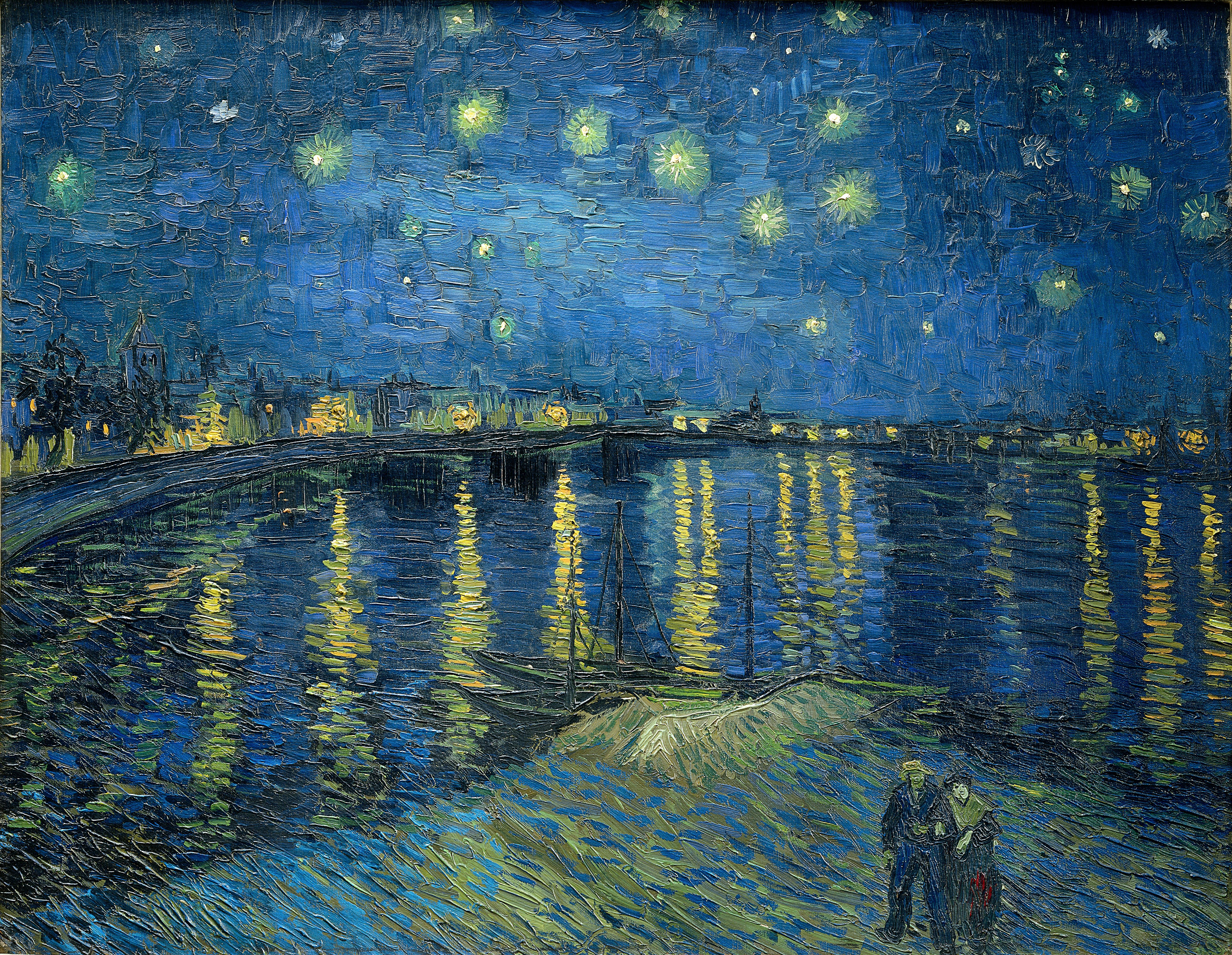
The kids should be able to see the Starry Night at MoMA in a couple of weeks (along with Picasso's Les Demoiselles d'Avignon, which is on my mind after seeing Steve Martin's play last Saturday), so hopefully they can imagine the two together. I actually saw the Vollard exhibit at the Art Institute of Chicago where the two were paired, and that was so cool. I think I went back 3 times just to see that.
Finally, in the summer of 2017, the AGO is going to have an exhibit on Georgia O'Keeffe, primarily organized by the Tate Modern. I'm looking forward to that as well, especially as this is the only North American stop. That doesn't happen too often that Toronto gets an exclusive. So if you are a major O'Keeffe fan, start making your travel arrangements soon...
Not too surprisingly, I am not interested in what Canadian Stage nor Mirvish is doing, though I did hear rumors that Mirvish was going to bring The Book of Mormon back for a short stint. I would probably go see that again.
Tarragon's new season looks a bit more appealing than this year's season, which left me quite cold. This upcoming season they are rehashing Infinity and The Watershed. I have to say I find their scheduling very odd. Loyal subscribers (and I do not count myself among them) sort of get shafted when they keep remounting things so often. I've noticed Soulpepper does this as well, but they have so many different events going on that probably few people subscribe to the entire season. I did enjoy Infinity, though I don't feel I need to see it again. I'm not that interested in The Watershed, but I may go just so I can see I finally saw Eric Peterson on stage, since I am increasingly being mixed up with him. I am leaning towards seeing Sequence and The Realistic Joneses, and I may go see The Circle, since it is about high schoolers. It might help -- or it might block me -- from finishing The Study Group. I have around 8 months to decide. I am quite on the fence about Midsummer (a "play with songs") but leaning against.
Where I have no ambivalence is the upcoming exhibitions at AGO. They are looking quite enticing, so I will certainly renew our membership. This summer they are bringing the Lawren Harris exhibit to town. I've blogged about this already, so I will refrain now.
Then in the fall they are bringing an exhibition of "masterworks" from the Musee d'Orsay and elsewhere. I've probably seen many of these paintings, but not that often. It is a very good opportunity to go again. There will be paintings by Georgia O'Keeffe, Monet, Gauguin, Van Gogh and many others. I'm most excited about seeing Van Gogh's Starry Night over the Rhone at Arles.
The kids should be able to see the Starry Night at MoMA in a couple of weeks (along with Picasso's Les Demoiselles d'Avignon, which is on my mind after seeing Steve Martin's play last Saturday), so hopefully they can imagine the two together. I actually saw the Vollard exhibit at the Art Institute of Chicago where the two were paired, and that was so cool. I think I went back 3 times just to see that.
Finally, in the summer of 2017, the AGO is going to have an exhibit on Georgia O'Keeffe, primarily organized by the Tate Modern. I'm looking forward to that as well, especially as this is the only North American stop. That doesn't happen too often that Toronto gets an exclusive. So if you are a major O'Keeffe fan, start making your travel arrangements soon...
Hidden Toronto Part #1
I've really been enjoying coming across interesting neighbourhoods in Toronto while on the way to some new destination. What seems to happen in Toronto is that small theatres are scattered all over the place (south of Bloor) in places that are still fairly accessible. The Harbourfront theatre is perhaps less accessible (at least mentally) but now that the 509 streetcar is back up and running, it isn't that bad. Actually, the Canadian Stage Berkeley stage and Alumnae Theatre are a bit out of the way, though they are quite easy for me to get to so long as I can bike. This dispersion with decent access is similar to Chicago, though I found Vancouver was pretty miserable in that the main stages and small indy theatres all were hard to get to with only one or two exceptions.
At any rate, this leads me to taking the streetcar and exploring. My favourite streetcar line is the Carlton/College/Gerrard line, which goes through Little India, a small Asian district, Cabbagetown, Little Italy and finally ends up at this weird island at the edge of High Park. I'll have to take a photo of that some day.
In any case, last Saturday I went to a new venue (new to me anyway) called Bounce. It is really a fully functioning bar, but they had a few tables set aside for the actors, then the rest for the audience. Interesting, a fair number of the tables were elevated on a rise (perhaps because this place also has dancing?) which worked pretty well. I was running just a bit late, then it turned out that the Spadina streetcar wasn't running and they had replacement buses but they were not running well and the number of people on the platform was kind of dangerous. I decided to try to catch a cab the rest of the way, though I didn't see any at all. In my whole trip down Spadina I think I only saw three occupied cabs. I would think that the cabbies might keep an eye out for TTC disruptions and hang out in those areas, but they did not. As it happened, the buses finally started arriving, and I did squeeze onto one. I still had to force my way through the Chinatown crowds and run to Bounce (it's just off Dundas about halfway between Spadina and Bathurst). I made it with about 5 minutes to spare.
I enjoyed the play, though I agree there isn't a whole lot of plot to it. It's mostly concerned with artistic and scientific innovation. Perhaps its greatest contribution is to portray a world where Cubism isn't old hat and there is still so much "new" to discover.
After the play I actually had to head over to Dundas and Bathurst, since it was the only library I was likely to have time to get to before closing. I am not sure quite when it happened, but it appears that Chinatown has stretched down along Dundas to Bathurst and most of the stores were oriented towards a Chinese or Vietnamese clientele. There were actually two vegetarian restaurants, and I ate a very delayed lunch at one. I wasn't that crazy about the flavour though, and will try the other one the next time I am in the area.
The library sort of flowed into a community centre and then another official-looking building. But what was particularly interesting is that there were little stores made out of shipping containers right in front. It is more permanent than a food truck. I suppose at least some of these stores had water hook-ups, but I can't imagine these are very comfortable places to work, probably quite cold and drafty in the winter and then hot in the summer. But they were cool to look at, and I'll have a few pictures below. I'm hoping that this summer, particularly weekends in June and then through July, I can take the family around to these various neighbourhoods and show them how fascinating Toronto can be.


At any rate, this leads me to taking the streetcar and exploring. My favourite streetcar line is the Carlton/College/Gerrard line, which goes through Little India, a small Asian district, Cabbagetown, Little Italy and finally ends up at this weird island at the edge of High Park. I'll have to take a photo of that some day.
In any case, last Saturday I went to a new venue (new to me anyway) called Bounce. It is really a fully functioning bar, but they had a few tables set aside for the actors, then the rest for the audience. Interesting, a fair number of the tables were elevated on a rise (perhaps because this place also has dancing?) which worked pretty well. I was running just a bit late, then it turned out that the Spadina streetcar wasn't running and they had replacement buses but they were not running well and the number of people on the platform was kind of dangerous. I decided to try to catch a cab the rest of the way, though I didn't see any at all. In my whole trip down Spadina I think I only saw three occupied cabs. I would think that the cabbies might keep an eye out for TTC disruptions and hang out in those areas, but they did not. As it happened, the buses finally started arriving, and I did squeeze onto one. I still had to force my way through the Chinatown crowds and run to Bounce (it's just off Dundas about halfway between Spadina and Bathurst). I made it with about 5 minutes to spare.
I enjoyed the play, though I agree there isn't a whole lot of plot to it. It's mostly concerned with artistic and scientific innovation. Perhaps its greatest contribution is to portray a world where Cubism isn't old hat and there is still so much "new" to discover.
After the play I actually had to head over to Dundas and Bathurst, since it was the only library I was likely to have time to get to before closing. I am not sure quite when it happened, but it appears that Chinatown has stretched down along Dundas to Bathurst and most of the stores were oriented towards a Chinese or Vietnamese clientele. There were actually two vegetarian restaurants, and I ate a very delayed lunch at one. I wasn't that crazy about the flavour though, and will try the other one the next time I am in the area.
The library sort of flowed into a community centre and then another official-looking building. But what was particularly interesting is that there were little stores made out of shipping containers right in front. It is more permanent than a food truck. I suppose at least some of these stores had water hook-ups, but I can't imagine these are very comfortable places to work, probably quite cold and drafty in the winter and then hot in the summer. But they were cool to look at, and I'll have a few pictures below. I'm hoping that this summer, particularly weekends in June and then through July, I can take the family around to these various neighbourhoods and show them how fascinating Toronto can be.


Tuesday, March 1, 2016
Slesinger and other artists of the left
This is going to be an imbalanced post, but I don't really have the energy to smooth it out (or to do all the necessary research).
Last Thurs. I heard about a party at the Chester subway station, and I managed to leave a little bit early. However, my impression was that the party was going to be 6-7, and I turned up at the tail end of that time. Unfortunately, the organizers ended up starting much earlier at 3, and it was definitely over by the time I showed up. There were a couple of pieces of cake hidden in the storefront for people connected to the event. Maybe if I had shown up 15 minutes earlier there would have been a bit more activity. Anyway, the party was not an official TTC celebration but more of an informal thing that these artists renting out the kiosk at Chester dreamed up to celebrate the 50th anniversary of the opening of the Bloor-Danforth line.
You can see the way they had decorated the kiosk below. It was supposed to be a kind of pinata.

I poked around at what was actually on sale, and it was mostly 'zines and a mix tape (about reproductive rights) and a number of other artistic products with a definite leftist slant. I decided upon reflection that I really ought to buy something, as they are not renewing their lease come April, and I picked up this postcard celebrating Eugene Debs. (I could have used it to get feedback from the Star short story contest, but I decided to not enter at the last minute, though the deadline itself was still helpful.)

I am no longer that tied into artistic circles, even to the point to evaluate whether it is surprising that there is still a relatively large collective of leftist artists in Toronto (to the point they can rent a storefront from the TTC for a year). It may be that the safety net, while somewhat frayed in Canada, is still sufficiently strong that political and politicized artists can still survive, whereas leftists artists seem to be really marginalized in the States, though I am sure part of this is not being around and active on the scene, as well as complete lack of access to the mainstream media. My impression is that leftist artists have a slightly easier time of it in Canada than the U.S., but I am open to being proved wrong.
Most of the theatre that I go to is not overtly politicized, though there are some exceptions, like the Svitch piece I saw at the Theatre Centre last year. I could go to quite a bit of that if I so chose, but I suppose I am not that convinced that having a specific political agenda makes for very good theatre. Usually it descends into celebrating a hero or heroine and then castigating everyone else. Where things get tricky is dealing with the audience -- either the playwright allows them a bit of smugness since they are aligned with the forces of good, while the most challenging work makes the audience think about its privilege (not least of which involves the money they spent on entertainment rather than giving directly to the needy -- this is a bit of a rabbit hole when you push things too far). I used to go to that kind of theatre, but I don't get much of a charge out of it anymore. It all comes across as the same to me now.
Leaving those kinds of plays aside, there are some plays that can be interesting when they feature a number of leftists characters all sitting around and trying to be the most virtuous but secretly conniving and being not that different from everyone else, despite their politics. Probably the more interesting (but rarer) plays would combine characters of different political backgrounds and have them duke it out. I would say that Kushner's Angels in America does this reasonably well. I am sure there are other plays along these lines, but I am not going to investigate right now.
Kushner's latest opus is much more like the first approach. I mentioned already that I went down and saw The Intelligent Homosexual's Guide To Capitalism And Socialism ... at Shaw this past summer. It was a challenging piece, but it was at heart about a family who were (with a few exceptions) always trying to prove that they had the best socialist or even communist credentials. I would have had no interest in sticking around and being part of this discussion, and yet the play still worked for me. In contrast, I just am not willing to give any slack to Amy Herzog, who is writing almost the exact same plot in After the Revolution. I particularly disliked the grandmother figure who seemed to take advantage of her age as a wise yente to say some really terrible things about others. I read 4000 Miles and it is all about her and her grandson, and I am so glad I didn't see that in Chicago when I had the chance.
Clearly at this point in my life, I am not that interested in hearing directly from the true believers but I don't mind plays or other literature that pokes at least a little fun at leftist intellectuals. This finally brings me around to Tess Slesinger, who is a fairly marginal literary figure due to her dying quite young. Her novel, The Unpossessed, was reissued a while back by NYRB, and I read it and enjoyed it quite a bit. I am actually reasonably sure this is the second go-around but it has made a much bigger impression this time around for a few reasons, which I will get to in a minute.
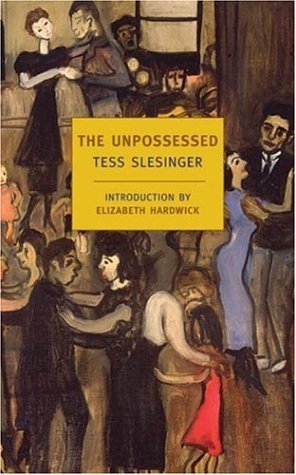
I would warn anyone reading the NYRB edition of the book that you really should hold off on reading Hardwick's introduction until the end. She simply gives away too many important plot points. Interestingly, many people considered this a bit of a roman a clef, with Lionel and Diana Trilling being prominently featured (or at least somewhere in the composite mix of characters). Later on, Lionel Trilling wrote an Afterward to the book, which is quite perceptive and appropriately placed at the end of the book. I think NYRB should have fought harder to get the rights to put this in their edition, but it actually isn't that hard to turn up Trilling's piece. It is titled "A Novel of the 30s" and is reprinted a few places, including in The Last Decade.
In case you haven't read the book, I would recommend turning away, as I will probably SPOIL it to some degree in the last part of this post.
SPOILERS on the left, but no SPOILERS on the right.
I probably should have picked up the influence sooner, but I am reasonably proud that a scene (Part 2, Chapter 2) with Prof. Bruno Leonard talking to and mixing it up with the Black Sheep (his undergraduate students competing to be the most righteous) made me think back to a similar scene with the same kind of manic comic energy found in Dostoevsky's Demons (Part 2, Chapter 7) when a number of plotters are all in the same room and two of the women in the room keep insisting on bringing up female liberation no matter the topic being discussed.
Some time after this, I decided to flip through Hardwick's introduction and she said that in many ways Slesinger was riffing off of Dostoevsky's book (perhaps not quite to the same extent of Joyce transforming Homer in Ulysses but not completely dissimilar either). Hardwick made it clear that Leonard's failed speech at the tail end of the party is drawn directly from a similar fete in Demons that becomes a complete shambles. (The Unpossessed is certainly worth reading for Part 3, which ends up just about as madcap as a Marx Brothers film or prefiguring the nightclub scene in Tati's Playtime.) At any rate, Hardwick reassures us that it would have been much easier in Slesinger's day to make the connection, since Demons was typically translated as The Possessed back then (whereas the title morphed to The Devils at some point, but probably Demons will stick).
What Hardwick doesn't capture is that Slesinger was mixing up the party politics issues with modern literature. She name drops Ulysses, and I am reasonably confident that when we are introduced to Elizabeth (Bruno's cousin) she is drawing on Eliot's The Waste Land. Generally, the artistic level is amped up the most when Elizabeth is center stage, and there will be long sections on what she might have or ought to have said with then a short passage indicating what she actually said.
There really is a lot going on in this book, but what is quite apparent is that most of the main actors are working out their issues, either sexual hang-ups or childhood traumas, and it is almost accidental that they are trying to start a socialist revolution. (I think Slesinger was also picking up all the Freud in the air in the 1930s.) Most of the people she describes are complete headcases, though the most annoying to me is Miles Flinders who decides that it is simple weakness to love his wife and that there is no justification for bringing another baby into the world (before the revolution), so he convinces her somehow to have an abortion, mostly out of fear masquerading as political principles. I was so disgusted with this that it was just as well that this happens at the end of the book. Not that you don't find some people claiming the same sort of thing nowadays (that due to climate change it is irresponsible to have more children), but that is a whole different thing from forcing an illegal abortion on a woman who clearly wanted the child (and apparently Slesinger's first husband put her in exactly this same position in real life, but she had the sense to leave him eventually). So that was a pretty big downer to me, and it was probably intended to make that impression -- that these leftist intellectuals could talk the big talk all they wanted, but fundamentally they were anti-life. No wonder the New Masses crowd hated this book so much. What is quite baffling to me is that apparently she stayed in touch with people on the left and after she moved to Hollywood, Slesinger joined the Communist Party (maybe because it was an effective anti-Nazi moment in the early 1940s). However, she did have two children, though she died tragically young at 39.
In short, The Unpossessed is an idiosyncratic novel about leftist intellectuals of the 1930s and their struggles and their hang-ups. There is quite a bit of humor (black and otherwise) throughout the novel (and I think I mentioned enjoying the delivery of the file cabinet which indirectly sets off the party which proves so disastrous for Prof. Leonard), though I do think the last section casts a bit of a pall over the book as a whole, and certainly I lost pretty much any sympathy I had for Miles Flinders. However, I would not recommend it if you consider yourself a leftist with unimpeachable credentials, since you will certainly not enjoy seeing yourself reflected back in this book.
Last Thurs. I heard about a party at the Chester subway station, and I managed to leave a little bit early. However, my impression was that the party was going to be 6-7, and I turned up at the tail end of that time. Unfortunately, the organizers ended up starting much earlier at 3, and it was definitely over by the time I showed up. There were a couple of pieces of cake hidden in the storefront for people connected to the event. Maybe if I had shown up 15 minutes earlier there would have been a bit more activity. Anyway, the party was not an official TTC celebration but more of an informal thing that these artists renting out the kiosk at Chester dreamed up to celebrate the 50th anniversary of the opening of the Bloor-Danforth line.
You can see the way they had decorated the kiosk below. It was supposed to be a kind of pinata.

I poked around at what was actually on sale, and it was mostly 'zines and a mix tape (about reproductive rights) and a number of other artistic products with a definite leftist slant. I decided upon reflection that I really ought to buy something, as they are not renewing their lease come April, and I picked up this postcard celebrating Eugene Debs. (I could have used it to get feedback from the Star short story contest, but I decided to not enter at the last minute, though the deadline itself was still helpful.)

I am no longer that tied into artistic circles, even to the point to evaluate whether it is surprising that there is still a relatively large collective of leftist artists in Toronto (to the point they can rent a storefront from the TTC for a year). It may be that the safety net, while somewhat frayed in Canada, is still sufficiently strong that political and politicized artists can still survive, whereas leftists artists seem to be really marginalized in the States, though I am sure part of this is not being around and active on the scene, as well as complete lack of access to the mainstream media. My impression is that leftist artists have a slightly easier time of it in Canada than the U.S., but I am open to being proved wrong.
Most of the theatre that I go to is not overtly politicized, though there are some exceptions, like the Svitch piece I saw at the Theatre Centre last year. I could go to quite a bit of that if I so chose, but I suppose I am not that convinced that having a specific political agenda makes for very good theatre. Usually it descends into celebrating a hero or heroine and then castigating everyone else. Where things get tricky is dealing with the audience -- either the playwright allows them a bit of smugness since they are aligned with the forces of good, while the most challenging work makes the audience think about its privilege (not least of which involves the money they spent on entertainment rather than giving directly to the needy -- this is a bit of a rabbit hole when you push things too far). I used to go to that kind of theatre, but I don't get much of a charge out of it anymore. It all comes across as the same to me now.
Leaving those kinds of plays aside, there are some plays that can be interesting when they feature a number of leftists characters all sitting around and trying to be the most virtuous but secretly conniving and being not that different from everyone else, despite their politics. Probably the more interesting (but rarer) plays would combine characters of different political backgrounds and have them duke it out. I would say that Kushner's Angels in America does this reasonably well. I am sure there are other plays along these lines, but I am not going to investigate right now.
Kushner's latest opus is much more like the first approach. I mentioned already that I went down and saw The Intelligent Homosexual's Guide To Capitalism And Socialism ... at Shaw this past summer. It was a challenging piece, but it was at heart about a family who were (with a few exceptions) always trying to prove that they had the best socialist or even communist credentials. I would have had no interest in sticking around and being part of this discussion, and yet the play still worked for me. In contrast, I just am not willing to give any slack to Amy Herzog, who is writing almost the exact same plot in After the Revolution. I particularly disliked the grandmother figure who seemed to take advantage of her age as a wise yente to say some really terrible things about others. I read 4000 Miles and it is all about her and her grandson, and I am so glad I didn't see that in Chicago when I had the chance.
Clearly at this point in my life, I am not that interested in hearing directly from the true believers but I don't mind plays or other literature that pokes at least a little fun at leftist intellectuals. This finally brings me around to Tess Slesinger, who is a fairly marginal literary figure due to her dying quite young. Her novel, The Unpossessed, was reissued a while back by NYRB, and I read it and enjoyed it quite a bit. I am actually reasonably sure this is the second go-around but it has made a much bigger impression this time around for a few reasons, which I will get to in a minute.
I would warn anyone reading the NYRB edition of the book that you really should hold off on reading Hardwick's introduction until the end. She simply gives away too many important plot points. Interestingly, many people considered this a bit of a roman a clef, with Lionel and Diana Trilling being prominently featured (or at least somewhere in the composite mix of characters). Later on, Lionel Trilling wrote an Afterward to the book, which is quite perceptive and appropriately placed at the end of the book. I think NYRB should have fought harder to get the rights to put this in their edition, but it actually isn't that hard to turn up Trilling's piece. It is titled "A Novel of the 30s" and is reprinted a few places, including in The Last Decade.
In case you haven't read the book, I would recommend turning away, as I will probably SPOIL it to some degree in the last part of this post.
SPOILERS on the left, but no SPOILERS on the right.
I probably should have picked up the influence sooner, but I am reasonably proud that a scene (Part 2, Chapter 2) with Prof. Bruno Leonard talking to and mixing it up with the Black Sheep (his undergraduate students competing to be the most righteous) made me think back to a similar scene with the same kind of manic comic energy found in Dostoevsky's Demons (Part 2, Chapter 7) when a number of plotters are all in the same room and two of the women in the room keep insisting on bringing up female liberation no matter the topic being discussed.
Some time after this, I decided to flip through Hardwick's introduction and she said that in many ways Slesinger was riffing off of Dostoevsky's book (perhaps not quite to the same extent of Joyce transforming Homer in Ulysses but not completely dissimilar either). Hardwick made it clear that Leonard's failed speech at the tail end of the party is drawn directly from a similar fete in Demons that becomes a complete shambles. (The Unpossessed is certainly worth reading for Part 3, which ends up just about as madcap as a Marx Brothers film or prefiguring the nightclub scene in Tati's Playtime.) At any rate, Hardwick reassures us that it would have been much easier in Slesinger's day to make the connection, since Demons was typically translated as The Possessed back then (whereas the title morphed to The Devils at some point, but probably Demons will stick).
What Hardwick doesn't capture is that Slesinger was mixing up the party politics issues with modern literature. She name drops Ulysses, and I am reasonably confident that when we are introduced to Elizabeth (Bruno's cousin) she is drawing on Eliot's The Waste Land. Generally, the artistic level is amped up the most when Elizabeth is center stage, and there will be long sections on what she might have or ought to have said with then a short passage indicating what she actually said.
There really is a lot going on in this book, but what is quite apparent is that most of the main actors are working out their issues, either sexual hang-ups or childhood traumas, and it is almost accidental that they are trying to start a socialist revolution. (I think Slesinger was also picking up all the Freud in the air in the 1930s.) Most of the people she describes are complete headcases, though the most annoying to me is Miles Flinders who decides that it is simple weakness to love his wife and that there is no justification for bringing another baby into the world (before the revolution), so he convinces her somehow to have an abortion, mostly out of fear masquerading as political principles. I was so disgusted with this that it was just as well that this happens at the end of the book. Not that you don't find some people claiming the same sort of thing nowadays (that due to climate change it is irresponsible to have more children), but that is a whole different thing from forcing an illegal abortion on a woman who clearly wanted the child (and apparently Slesinger's first husband put her in exactly this same position in real life, but she had the sense to leave him eventually). So that was a pretty big downer to me, and it was probably intended to make that impression -- that these leftist intellectuals could talk the big talk all they wanted, but fundamentally they were anti-life. No wonder the New Masses crowd hated this book so much. What is quite baffling to me is that apparently she stayed in touch with people on the left and after she moved to Hollywood, Slesinger joined the Communist Party (maybe because it was an effective anti-Nazi moment in the early 1940s). However, she did have two children, though she died tragically young at 39.
In short, The Unpossessed is an idiosyncratic novel about leftist intellectuals of the 1930s and their struggles and their hang-ups. There is quite a bit of humor (black and otherwise) throughout the novel (and I think I mentioned enjoying the delivery of the file cabinet which indirectly sets off the party which proves so disastrous for Prof. Leonard), though I do think the last section casts a bit of a pall over the book as a whole, and certainly I lost pretty much any sympathy I had for Miles Flinders. However, I would not recommend it if you consider yourself a leftist with unimpeachable credentials, since you will certainly not enjoy seeing yourself reflected back in this book.
Subscribe to:
Posts (Atom)