Thursday, June 19, 2014

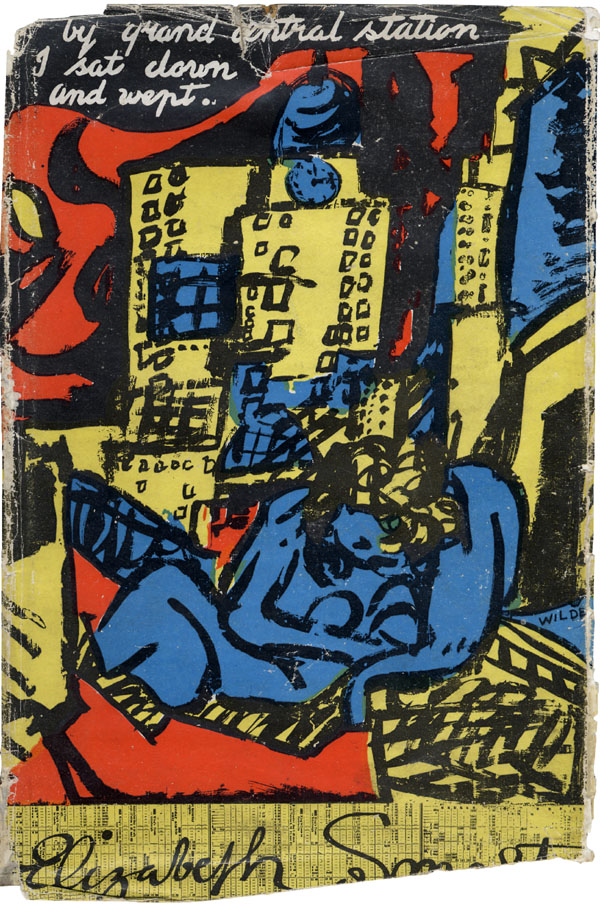
7th Canadian Challenge - 17th review - By Grand Central Station I Sat Down and Wept

As I mentioned, I came across a copy of Elizabeth Smart's By Grand Central Station I Sat Down and Wept mis-shelved at the library.  I'm not entirely sure when I heard the basic back story, but probably about a year ago. Elizabeth Smart came across a book by George Barker and fell in love with his verse and decided that she was in love with him too.  She started an affair with him, hoping that he would leave his wife, but this never happened.  She had not one, but four children with Barker.  She wrote By Grand Central Station... shortly after the birth of her first child.


It is pretty much impossible to avoid making some kind of moral judgement about Smart, given this background.  I think she was a terrible fool who didn't care at all about hurting others, but she also seems to have a bit of screw loose, which led to some fairly interesting writing.  She certainly strikes me as an unfit mother, but there doesn't seem to be that much written on her children after the first one.

It is also difficult to separate their literary merit as opposed to the scandal.  I suspect that in the absence of this affair, Elizabeth Smart wouldn't have written anything and George Barker would have been less known.  But as a contemporary Abelard and Heloise they have achieved minor literary immortality.  I actually went through Barker's Collected Poems last year, and to be honest only found 10 or 15 of them of any interest.  I thought he was an extremely minor poet, and certainly not worth all this fuss.  I've never met a poetry groupie in real life, though I know they do exist.  I have encountered poets who thought they were special enough to merit a groupie...

The book is difficult to review.  Not all that much happens in the book other than Smart recounting the ups and downs (mostly downs) of her having an affair with Barker, ultimately leaving her abandoned with a "bun in the oven" (but then apparently couldn't leave well enough alone and kept coming back to her but without making any final break with his wife, although this is all after the events in By Grand Central Station...).   The language is very over the top with lots of references to Old Testament imagery (particularly Song of Songs) and other ecstatic poets like Blake (and more than a few apparent references to John Donne and perhaps even George Herbert).  It's quite unusual in that Smart is operating on two levels at once -- the ecstatic and the real (though mostly in the ecstatic world).  I have no idea if she was this way in real life (though some comments in the book suggest she was, with people calling her a religious loony), but she certainly retrospectively portrayed these events in that light.  (It may not be a good metaphor at all, but I sort of see her doing what Stanley Spencer was doing in the visual arts, basically claiming that people on the British Isles should be acting as if Jesus would return at any moment, and yet he also would be painting absolutely contemporary scenes.)

Stanley Spencer, The Resurrection Port Glasgow, c. 1947-50

I find it extremely hard to take how Smart tries to justify her actions by claiming that she is in the grasp of an all-encompassing love and that it is self-evident she and Barker are soul-mates (so why won't his wife just release him already).  I wasn't always terribly sympathetic to the various odd things that Barbara Comyns' feckless characters got up to, but they didn't try to justify their behaviour using flowery metaphors that claimed they couldn't help it.  Here's a pretty typical example: "To deny love, and deceive it meanly by pretending that what is unconsummated remains eternal, or that love sublimated reaches highest to heavenly love, is repulsive, as the hypocrite’s face is repulsive when placed too near the truth."

In addition to what appear to be references to Blake, Donne and Herbert, I found something of the obsessive Christopher Smart (probably not a relation) in this work, and maybe some of the extravagant metaphors of Dylan Thomas.  I found this passage somewhat amusing and suitably over the top.  Smart is reflecting on Barker's wife and the damage she is doing to her: "On her mangledness I am spreading my amorous sheets, but who will have any pride in the wedding red, seeping up between the thighs of love which rise like a colossus, but whose issue is only the cold semen of grief?"

The single most brilliant sequence -- which really emphasizes the dualism that Smart embodies/suffers from -- is the opening of Part Four:
But at the Arizona border they stopped us and said Turn Back, and I sat in a little room with barred windows while they typed.
What relation is this man to you? (My beloved is mine and I am his: he feedeth among the lilies.)
How long have you know him? (I am my beloved’s and my beloved is mine: he feedeth among the lilies.)
Did you sleep in the same room? (Behold thou art fair, my love, behold thou art fair: thou hast dove’s eyes.)
In the same bed? (Behold thou art fair, my beloved, yea pleasant, also our bed is green.)
Did intercourse take place? (I sat down under his shadow with great delight and his fruit was sweet to my taste.)


This leads to their arrest for crossing state borders for immoral purposes.  By the most amazing coincidence, there was a recent story about a UBC student who was detained at the US border on suspicion that she was a sex worker, and this remains grounds for denial of entry to the U.S., though the laws against your run-of-the-mill adultery barring admission have been eliminated. Plus ça change...

By Grand Central Station is a very short book (roughly 100 pages), and it is hard to tell how well this style would hold up in a longer narrative. I guess I will find out, as there is sort of a follow-up (much less famous though) called The Assumption of the Rogues & Rascals that was bundled in the copy I borrowed from the library.  That is also about 100 pages, and appears to be written in a slightly less fraught style.  For those looking for more on Elizabeth Smart and her later works, this page is a good starting place.

Monday, June 16, 2014

7th Canadian Challenge - 16th review - Generation X

While it was kind of omnipresent for a while in the early 90s, I'd actually never read Douglas Coupland's Generation X: Tales for an Accelerated Culture.  Or in fact any of his novels, though I did review his non-fiction book on Vancouver a little while back.

I actually liked his exhibit at the Vancouver Art Gallery a lot more than I expected, and a review of that is forthcoming.  So when I saw a copy of Generation X sitting up front at the Burnaby Library, I decided to grab it.  


Generation X wasn't quite as flash or as shallow as I had sort of imagined.  At the same time, I'm still feeling that Coupland starts from some social science position he wants to illuminate and sort of builds around that framework.  The characters are really not much more than mouthpieces of their generation, and Coupland is kind of upfront about that.  There really is no one in the book on which one would really expend too much emotional effort.  But it was a moderately entertaining exercise, and it is short, which I am valuing more at the moment.  I didn't feel nearly as much nostalgia about these people in their early 20s as I did about the folks in Bogosian's subUrbia.  Even though I took a different path than any of them, I still could sort of recognize classmates in subUrbia, whereas I didn't know anyone who completely dropped out of life the way this trio did in Generation X.  (Now I am wondering what and how I will feel if I watch Winona Ryder in Reality Bites -- one of the Gen. X movies I assiduously avoided back in the 90s.)  


It does seem like Coupland's bunch (who somehow avoid shacking up together) are 5-6 years older than me (and most of the characters in Reality Bites and subUrbia) but I don't think that is really the issue.  It is more their general listlessness that I can't relate to.

What I do find interesting is that Coupland does tend to capture the zeitgeist fairly well.  There were loads of people who withdrew from consumer society, more or less successfully, during this period.  And notably, most of them did struggle to make it on their own in lousy McJobs, but only a relatively few went home again (Coupland sort of mentions this in a sidebar but it doesn't play a real role in the book).  The Gen Xers by and large did leave the nest, scraping by in dingy apartments or living with roommates long after college, but statistics show that is not nearly so much the case for the Millennials.  Truly staggering numbers are still living at home.  Granted they got an even rawer deal than the Gen Xers, but I just don't see this as healthy at all, either from a personal or societal standpoint.

One thing is that they probably have a lot of (deserved) internalized anxiety over climate change/global warming, but they really do not have the fear of nuclear annihilation that some of us did in the Reagan years.  I know I was affected, and I am a much darker person because of it.  (I believe this is basically the theme of Nancy Lee's The Age, which I expect to read in a few months.)  All I can say is that it is a good thing Reagan was dealing with Gorbachev and not Putin, or history might have taken a very unpleasant turn...  

At any rate, the idea that everything can be lost in a flash seems more real to a lot of Gen Xers than to the Millennials (who may never have had anything that wasn't their parents' to begin with).  As much as there is no question that the fairly lousy economic hand dealt to Gen X is part of their general disaffection and dissatisfaction with contemporary life, another not-insignificant reason is the attitude: why bother if it's getting blown to Kingdom Come anyway.

Not surprisingly, Coupland latches onto this as well.  There is a generalized threat and dread (of nuclear devastation and other types of disasters) that is in the background of this book, though the characters do occasionally acknowledge it directly, as when Dag himself tells apocalyptic stories about bombs leveling shopping districts.

As if that weren't enough, Coupland raises the stakes. Dag accidentally spills radiated beads from New Mexico in Claire's bungalow, and she freaks out.  The nuclear threat suddenly becomes very real to her.  I actually wonder if she is really up for Dag's crazy plans to open up a hotel in Mexico, or is it just an excuse to get the heck out of Dodge (after her home has been violated)?

In general the book went along fairly smoothly, nothing too deep, but there were a few things that bugged me about it.  While it was only a tiny story within the whole work, it was just absurd that there was some cult that had a year that lasted only 1/7th as long as the "Western" year. That is just silly: while human societies sure can get up to strange things, the one universal is that a year is either based on a solar year (364-66 days) or lunar year (roughly 354 days).

I found the final image to be so strange -- the narrator (Andy) pulls over to see a huge cloud generated by farmers burning off a field after it has been harvested.  He is unbelievably relieved that it isn't an atom cloud.  However, while standing there he is attacked by a white egret and then is smothered (in a good way apparently) by developmentally challenged children on some kind of bus trip. A little too sentimental perhaps or symbolic or both. Nature (violently) communes with him, and then he gets all the human contact he can stand in a non-ironic way.

Finally, I did think Coupland tried too hard with the ex-mercenary character (The Boy with the Hummingbird Eyes), where the tale frankly came across as a bad retread of some MASH storyline, perhaps even from the finale.

Actually that is a decent segue to some of Coupland's sidebar comments, which put the action such as it is in the stories or the stories within stories into a broader context.  Coupland sure has a way with these little text bombs or pure aphorisms that he turned into posters for his art gallery show.

Here are a few I liked from Generation X:

Tele-Parablizing: Morals used in everyday life that derive from TV sitcom plots.

Ultra Short Term Nostalgia: Homesickness for the extremely recent past.

Down-Nesting: The tendency of parents to move to smaller, guest-room-free houses after the children have moved away so as to avoid children aged 20 to 30 who have boomeranged home.

Occupational Slumming: Taking a job well beneath one's skill or education level as a means of retreat from adult responsibilities and/or avoiding possible failure in one's true occupation.

I can attest to the temptation of this last one, though I have been fairly ambitious in my work life.  Still, I basically changed my major to the humanities when it became apparent I would never be a star in either physics or advanced mathematics.  I don't regret too much about my career path, but I do regret giving up. However, sometimes sticking it out just to make a point can lead to really bad outcomes, such as being a depressed high school math teacher who never made the grade.  That would have been pretty terrible.  Or even worse, being just a substitute teacher.  Knowing when to fold them (as Kenny Rogers would say) is a critical life lesson that isn't emphasized enough.

So I have to admit I don't have really strong feelings for Generation X either way.  It seems to focus a lot more on the drop-outs from my generation than I would have preferred, and I think there were many of us that managed to carve out a path that wasn't a complete rejection of society nor a yearning for yuppie-dom.  But you can't really criticize a person for the book they didn't write, only the one that they did.  My biggest beef was that Andy was far too passive, but that was pretty much the point.  I don't feel I need to ask for the couple of hours it took to read this back, and I suppose that is sufficient.

Notes to self

While these are mostly personal thoughts I've have recently that I would be sorry to forget, a few might be of more general interest, though as always I'll probably go on for too long (rather than breaking this up into shorter posts).

It has generally been a big relief to read shorter novels from time to time, and I will make more of an effort to intersperse the long novels with shorter ones unless there is a particular reason to read them back to back.  I seem to feel as much accomplishment reading a short novel (and crossing it off the list) as a long one.  Even for picturesque novels with more plot, I think 250-300 pages is a good target.  If I get around to my work, this is what I will aim for.  Iris Murdoch's Under the Net was about 250 pages and it seemed just right.

Being short doesn't salvage a bad novel, but at least it keeps the damage limited.  On that note, I am about halfway through George Eliot's Silas Marner and am not liking it at all.  She piles one thing after another onto this guy, just in order to show that even the most crabbed and downtrodden person can find happiness -- particularly if they open their heart to others (and stop being so miserly).  It sounds like a freaking After School Special.  While there were considerable flashes of insight in The Mill on the Floss (more than I see here frankly), the ending of The Mill on the Floss was so lousy (as much of a disappointment as the end of Uncle Vanya but for different reasons).  Given that many people have problems with the ending of Adam Bede, I am just going to remove this from my reading list.  I can understand why some people do think she was a great writer, but I am no longer one of them.  I find her too bound by moral conventions, even when she tries to bend or subvert them.  Anyone (in these early novels) who doesn't ultimately accept society's dictates will suffer.  I am kind of surprised that she supposedly made this quantum leap into greatness with Middlemarch, and I'll give it a shot, but I'll bail on it fairly quickly if it I am not enjoying it.

A bit of randomness to the TBR pile seems to help.  I sort of just happened across a couple of interesting books while waiting for a book from the library where the person ahead of me hasn't returned it on time (grrr).  So I went ahead and read Douglas Coupland's Generation X (inspired by my recent visit to his show at the Vancouver Art Gallery) and I also saw Elizabeth Smart's By Grand Central Station I Sat Down and Wept, which was mis-shelved with the children's paperbacks (it really should be young adult or more properly an adult paperback).  Rather than kicking up a fuss, I decided I would check it out and then take it to the main library where it should be shelved appropriately.  Anyway, it is very short (under 100 pages), so I should have it read in just a couple of days.

It's been a bit heartening and rewarding to see how close I am to wrapping up all the books from my January detour from the primary TBR list.  I really ought to be done by the first week of July or so, and then I will have a brand new TBR list to unveil (and which should keep me busy for a few years).  I've decided that since I've done as much as I can in terms of clearing out books before the move, I will reorient the TBR pile just a bit. I've generally been reading books that I feel I ought to read, and I now will mix in more books that I think I will enjoy and add a few more of the books to be re-read (which I know I will enjoy).  There are some books I've owned and been itching to read for years in some cases, and it is silly to keep pushing them off.  That said, I have quite a nice mix of books to keep me occupied for some time.

Ok a quite swerve into New Yorker magazine territory.  I picked up a small stack for $1 on a recent trip to the library.  For once, I went through them quickly, since I had no intention of packing them up!  One of them had a short feature on the fiction writer Lydia Adams.  She does strike me as the quintessential New Yorker writer -- a bit esoteric, and more than a little stuck up.  The one thing I did appreciate about her is that she tried to keep her children out of her work (unlike Sharon Olds for example), though her husband was fair game. But in general, I thought she was incredibly snobby and was running down others' writing, not just when there was a mixed metaphor (which might have actually been intentional or not) but when she thought that some phrase didn't work.  It's hard to convey without quoting directly, but it really as if she thinks there are objective rules governing style, and that naturally many writers fall short.  I suppose there is a tiny chance I'll investigate her stories stories or a novel, but it's so unlikely that I would look very kindly on her writing, given how awful I thought she was about others not making the grade.

It is always so hard to control how others perceive creative work, and probably it is best to not fret too much about it.  Misunderstandings abound for all kinds of reasons.  I was really intrigued and even a bit disturbed by this piece on Young Jean Lee. I vaguely remember hearing about The Shipment which was at the MCA in Chicago in 2010.  I was pretty sure I wouldn't like it, and indeed, in the aftermath, I feel I did the right thing in skipping it.  I find it particularly intriguing that in an earlier incarnation of this work Lee was not able to get her point across to some audiences (and perhaps the majority of white audience members).  I think it is a clear reminder that authorial intent is often misinterpreted, and that may not be a bad thing in all cases.  But I really feel sorry for her that she felt "sick" that she wasn't able to make most of the audience unhappy by the end of her piece. I don't find this at all a productive or constructive approach to changing minds about race or any number of other social problems.  I know that a lot of progressives will do the internalizing guilt thing, and I did a great deal of this in my youth and still do to some extent.  But I am surely not going to pay $50 for someone to rub my nose into white privilege -- and then say they felt sick that they didn't succeed in making me feel bad enough.  So this is another artist, much beloved by the New Yorker crowd, who I will simply avoid.  Life is just too short...

I was going to make some observations on Iris Murdoch's Under the Net, which I actually did enjoy quite a bit, but that will have to wait for another post after all.


Sunday, June 15, 2014

Review of last VSO concert

The perhaps sounds a bit apocalyptic (perhaps appropriately given that I have been reading a fair bit of apocalyptic fiction lately), but I really only mean that I am probably not going to be attending any more of their concerts, given that we are moving in only 3 more weeks.  Stranger things have happened, and TransLink might bring me back for an extended trip, but I am not expecting it.  Of all the cultural things in Vancouver, I'll probably miss the VSO the most.  While Bard on the Beach is fun, there is no question that Stratford is a huge upgrade in that department.  I had a good time at the Fringe Fest, but Toronto has one that is fairly comparable.  Same thing with the International Film Fest and the Jazz Fest, with the added benefit that it will actually be easier for me to get to these places, as they won't be tucked away on a hard-to-get-to place like Granville Island.

Obviously, Toronto also has a good symphony, which is probably a bit more technically proficient than the VSO.  However, I am not at all crazy about Roy Thompson Hall.  The Orpheum is just such a nice place to go and see a concert, although does struggle when there is a completely sold out house (last night and then some of the Yefim Bronfman concerts when he was doing the Beethoven piano concerto cycle).  I assume that the Yo-Yo Ma concert will be sold out (and incidentally it turns out Ma is doing a similar concert in Toronto, so I really had better order tickets soon).  I guess my general feeling is that the VSO punches above its weight, and the TSO isn't quite as good as it ought to be.  That feeling may change over time, and who knows what will happen in a few years after Bramwell Tovey retires for good.  (I'm actually feeling a bit sentimental and a little bit sorry that I am not seeing an intimate concert today (just too busy) where Tovey and Dale Barldrop and a few others are going to pay Smetana's String Quartet #1 and a piano piece by Sarasate.  However, it turns out that I actually saw the Pacific Rim String Quartet do this Smetana String Quartet a couple of years back.)

Anyway, this was essentially the final concert of the season, although they repeat the same program on Monday.  Some general program notes are here.

I thought it was a very good concert. It kicked off with the Passacaglia from Britten's Peter Grimes.  I believe there is a different concert version that includes 4 Sea Songs as well, but I think they cut those, knowing that the concert would run long, as indeed it did.  The Passacaglia really features the cellos and I was sitting near them, so that was good.  However, I often find myself drifting off in the first half of concerts.  I have lived most of my life in a state of extreme sleep deprivation, and being in a darkened hall with mellow music is pretty deadly.  I often kind of drift in and out.  That was definitely the case with the Elgar Violin Concerto, though I would occasionally pinch my fingers and such to try to stay awake. I did manage to keep alert for the final movement.  The Elgar was a nice piece, though probably not one I would make a point of seeking out to see again.

James Ehnes got a huge standing ovation, and eventually returned for an encore.  (Encores, even for featured soloists, are actually fairly rare in North America compared to Europe.  I think I've only seen four or so in Vancouver and almost none in Chicago after years of concert going.  Here I'm only talking about for classical concerts.)  He did a very lovely piece by Bach, and I was able to stay awake through that.

After splashing water on my face at the intermission, I returned to my seat.  A few people here and there had left at intermission, but most stayed. They were in for a treat.  Tovey programmed two really up-tempo energizing pieces.  Berlioz's Roman Carnival and then Respighi's Pines of Rome.  I can't believe how big Tovey built up the final movement of Pines of Rome.  It was incredible, and I will definitely try to see this live another time.  It was terrific.  Most amusing was that as the musicians were taking their final bows, I saw that James Ehnes had joined them to play in Pines of Rome (and probably Roman Carnival, since there was almost no changeover between these pieces).  How cool is that!  They made a bit of a big deal a year ago when Dale Barltrop did the demanding Britten Violin Concerto and then joined the back row of violins for Elgar's Engima Variations.*  But Dale is a mainstay of the VSO and would have time to rehearse the Elgar.  I'm certainly not aware of any other time that a featured soloist has gone back into the ranks for the second half of the concert, so huge respect to James Ehnes.  It was a very fitting (and rousing) last concert of the season. I'm glad I was along for the ride.

While I am definitely more of a "program guy" than a ticket stub sort of guy, I did hang onto this one.


* I was also at that concert incidentally with the same general issue of needing to fight to stay awake to hear the amazing music.  Then as now, I generally do a bit better in the second half of concerts, though Britten's Violin Concerto isn't quite as "relaxing" as Elgar's, so that also helped.

Saturday, June 14, 2014

Books I should have read

As I mentioned in the last post, I skipped over the 10th grade honors English, which focused on American literature.  I think over time I've gotten around to most of what would have been in that course, namely Fitzgerald's The Great Gatsby, Hemingway short stories (and possibly The Sun Also Rises, though intimations of infidelity run through that book), Miller's The Crucible and Hawthorne's The Scarlet Letter.  I've also read a fair bit of Emerson and selections from Thoreau's Walden, though I am not sure I've ever read the whole thing, cover to cover.  I've read a fair bit of Mark Twain already (Messieurs Sawyer and Finn and Life on the Mississippi), leaving just a few gaps to be filled.  I've covered several shorter Steinbeck novels as well.  I've even read Moby Dick for kicks twice, for goodness' sakes.

Nonetheless, I am trying to think of what American lit. I probably should have read back then but didn't.*  Here's a fairly representative list:
Hawthorne The House of Seven Gables
Thoreau Walden (for reals this time)
Salinger The Catcher in the Rye (no idea if this was assigned or an optional pick but I think I am well past the point I would be interested)
Harper Lee To Kill a Mockingbird (this one I really ought to just go ahead and read it)
Willa Cather My Antonia
Fitzgerald This Side of Paradise
Fitzgerald Tender is the Night
Hemingway A Farewell to Arms
Hemingway For Whom the Bell Tolls
Sinclair Lewis Babbitt
Sinclair Lewis Main Street (this might have been a bit long for high school)
Steinbeck Of Mice and Men
Steinbeck The Grapes of Wrath
Steinbeck East of Eden (ok, probably not a high school selection)
Agee Let Us Now Praise Famous Men (an edition with the Walker Evans photos)
Sherwood Anderson Winesburg, Ohio
Thornton Wilder Our Town (I've seen the play twice but never read it)
Edgar Lee Masters Spoon River Anthology (I've read bits and pieces but not the whole thing.  I'd have to be careful choosing the proper time though, as this is a real downer.)

(I think if I do get through these one day, I will feel I have finally made up for "skipping" that particular class.)

At University of Michigan, at one point I had four reading courses and something had to give now and again.  The one book I regret not reading is:
Arnold Bennett The Old Wives' Tales

I actually remember my mom had to help round up used copies in the days before you could buy books on the internet, and I still didn't read the darn thing!  But it is lurking on my TBR pile, so I expect to pay off this debt next year (edit -- it actually took until early 2018; it's a shame I waited so long, as it really is a very good novel).

(Minor update -- I came across an "ancient" paper that looked like it was listing all the novels that we were assigned in Honors English at UM.  Apparently, I was supposed to have read Hardy's Jude the Obscure as well.  Oops.  Well, it will get added to the TBR list eventually, but I don't feel quite as bad for skipping over that -- or perhaps just skimming it back in the day to get through class.)

Now my single biggest (academic) regret from University of Michigan is that I skipped out of the Great Books courses.  I had a different honors course that was quite rewarding (the very philosophical "Ways of Thinking," I believe), but I should have found a way to take both.  Or dropped physics a lot sooner and audited Great Books.  I really was keeping my options open by taking humanities and math and physics (and even art history and a couple of courses on comparative religion).  However, I missed out on my chance to have Dante taught by Ralph Williams.  As it happens, I did take The Bible as Literature with Williams, so I did get the Williams experience, but all in all I still think I would have gotten more from taking Great Books.  (It really is a shame he apparently never recorded his lectures.  Update: actually he did record what is essentially a podcast of his lectures on Shakespeare and one on the Book of Job, which I will definitely have to download, and he has a series of Youtube videos as well.  So that is a huge plus, though I am still not sure there are any recordings of Williams on Virgil or Dante, but I will keep seeking.)

This is what I have reconstructed as being part of the series at least in many years (it really varies quite a bit whether the first part is Greek only or Greek and Roman or even the Old Testament mixed in, so this is actually a bit overstuffed for any particular class**):
Plato The Symposium
Aristotle Poetics
Homer The Iliad
Homer The Odyssey
Herodotus The Histories
Aeschylus The Oresteia (Agamemnon, The Libation Bearers, The Eumenides)
Thucydides History of the Peloponnesian War
Sophocles Oedipus the King
Sophocles Oedipus at Colonus
Sophocles Antigone
Euripedes Medea
Euripedes Hippolytus
Euripedes The Trojan Women
Euripedes Bacchae
Virgil The Aeneid
Ovid Metamorphoses
Petronius The Satyricon
Marcus Aurelius Meditations
Selections from the Old Testament of the Bible
Dante The Divine Comedy (Inferno, Purgatorio, Paradiso)
Confessions of St. Augustine
Boccaccio The Decameron
Beowulf
Chaucer The Canterbury Tales

(I'm not even sure of Chaucer, but I imagine it is in there in some years in the 2nd part of the course, unless there is just too much of a turf war with the English department claiming Chaucer.)  This is basically where my sources break down. 

Now I've read nearly all of these on my own, though I could certainly use a refresher on the Greek drama. The ones that I have not read and certainly not studied carefully are:
Aristotle Poetics
Herodotus The Histories
Thucydides History of the Peloponnesian War
Euripedes Hippolytus
Euripedes Bacchae
Virgil The Aeneid
Petronius The Satyricon
Marcus Aurelius Meditations
Confessions of St. Augustine

That's actually not all that daunting, and I'll go ahead and try to add a couple periodically to the updated TBR pile. (Though more recently I was inspired to do a deeper dive into Roman literature, which means adding The Nature of Things ✓ by Lucretius, Juvenal's Satires, Horace's Odes and The Golden Ass ✓ by Apuleius.)

* Feel free to comment if you think I missed something, and I will respond, including whether I have actually read the work or not.

** Again, jump in if I have missed something that was typically part of Great Books I or II, and I'll add it to the list.

Teachers made a difference to me

Before I get into this at all, I will just note that 1) currently everything about teachers and teacher unions is so politicized and I am attempting to keep things positive and 2) comments are moderated so insulting comments, particularly about teacher unions or the alleged laziness of teachers, will not be published.  I've actually been on all sides of this issue, having been a very good student in a good public school, actually having been a mediocre teacher myself in a failing public school and currently having children in public school and dealing with the teachers going on strike (and making what I consider a major tactical blunder).  At any rate, I am using this post to remind myself how lucky I was to go to a good public school during a period of minimal and indeed perhaps no labor tensions.  While "the pie" had shrunk a bit from what the Boomers experienced (particularly when it came time for student grants and scholarships), it was a much more generous time in the United States.  My children face an era of constriction, and it will probably get worse from here on out.  It would be nice if people could get over their resentment of what the unions are asking for and recall what they had available to them when they were children.  The world has changed and gotten much harsher.  That said there are still good public schools and many caring teachers, but the worst public schools do seem a lot worse now than they were in the 1970s and 1980s...

I really did soak up knowledge like a sponge in those days and was equally interested in the sciences, particularly physics, as I was in the humanities.  One of my regrets is that, while I have kept up my skills in math (though not advanced mathematics), my natural feel for understanding physics has atrophied.  I'll have to brush up a lot when my children enter high school.

I was fortunate enough to be in the arts programs (no cuts in those days, although the parents did have to do a fair bit of fund raising).  I was in marching band and the pep band for basketball games (I tolerated both but it wasn't really my thing) and the concert band, which I enjoyed quite a bit.  I was occasionally added to the string orchestra, though this happened more in middle school than high school, if I am recalling correctly.  I was supposed to be in the pit band for a musical, but it was cancelled (perhaps the drama teacher had a nervous breakdown, I can't recall).  And I was in a jazz band for two years, even learning saxophone so I could play on more charts.  I was not a stand-out there (and certainly not in college where I learned how average I was!), but I had a good time.  I actually found a tape of one of our concerts.  Sadly, I don't think we ever recorded "The Stripper," which was one of our greatest hits (just imagine how much trouble the band teacher would have gotten in today!) but there is a decent version of Herbie Hancock's Chameleon.  In some ways, in addition to a greater appreciation for the arts, the best lesson was just mixing it up with other kids who weren't in the honors classes, for example.  (Although there was a very high correlation between honors students and the students in band -- probably because we had parents that pushed us to excel.)

While I would have to dig out the high school yearbooks (yes, I have them in a box somewhere) because I can't remember my English teachers' names, I do recall that I came to a great appreciation of literature through them.  Curiously enough, I skipped over 10th grade honors English, which focused on American lit. (and my next post will talk about books that I should have read had I been in that course) and went into the 11th grade honors English.  This was literature from Great Britain (and probably at least a bit from Ireland, since I'm sure we read Yeats).  A lot of it was poetry of course.  Our Shakespeare play for 11th grade was Midsummer's Night's Dream, and we actually acted out in class over a week or so.  (Romeo and Juliet was the 10th grade text.  I'm blanking on what was done in 12th grade, probably Hamlet, though we may also have read Macbeth.*)  I don't remember all the books we read, though I do remember Hardy's Far From the Madding Crowd and Conrad's Heart of Darkness.  We might have tackled Pride and Prejudice or a similar Austen book.  I'm thinking that we didn't read any Bronte, though Wuthering Heights might have been an optional book on the reading list.  The 11th and 12th grade Honors teachers always made a point of taking the class to a Shakespeare production in the neighboring "big city" of Kalamazoo.  Sadly, my memory does fail me as to which it was, but almost certainly one of the comedies.  I do remember that I got a bit lost driving there (they didn't bus high school kids in those days!), and we entered in the middle of the first act.  Maybe this will pop up in a journal entry I wrote decades ago.  But the point was they had a bunch of motivated students and were able to inspire them to go even further.  (There was another class trip to see Julius Caesar in 1990 (with Brian Bedford!) but that was through University of Michigan.  While that was a cool trip, the early exposure in high school was more formative.  Still, university trips can be rewarding.  At UToronto, Prof. Linda Hutcheon organized a trip to the opera Carmen for us.)

It's not like I hadn't been exposed to literature through my parents or even on my own (by this point I was working at the library and had first pick over all the donations in the library book sale).  Still, one of the most rewarding classes I took in high school (in addition to world history) was taking the 12th grade English honors class (in 11th grade**).  This was world literature, though in practice I think it was European literature, though it is possible we read a few stories by Borges.  We read short stories by Dostoevsky and Tolstoy and perhaps Kafka (I had been reading Kafka already).  I definitely remember reading Turgenev's Fathers and Sons, as I went into a funk for a while, thinking about how the truly great are brought down while the mediocre triumph.  (While this may indeed have been Turgenev's view, I now have a more jaded or at least nuanced view of those who consider themselves to be so special that they deserve special treatment.)  I read Crime and Punishment around this time, but I don't think for class.

I do wish I could recall more (and it is just possible that I hung onto these notebooks, in which case I'll come back around and fill in more details).  We may have read a short story or two by Flaubert, but we did not read Madame Bovary, since I came to that for the first time last year.  It certainly broadened my horizons.  What I remember best of all is during exam week, the teacher said that she was required to pass out final exams, but she was not required to mark them.  She passed out the exams, and then the class left them there, and we all went to an empty room (the band practice room, incidentally) and did a staged reading of Beckett's Waiting for Godot.  How cool was that! That is the kind of teacher who inspires a life-long love of learning.  And I can only hope that most of you out there will (or did) have such a teacher.

* I'm definitely over-thinking this. I know I skipped R & J.  I know that we read Midsummer's Night's Dream, though maybe we actually did two Shakespeare plays a year in 11th and 12th grade honors (and we were reading this one because it was also the play the class was going to see?)  Now I am wondering if we read Macbeth in 11th grade and Hamlet (and King Lear?) in 12th grade honors?  Or Macbeth/Hamlet in 11th grade and Othello/Lear in 12th grade?  It all gets mixed up with the fact that I took a course on Shakespeare at U-Michigan (not with Ralph Williams though) where we covered essentially all the tragedies and a handful of comedies and history plays.  Anyway, I am over-thinking this, as it doesn't change the underlying point.

** I solved the problem of what to do as a senior (facing the problem of running out of classes) by jumping to university a year early.  While I had a pretty good run in high school, I really did come into my own in college, where I was the editor of a literary magazine, I joined a writers' group, I played a bit of indoor soccer with a team from my dorm, I helped build a homecoming float, I was in a play and even knew a couple of musicians in a band.  Just everything that one imagines that the "popular" kids are doing.  I pretty much grabbed every opportunity I could and have only a few regrets from those years, academically, personally or romantically.  I'll deal with the academic regret in the next post. 

Plays I don't remember seeing

Probably the most embarrassing aspect of seeing so much theatre is that some of it just slips my mind.  Sometimes this is because I was in the midst of huge work pressures and only managed to sneak out to see a show, and then returned to whatever I was dealing with.  Sometimes I just wasn't receptive to it, and it slipped my mind.  Or I didn't think they did a good job and I let it fall out of my mind.  (Granted, the shows that I really hated I tend to remember.)  And of course the further back I go, the more likely it is that I can't recall much about a show.  (Now I don't want to beat myself up too much, as I've seen literally hundreds of productions over the years and remember bits and pieces from most of them.)

Fortunately, hanging onto theatre programs will often, though not always, trigger at least some memories, and I am essentially done with scanning them.  But sometimes I look at one, and I still can't remember a darn thing about the show.  That's a shame.

Of all the ones that I will list, the most curious is Court Theatre's production of Tom Stoppard's The Real Thing in 1999.  I can't remember anything at all about the production or the play itself.  I think this is a case where perhaps if I read the entire play, I might remember seeing it.  But it's a shame, as Stoppard is probably my favorite living playwright (just slightly ahead of Tony Kushner).

Here are a few others where a bit more was triggered after I ran across the relevant program as part of this scanning process:
T.S. Eliot The Family Reunion, Downtown Little Theatre, Toronto 1994
Vaclav Havel* The Increased Difficulty of Concentration, Famous Door, Chicago, 1996
Edward Albee Who's Afraid of Virginia Woolf, Northwestern student production, 1997 (it had completely slipped my mind that I had ever seen this)
Lisa Loomer The Waiting Room, Trap Door, Chicago, 1998 (some of this came back after reading the play)
Tom Stoppard The Real Thing, Court Theatre, Chicago, 1999
Bulgakov Zoyka's Room, European Rep, Chicago, 1999 (I wish more of this had stuck with me)
John Orlock Indulgences in the Lousiville Harem, Rivendell, Chicago, 2002
Nilo Cruz A Park in Our House, Victory Gardens, Chicago, 2007 (I remember that I did attend this, but not that much about the play or production itself)
Joe Orton What the Butler Saw, Court Theatre, Chicago, 2007 (the opposite, I blanked on this at first, but then remembered a few slapstick elements of the play after seeing the program)

All in all, I have a pretty good memory of the plays I've seen in the past 15+ years, with just a couple of exceptions around 2007 interestingly enough.**  And there were some very memorable performances, even from 20 years back!  But I may well come back around in 5 more years and some more will have slipped my mind for sure.  I'm just trying to force too much stuff to stay in my head, and some things are bound to escape.✝

* Curiously, I have a much better memory of watching Havel's The Memorandum five years earlier.
** Presumably if I came across a cache of programs over 15 years old, there would be at least a few more I would need to add to this list.
✝ Indeed, I may need to make a list sooner rather than later of plays I attended where I didn't hang onto the program for one reason or another, including that you had to buy the program in the UK and I never felt it was worth it.