While the audience at Sing-for-Your-Supper was quite small (and at one point almost the entire audience was cast in one play!), I think Double Sabbatical went quite well. People particularly liked the revenge haikus. (I would say for my part, I feel I am getting the hang of establishing a mood and a basic plot in under 10 minutes. In general, this helps me from writing pieces that are too flabby.) There were two other pieces that I enjoyed -- one about a household where everything was locked up or password protected, and then another one where it turned out that Jesus turned Lazarus into the first zombie. This play was particularly notable for one character twittering on and on while the zombies threatened to get in. It wasn't quite Abbott and Costello, but sort of along those lines.
I have to admit, I may start passing on Sing-for-Your-Supper until either 1) they get a permanent home or at least improve their notification system or 2) I decide for certain whether I am going to stage some shorts in the fall. I am starting to lean that way, and if so, I will need to recruit actors who will work for a small honorarium and a cut of the profits if any. (While the evening is probably already overstuffed, I wonder if I should include "Double Sabbatical." It's probably a stronger piece than "Blue Grass Mash" or whatever I am calling it these days.)
Toronto Cold Reads was fun, though I don't think the scripts stood out as much as on other evenings. There was one piece about a shyster and the somewhat mentally slow man he is trying to scam. It had funny bits, but overall felt a bit too predictable. My piece, with the X-Files vibe, went over pretty well. Again, trying to get so much to happen in 10 pages is a huge challenge. The musical guest was very good, though I was feeling kind of broke, so I didn't buy any of his CDs.
Toronto Cold Reads is becoming my favored cold reads event, though they only have a few more shows before taking the summer off. I probably can't make the event on the 21st, since I'll be coming back from Montreal that afternoon. What I really need to do is to join up with the writers' group, particularly if they are going to be meeting periodically through the summer.
I spent what little time I had on making revisions to Corporate Codes of Conduct. I'm getting close on the first act. I must have chopped 15 minutes. It probably would still be better losing another 5-10, though I probably do need to see it read "live" to see what can be cut. I think the key is what do I want to come back in the second act (the WWII references?, more about Li's unresolved issues with her father?, etc.) before I can really decide what to cut. (Also, I added a bit where there is verbal ping-pong between two dyads on stage, and I don't know if that works or not.) The second act needs to be completely redone, and I have some ideas on where to go, but it will take a while. I was working towards a deadline (of yesterday!) but I finally decided that while this did feature a strong female lead character (particularly with the edits I was going to implement in the second act), it is still largely just a work romance story (and one where the male lead saves her bacon), so it just didn't feel very "feminist," so I ultimately did not submit it. Nonetheless, this has kick-started me into taking another look. I think over the next few weeks, I will try to fix the second act and then try to convince the TC Writers' Group to workshop it.
After this, I probably just want to finish Straying South, and then start editing Dharma Donuts. And then finally I need to decide whether to work on Final Exam or The Study Group. Some hard choices to make down the line, but at least a glimmer of a payoff here and there (like the last two evenings where the audience liked my work). So there is a point to it all, I suppose. Ciao for now.
Tuesday, May 9, 2017

Saturday, May 6, 2017
Midsummer in Edinburgh (Tarragon)
We are just back from Midsummer at Tarragon. It's light entertainment and predictable but still entertaining for all that. Given that the play talks about the constant rain over the Midsummer weekend in Edinburgh, it felt quite appropriate, given the massive rainfall we've had over the past 4 days. However, I thought the play could be tightened (maybe losing 10-15 minutes, particularly the number of times songs were "reprised"). My wife thought it should lose 30 minutes. Perhaps the single most amusing line was the message reading on the car park ticket machine saying "Change is possible." I never saw that when I was in Edinburgh, though I also never drove anywhere.
One thing that she found really puzzling was that the play seemed to be set in 2016 (or at least in 2009 when it premiered at the Edinburgh Fringe), given how much emoticons were used in text messages (and the phone noises seemed fairly contemporary). However, if the main characters really were just turning 35 in 2009, then they would have been 9 in 1983 (probably a bit too young to sneak in and see The Jesus and Mary Chain). Perhaps this was more of a passing reference to when the band formed, but Bob definitely said he had seen them in 1987, which would have still left him at 13 or so (and 5ish if we are to assume the play is set now). I didn't let this bother me too much, but she felt it was a pretty big inconsistency. (So some theatre goers do sweat the small details. I've recently decided that Corporate Codes will be set in 1999, so I need to make sure all the internal references square up with that.) If they had said the play took place in 2000, then the internal chronology would make much more sense, but they would have to have ancient phones that only texted and basically no emoticons.
On further reflection, I have to say 35 is a pretty weird age to suddenly discover that it is worth ditching everything and making that long delayed ferry ride to the Continent to busk. I'd say 28 or 29 is about the latest it would really not seem "too late" to change one's life. (It's also a little hard to believe 35 year olds would hang with the goth teenagers even for just a wild night.) On the other hand, if Bob and Helena were in their mid-40s, then there might be more comic potential in watching them try to reclaim their glory years.
The program included this amusing map, which only has a few tourist attractions, favoring the Ikea just out of town as well as the industrial estate. I suppose if one lives in a place long enough, then one probably does navigate by more personal landmarks rather than the big touristic ones. (If you've never read Kevin Lynch's The Image of the City, it's certainly worth a look.)

I went ahead and dug out a few of my photos of Edinburgh. Just looking through them, I am exhausted, since I seem to have criss-crossed the city three times in two days. I'll just post some ones that remind me of the trip, but I won't be able to label them or anything. It was a nice trip (I also visited Glasgow on the same trip) and I wouldn't mind going back, though I think it is somewhat unlikely at this point.


One thing that she found really puzzling was that the play seemed to be set in 2016 (or at least in 2009 when it premiered at the Edinburgh Fringe), given how much emoticons were used in text messages (and the phone noises seemed fairly contemporary). However, if the main characters really were just turning 35 in 2009, then they would have been 9 in 1983 (probably a bit too young to sneak in and see The Jesus and Mary Chain). Perhaps this was more of a passing reference to when the band formed, but Bob definitely said he had seen them in 1987, which would have still left him at 13 or so (and 5ish if we are to assume the play is set now). I didn't let this bother me too much, but she felt it was a pretty big inconsistency. (So some theatre goers do sweat the small details. I've recently decided that Corporate Codes will be set in 1999, so I need to make sure all the internal references square up with that.) If they had said the play took place in 2000, then the internal chronology would make much more sense, but they would have to have ancient phones that only texted and basically no emoticons.
On further reflection, I have to say 35 is a pretty weird age to suddenly discover that it is worth ditching everything and making that long delayed ferry ride to the Continent to busk. I'd say 28 or 29 is about the latest it would really not seem "too late" to change one's life. (It's also a little hard to believe 35 year olds would hang with the goth teenagers even for just a wild night.) On the other hand, if Bob and Helena were in their mid-40s, then there might be more comic potential in watching them try to reclaim their glory years.
The program included this amusing map, which only has a few tourist attractions, favoring the Ikea just out of town as well as the industrial estate. I suppose if one lives in a place long enough, then one probably does navigate by more personal landmarks rather than the big touristic ones. (If you've never read Kevin Lynch's The Image of the City, it's certainly worth a look.)

I went ahead and dug out a few of my photos of Edinburgh. Just looking through them, I am exhausted, since I seem to have criss-crossed the city three times in two days. I'll just post some ones that remind me of the trip, but I won't be able to label them or anything. It was a nice trip (I also visited Glasgow on the same trip) and I wouldn't mind going back, though I think it is somewhat unlikely at this point.


Canadian book blow out
There are only about 7 weeks left in the 10th Canadian Challenge. While there will be an 11th Challenge, I still have a fair number of books I wanted to review. Looking over this list, I think I will have to reorder my reading list yet again. At this point, I will still get through Murakami's 1Q84 (which I am enjoying, but which is very long!) and then move all the relevant Canadian novels way, way up the list. Then perhaps I will mostly be back on track.
The books I really hope to get to are:
Morley Callaghan The Many Colored Coat ✓
Hugh MacLennan The Watch That Ends the Night ✓
Jane Urquhart The Stone Carvers ✓
Findley Not Wanted on the Voyage ✓ (just made it in time!)
I'm not quite as fussed about Bissoondath's The Soul of All Great Designs ✓, but it's fairly short, so I'll probably sneak it in.
Ideally I would also get to Richler's The Apprenticeship of Duddy Kravitz and Miriam Toews's A Complicated Kindness, but they aren't as pressing, and they'll probably be among the first books I review for the 11th Challenge (along with Atwood's dystopian trilogy beginning with Oryx and Crake). Similarly, if I can read Munro's Friend of My Youth or a short story collection by Mavis Gallant, that would be great, but perhaps not worth distorting my reading list any further.
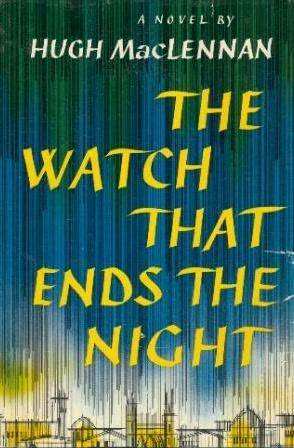
I no longer appear to own a copy of The Watch That Ends the Night. I'm pretty sure I owned one back in the 90s, and I'm leaning towards buying another copy. I dropped in at this odd bookstore that has just about reopened on Pape. There was a nice reading copy of the Book Club edition from 1959 in stock, and I probably should have just bought that. However, I am most familiar with the 1986 paperback edition, which would be cheaper (and also easier to read on the train). He said he might have a copy of that in storage, and I said I would check back in a couple of weeks. Maybe I'll end up springing for the hard cover in the end

The books I really hope to get to are:
Morley Callaghan The Many Colored Coat ✓
Hugh MacLennan The Watch That Ends the Night ✓
Jane Urquhart The Stone Carvers ✓
Findley Not Wanted on the Voyage ✓ (just made it in time!)
I'm not quite as fussed about Bissoondath's The Soul of All Great Designs ✓, but it's fairly short, so I'll probably sneak it in.
Ideally I would also get to Richler's The Apprenticeship of Duddy Kravitz and Miriam Toews's A Complicated Kindness, but they aren't as pressing, and they'll probably be among the first books I review for the 11th Challenge (along with Atwood's dystopian trilogy beginning with Oryx and Crake). Similarly, if I can read Munro's Friend of My Youth or a short story collection by Mavis Gallant, that would be great, but perhaps not worth distorting my reading list any further.
I no longer appear to own a copy of The Watch That Ends the Night. I'm pretty sure I owned one back in the 90s, and I'm leaning towards buying another copy. I dropped in at this odd bookstore that has just about reopened on Pape. There was a nice reading copy of the Book Club edition from 1959 in stock, and I probably should have just bought that. However, I am most familiar with the 1986 paperback edition, which would be cheaper (and also easier to read on the train). He said he might have a copy of that in storage, and I said I would check back in a couple of weeks. Maybe I'll end up springing for the hard cover in the end

10th Canadian Challenge - 28th Review - If Borderlands
I wasn't entirely sure whether If Borderlands, the collected poems by Elise Partridge, should count towards the challenge. Partridge was an American, though she moved with her husband to Vancouver in 1992 (itself an interesting date, which implies it was not a political move but probably one done based on her husband's work, which she actually confirmed in an interview -- the interview itself is quite good on her thoughts on publishing poems that had such intimate details about her illness). Partridge only lived 15 or so years in Canada, before dying from a remission of cancer, but all 3 of her individual poetry collections were published in Canada and she became a dual citizen, so it would be quite begrudging not to include her. In fact, she became quite a mainstay of the Vancouver literary community (although she had other admirers, including Robert Pinsky), and there was quite an outpouring of grief when she died in 2015. (Indeed, it was particularly sad that Partridge did not live long enough to see the publication of her third book, The Exiles' Gallery, which came out on House of Anansi Press.)
Somewhat unusually for a 20th Century poet, most of the poems, particularly in the first two books (Fielder's Choice and Chameleon Hours), follow the more formal rules of poetry, i.e. the lines are generally metrically even and there is usually a rhyme scheme. She includes poems with ABAB scheme and couplets (like "Temp"). In this she seems to be following in the footsteps of early Marianne Moore or very early Adrienne Rich, though Partridge seems to have been modelling herself on Keats, at least a little bit. She also writes slightly looser poems where the stanza is 5 or 6 lines long but the first and last line of the stanza rhymes (I didn't check to see if the inner lines rhyme across the stanzas, but they may have). I have to admit, it is very difficult for me to read formalist poetry written post 1960. It just somehow feels wrong, after the vast majority of poets abandoned this approach. It's my own hang-up to be sure, but it did mean that I sort of glossed over many of her earlier poems.
That said, I thought "Temp" had some brilliant couplets . The temp is here riding the elevator (not into the sky but just to her desk): "She watched the gleaming silver doors / parting to show identical floors / painted a flat oyster white, / pebble-gray rugs, fluorescent light. / A briefcase and two suits stepped off. / Pinstriped shoulders; stifled cough..." After a day spent filling in, answering phones, making copies, filing, etc., things start winding down: "3:25, back at her station, / she double-checked the pagination / of reports that had to be couriered / by 4 p.m.; retyped a word;" (she is approaching Byron's Don Juan levels of stretch here...). It is possible that my empathy with the temp, uncertain who will be friendly or not on a week by week basis, has colored my perception of the poem, but it was one of my favorites. My temp days are long over (and generally jobs for secretaries and assistants are being reduced as office workers are all expected to "type" up their own reports and make their own copies and file them if necessary, so the temp market has presumably shrunk quite a lot), but this did bring up memories.
It is probably not that surprising that, as Partridge was a poet who wrote about her own medical procedures and the struggles of other cancer survivors (and who died relatively young from cancer), most reviews focus on this aspect of her work (see here and here). I'll basically be following in this same tradition, since these poems do seem to be the most compelling and have the most urgency. (What may be a bit more surprising is that no one seems to have linked Partridge with Audre Lorde who had a long struggle with cancer. Perhaps this is because The Cancer Journals was a non-fiction memoir and Lorde's poems were more generally devoted to social justice issues.)
In "Chemo Side Effects: Memory," Partridge talks about the impact of chemotherapy on her memory, which seems particularly cruel for a poet: "Where is the word I want? / ... / I can hear it / scrabbling like a squirrel / on the oak's far side. / ... / No use-- / it's turning / out of sight, / a bicycle down a / Venetian alley--".
The chemo also affects her vision "Gnats in dervish clouds, / indistinguishable, words fizzle / Or keep fading in and / out of focus--" and she worries that she may never fully recover her eyesight: "So many small things I still want to see / sheen of my nephew's corner eyelash, / snowflake circuitry, fleas' thighs, / ... / the peaks and valleys of each mustard seed."
Even in the poems not directly about cancer often have quite a melancholic air, and some explicitly focus on the pangs one faces when considering the "path not taken." In "Childless," she frets that her genetic legacy has terminated: "Helixes snapped like crepe-paper streamers, / our DNA ladder / sways with frayed ends, an idle last rung. / No filaments spiraling us to the future..." She then moves into more sociological territory, positing that those couples without children are not valued by society. There is probably some truth to this, but certainly less than there used to be. Anyway, her comments are fairly cutting: "Minor characters from a serial novel, / we turn out of sight down a boulevard / hand in hand, at the end of Book Three." This theme returns in "Gifts" where she wonders what she will leave behind after death: "I leave / nothing of enviable worth ; / no children; tureens of cracked / china (an aunt's). / Why shouldn't I drift off / like a lost balloon?"
"A Late Writer’s Desk" dwells on a discarded desk, useless now that the writer who used it has passed away: "They couldn’t give it away, I guess, / so left it by the side of the road, / where, obdurate, it warps." This poem was published in The Walrus, and is still available on-line here.
I found two poems that sort of explored the issue of alternative futures, i.e. what-if scenarios, to be interesting. The first ("Alternate Histories"*) is almost as compressed as a Edward Gorey story and presumably details a whole range of fatal events that might have been avoided with just one change (just as Partridge must have dearly wished her circumstances to be different): "If they had straightened, not veered, / if they'd caught the night ferry. / If the Consul's clerk had replied, / if west-running tracks had cleared. // If she'd taken the hallway stairs. / If he hadn't missed the warning / while he whistled at tea. / If they'd walked home late from the fair." It is worth noting that the first and last line of the stanzas rhyme or are near-rhymes.
The If Borderlands collects Partridge's 3 collections and adds a small handful of uncollected poems, which she was able to revise before her death. There is no question this is the definitive collection of her work, although if I had to pick a single stand-alone collection it would be The Exiles' Gallery, which includes "A Late Writer’s Desk," "Alternate Histories" and ends with "The If Borderlands," which is another mediation on what-ifs. "The If Borderlands" considers a wider variety of things that might have turned out differently and seems a bit lighter or at least less tragic than "Alternate Histories." In this imaginary land: "Gifts never shrivel, / no one flails in the whirlpools / of a culture's lies. // We don't lose visas / in cabs; with the loves / of our lives, / we raid the warehouse / of inerrant fortune cookies."

Not all of Partridge's poems speak to me, but those that do are quite powerful. She wrote about living life fully, even under a death watch, but at the same time acknowledged how much she wanted her life to be different. She had an eye for the unusual, and, at least in a few poems, demonstrated a sly sense of humor. I can certainly recommend interested readers check out The Exiles' Gallery and then perhaps push on to The If Borderlands for the rest of her work.
* I have no particular reason to believe that Partridge knew about Constance Urdang, whose final book of poems was called Alternative Lives, though I have no reason to believe she didn't know about her. In addition to the title poem, the book contains "A Life You Might Say You Might Live;" both seem thematically a bit similar to "Alternate Histories" in the expression of a rage to live, however quietly expressed (to borrow shamelessly from Pope's Epistle to a Lady). In addition to some of my other ideas, offered up freely, a study comparing Urdang to Partridge seems like a worthy endeavor. One minor difference that I can see is that Urdang lived for 6 years after Alternative Lives before dying (also of cancer though at 73 not 56). Also, Urdang and her husband, the poet, Donald Finkel had several children. So Partridge does appear to get the rawer deal from life when compared to Urdang.
Somewhat unusually for a 20th Century poet, most of the poems, particularly in the first two books (Fielder's Choice and Chameleon Hours), follow the more formal rules of poetry, i.e. the lines are generally metrically even and there is usually a rhyme scheme. She includes poems with ABAB scheme and couplets (like "Temp"). In this she seems to be following in the footsteps of early Marianne Moore or very early Adrienne Rich, though Partridge seems to have been modelling herself on Keats, at least a little bit. She also writes slightly looser poems where the stanza is 5 or 6 lines long but the first and last line of the stanza rhymes (I didn't check to see if the inner lines rhyme across the stanzas, but they may have). I have to admit, it is very difficult for me to read formalist poetry written post 1960. It just somehow feels wrong, after the vast majority of poets abandoned this approach. It's my own hang-up to be sure, but it did mean that I sort of glossed over many of her earlier poems.
That said, I thought "Temp" had some brilliant couplets . The temp is here riding the elevator (not into the sky but just to her desk): "She watched the gleaming silver doors / parting to show identical floors / painted a flat oyster white, / pebble-gray rugs, fluorescent light. / A briefcase and two suits stepped off. / Pinstriped shoulders; stifled cough..." After a day spent filling in, answering phones, making copies, filing, etc., things start winding down: "3:25, back at her station, / she double-checked the pagination / of reports that had to be couriered / by 4 p.m.; retyped a word;" (she is approaching Byron's Don Juan levels of stretch here...). It is possible that my empathy with the temp, uncertain who will be friendly or not on a week by week basis, has colored my perception of the poem, but it was one of my favorites. My temp days are long over (and generally jobs for secretaries and assistants are being reduced as office workers are all expected to "type" up their own reports and make their own copies and file them if necessary, so the temp market has presumably shrunk quite a lot), but this did bring up memories.
It is probably not that surprising that, as Partridge was a poet who wrote about her own medical procedures and the struggles of other cancer survivors (and who died relatively young from cancer), most reviews focus on this aspect of her work (see here and here). I'll basically be following in this same tradition, since these poems do seem to be the most compelling and have the most urgency. (What may be a bit more surprising is that no one seems to have linked Partridge with Audre Lorde who had a long struggle with cancer. Perhaps this is because The Cancer Journals was a non-fiction memoir and Lorde's poems were more generally devoted to social justice issues.)
In "Chemo Side Effects: Memory," Partridge talks about the impact of chemotherapy on her memory, which seems particularly cruel for a poet: "Where is the word I want? / ... / I can hear it / scrabbling like a squirrel / on the oak's far side. / ... / No use-- / it's turning / out of sight, / a bicycle down a / Venetian alley--".
The chemo also affects her vision "Gnats in dervish clouds, / indistinguishable, words fizzle / Or keep fading in and / out of focus--" and she worries that she may never fully recover her eyesight: "So many small things I still want to see / sheen of my nephew's corner eyelash, / snowflake circuitry, fleas' thighs, / ... / the peaks and valleys of each mustard seed."
Even in the poems not directly about cancer often have quite a melancholic air, and some explicitly focus on the pangs one faces when considering the "path not taken." In "Childless," she frets that her genetic legacy has terminated: "Helixes snapped like crepe-paper streamers, / our DNA ladder / sways with frayed ends, an idle last rung. / No filaments spiraling us to the future..." She then moves into more sociological territory, positing that those couples without children are not valued by society. There is probably some truth to this, but certainly less than there used to be. Anyway, her comments are fairly cutting: "Minor characters from a serial novel, / we turn out of sight down a boulevard / hand in hand, at the end of Book Three." This theme returns in "Gifts" where she wonders what she will leave behind after death: "I leave / nothing of enviable worth ; / no children; tureens of cracked / china (an aunt's). / Why shouldn't I drift off / like a lost balloon?"
"A Late Writer’s Desk" dwells on a discarded desk, useless now that the writer who used it has passed away: "They couldn’t give it away, I guess, / so left it by the side of the road, / where, obdurate, it warps." This poem was published in The Walrus, and is still available on-line here.
I found two poems that sort of explored the issue of alternative futures, i.e. what-if scenarios, to be interesting. The first ("Alternate Histories"*) is almost as compressed as a Edward Gorey story and presumably details a whole range of fatal events that might have been avoided with just one change (just as Partridge must have dearly wished her circumstances to be different): "If they had straightened, not veered, / if they'd caught the night ferry. / If the Consul's clerk had replied, / if west-running tracks had cleared. // If she'd taken the hallway stairs. / If he hadn't missed the warning / while he whistled at tea. / If they'd walked home late from the fair." It is worth noting that the first and last line of the stanzas rhyme or are near-rhymes.
The If Borderlands collects Partridge's 3 collections and adds a small handful of uncollected poems, which she was able to revise before her death. There is no question this is the definitive collection of her work, although if I had to pick a single stand-alone collection it would be The Exiles' Gallery, which includes "A Late Writer’s Desk," "Alternate Histories" and ends with "The If Borderlands," which is another mediation on what-ifs. "The If Borderlands" considers a wider variety of things that might have turned out differently and seems a bit lighter or at least less tragic than "Alternate Histories." In this imaginary land: "Gifts never shrivel, / no one flails in the whirlpools / of a culture's lies. // We don't lose visas / in cabs; with the loves / of our lives, / we raid the warehouse / of inerrant fortune cookies."

Not all of Partridge's poems speak to me, but those that do are quite powerful. She wrote about living life fully, even under a death watch, but at the same time acknowledged how much she wanted her life to be different. She had an eye for the unusual, and, at least in a few poems, demonstrated a sly sense of humor. I can certainly recommend interested readers check out The Exiles' Gallery and then perhaps push on to The If Borderlands for the rest of her work.
* I have no particular reason to believe that Partridge knew about Constance Urdang, whose final book of poems was called Alternative Lives, though I have no reason to believe she didn't know about her. In addition to the title poem, the book contains "A Life You Might Say You Might Live;" both seem thematically a bit similar to "Alternate Histories" in the expression of a rage to live, however quietly expressed (to borrow shamelessly from Pope's Epistle to a Lady). In addition to some of my other ideas, offered up freely, a study comparing Urdang to Partridge seems like a worthy endeavor. One minor difference that I can see is that Urdang lived for 6 years after Alternative Lives before dying (also of cancer though at 73 not 56). Also, Urdang and her husband, the poet, Donald Finkel had several children. So Partridge does appear to get the rawer deal from life when compared to Urdang.
Wednesday, May 3, 2017
Too much cyclical time?
This past weekend, I saw Amici play Messiaen's Quartet for the End of Time. This is a challenging, yet beautiful piece of music, and I generally seek it out whenever I know it is being played. (However, I did pass on a chance a few months ago to see Jonathan Crow play the piece in Kingston, since I then learned he would be the guest violinist with Amici in Toronto, which was an event not to be missed.) It was great, though I realized that I thought the piece ended with the clarinet playing impossibly high and fading into nothingness, but it is actually the violin. (Probably a good thing, as I am not sure a clarinet player, even as good as Joaquin Valdepenas, could sustain that note.)
I was talking with a friend before the show, saying that this would be the 4th time for me seeing the piece, but I couldn't recall the details of the second time. I poked around in my collection of programs and learned that I had seen Amici playing the piece in Toronto in Walter Hall in 1994! In addition to Joaquin, David Hetherington was with the group, but they had a different pianist 23 years ago. This is actually Amici's 29th year as an ensemble, which is itself pretty incredible, and I'll try to make one or two concerts next year on their 30th anniversary tour.
Just to contrast how professional and/or slick they have become over the years, here are the covers of the two programs.


This set me off on the path of searching my memory to contrast Toronto from 23 years ago to today (I left right before amalgamation, but also before the 1995 Quebec referendum). While I naturally prefer older Toronto, since it corresponds to a time in my life I was younger and less disillusioned. I think it is probably fortunate that I was only in Toronto for a year and I did stay fairly close to campus. This way I haven't completely choked off the Toronto of today with nostalgic memories, since there are plenty of neighbourhoods (particularly in East York) that I didn't visit at all. I'm quickly reaching the point where I will have lived in Toronto three times longer than on my first stay. I would say it is time to bury the past, but I actually do need to hang onto it a bit longer -- at least until I finish Straying South (which is set in the 90s) and then my novel, Northern Lattitudes (ditto), if I think I'll ever actually make real progress on this, presumably after I wrap up Straying South.
I guess I'll close out this mini-meditation on how some events do seem somewhat cyclical by noting that I have a chance to (somewhat) redeem myself with my daughter. Last year, I missed going to her art show at school, so I will make sure I make it this year, even if I have to leave work a bit early. I really did feel quite guilty last year (even though no one had put it on my calendar), and I can't let that happen again.
I was talking with a friend before the show, saying that this would be the 4th time for me seeing the piece, but I couldn't recall the details of the second time. I poked around in my collection of programs and learned that I had seen Amici playing the piece in Toronto in Walter Hall in 1994! In addition to Joaquin, David Hetherington was with the group, but they had a different pianist 23 years ago. This is actually Amici's 29th year as an ensemble, which is itself pretty incredible, and I'll try to make one or two concerts next year on their 30th anniversary tour.
Just to contrast how professional and/or slick they have become over the years, here are the covers of the two programs.


I guess I'll close out this mini-meditation on how some events do seem somewhat cyclical by noting that I have a chance to (somewhat) redeem myself with my daughter. Last year, I missed going to her art show at school, so I will make sure I make it this year, even if I have to leave work a bit early. I really did feel quite guilty last year (even though no one had put it on my calendar), and I can't let that happen again.
Tuesday, May 2, 2017
10th Canadian Challenge - 27th Review - Civil Elegies
Not having grown up in Canada, I was not exposed to Dennis Lee and his poems for children, such as Alligator Pie (though I fairly recently heard about them due to the Soulpepper show aimed at children). It was a recent Toronto Star article discussing Lee's upcoming collected poems Heart Residence that convinced me that Lee was an important figure in Toronto's literary history (not least because he was a co-founder of House of Anansi Press) and that I really ought to check out this collection. (And indeed I have Heart Residence on hold at the library, and I expect to be able to read and review this later in May.) The article also mentioned Lee's connection to Rochdale College, and perhaps by coincidence the Star had a fascinating article on Rochdale just a day or two before. I had no idea that I lived right around the corner from Rochdale in the mid 1990s, though the co-op had been closed down in 1975 with the residents evicted. It served as senior housing by the time I lived down the street, and I did a lot of shopping at the grocery store that was on the first floor (perhaps this was actually one building over from Rochdale).

While this is a digression, the poems in Civil Elegies are very much focused on Toronto and how the city should serve its residents (particularly the somewhat marginalized, i.e. youth and students and artists and seniors). Civil Elegies came out in 1968 (when Rochdale was just getting started along with Anansi Press), but I suspect even then Lee was suspicious that the good times wouldn't last.
I like the cover of the reissued Civil Elegies with its focus on City Hall and Nathan Phillips Square.

There was a lot of urban redevelopment to make this urban civic space (basically wiping out The Ward, which was essentially Toronto's first slum). The new City Hall opened in 1965, and it must have seemed incredibly futuristic at the time. I'm still a big fan of Nathan Phillips Square and have seen some nice concerts there (including Joshua Redman back before he became quite so famous) and even The Flaming Lips! I'm not good enough at skating to skate there during the winter unfortunately, and I've also kind of given up going there for fireworks displays, since the crowd control is pretty dicey.
Here are a few of my photos of the area in the late 2010s.


I must have a picture somewhere of the entire city hall, but normally I am focused more on the activities in the Square itself (including art installations). The first photo in the sequence comes the closest to capturing all of City Hall, whereas the second photo does include the Henry Moore sculpture The Archer (though it is very small). In the other photos there are too many other people in the way. This is in complete contrast to the cover of Civil Elegies which prominently features the sculpture, but the plaza is otherwise empty aside from one lonely citizen. (While there is something to be said for the alienated artist, alone even in the midst of a bustling city, I definitely appreciate that in reality crowds continue to come out for all kinds of civic events and that Nathan Phillips Square is a well-used space.)
And finally I suppose I should actually review the poems in the book...
The introduction in the reissued edition (2012) is helpful, since it points out that between 1968 and 1971, Lee revisited and revised Civil Elegies, adding two new elegies (2 and 4) and modifying some of the others. Apparently, Margaret Atwood helped him re-edit the poem! In the space of only 3 years, the mood had gotten more somber, as Lee felt Rochdale was already on its way to failure, and in general whatever had been left of the spirit of the 60s (the high of Expo '67 for example) was being crushed. In addition to the changes to Civil Elegies, 16 new, separate poems were added to the front of the book. In Heart Residence, these stand-alone poems have been relocated towards the back of the book into a section titled "Not Abstract Harmonies But."
Despite Lee's more recent efforts to put some space between them and Civil Elegies, I will still review them here. Of the 16, my favourite is "400: Coming Home," which may in fact be the only poem I am aware of that sort of celebrates Toronto's 400-series highways: "You are on the highway, there is a kind of / laughter, the cars pound / south ... And you are still on the highway. There are no / houses, no farms. Across the median, past the swish and thud of the / northbound cars, beyond the opposite fences, / the fields, the / climbing escarpment ..." The poem seems almost a dream where no matter how far one drives, one is still on the highway. (I suppose the only difference is that in the late 1960s, one would actually be driving all this time, whereas one might well be stuck in traffic in the 2000s.)
Roughly half of these first 16 poems seem to be about the domestic arrangements of the poems' narrator (which may or may not be Lee). While there are some hints that whatever issues he and his wife are having, they can partly be attributed to city living and or living through a period of war (Toronto had become quite a haven for Vietnam War resisters, though perhaps not quite to the same level as Vancouver). I do prefer the poems that are more directly about the city, such as the poems about High Park or Sibelius Park.
I have never actually visited Sibelius Park, since anytime I exit the subway at Spadina, I stay on Bloor or head south. I'll have to check it out one of these days. "Sibelius Park" is a poem where the poet seems to be questioning his purpose: "and behind him, five blocks south, his other lives / in rainy limbo till tomorrow: / Rochdale, yes Anasi / the fine iconic books, sheepish errata / shitwork in a cold basement, moody / triumphs of the mind". He is sort of trudging along with these (largely mental) burdens. The park offers a refuge and a kind of renewal: "And then Sibelius Park! / The grass is wet, it / gleams, across the park's wide / vista the lanes of ornamental / shrub come breathing and the sun has filled the / rinsed air till the green goes luminous and it does it / does, it comes clear!"
I've read "Civil Elegies" a couple of times now, and it really is quite an ambitious poem. I may simply be unaware of a comparable poem that tries to tackle Toronto's complexity, whereas I can think of book-length poems by George Bowering, Daphne Marlatt, W.H. New, Meredith Quartermain, and George Stanley that cover Vancouver. Of course, if I have missed any major Toronto poems, do leave a comment below.
Civil Elegies opens with Lee (or rather the poem's narrator) sitting in Nathan Phillips Square, in the heart of old Toronto. Lee is probably intentionally drawing comparison's to Eliot's The Waste Land when he writes: " Therefore the spectres arrive, congregating / in bitter droves, thick in the April sunlight, / accusing us and we are no different, though you would not expect / the furies assembled in hogtown and ring me round, invisible, demanding / what time of our lives we wait for till we shall start to be."
Some themes that arise from time to time in Civil Elegies is the complicated history of Canada, particularly how the land was taken from Natives, and how Americans (though not really the draft-dodgers) threaten to take over the city. Elegy 3 contrasts the sleepy complacency of lunchtime workers "and the people come and they feel no consternation, dozing at / lunchtime; even the towers comply" with the fact that the city is built on stolen land. He seems to be griping a bit at the name of the Henry Moore sculpture (which isn't technically called The Archer at all): "that [greedy] people will botch its cities, its greatest squares / will mock its money and stature, and prising wide / a civil space to live in, by the grace of its own invention it will / fill that space with the artifacts of death."
I have to say this section (Elegy 3) is a bit overwrought and reminds me more than a little of William Kurelek and his view on what made Toronto a false city upon the hill and indeed one that would be wiped away either by God or war, but in either case the city would be purified by fire.
While Kurelek and Lee would surely not agree on what was wrong with the city, they both had that zeal and fervour, which so often leads to uncompromising posturing (political or religious) and, indeed, sometimes armed conflict. I doubt very much Lee would ever have taken it that far (and in the interview he does say he was still fairly square, though he interacted with plenty of radicals through his time at Rochdale).
Lee continues a bit in this vein in Elegy 5 where he worries that our attachment to children (and more broadly to our personal needs and comfort) does blind citizens to all the misdeeds that politicians do in our name. (It is hardly surprising that within a few pages, he calls out the Canadian politicians who did not attempt to do more to halt the Vietnam War.) It is a fairly uncompromising (and unrealistic) stance from a leftist perspective. I would say it does undermine the poem in some ways, but it mostly just shows that Civil Elegies was very much rooted in its era. In some ways, it is impressive that certain passages still hold up and have a certain grandeur to them: "once in summer looking up I saw the noxious cloud suspended / taut above the city, clenched, as now everywhere it is the / imperial way of life that bestows its fallout."
Elegies 6 through 8 continue along these lines with Lee railing against the need to compromise one's principles to live a comfortable life in the West. Modern life cannot easily stand such scrutiny, and yet few are willing to truly follow their principles and become martyrs (or even just social outcasts). In Elegy 8, Lee starts winding down with a return to the public square, training his attention on the crowds who are less conflicted (or less obviously conflicted) than he: "caught once more in the square's great hush with the shoppers, / hippies, brokers, children, old men dozing alone by the pool and waiting, / feeling the pulse in the bodies jostling past me driving to climax and dollars and blood, / making my cry here quick and obscure among many in transit".
The final Elegy begins with the plaza emptying out: "The last few tourists pose by the Moore and snap their proof that they too were alive. / ... / Across the square the crisp leaves blow in gusts, tracing / the wind's indignant lift in corners, / filling the empty pool."
This leads to a weird discussion of the void (apparently since the modern life can have no inherent meaning and the contradictions of life in capitalist society cannot be squared) and how acceptance of this void may come to supplant religion. For what appears to be on the surface, a fairly nihilistic position, God (even if denied) certainly turns up a lot in this elegy. It is also possible that Lee is flirting with Zen here: "We enter void when void no longer exists."
Politics aside, this is a very complicated and rich poem, which I intend to return to from time to time. It has generated a few academic articles (here and here and here) and an entire monograph by Robert Lecker written about the poem! And yet it doesn't seem particularly well known, perhaps because Dennis Lee's poems for children have so overshadowed his poetry for adults. It is possible that Heart Residence will change that, and I will return to this issue in that forthcoming review.

While this is a digression, the poems in Civil Elegies are very much focused on Toronto and how the city should serve its residents (particularly the somewhat marginalized, i.e. youth and students and artists and seniors). Civil Elegies came out in 1968 (when Rochdale was just getting started along with Anansi Press), but I suspect even then Lee was suspicious that the good times wouldn't last.
I like the cover of the reissued Civil Elegies with its focus on City Hall and Nathan Phillips Square.

There was a lot of urban redevelopment to make this urban civic space (basically wiping out The Ward, which was essentially Toronto's first slum). The new City Hall opened in 1965, and it must have seemed incredibly futuristic at the time. I'm still a big fan of Nathan Phillips Square and have seen some nice concerts there (including Joshua Redman back before he became quite so famous) and even The Flaming Lips! I'm not good enough at skating to skate there during the winter unfortunately, and I've also kind of given up going there for fireworks displays, since the crowd control is pretty dicey.
Here are a few of my photos of the area in the late 2010s.


I must have a picture somewhere of the entire city hall, but normally I am focused more on the activities in the Square itself (including art installations). The first photo in the sequence comes the closest to capturing all of City Hall, whereas the second photo does include the Henry Moore sculpture The Archer (though it is very small). In the other photos there are too many other people in the way. This is in complete contrast to the cover of Civil Elegies which prominently features the sculpture, but the plaza is otherwise empty aside from one lonely citizen. (While there is something to be said for the alienated artist, alone even in the midst of a bustling city, I definitely appreciate that in reality crowds continue to come out for all kinds of civic events and that Nathan Phillips Square is a well-used space.)
And finally I suppose I should actually review the poems in the book...
The introduction in the reissued edition (2012) is helpful, since it points out that between 1968 and 1971, Lee revisited and revised Civil Elegies, adding two new elegies (2 and 4) and modifying some of the others. Apparently, Margaret Atwood helped him re-edit the poem! In the space of only 3 years, the mood had gotten more somber, as Lee felt Rochdale was already on its way to failure, and in general whatever had been left of the spirit of the 60s (the high of Expo '67 for example) was being crushed. In addition to the changes to Civil Elegies, 16 new, separate poems were added to the front of the book. In Heart Residence, these stand-alone poems have been relocated towards the back of the book into a section titled "Not Abstract Harmonies But."
Despite Lee's more recent efforts to put some space between them and Civil Elegies, I will still review them here. Of the 16, my favourite is "400: Coming Home," which may in fact be the only poem I am aware of that sort of celebrates Toronto's 400-series highways: "You are on the highway, there is a kind of / laughter, the cars pound / south ... And you are still on the highway. There are no / houses, no farms. Across the median, past the swish and thud of the / northbound cars, beyond the opposite fences, / the fields, the / climbing escarpment ..." The poem seems almost a dream where no matter how far one drives, one is still on the highway. (I suppose the only difference is that in the late 1960s, one would actually be driving all this time, whereas one might well be stuck in traffic in the 2000s.)
Roughly half of these first 16 poems seem to be about the domestic arrangements of the poems' narrator (which may or may not be Lee). While there are some hints that whatever issues he and his wife are having, they can partly be attributed to city living and or living through a period of war (Toronto had become quite a haven for Vietnam War resisters, though perhaps not quite to the same level as Vancouver). I do prefer the poems that are more directly about the city, such as the poems about High Park or Sibelius Park.
I have never actually visited Sibelius Park, since anytime I exit the subway at Spadina, I stay on Bloor or head south. I'll have to check it out one of these days. "Sibelius Park" is a poem where the poet seems to be questioning his purpose: "and behind him, five blocks south, his other lives / in rainy limbo till tomorrow: / Rochdale, yes Anasi / the fine iconic books, sheepish errata / shitwork in a cold basement, moody / triumphs of the mind". He is sort of trudging along with these (largely mental) burdens. The park offers a refuge and a kind of renewal: "And then Sibelius Park! / The grass is wet, it / gleams, across the park's wide / vista the lanes of ornamental / shrub come breathing and the sun has filled the / rinsed air till the green goes luminous and it does it / does, it comes clear!"
I've read "Civil Elegies" a couple of times now, and it really is quite an ambitious poem. I may simply be unaware of a comparable poem that tries to tackle Toronto's complexity, whereas I can think of book-length poems by George Bowering, Daphne Marlatt, W.H. New, Meredith Quartermain, and George Stanley that cover Vancouver. Of course, if I have missed any major Toronto poems, do leave a comment below.
Civil Elegies opens with Lee (or rather the poem's narrator) sitting in Nathan Phillips Square, in the heart of old Toronto. Lee is probably intentionally drawing comparison's to Eliot's The Waste Land when he writes: " Therefore the spectres arrive, congregating / in bitter droves, thick in the April sunlight, / accusing us and we are no different, though you would not expect / the furies assembled in hogtown and ring me round, invisible, demanding / what time of our lives we wait for till we shall start to be."
Some themes that arise from time to time in Civil Elegies is the complicated history of Canada, particularly how the land was taken from Natives, and how Americans (though not really the draft-dodgers) threaten to take over the city. Elegy 3 contrasts the sleepy complacency of lunchtime workers "and the people come and they feel no consternation, dozing at / lunchtime; even the towers comply" with the fact that the city is built on stolen land. He seems to be griping a bit at the name of the Henry Moore sculpture (which isn't technically called The Archer at all): "that [greedy] people will botch its cities, its greatest squares / will mock its money and stature, and prising wide / a civil space to live in, by the grace of its own invention it will / fill that space with the artifacts of death."
I have to say this section (Elegy 3) is a bit overwrought and reminds me more than a little of William Kurelek and his view on what made Toronto a false city upon the hill and indeed one that would be wiped away either by God or war, but in either case the city would be purified by fire.
 |
| William Kurelek, Harvest of Our Mere Humanism Years, 1972 |
While Kurelek and Lee would surely not agree on what was wrong with the city, they both had that zeal and fervour, which so often leads to uncompromising posturing (political or religious) and, indeed, sometimes armed conflict. I doubt very much Lee would ever have taken it that far (and in the interview he does say he was still fairly square, though he interacted with plenty of radicals through his time at Rochdale).
Lee continues a bit in this vein in Elegy 5 where he worries that our attachment to children (and more broadly to our personal needs and comfort) does blind citizens to all the misdeeds that politicians do in our name. (It is hardly surprising that within a few pages, he calls out the Canadian politicians who did not attempt to do more to halt the Vietnam War.) It is a fairly uncompromising (and unrealistic) stance from a leftist perspective. I would say it does undermine the poem in some ways, but it mostly just shows that Civil Elegies was very much rooted in its era. In some ways, it is impressive that certain passages still hold up and have a certain grandeur to them: "once in summer looking up I saw the noxious cloud suspended / taut above the city, clenched, as now everywhere it is the / imperial way of life that bestows its fallout."
Elegies 6 through 8 continue along these lines with Lee railing against the need to compromise one's principles to live a comfortable life in the West. Modern life cannot easily stand such scrutiny, and yet few are willing to truly follow their principles and become martyrs (or even just social outcasts). In Elegy 8, Lee starts winding down with a return to the public square, training his attention on the crowds who are less conflicted (or less obviously conflicted) than he: "caught once more in the square's great hush with the shoppers, / hippies, brokers, children, old men dozing alone by the pool and waiting, / feeling the pulse in the bodies jostling past me driving to climax and dollars and blood, / making my cry here quick and obscure among many in transit".
The final Elegy begins with the plaza emptying out: "The last few tourists pose by the Moore and snap their proof that they too were alive. / ... / Across the square the crisp leaves blow in gusts, tracing / the wind's indignant lift in corners, / filling the empty pool."
This leads to a weird discussion of the void (apparently since the modern life can have no inherent meaning and the contradictions of life in capitalist society cannot be squared) and how acceptance of this void may come to supplant religion. For what appears to be on the surface, a fairly nihilistic position, God (even if denied) certainly turns up a lot in this elegy. It is also possible that Lee is flirting with Zen here: "We enter void when void no longer exists."
Politics aside, this is a very complicated and rich poem, which I intend to return to from time to time. It has generated a few academic articles (here and here and here) and an entire monograph by Robert Lecker written about the poem! And yet it doesn't seem particularly well known, perhaps because Dennis Lee's poems for children have so overshadowed his poetry for adults. It is possible that Heart Residence will change that, and I will return to this issue in that forthcoming review.
Monday, May 1, 2017
Music at Toronto Cold Reads & Other News
It's been quite an interesting experiment this season when they added live music to the Toronto Cold Reads line-up (generally the music act gets three songs at the start of the evening and then three more after the intermission). Each has been quite different (I've gone 4 times), but good in their own way. I particularly liked Abigail Lapell and got both her downloads and have Hide Nor Hair in pretty much constant rotation at work.
This week was Skye Wallace. She is definitely another real talent to watch. It seems as though she normally plays and records with a band, but she was doing it all solo today. I only bought Living Parts, since it had the song "Middle Class Ontario" about growing up in the suburbs of Toronto, and I can relate to growing up (with world-class angst) in the suburbs of Michigan (though presumably a couple of decades earlier). If I like the way the full band sounds, I may buy a download to her newest album Something Wicked. Watching her on stage she reminded me a girl I knew in high school* or rather I knew her a bit. She played guitar and had a boyfriend who also played guitar. I was just not cool enough to hang out with them, and basically I stopped spending time with them (before I did anything too embarrassing like try to split them up). I chatted very briefly with her (Skye, that is) after the evening was over. She has put her stuff into storage, as she is touring a lot. She is off to Italy for two weeks (how exciting!) and then she has a show at the Monarch Tavern in Toronto on May 20th, though I will be out of town myself (and in Montreal) on that date.
I was quite surprised to win the writer's challenge. I need to come up with an idea that incorporates sandpaper and a bedroom stargazing portal. I have an idea, but it is very, very dark (like one of the super grim X-Files shows) and I think it might actually be too much. (I just wrapped up Freud's write up of the Psychotic Doctor Schreber, and that is clearly an influence.) Nonetheless, they basically have to put up my piece next Sunday, so I'll need to keep my calendar clear. Since it was a small crowd overall, I agreed to be cast (and ended up reading the stage directions and the voice of a ghost for this week's winner). I also made a bit more progress on rewriting Corporate Codes of Conduct, so all in all it was a worthwhile trip, even though I got pretty wet on the way home.
The other news is that Sing-for-Your-Supper has been postponed until May 8. While I kind of wanted to see my piece tomorrow, this way I can recruit more people to turn up, and it also means I will have pieces read back to back on May 7 and 8! Definitely a high point in my breaking into the arts scene in Toronto...
* I've been spending more time lately delving into my high school yearbooks and dredging up a lot of repressed memories. It's not so much that I want to go back to the past (I much preferred university to high school and then grad school, at least the first time round, was better than university) but a couple of my plays revolve around high schoolers, so I want to at least remember what it was like for me. Whether the plays will have to be updated to a more current generation is a different issue.
This week was Skye Wallace. She is definitely another real talent to watch. It seems as though she normally plays and records with a band, but she was doing it all solo today. I only bought Living Parts, since it had the song "Middle Class Ontario" about growing up in the suburbs of Toronto, and I can relate to growing up (with world-class angst) in the suburbs of Michigan (though presumably a couple of decades earlier). If I like the way the full band sounds, I may buy a download to her newest album Something Wicked. Watching her on stage she reminded me a girl I knew in high school* or rather I knew her a bit. She played guitar and had a boyfriend who also played guitar. I was just not cool enough to hang out with them, and basically I stopped spending time with them (before I did anything too embarrassing like try to split them up). I chatted very briefly with her (Skye, that is) after the evening was over. She has put her stuff into storage, as she is touring a lot. She is off to Italy for two weeks (how exciting!) and then she has a show at the Monarch Tavern in Toronto on May 20th, though I will be out of town myself (and in Montreal) on that date.
I was quite surprised to win the writer's challenge. I need to come up with an idea that incorporates sandpaper and a bedroom stargazing portal. I have an idea, but it is very, very dark (like one of the super grim X-Files shows) and I think it might actually be too much. (I just wrapped up Freud's write up of the Psychotic Doctor Schreber, and that is clearly an influence.) Nonetheless, they basically have to put up my piece next Sunday, so I'll need to keep my calendar clear. Since it was a small crowd overall, I agreed to be cast (and ended up reading the stage directions and the voice of a ghost for this week's winner). I also made a bit more progress on rewriting Corporate Codes of Conduct, so all in all it was a worthwhile trip, even though I got pretty wet on the way home.
The other news is that Sing-for-Your-Supper has been postponed until May 8. While I kind of wanted to see my piece tomorrow, this way I can recruit more people to turn up, and it also means I will have pieces read back to back on May 7 and 8! Definitely a high point in my breaking into the arts scene in Toronto...
* I've been spending more time lately delving into my high school yearbooks and dredging up a lot of repressed memories. It's not so much that I want to go back to the past (I much preferred university to high school and then grad school, at least the first time round, was better than university) but a couple of my plays revolve around high schoolers, so I want to at least remember what it was like for me. Whether the plays will have to be updated to a more current generation is a different issue.
Subscribe to:
Posts (Atom)